Did Ancient Hindu Sages Predict Quantum Physics? Exploring Parallels in Vedas and Upanishads
Did Ancient Hindu Sages Predict Quantum Physics? Exploring Parallels in Vedas and Upanishads The intersection of ancient Hindu philosophy and modern quantum…
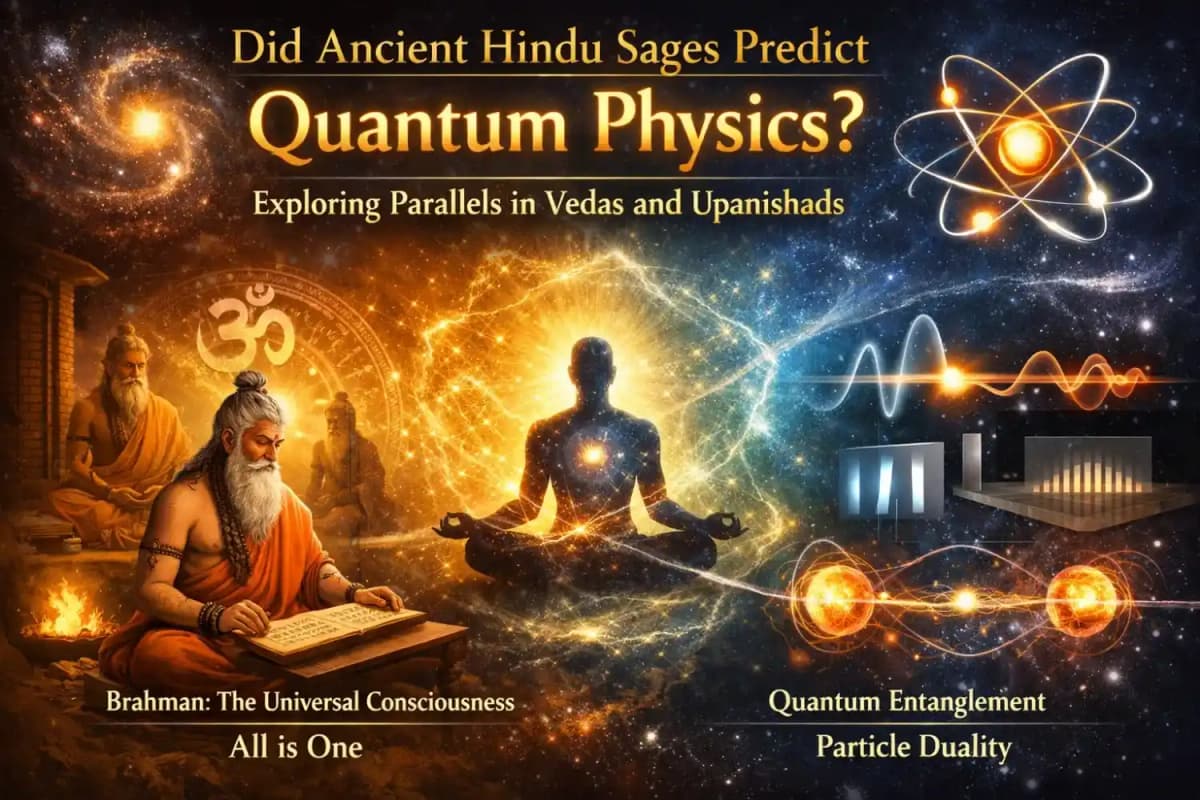
Did Ancient Hindu Sages Predict Quantum Physics?
Did Ancient Hindu Sages Predict Quantum Physics? Exploring Parallels in Vedas and Upanishads
The intersection of ancient Hindu philosophy and modern quantum physics has fascinated scientists and spiritual seekers for decades. While it would be inaccurate to claim that ancient Indian texts predicted quantum mechanics in a scientific sense, the philosophical parallels are striking and worthy of serious consideration.
The Observer Effect and Consciousness in Upanishads
One of quantum physics' most perplexing discoveries is the observer effect, where the act of observation fundamentally affects the behavior of subatomic particles. The Upanishads explored similar territory thousands of years ago, proposing that consciousness and reality are intimately intertwined.
The Brihadaranyaka Upanishad states: "You are what your deep, driving desire is." This ancient text suggests that consciousness plays an active role in shaping experience, a concept that resonates with quantum mechanics' revelation that observation collapses wave functions into definite states.
What Pioneer Physicists Said
J. Robert Oppenheimer, the father of the atomic bomb, was deeply influenced by the Bhagavad Gita. After witnessing the first nuclear test, he famously quoted Krishna: "Now I am become Death, the destroyer of worlds." Oppenheimer studied Sanskrit and found philosophical depth in Hindu texts that complemented his understanding of quantum reality.
Niels Bohr, one of quantum theory's founding fathers, was so inspired by the concept of complementarity in Eastern philosophy that he chose the yin-yang symbol for his coat of arms. He recognized that the Vedantic principle of unity underlying apparent dualities mirrored his own complementarity principle in quantum mechanics.
Maya and Wave-Particle Duality
The Vedantic concept of Maya, often translated as "illusion," describes reality as fluid and dependent on perspective. This bears a remarkable resemblance to wave-particle duality, where light and matter exhibit different properties depending on how they're observed.
In quantum mechanics, an electron behaves as both a wave and a particle, never fully one or the other. Similarly, Maya in Hindu philosophy suggests that the material world appears solid and separate, but this appearance masks an underlying unified reality. Both frameworks challenge our everyday assumptions about the nature of existence.
The Isha Upanishad captures this paradox: "It moves. It moves not. It is far, and It is near. It is within all this, and It is outside of all this." This description could easily apply to the quantum world, where particles exist in superposition, simultaneously here and there until observed.
Superposition and Multiple Realities in Yoga Vasistha
The Yoga Vasistha, an ancient philosophical text, explores the concept of multiple simultaneous realities in ways that parallel quantum superposition. The text describes the story of Queen Leela, who experiences multiple lifetimes simultaneously in different realms, suggesting that reality is not singular but multifaceted.
In quantum mechanics, superposition means a particle exists in all possible states at once until measurement forces it into one specific state. The Yoga Vasistha's narrative frameworks similarly propose that consciousness can experience multiple realities concurrently, challenging linear notions of time and singular existence.
The Indivisible Atom: Paramanu in Ancient Texts
The Vaisheshika school of Hindu philosophy, founded by Sage Kanada around the 6th century BCE, proposed the concept of "paramanu" (the ultimate atom). Kanada theorized that matter consists of indivisible particles, millennia before John Dalton's atomic theory.
While Kanada's paramanu differs from modern atomic theory in specifics, the fundamental insight that matter has a granular, particulate nature at the smallest scales was remarkably prescient. The Vaisheshika Sutras describe how paramanus combine to form larger structures, anticipating molecular theory's basic principles.
Interconnectedness: Indra's Net and Quantum Entanglement
The Avatamsaka Sutra's metaphor of Indra's Net, while Buddhist in origin, reflects broader Hindu philosophical concepts found in Vedantic texts. The net contains infinite jewels, each reflecting all others, symbolizing universal interconnectedness.
Quantum entanglement, where particles remain connected regardless of distance, echoes this ancient wisdom. When two particles become entangled, measuring one instantly affects the other, even across vast cosmic distances. This "spooky action at a distance," as Einstein called it, mirrors the Vedantic teaching that all existence is fundamentally interconnected.
The Rig Veda proclaims: "Truth is one, the wise call it by various names," suggesting an underlying unity beneath apparent diversity—a principle quantum physics reinforces through discoveries about the fundamental interconnectedness of all matter and energy.
Time, Space, and the Nature of Reality
The Mandukya Upanishad explores consciousness through four states: waking, dreaming, deep sleep, and turiya (pure consciousness). This framework treats time and space as relative constructs dependent on consciousness states, presaging Einstein's relativity and quantum mechanics' challenges to absolute time and space.
Modern physics reveals that time dilates, space curves, and simultaneous events are relative to the observer—concepts the ancient rishis explored philosophically when contemplating the nature of Brahman (ultimate reality) beyond the constraints of time and space.
Important Distinctions: Philosophy vs. Science
While these parallels are intellectually fascinating, it's crucial to maintain scholarly integrity. Ancient Hindu texts were philosophical and spiritual explorations, not scientific theories with testable predictions and mathematical frameworks.
The sages pursued understanding through meditation, introspection, and philosophical inquiry rather than empirical experimentation. Quantum physics emerged from rigorous mathematical formulations and experimental verification. The two approaches differ fundamentally in methodology and objectives.
However, this doesn't diminish the value of these ancient insights. The Hindu philosophical tradition explored the nature of consciousness, reality, and existence in profound ways that sometimes anticipated questions modern physics would later encounter from a completely different angle.
What This Means for Modern Seekers
The convergence of ancient wisdom and modern science offers a richer, more holistic understanding of reality. Neither invalidates the other; instead, they provide complementary perspectives on existence's deepest mysteries.
For those exploring spirituality, these parallels suggest that ancient wisdom traditions were asking profound questions about reality's nature. For scientists, Eastern philosophy offers conceptual frameworks that might inspire new ways of thinking about quantum mechanics' philosophical implications.
Werner Heisenberg, who formulated the uncertainty principle, noted: "After the conversations about Indian philosophy, some of the ideas of Quantum Physics that had seemed so crazy suddenly made much more sense."
Conclusion: Resonance Without Reduction
The philosophical parallels between Vedic wisdom and quantum physics reveal something remarkable: whether through contemplative insight or mathematical rigor, humanity has repeatedly encountered the same profound mysteries at the heart of existence.
Ancient Hindu sages didn't predict quantum physics in any literal sense, but they explored consciousness, reality, and interconnectedness in ways that resonate deeply with discoveries in modern physics. This convergence invites us to approach both ancient wisdom and contemporary science with open minds, recognizing that multiple paths can lead toward understanding reality's ultimate nature.
As we continue probing the quantum realm and consciousness itself, perhaps the greatest insight is that our ancestors were asking the right questions—questions we're still learning to answer today.
Explore more connections between ancient Hindu wisdom and modern science at HinduTone.com, where tradition meets contemporary understanding.
Frequently Asked Questions
What is the Did Ancient Hindu Sages Predict Quantum Physics??
Did Ancient Hindu Sages Predict Quantum Physics? Exploring Parallels in Vedas and Upanishads The intersection of ancient Hindu philosophy and modern quantum physics has fascinated scientists and spiritual seekers for decades.
How many times should the Did Ancient Hindu Sages Predict Quantum Physics? be chanted?
It is traditionally chanted 108 times using a rudraksha or tulsi mala. Even 11 or 21 sincere repetitions daily are considered beneficial — steady, focused practice matters more than the count.
What is the best time to chant the Did Ancient Hindu Sages Predict Quantum Physics??
Dawn (Brahma Muhurta) after a bath is considered ideal, though it may be chanted any time with a calm, focused mind. Many devotees keep a fixed daily time to build consistency.
Who can chant the Did Ancient Hindu Sages Predict Quantum Physics??
Anyone may chant it with faith and a pure mind, regardless of age, gender or background. Beginners benefit from first hearing the correct pronunciation and understanding its meaning.
What are the benefits of chanting the Did Ancient Hindu Sages Predict Quantum Physics??
It is believed to calm the mind, dissolve negativity, and draw divine grace, protection and clarity to the devotee.
You might also like
Powerful Mantras for Students & Parents Before Joining School
Powerful Hindu Mantras for Purushottam Maas 2026: Vishnu Bhakti, Chanting Guide & Global Devotion
Shani Deva Temples Worldwide & Must-Performed Rituals — Complete Devotee's Guide