Kubera Mantra — Complete Guide for Wealth and Abundance | HinduTone
Introduction In the vast and sacred tradition of Hindu spirituality, Lord Kubera stands as the supreme divine authority over wealth, prosperity, material…

Introduction In the vast and sacred tradition of Hindu spirituality, Lord Kubera stands as the supreme divine authority over wealth, prosperity, material…
Introduction
In the vast and sacred tradition of Hindu spirituality, Lord Kubera stands as the supreme divine authority over wealth, prosperity, material abundance, and financial well-being. He is the Dhanapati — the Lord of Wealth — and the Yaksheshwara — the King of the Yakshas. As the divine treasurer of the heavens, Kubera presides over all earthly riches, hidden treasures, and the material prosperity that sustains human life.
Unlike Goddess Lakshmi — who represents the flowing, grace-bestowing aspect of prosperity — Kubera represents the accumulated, guarded, and wisely managed aspect of wealth. Where Lakshmi brings wealth through grace and blessing, Kubera governs its custody, multiplication, and righteous distribution. In the cosmic economy of Hindu cosmology, Kubera is the divine banker and treasurer — and his mantras are among the most powerful tools for attracting and sustaining financial abundance.
This comprehensive guide from HinduTone is the most complete resource available on Kubera Mantras — covering the sacred mythology of Lord Kubera, every major Kubera mantra with authentic Sanskrit text and meaning, correct chanting methods, the best times and rituals, the Kubera Yantra, and the specific benefits for different life situations.
Who is Lord Kubera? — Sacred Mythology and Significance
The Divine Treasurer of the Heavens
Lord Kubera (कुबेर) is described in the Vedas, Puranas, Ramayana, and Mahabharata as the god of wealth, riches, and worldly treasures. He is one of the Ashtadikpalas — the eight guardians of the eight directions — governing the north direction, which is why facing north while chanting Kubera mantras is considered most auspicious.
Kubera's Divine Lineage
According to the Vishnu Purana and Mahabharata, Kubera is the son of the great sage Vishrava (son of Pulastya) and Ilavida. He is the half-brother of the demon king Ravana — both born of the same father but different mothers. Despite this complex lineage, Kubera is firmly established as a deva (divine being) through his extraordinary tapasya (austerities) and devotion to Lord Brahma.
How Kubera Became Lord of Wealth
Kubera performed intense tapasya for thousands of years, pleasing Lord Brahma with his extraordinary devotion and discipline. Brahma was so pleased that he granted Kubera:
- Lordship over all earthly treasures and wealth — including the nine legendary nidhi (treasures)
- Governance of Lanka — the golden city (later seized by his half-brother Ravana)
- The divine city of Alaka (also called Alakapuri) in the Himalayas near Mount Meru — his eternal abode
- The Pushpaka Vimana — the legendary flying chariot of gold (also later seized by Ravana)
- Guardianship of the North — one of the eight cardinal directions
Kubera's Nine Divine Treasures (Nava Nidhi)
Lord Kubera is the custodian of the legendary Nava Nidhi — nine forms of divine treasure that sustain the wealth of the three worlds:
When we chant Kubera mantras, we are invoking the lord of all nine forms of wealth — not just monetary riches, but abundance in every dimension of material life.
Kubera's Divine Appearance
Kubera is described in Puranic texts as:
- Pot-bellied (tundila) — representing fullness, contentment, and material abundance
- Three-legged or standing on one foot — symbolizing stability and groundedness
- Eight-toothed — representing auspiciousness
- Carrying a money pot (nidhi) and a club (gada)
- Wearing yellow garments — the color of gold and prosperity
- Adorned with jewels — representing the wealth he governs
- Accompanied by Yakshas — his divine attendants who carry and guard treasures
- Riding a man (nara) or a peacock in some traditions
The Complete Collection of Kubera Mantras
1. Kubera Moola Mantra — The Most Complete Kubera Invocation
The Moola Mantra (root mantra) is the primary, most complete form of the Kubera invocation. It is recommended for those who want to establish a deep, sustained relationship with Kubera's energy.
ॐ यक्षाय कुबेराय वैश्रवणाय
धनधान्याधिपतये
धनधान्यसमृद्धिं मे देहि दापय स्वाहा॥
Transliteration:
Om Yakshaya Kuberaya Vaishravanaya
Dhanadhanyaadhipataye
Dhanadhanya Samriddhim Me Dehi Dapaya Svaha
Word-by-Word Meaning:
- Om — The primordial sound, the universal consciousness
- Yakshaya — To the King of the Yakshas (divine beings)
- Kuberaya — To Lord Kubera
- Vaishravanaya — To the son of Vishrava (Kubera's patronym)
- Dhanadhanyaadhipataye — To the lord and master (adhipati) of all wealth (dhana) and grain (dhanya)
- Dhanadhanya Samriddhim — Wealth and grain abundance/prosperity
- Me Dehi — Please give me
- Dapaya — Bestow, grant, cause to give
- Svaha — Sacred offering; "I offer this"; the closing invocation of completion
Complete Meaning: O Lord Kubera, King of the Yakshas, son of Vishrava, lord of all wealth and abundance — please grant me prosperity in wealth, grain, and all material abundance. I offer this prayer unto you.
Benefits:
- The most comprehensive Kubera invocation — covers all nine forms of divine wealth
- Establishes a deep, permanent relationship with Kubera's energy
- Recommended for: business owners, entrepreneurs, investors, bankers, and anyone seeking comprehensive financial transformation
- Most powerful when chanted on Dhanteras and during the Navratri period
How to Chant:
- Time: Thursday mornings at sunrise; Friday evenings; Dhanteras
- Repetitions: 108 times daily; 1008 times on Dhanteras for maximum potency
- Mala: Gold-colored mala or sphatik (crystal) mala
- Direction: Face north (Kubera's direction) while chanting
- Posture: Sit on a yellow cloth or asana
2. Kubera Beej Mantra — The Seed of All Wealth
The Beej Mantra (seed mantra) is the most concentrated, powerful form of Kubera's energy — compressed into the primal syllable that contains his entire divine essence.
ॐ धं कुबेराय नमः॥
Transliteration:
Om Dham Kuberaya Namah
Meaning: Salutations to Lord Kubera through the divine seed syllable Dham.
The Power of Dham:
The syllable Dham (धं) is the beej (seed) of Lord Kubera — the compressed vibrational essence of his wealth-bestowing energy. Just as a seed contains the entire tree, Dham contains the full power of Kubera's Moola Mantra. For those who cannot dedicate extended time to longer mantra chanting, this beej mantra is equally powerful when chanted with sincere devotion.
Benefits:
- Quick-access daily practice — 108 repetitions takes under 5 minutes
- Builds a constant vibrational connection to Kubera's energy throughout the day
- Ideal for chanting during commutes, breaks, and quiet moments
- Particularly powerful for those in finance, banking, business, and investment sectors
How to Chant:
- Time: Any time; most powerful at sunrise facing north
- Repetitions: 108 times minimum; can be chanted throughout the day mentally (manasik japa)
- Use on: Thursdays and Fridays especially
3. Kubera Ashta Lakshmi Mantra — For Comprehensive Prosperity
This mantra combines Kubera's wealth energy with Ashta Lakshmi (eight forms of Lakshmi) — creating the most comprehensive invocation for all-round abundance.
ॐ ह्रीं श्रीं क्रीं श्रीं कुबेराय अष्टलक्ष्मी
मम गृहे धनं पूरय पूरय नमः॥
Transliteration:
Om Hreem Shreem Kreem Shreem Kuberaya Ashtalakshmi
Mama Gruhe Dhanam Puraya Puraya Namah
Meaning: O Lord Kubera, combined with the power of the eight forms of Lakshmi — please fill my home with wealth and abundance, fill it completely. Salutations.
Benefits:
- Invokes both Kubera's treasure-guarding energy and Lakshmi's grace-bestowing energy simultaneously
- Specifically directed at the home (gruha) — brings prosperity into the household
- Most powerful for: attracting home loans, property purchase, business expansion, and household financial stability
- Recommended for newly married couples establishing homes and families
How to Chant:
- Time: Friday evenings during Lakshmi Puja; also Thursday mornings
- Repetitions: 108 times
- Offerings: Both yellow flowers (Kubera) and pink lotus (Lakshmi)
4. Kubera Dhana Prapti Mantra — For Specific Wealth Attraction
ॐ श्रीं ह्रीं क्लीं श्रीं क्लीं वित्तेश्वराय नमः॥
Transliteration:
Om Shreem Hreem Kleem Shreem Kleem Vitteshvaraya Namah
Meaning: Salutations to the Lord of Wealth (Vitteshvara — another name for Kubera), through the combined power of Shreem (prosperity), Hreem (divine power), and Kleem (attraction).
The Power of the Beej Syllables:
- Shreem (श्रीं) — The beej of Lakshmi; attracts prosperity and grace
- Hreem (ह्रीं) — The beej of divine power and Mahamaya; commands reality
- Kleem (क्लीं) — The beej of attraction and desire fulfillment; magnetizes what you seek
Benefits:
- Specifically designed for attracting new wealth — new income sources, business opportunities, investment returns
- Most powerful for: freelancers, entrepreneurs, sales professionals, and those seeking salary hikes
- Creates a magnetic field of financial attraction around the practitioner
How to Chant:
- Time: Thursday mornings and at midnight (the hour of Kubera's special power)
- Repetitions: 108 times on 11 consecutive Thursdays (Guruvaar Vrata)
- Facing: North direction
5. Kubera Gayatri Mantra — For Wise and Righteous Wealth
ॐ यक्षराजाय विद्महे वैश्रवणाय धीमहि।
तन्नो कुबेरः प्रचोदयात्॥
Transliteration:
Om Yaksharagaya Vidmahe Vaishravanaya Dhimahi
Tanno Kuberah Prachodayat
Meaning: We know the King of the Yakshas, we meditate upon the son of Vishrava (Kubera). May Lord Kubera guide and illuminate our path.
The Gayatri Format:
This mantra follows the sacred Gayatri meter (Gayatri Chandas) — the most powerful metrical form in Vedic tradition. Kubera mantras in Gayatri form are considered especially pure and sattvic, invoking wealth through dharmic means (righteous effort, wise action, and spiritual merit).
Benefits:
- Invokes wealth aligned with dharma — righteous, sustainable, spiritually earned prosperity
- Purifies existing wealth — removes the negative karma associated with money earned through questionable means
- Particularly recommended for those who feel spiritually conflicted about wealth and material success
- Excellent for spiritual seekers who want abundance without compromising their values
How to Chant:
- Time: Sunrise and sunset (traditional Gayatri times)
- Repetitions: 108 times
- Method: Same as Gayatri Mantra practice — facing east at sunrise, facing west at sunset
6. Kubera Mantra for Business Success
ॐ नमो धनदाय स्वाहा॥
Transliteration:
Om Namo Dhanadaya Svaha
Meaning: Salutations to the giver of wealth (Dhanada — another name for Kubera). I offer this prayer.
Dhanada means "the one who gives wealth" — this simple, powerful mantra directly invokes Kubera as the giver and granter of material prosperity. Its brevity makes it exceptionally practical for busy professionals and business owners.
Benefits:
- Quick, powerful invocation for business success
- Ideal for chanting before business meetings, client presentations, sales calls, and negotiations
- Recommended for shop owners — chant before opening the shop every morning
- Powerful for online businesses and e-commerce entrepreneurs
How to Chant:
- Time: Every morning before beginning business activities; before important business events
- Repetitions: 21 times before business interactions; 108 times in the morning sadhana
- Practical use: Many business owners chant this 11 times mentally before entering a client meeting or negotiation
7. Kubera Lakshmi Mantra — Combined Wealth Invocation
ॐ ह्रीं श्रीं क्रीं श्रीं कुबेराय श्री लक्ष्म्यै
ह्रीं गौरीयै धनं देहि स्वाहा॥
Transliteration:
Om Hreem Shreem Kreem Shreem Kuberaya Shri Lakshmyai
Hreem Gouriyai Dhanam Dehi Svaha
Meaning: O Lord Kubera, combined with the energy of Goddess Lakshmi and Goddess Gauri — please grant me wealth. I offer this prayer.
Why This Mantra is Uniquely Powerful:
This mantra invokes three divine forces simultaneously:
- Kubera — the accumulator and guardian of wealth
- Lakshmi — the bestower of grace and prosperity
- Gauri (Parvati) — the divine mother who fulfills the deepest desires of her devotees
Benefits:
- The most comprehensive wealth mantra in the Kubera tradition
- Particularly powerful for: women seeking financial independence, mothers seeking household prosperity, those navigating family financial challenges
- Recommended for Diwali Lakshmi Puja when Kubera and Lakshmi are worshipped together
8. Mantra from Atharva Veda for Kubera's Blessings
ॐ कुबेर त्वं धनाधीशो दानशीलाय दत्तम्।
मम वित्तं वर्धय नित्यं नमस्तुभ्यं नमो नमः॥
Transliteration:
Om Kubera Tvam Dhanadhisho Danashilaya Dattam
Mama Vittam Vardhaya Nityam Namastubhyam Namo Namah
Meaning: O Kubera, you are the lord of wealth. I, who am generous and charitable in nature, offer my salutations. May my wealth increase daily. Salutations, salutations to you.
The Principle of Danashila (Charitable Nature):
This mantra contains a profound spiritual teaching — it positions the practitioner as Danashila (one inclined toward generosity and charity) before asking for wealth. This reflects the Vedic understanding that wealth flows most freely to those who are willing to share it. Chanting this mantra with genuine charitable intent creates a self-reinforcing cycle of abundance.
Benefits:
- Most powerful for those who regularly practice daan (charity and giving)
- Invokes daily, sustained growth in wealth — nityam (always) vardhaya (increase)
- Particularly recommended for philanthropists, NGO workers, and those in charitable vocations who also need personal financial stability
Complete Kubera Puja Vidhi (Worship Ritual)
What You Need (Puja Samagri)
Deity:
- Kubera idol (brass or gold-colored) or a framed image of Lord Kubera
- Alternatively, a Kubera Yantra (most commonly used for Kubera worship)
Offerings (Upachara):
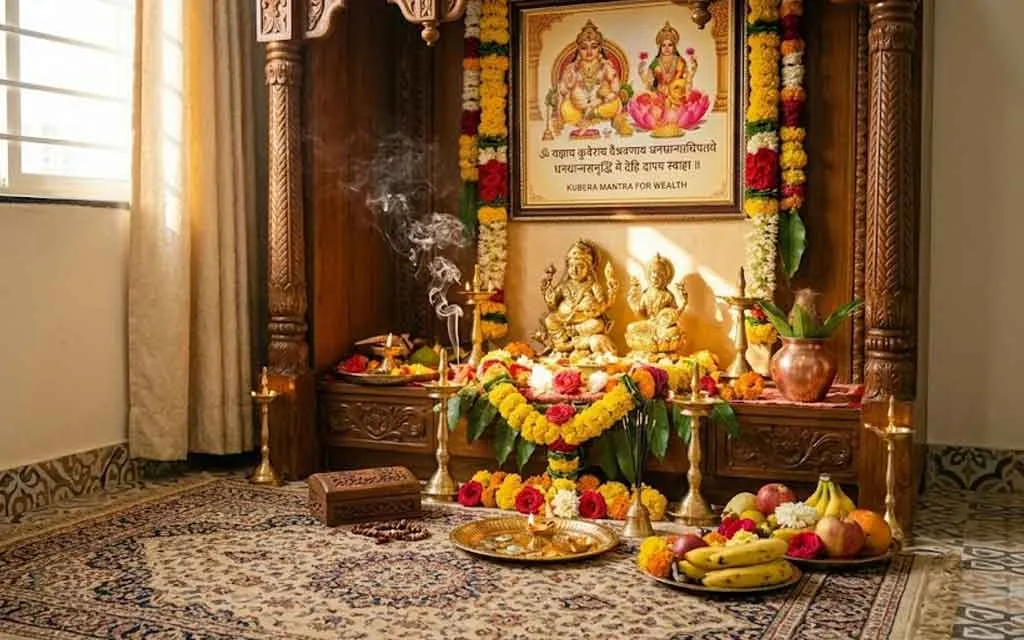
- Yellow flowers (marigold, chrysanthemum — Kubera's color)
- Yellow sweets (besan ladoo, motichoor ladoo, yellow pedas)
- Yellow fruits (banana, yellow apple, mango when in season)
- 5 coins or notes (symbolic of wealth offering)
- Ghee lamp (diya)
- Incense (agarbatti)
- Sandalwood paste (chandan)
- Yellow cloth for altar
- Kumkum and turmeric (haldi)
- Camphor (kapoor) for aarti
- Copper water vessel
Optional but Powerful:
- Saffron (kesar) — add to water offering
- Gold or silver coin to place before the deity during puja
- Sphatik (crystal) Kubera Yantra for permanent altar
Step-by-Step Kubera Puja Vidhi
Step 1 — Purification (Shuddhi)
Bathe early in the morning. Wear clean yellow or white clothing. Clean your puja space thoroughly.
Step 2 — Sanctify the Space
Sprinkle clean water around the puja area while chanting:
Om Apavitrah Pavitro Va Sarvavasthan Gatopi Va
Yah Smaret Pundarikaksham Sa Bahyabhyantarah Shuchih
Step 3 — Invoke Lord Ganesha First
No Hindu puja begins without Ganesha's invocation:
Om Gam Ganapataye Namah — 11 times
Place a small amount of kumkum before Ganesha's image or toward the east.
Step 4 — Invoke Lord Kubera
Place the Kubera idol, image, or Yantra facing north on a yellow cloth. Light the ghee diya and incense.
Chant the Avahana (Invocation):
ॐ यक्षाय कुबेराय वैश्रवणाय नमः।
आगच्छ देव धनपते पूजां गृहाण।
Om Yakshaya Kuberaya Vaishravanaya Namah
Agaccha Deva Dhanapate Pujam Grihana
Meaning: O Lord Kubera, please come and accept this worship.
Step 5 — Offer the Sixteen Upacharas (Shodashopachara)
Step 6 — Coin/Wealth Offering
Place 5 coins or a currency note before the Kubera image. Chant:
Om Dhanadaya Namah — 11 times
This symbolic offering of wealth to Kubera represents the spiritual principle that wealth offered to the divine returns multiplied.
Step 7 — Main Mantra Chanting
Chant the Kubera Moola Mantra — 108 times on a sphatik or gold mala, facing north.
Step 8 — Kubera Aarti
Perform aarti with camphor while singing or reciting:
जय कुबेर देवा, जय धनपति देवा।
ऋद्धि सिद्धि प्रदाता, धनधान्य विधाता।
सदा भक्तों के रक्षक, नव निधि के स्वामी।
ॐ जय कुबेर देवा॥
Jay Kubera Deva, Jay Dhanapati Deva
Riddhi Siddhi Pradaata, Dhanadhanya Vidhaata
Sada Bhakton ke Rakshak, Nav Nidhi ke Swami
Om Jay Kubera Deva
Step 9 — Prasad Distribution
Distribute the yellow sweets as prasad to family members. Keep the coins offered to Kubera in your wallet, cash box, or safe — they are considered energized with Kubera's blessing and attract more wealth.
Step 10 — Visarjana (Closing)
Om Yakshaya Kuberaya Vaishravanaya Namah
Yathasthanam Pratishtha Dehi
"O Lord Kubera, please return to your abode, having blessed this worship."
The Kubera Yantra — Sacred Geometry of Wealth
The Kubera Yantra is the geometric diagram that represents Lord Kubera's divine energy in visual form. It is considered an equally powerful tool to mantra chanting — some Kubera devotees use both together for maximum effect.
Structure of the Kubera Yantra
The Kubera Yantra contains a 3×3 magic square of 9 numbers arranged so that every row, column, and diagonal adds up to the same sum (72 in the traditional Kubera Yantra):
20  | 22  | 18
17  | 23  | 19
24  | 16  | 21
Note: Traditional Kubera Yantras have specific number arrangements that add up to the sacred sum. Consult an authentic source for the precise arrangement.
The central square is surrounded by:
- Lotus petals — representing Lakshmi's co-presence
- Outer square — the bhupura representing the earth plane where wealth manifests
- Sanskrit inscriptions of Kubera's names and beej mantras around the border
Where to Place the Kubera Yantra
- North wall of your home — most auspicious; Kubera's direction
- North wall of your office or business — attracts business prosperity
- North side of your cash register, safe, or cash box — energizes the flow of money
- Study table (facing north) — for students seeking financial success after studies
- Wallet or purse — small Kubera Yantra cards are carried for continuous protection
How to Energize and Use the Kubera Yantra
- Wash the Yantra with panchamrit (milk, curd, honey, ghee, sugar)
- Wipe clean with a yellow cloth
- Place facing north on a yellow cloth
- Chant the Kubera Moola Mantra 108 times while focusing on the Yantra
- Offer yellow flowers and a ghee lamp
- The Yantra is now energized — place it in its permanent north-facing location
Best Time to Chant Kubera Mantra
Daily Timings
[figure: ⭐]
[figure: ⭐]
[figure: ⭐]
[figure: ⭐]
[figure: ⭐]
[figure: ⭐]
[figure: ⭐]
[figure: ⭐]
[figure: ⭐]
[figure: ⭐]
[figure: ⭐]
[figure: ⭐]
[figure: ⭐]
[figure: ⭐]
[figure: ⭐]
[figure: ⭐]
[figure: ⭐]
[figure: ⭐]
[figure: ⭐]
[figure: ⭐]
[figure: ⭐]
[figure: ⭐]
Weekly — Best Days
Annual — Most Auspicious Days for Kubera Mantra
Benefits of Regular Kubera Mantra Practice
Financial Benefits
Wealth Attraction:
Regular Kubera mantra chanting is associated with the gradual but definite attraction of financial opportunities — new income sources, unexpected windfalls, business opportunities, better-paying employment, and investment returns.
Debt Relief:
The Kubera Moola Mantra specifically addresses dhanadhanya (wealth and grain abundance) — for those burdened by debt, this mantra is said to open pathways to debt resolution through improved financial circumstances.
Business Growth:
Business owners who maintain a daily Kubera mantra practice report improved sales, better client relationships, smoother financial transactions, and sustainable business growth over time.
Career Financial Growth:
Professionals chanting Kubera mantras consistently report recognition, promotions, salary increases, and financial advancement at their workplaces — often in ways they had not directly engineered themselves.
Spiritual and Psychological Benefits
Healthy Relationship with Money:
Many people carry unconscious negative beliefs about wealth — that money is corrupt, that wanting wealth is spiritually wrong, or that they do not deserve abundance. Kubera mantras, particularly the Gayatri form, help purify these beliefs and establish a dharmic, spiritually healthy relationship with material prosperity.
Generosity and Charitable Nature:
Paradoxically, Kubera mantras cultivate generosity. The divine treasurer governs not just the accumulation but also the right flow of wealth — and practitioners often find themselves naturally drawn toward charitable giving, which in turn creates positive karma that attracts more abundance.
Release of Scarcity Mindset:
Consistent mantra practice gradually dissolves the fear-based scarcity mindset — the constant anxiety about not having enough — replacing it with a grounded sense of abundance and trust in the divine provision.
Protection of Existing Wealth:
Kubera is a dhana rakshak — a protector of wealth. His mantras are invoked to protect existing assets, savings, and property from loss, theft, unexpected expenses, or financial catastrophe.
Who Should Chant Kubera Mantras?
Kubera mantras are beneficial for virtually everyone seeking financial well-being. Here is specific guidance for different groups:
Business Owners and Entrepreneurs
Most Recommended Mantra: Kubera Moola Mantra + Om Namo Dhanadaya Svaha
Business owners should establish a daily morning Kubera puja before beginning business activities. Keep a Kubera Yantra facing north in the office or shop. Place a small Kubera image near the cash register or payment terminal.
Job Seekers and Career Aspirants
Most Recommended Mantra: Kubera Dhana Prapti Mantra + Kubera Beej Mantra
For those seeking employment or better-paying jobs, chant the Kubera Dhana Prapti Mantra 108 times every Thursday for 11 consecutive weeks (Guruvaar Vrata). Keep your resume and job application documents briefly before the Kubera image while chanting.
Those in Debt
Most Recommended Mantra: Kubera Moola Mantra + Kubera Ashta Lakshmi Mantra
Those burdened by debt should focus on the Moola Mantra (for comprehensive wealth) and the Ashta Lakshmi Mantra (for household prosperity). Additionally, practice daan (charity) — even a small, sincere act of giving — as this activates the reciprocal flow of abundance.
Investors and Financial Professionals
Most Recommended Mantra: Kubera Gayatri Mantra + Kubera Beej Mantra
The Gayatri format invokes dharmic wealth — wealth earned through wisdom, right action, and righteous means. For those whose work involves managing others' money (fund managers, financial advisors, bankers), this mantra establishes a spiritually clean relationship with financial resources.
Students Seeking Scholarship and Financial Aid
Most Recommended Mantra: Kubera Beej Mantra + Saraswati Mantra combined
Students seeking scholarships, study abroad funding, or educational financial support can chant the Kubera Beej Mantra combined with Saraswati mantras — invoking both financial support and academic excellence simultaneously.
Real Estate and Property Seekers
Most Recommended Mantra: Kubera Moola Mantra + Kubera Ashta Lakshmi Mantra
For those seeking to purchase a home, plot, or commercial property, chant both these mantras intensively in the 3 months preceding the intended purchase. Place a Kubera Yantra in the north direction of your desired property during property viewing visits.
Subject-Wise Mantra Recommendations (Recap Table)
Complementary Practices for Maximum Kubera Mantra Benefit
The Principle of Dharmic Wealth
The Vedic tradition is clear: Kubera's blessings flow most freely to those who seek wealth through dharmic (righteous) means — honest effort, fair dealing, and ethical conduct. Mantras are not substitutes for integrity in financial life; they amplify the results of righteous effort.
Alongside mantra practice, commit to:
- Honest income — ensuring all wealth is earned through legitimate and ethical means
- Timely repayment — of all debts, loans, and obligations
- Fair dealing — in all financial transactions and business relationships
- Gratitude — acknowledging and being grateful for existing wealth, however modest
Daan (Charity) — The Secret Multiplier
Perhaps the most important complementary practice is daan (charitable giving). The Kubera mantra from the Atharva Veda specifically positions the practitioner as Danashila (charitable by nature) before requesting wealth.
The Vedic principle is: Daan Karoti Dhana Pushti — charity increases wealth. This is not merely poetic — it reflects a cosmic law of reciprocal abundance. What is freely given returns multiplied.
Simple daan practices for Kubera devotees:
- Feed the hungry on Thursdays (Kubera's day)
- Donate to a cause you believe in every Friday (Lakshmi's day)
- Give to those in need without expectation — even a small amount given sincerely
- Support a student's education — considered especially meritorious
Yellow Color Practices
Yellow is Kubera's sacred color — the color of gold, abundance, and prosperity. Incorporating yellow into your Kubera practice amplifies the mantra's effects:
- Wear yellow on Thursdays during intensive Kubera sadhana
- Use a yellow asana (cloth to sit on) while chanting
- Offer yellow flowers (marigold, chrysanthemum) to the Kubera image
- Place yellow fruits and yellow sweets as naivedya (food offering)
- Store your cash, investments, or important financial documents near yellow cloth
North-Facing Arrangements
Since Kubera governs the north direction, aligning your financial spaces toward the north amplifies his energy in your physical environment:
- Place your safe, cash box, or financial documents in the north part of your home
- Sit facing north when managing finances, reviewing investments, or doing accounting
- Place the Kubera Yantra on the north wall of your home and office
- Avoid placing garbage, shoes, or toilets in the north area of your home (Vastu principle)
Kubera Mantra for Specific Days — Weekly Sadhana Schedule
[figure: ⭐]
[figure: ⭐]
The Guruvaar Vrata — 11-Thursday Kubera Sadhana
The Guruvaar (Thursday) Vrata is one of the most powerful structured Kubera practices in the tradition:
Duration: 11 consecutive Thursdays
Commitment: Unbroken — if a Thursday is missed, restart the count from Thursday 1
Each Thursday Practice:
- Wake before sunrise; bathe; wear yellow clothing
- Light a ghee diya before the Kubera image/Yantra facing north
- Offer yellow flowers, yellow sweets, 5 coins
- Chant Kubera Moola Mantra — 108 times
- Chant Kubera Beej Mantra — 108 times
- Distribute yellow sweets as prasad
- Perform a daan — give food, money, or help to someone in need
- Fast or eat simple sattvic food throughout the day (optional but amplifying)
On the 11th Thursday: Perform a more elaborate puja with all offerings, chant 1008 times of the Moola Mantra, and make a significant charitable donation.
Many practitioners of the Guruvaar Vrata report tangible financial improvements — job offers, business deals, debt resolution, investment returns — appearing within the 11-week period.
Frequently Asked Questions About Kubera Mantra
Q: What is the best Kubera mantra for a beginner?
Begin with the Kubera Beej Mantra (Om Dham Kuberaya Namah) — it is short, powerful, and accessible. Chant it 108 times every morning facing north. Once you are comfortable with daily practice after 21 days, add the Kubera Moola Mantra.
Q: Can women chant Kubera mantras during menstruation?
It is traditionally recommended to pause active puja (formal worship ritual) during menstruation, but mental chanting (manasik japa) of the Kubera Beej Mantra can continue. Resume the full practice after the period ends.
Q: Is it necessary to have a Kubera idol or image?
No — you can use a Kubera Yantra, a printed image, or simply face north and chant with sincere intention. The deity is invoked by the sound vibration of the mantra, not limited to a physical representation.
Q: Can I chant Kubera mantras if I already chant Lakshmi mantras?
Absolutely — Kubera and Lakshmi are spiritually complementary. Many devotees chant both, treating Lakshmi mantras (especially on Fridays) and Kubera mantras (especially on Thursdays) as two aspects of a complete prosperity practice.
Q: How long does it take to see results?
Results vary significantly based on sincerity, consistency, and personal karma (prarabdha). Many practitioners notice subtle positive shifts — unexpected opportunities, reduced financial anxiety, improved clarity about financial decisions — within 21 to 40 days. Significant financial change often manifests between 3 months and 1 year of consistent daily practice.
Q: Is there a specific number of repetitions that is most powerful?
The traditional counts are 108 (daily practice), 1008 (special occasions like Dhanteras), and 11 consecutive rounds of 108 (for intensive sadhana). Any sincere chanting is beneficial — do not let the perfect be the enemy of the good.
Q: Can I chant Kubera mantras for someone else's financial well-being?
Yes. You can chant with the intention of blessing a family member, partner, or loved one's financial situation. State the intention clearly at the start of your chanting: "I chant this for the financial well-being of ."
Q: What is the relationship between Kubera and Lakshmi?
Kubera and Lakshmi represent two complementary aspects of prosperity. Lakshmi is the grace, flow, and abundance of wealth; Kubera is the accumulation, protection, and wise management of wealth. For complete financial well-being, devotees traditionally honor both — Lakshmi on Fridays for incoming prosperity, and Kubera on Thursdays for its preservation and growth.
Q: Should I keep the Kubera Yantra secret?
Unlike some tantric practices, the Kubera Yantra and its mantras are not secret — they are part of the openly accessible Vedic-Puranic tradition. However, sincere personal practice with focused intention (rather than performing it casually or publicly) yields the best results.
Conclusion
Lord Kubera — the divine treasurer of the heavens, guardian of the nine mystical treasures, lord of the north — is one of the most directly accessible and benevolent deities in the Hindu tradition for those seeking material well-being and financial prosperity.
His mantras are not magic formulas for instant riches. They are sacred sound vibrations that, when chanted consistently with sincere devotion, righteous intent, and aligned action, gradually transform the practitioner's relationship with money, attract genuine financial opportunities, protect existing wealth, and open the flow of divine abundance into everyday life.
The complete Kubera practice is:
- Kubera Moola Mantra — for comprehensive wealth invocation (Thursdays)
- Kubera Beej Mantra — for daily quick practice (every morning)
- Kubera Dhana Prapti Mantra — for specific wealth attraction
- Kubera Ashta Lakshmi Mantra — for household and business prosperity
- Kubera Gayatri Mantra — for dharmic, righteous abundance
- Full Thursday Puja — weekly ritual worship
- Dhanteras and Akshaya Tritiya — annual high-potency practices
- Daan (charity) — the sacred multiplier that makes Kubera's blessings flow
At HinduTone, we provide authentic audio recordings of all Kubera mantras with correct Sanskrit pronunciation, Kubera puja playlist music, devotional content for Dhanteras and Diwali, and comprehensive guides for all wealth and prosperity mantras in the Hindu tradition.
Begin on a Thursday. Face north. Chant with devotion. Let Kubera's grace transform your financial life.
Related Articles on HinduTone
- Lakshmi Mantra — Complete Guide for Wealth and Prosperity
- Best Hindu Mantras for Job Stability and Career Growth
- Best Hindu Mantras for Bank PO Aspirants
- Dhanteras Puja Vidhi — Complete Guide for Kubera and Lakshmi
- Akshaya Tritiya — Most Auspicious Day for Wealth Rituals
- Gayatri Mantra — Full Meaning, Benefits and How to Chant
- Diwali Lakshmi Puja Vidhi — Step by Step Guide
- Kubera Yantra — Benefits, Activation and Placement Guide
- Saraswati Mantra — Complete Guide for Knowledge and Wisdom
© 2024 HinduTone.com — Your Trusted Source for Hindu Mantras, Devotional Music & Spiritual Wisdom
Tags: Kubera mantra, Lord Kubera mantra for wealth, Kubera beej mantra, Kubera moola mantra, Kubera puja vidhi, Kubera yantra, mantra for wealth and abundance, mantra for financial success, Dhanteras Kubera puja, Akshaya Tritiya mantra, mantra for business success, mantra for debt relief, Kubera Gayatri mantra, Kubera Ashta Lakshmi mantra, Hindu mantra for prosperity, wealth mantra, Dhanapati mantra, Nava Nidhi, Guruvaar vrata, Thursday Kubera puja
You might also like

Mahishasura Mardini Stotra: Lyrics, English Meaning & Profound Spiritual Benefits

Hanuman Mantra: Strength & Protection Power
Kubera Mantra for Wealth — The Most Powerful Treasure Invocation | Complete Guide