
Kubera Mantra for Wealth — The Most Powerful Treasure Invocation | Complete Guide
Introduction: The God Who Guards All the Gold in the Universe Somewhere in the sacred Himalayas, at the peak of Mount Meru, in the golden celestial city of…
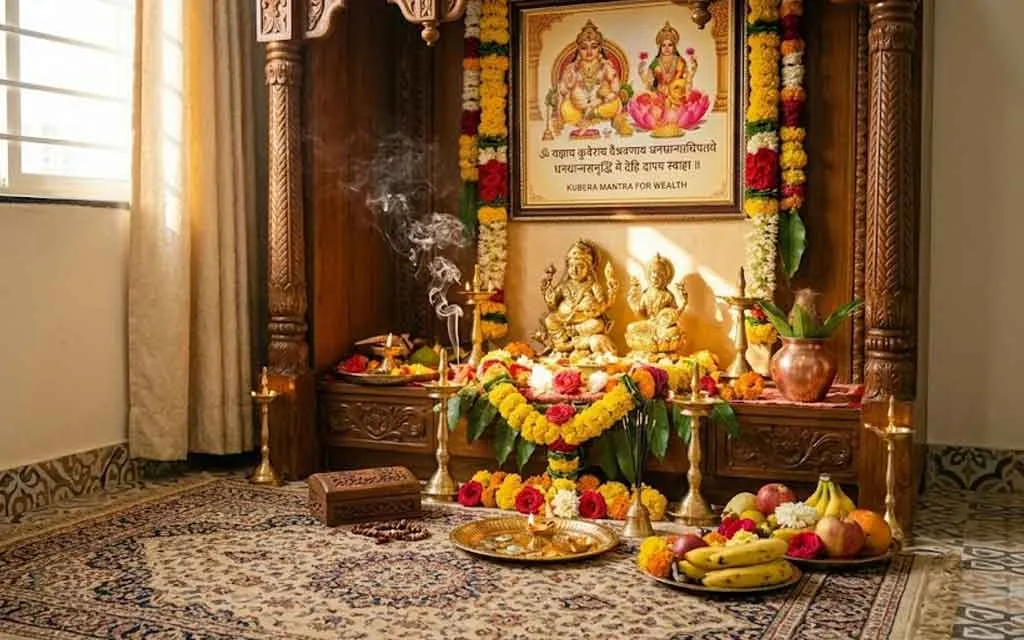
Introduction: The God Who Guards All the Gold in the Universe Somewhere in the sacred Himalayas, at the peak of Mount Meru, in the golden celestial city of…
Introduction: The God Who Guards All the Gold in the Universe
Somewhere in the sacred Himalayas, at the peak of Mount Meru, in the golden celestial city of Alaka — sits the most prosperous being in all of creation. He is plump and jeweled, his complexion as golden as sunrise, his three legs firmly planted in the north of the cosmos, his eight magnificent teeth gleaming beneath a crown studded with the nine treasures of the universe. Around him swirl his divine attendants — the Yakshas, Kinnaras, and Gandharvas — celestial beings who guard the storehouses of all earthly riches.
He is Lord Kubera — Dhanapati, Lord of Wealth. Yaksheshwara, King of the Yakshas. Vaishravana, Son of the sage Vishrava. Nidheeshwara, Master of all divine treasures. The divine treasurer of the gods, appointed by Lord Brahma himself to be the custodian of every gem hidden beneath the mountains, every gold vein running through the earth, every pearl resting at the bottom of the ocean.
And he has mantras — sacred sound vibrations of extraordinary power — through which any sincere devotee can connect directly with this divine source of abundance and invite its flow into their life.
At HinduTone, we present to you the most complete guide to Kubera Mantras — the sacred sounds that unlock the treasury of heaven.
[image: 🏛️] Who Is Lord Kubera? — The Complete Divine Portrait
His Names and Their Meanings
Lord Kubera is known by many names, each revealing a different dimension of his cosmic role:
His Divine Form — The Sacred Symbolism
Lord Kubera's form is one of the most symbolically rich in all of Hindu iconography. Every detail carries meaning:
Stout, pot-bellied body: Not a flaw — a divine teaching. Kubera's fullness represents purnata — completeness, satisfaction, the state of having enough and more. In a world of perpetual hunger and scarcity anxiety, he stands as living proof that the universe is abundant.
Golden/fair complexion: Mastery over gold — the most universally recognized form of material wealth throughout human history.
Three legs: He stands simultaneously in three worlds — the divine realm, the human realm, and the realm beneath the earth where all treasures sleep. He governs wealth in all dimensions of existence.
Eight teeth: Representing the eight directions — his wealth and protection extend in every compass direction.
One divine eye, one mortal eye: Giving him the ability to perceive both material and spiritual realms simultaneously — the rarest of wisdom.
Crown of Nava Nidhis: His crown is not studded with ordinary gems but with the nine cosmic treasures of the universe.
What He Carries:
- Nidhipot (treasure pot/money bag): The inexhaustible source of divine wealth
- Gada (mace): Power, authority, and the ability to protect accumulated wealth
- Pomegranate: Fertility, abundance with seeds — one seed becomes a hundred fruits
- Mongoose spitting jewels: One of the most unique symbols in Hindu iconography — the mongoose of Kubera vomits precious gems, representing the spontaneous, effortless generation of wealth that flows when one is truly aligned with the divine
His Vehicle: A human being (nara) — suggesting that true wealth flows through human effort and labor. Kubera does not bypass human action; he empowers it.
His Vahana/Companion: In some traditions, Pushpaka Vimana — the divine flying palace — which he originally owned until Ravana seized it.
[image: 📖] The Sacred Stories of Lord Kubera
Story 1: From Shame to Glory — How Kubera Became the God of Wealth
In the ancient world, before Kubera became the divine treasurer, he was a mortal man — a descendant of the great sage Pulastya, son of the sage Vishrava and his first wife Illavida.
Kubera, born with a peculiar form — short, rotund, with misshapen features — faced the world's cruelest teacher: mockery. People laughed at his appearance. He was derided, dismissed, and humiliated.
But within that ridiculed form beat a heart of extraordinary determination. Rather than collapsing under the weight of the world's scorn, Kubera turned to Lord Shiva. He performed austere tapasya — years of unbroken meditation, fasting, and devotion to Shiva at sacred Himalayan heights.
The penance was so intense, so unwavering, that even the planets stood still in admiration. Finally, the great Lord Shiva manifested before him, wreathed in divine fire.
"What do you desire?" Shiva asked.
Kubera had not prayed for beauty. He had not prayed for revenge against those who mocked him. He asked: "Let me serve the universe. Let me be the guardian of its wealth — not to hoard it, but to protect it and distribute it according to cosmic justice."
Shiva — the great god who rewards the truest prayers — was moved. He appointed Kubera as Dhanapati — Lord of All Wealth — and gave him the divine city of Alaka on Mount Meru as his eternal abode, and the nine cosmic treasures (Nava Nidhi) to govern.
Lord Brahma confirmed the appointment, making Kubera one of the eight Ashtadikpalas — the divine guardians of the eight directions — assigning him the auspicious North as his eternal direction.
The teaching of this story: Kubera's wealth came not from birth or luck, but from devotion, perseverance, and selfless intention. His mantras carry this same energy — they work not for the greedy but for the genuinely devoted.
Story 2: Lanka — The Golden Kingdom Kubera Built and Lost
Among all the stories of Kubera, the tale of Lanka is both his most magnificent achievement and his most profound loss.
Kubera, as the divine treasurer, commissioned the divine architect Maya and the celestial engineer Vishwakarma to build him a capital worthy of the lord of all wealth. They created Lanka — an island kingdom of pure gold, floating in the southern ocean, surrounded by protective mountains, its spires and palaces gleaming with a light visible from the celestial realms.
Lanka was not just wealthy — it was the physical embodiment of perfect prosperity: organized, beautiful, spiritually protected, and flowing with abundance.
Kubera ruled Lanka from his golden throne, governing the flow of cosmic wealth through the three worlds, distributing treasure through his Yaksha attendants who carried riches to the deserving.
But Kubera's half-brother — the demon Ravana, son of Vishrava through his second wife Kaikesi — was not governed by dharma. Ravana performed fierce penance to Lord Brahma and received extraordinary boons. Then, drunk on invincibility, he came to Lanka and issued a simple, terrible ultimatum to Kubera: "Leave. Lanka is mine now."
Kubera — who could have fought — chose differently. He recognized that a battle with Ravana would spill the blood of his Yakshas, and that the time for Lanka's transfer was written in the cosmic ledger of karma. He withdrew with dignity, taking his divine attendants, his Nava Nidhis, and his beloved Pushpaka Vimana — which Ravana then also seized from him.
Kubera retreated to the Himalayas and established the celestial city of Alaka — even more magnificent than Lanka, accessible only to the divine, perched at the summit of the world.
The teaching: Even the loss of Lanka did not break Kubera. He rebuilt, greater than before. His mantras carry this energy of resilience — the ability to rebuild wealth from the ground up, no matter how devastating the prior loss.
Story 3: Kubera's Feast with Shiva — The Lesson of Sacred Wealth
In the divine city of Alaka, Kubera once organized a magnificent feast for Lord Shiva — a celebration of gratitude for the boon that had transformed his life. The feast was legendary: mountains of food, rivers of nectar, jewels scattered on golden floors.
When Shiva arrived, he brought with him his son Ganesha — a child with an appetite as enormous as his divine wisdom. Ganesha ate through every course of the feast, then ate through the kitchens, then ate through the supplies, then looked at Kubera with still-hungry eyes and began eating the furniture, the walls, the treasures themselves.
Kubera, desperate and embarrassed, rushed to Shiva. "Lord — your son is eating everything! All my wealth is disappearing!"
Shiva smiled. He gave Ganesha a small handful of puffed rice — laja — the simplest, humblest food. Ganesha's hunger was immediately, completely satisfied.
Shiva turned to Kubera:
"You organized this feast to display your wealth — not to nourish anyone. Real abundance is not in the quantity of what you have, but in the intention with which you give. A handful of love satisfies infinitely more than a mountain of pride."
Kubera received this teaching in humility. From that day, he is also worshipped as the god who teaches the right relationship with wealth — that treasure is sacred, not to be hoarded or displayed, but held in trust and distributed with wisdom.
This is why Kubera mantras work best not when chanted from desperation or greed, but from a heart genuinely devoted to righteous prosperity — wealth used for the good of self, family, and the world.
Story 4: Kubera and the Friendship of Shiva — The North Star of Devotion
Of all divine friendships, few are as beautiful as the one between Kubera and Lord Shiva. After his appointment as Dhanapati, Kubera became not just Shiva's devotee but his sakha — his friend.
Lord Shiva, who himself has almost no possessions — who wanders ash-smeared and barefoot through the cremation grounds — is the most intimate companion of the lord of all wealth. This paradox is one of Hinduism's most profound theological statements:
True wealth and true renunciation are not opposites — they are two sides of the same coin.
Kubera's wealth has no meaning without Shiva's wisdom. Shiva's wisdom chooses poverty not from inability to be wealthy but from the deepest satiation — he already possesses everything. And Kubera guards material prosperity in service of dharma, not for his own gratification.
This is why the Kubera-Shiva connection is central to Kubera's worship. Kubera mantras are most powerful when combined with worship at Shiva temples and on Shiva's sacred days — especially Monday and Pradosh.
[image: 💎] The Nava Nidhi — Kubera's Nine Cosmic Treasures
"Nava" means nine; "Nidhi" means treasure. The Nava Nidhi are the nine forms of divine cosmic wealth that Kubera governs and distributes. They are not just material riches — each represents a complete category of abundance:
When we chant Kubera mantras, we invoke all nine of these dimensions of wealth — not just money, but the complete spectrum of human prosperity: material, relational, intellectual, physical, spiritual, and generational.
[image: 🕉️] The Complete Kubera Mantra Collection
MANTRA 1 — The Moola Mantra (Root Mantra) — Most Complete
This is the primary, most authoritative Kubera mantra — drawn from the ancient Vedic and Puranic scriptures. It is the most complete invocation, addressing Kubera in all his divine roles simultaneously.
Sanskrit (Devanagari):
ॐ यक्षाय कुबेराय वैश्रवणाय धनधान्याधिपतये धनधान्यसमृद्धिं मे देहि दापय स्वाहा॥
Transliteration:
Om Yakshaya Kuberaya Vaishravanaya Dhanadhanyaadhipataye Dhanadhanya Samriddhim Me Dehi Dapaya Svaha
Word-by-Word Meaning:
- Om — the primordial sound, the seed of creation
- Yakshaya — to the Yaksha (king of the nature spirits)
- Kuberaya — to Kubera
- Vaishravanaya — son of the sage Vishrava
- Dhanadhanyaadhipataye — to the lord (adhipati) of all wealth (dhana) and grain (dhanya)
- Dhanadhanya Samriddhim — the fullness/prosperity of wealth and grain
- Me Dehi — give to me
- Dapaya — cause to be given (make it so)
- Svaha — I offer this prayer into the sacred fire; so be it
Complete Meaning: "Om. To the Yaksha-lord Kubera, son of Vishrava, master of all wealth and grain — grant me the complete abundance of wealth and nourishment. So be it."
Best for: All-around financial improvement, sustained wealth, business prosperity, agricultural abundance.
Chant: 108 times daily for 21 consecutive days for best results.
MANTRA 2 — The Beej (Seed) Mantra — Shortest, Most Potent
Sanskrit:
ॐ श्रीं ह्रीं क्लीं श्रीं क्लीं वित्तेश्वराय नमः
Transliteration:
Om Shreem Hreem Kleem Shreem Kleem Vitteshvaraya Namah
Meaning:
- Shreem — Seed of Lakshmi (wealth energy)
- Hreem — Seed of divine power and Maya
- Kleem — Seed of attraction, magnetism
- Vitteshvaraya — to the Lord of all riches (Vitta = riches, Ishvara = Lord)
- Namah — I bow
Complete Meaning: "Om. Invoking the energies of wealth (Shreem), divine power (Hreem), and magnetic attraction (Kleem) — I bow to the Lord of all riches."
Best for: Rapid invocation, daily chanting, quick financial situations, beginning any financial endeavor.
Chant: 108 times — this mantra works quickly because the beej syllables are direct sound-keys to Kubera's energy.
MANTRA 3 — Lakshmi-Kubera Mantra — The Combined Power of Grace and Treasury
This mantra invokes both Goddess Lakshmi AND Lord Kubera simultaneously — bringing together the flowing grace of prosperity AND its stable accumulation.
Sanskrit (Devanagari):
ॐ ह्रीं श्रीं क्रीं श्रीं कुबेराय अष्ट-लक्ष्मी मम गृहे धनं पुरय पुरय नमः॥
Transliteration:
Om Hreem Shreem Kreem Shreem Kuberaya Ashta-Lakshmi Mama Grihe Dhanam Puraya Puraya Namah
Meaning:
- Hreem — Power, Maya, divine force
- Shreem — Lakshmi's seed syllable
- Kreem — Kali's seed — transformative energy that removes blockages
- Ashta-Lakshmi — the eight forms of Goddess Lakshmi
- Mama Grihe — in my home
- Dhanam Puraya Puraya — fill, fill with wealth (repeated twice for emphasis)
- Namah — I bow in reverence
Complete Meaning: "Om. I invoke the powers of divine force, prosperity, and transformation. O Kubera, with the eight forms of Lakshmi, fill my home with wealth — again and again. I bow to you."
Best for: Home wealth, family financial stability, inviting Lakshmi into a new home, Diwali and Dhanteras puja.
MANTRA 4 — The Kubera Gayatri Mantra — For Wisdom in Wealth
The Gayatri meter is the most sacred poetic form in the Vedic tradition. The Kubera Gayatri invokes not just wealth but the wisdom to understand, manage, and use wealth rightly.
Sanskrit:
ॐ यक्ष राजाय विद्महे, अलकाधीशाय धीमहि, तन्नो कुबेरः प्रचोदयात्॥
Transliteration:
Om Yaksha Rajaya Vidmahe Alakadhishaya Dhimahi Tanno Kuberah Prachodayat
Meaning:
- Yaksha Rajaya Vidmahe — We know the King of the Yakshas
- Alakadhishaya Dhimahi — We meditate on the Lord of Alaka (Kubera's golden city)
- Tanno Kuberah Prachodayat — May Lord Kubera illuminate and inspire our intellect
Complete Meaning: "We meditate on Lord Kubera, the king of Yakshas and lord of the celestial city of Alaka. May he illuminate our intellect and inspire us toward wisdom and prosperity."
Best for: Financial wisdom, right investment decisions, understanding the deeper purpose of wealth, students of commerce and economics.
Chant: Most effective during Brahma Muhurta (before sunrise), facing north.
MANTRA 5 — Kubera Dhana Prapti Mantra — For Specific Wealth Attraction
Sanskrit:
ॐ श्रीं ह्रीं ऐं कुबेराय लक्ष्म्यै कमलधारिण्यै धन आकर्षिण्यै स्वाहा॥
Transliteration:
Om Shreem Hreem Aim Kuberaya Lakshmiyai Kamala Dhaarinyai Dhana Aakarshinyai Svaha
Meaning:
- Aim — Seed of Saraswati — wisdom and intelligence
- Kamala Dhaarinyai — to the one who holds the lotus (Lakshmi)
- Dhana Aakarshinyai — to the one who attracts wealth
- Svaha — I offer this into the sacred fire
Complete Meaning: "Om. Invoking Shreem, Hreem, and Aim — to Kubera and Lakshmi who holds the lotus, who is the very force that attracts wealth — I offer this prayer. So be it."
Best for: Attracting new sources of income, business deals, financial opportunities, recovering from debt.
MANTRA 6 — The Vedic Kubera Mantra — From the Atharva Veda
This is among the most ancient Kubera mantras, drawn from the sacred Atharva Veda — one of the four foundational Vedas.
Sanskrit:
ॐ राजाधिराजाय प्रसह्ये साहिने नमो वयं वैश्रवणाय कुर्महे। स मे कामान् कामकामाय मह्यम् कामेश्वरो वैश्रवणो ददातु। कुबेराय वैश्रवणाय महाराजाय नमः॥
Transliteration:
Om Rajadhirajaya Prasahye Sahine Namo Vayam Vaishravanaya Kurmahe Sa Me Kaman Kamakamaya Mahyam Kameshvaro Vaishravano Dadatu Kuberaya Vaishravanaya Maharajaya Namah
Meaning:
- Rajadhirajaya — to the King of Kings
- Prasahye Sahine — to the supremely powerful one
- Namo Vayam — we bow
- Vaishravanaya Kurmahe — we perform obeisance to the son of Vishrava
- Sa Me Kaman — may he fulfill my desires
- Kamakamaya Mahyam — fulfilling my deepest longing
- Kameshvaro Vaishravano Dadatu — may Vaishravana (Kubera), lord of all desires, grant me
Complete Meaning: "O King of kings, supremely powerful one — we bow to Vaishravana (Kubera). May he, the lord of all desires and son of Vishrava, fulfill my deepest longings. To the Great King Kubera — salutations."
Best for: Invocation during formal Kubera Puja, Havan (fire ceremony), and Dhanteras ritual. Most powerful when chanted by a Vedic scholar during puja.
MANTRA 7 — Kubera Mantra for Business Success
Sanskrit:
ॐ ह्रीं श्रीं कुबेराय नमः। व्यापारे वृद्धिं देहि देहि स्वाहा॥
Transliteration:
Om Hreem Shreem Kuberaya Namah Vyapare Vriddhim Dehi Dehi Svaha
Meaning:
- Vyapare — in business / trade
- Vriddhim — growth, expansion, increase
- Dehi Dehi — give, give (repeated for emphasis)
Complete Meaning: "Om. Invoking Hreem and Shreem — I bow to Lord Kubera. Grant me growth and expansion in business. So be it."
Best for: Entrepreneurs, traders, shopkeepers, those launching new businesses, anyone seeking sales growth. Especially powerful when chanted before entering a shop or office.
MANTRA 8 — Kubera Mantra for Debt Relief
Sanskrit:
ॐ कुबेर त्वं धनाध्यक्षो गृहे ते धनसम्पदः। मम ऋणं विनाशय धनं देहि नमोस्तुते॥
Transliteration:
Om Kubera Tvam Dhanadhyaksho Grihe Te Dhana Sampadah Mama Rinam Vinashaya Dhanam Dehi Namostute
Meaning:
- Tvam Dhanadhyaksho — you are the supreme administrator of wealth
- Grihe Te Dhana Sampadah — in your abode there is infinite wealth
- Mama Rinam Vinashaya — destroy / remove my debt
- Dhanam Dehi — give me wealth
Complete Meaning: "O Kubera — you are the supreme overseer of all wealth. In your celestial abode, all riches reside. Remove my debt and grant me prosperity. I bow to you."
Best for: Debt relief, financial crisis, recovering loans, removing financial obstacles and karmic money blockages.
MANTRA 9 — Kubera Ashirvaad Mantra — The Blessing Mantra
Sanskrit:
ॐ कुबेराय नमः। धनं मे देहि, यशश्च देहि, सर्वान् काम्यान् सिद्धिं देहि। नमो कुबेराय॥
Transliteration:
Om Kuberaya Namah Dhanam Me Dehi, Yashascha Dehi Sarvan Kamyan Siddhim Dehi Namo Kuberaya
Meaning:
- Dhanam Me Dehi — give me wealth
- Yashascha Dehi — and give me fame/reputation
- Sarvan Kamyan Siddhim Dehi — grant me the accomplishment of all my desires
Complete Meaning: "I bow to Lord Kubera. Grant me wealth, grant me fame, and grant me the fulfillment of all my righteous desires. I bow to Kubera."
Best for: Career advancement, reputation building, all-around life improvement — wealth, fame, and success together.
MANTRA 10 — The Shiva-Kubera Joint Mantra — Amplified Power
Since Kubera received his divine status through Shiva's grace, invoking both together amplifies the power significantly:
Sanskrit:
ॐ नमः शिवाय च कुबेराय च। धनधान्यसमृद्धिं देहि। शिव-कुबेर प्रसीद प्रसीद॥
Transliteration:
Om Namah Shivaya Cha Kuberaya Cha Dhanadhanya Samriddhim Dehi Shiva-Kubera Prasida Prasida
Complete Meaning: "I bow to both Lord Shiva and Lord Kubera. Grant me the fullness of wealth and nourishment. O Shiva and Kubera — be gracious, be gracious."
Best for: Monday chanting (Shiva's day), Pradosh worship, when facing extreme financial difficulty requiring both divine intervention and grounded wealth.
[image: 🔵] The Kubera Yantra — Sacred Geometry of Infinite Wealth
The Kubera Yantra is a sacred geometric diagram — a Yantra (divine instrument) inscribed with specific numbers and geometric patterns that create a resonant field for Kubera's energy. It is one of the most widely used wealth yantras in the Hindu tradition.
The Structure of the Kubera Yantra
The classical Kubera Yantra consists of a 3×3 grid (nine boxes) filled with specific numbers:
20 | 25 | 27
---+----+---
28 | 24 | 20
---+----+---
24 | 23 | 25
The Mathematical Miracle: Every row, every column, and every diagonal of the Kubera Yantra sums to the same number: 72. This mathematical perfection represents cosmic balance — the same equilibrium with which Kubera distributes wealth across all three worlds.
72 also relates to the 72 divine names by which Kubera is worshipped in Vedic tradition.
How to Install and Worship the Kubera Yantra
Material: Copper is traditional and most auspicious. Gold is ideal for maximum effect. Silver or brass are acceptable. Never use plastic, aluminum, or cheap metal.
Direction: Face the Yantra toward North or East — North is Kubera's direction as an Ashtadikpala. Never toward South.
Height: Position the Yantra level with your eyes when sitting — this ensures direct energetic connection during worship.
What to Place on the Yantra:
- A gold or silver coin (representing the Padma Nidhi and Maha Padma Nidhi)
- Dried lotus seeds (Makhana)
- A small flower (yellow or white preferred)
Daily Yantra Worship:
- Clean the Yantra with a soft dry cloth each morning.
- Apply a small tilak of red kumkum at the center.
- Place a fresh flower.
- Light one ghee diya beside it.
- Chant the Kubera Moola Mantra 108 times facing the Yantra.
Activation (Pran Pratishtha): For maximum results, the Yantra should be ritually activated (Prana Pratishtha) — either by a qualified pandit on an auspicious day, or by the practitioner on Dhanteras or Diwali night during Kubera Puja.
Location in Home: North wall of the living room, or North side of the puja room. Can also be placed in the business locker room or treasury area facing North.
Kubera Puja Vidhi — Complete Step-by-Step
Best Days for Kubera Puja
Best Times for Kubera Mantra Chanting
Kubera Puja — Step by Step
Preparation:
- Bathe and wear clean clothes — yellow, orange, or white preferred
- Clean the puja space and set up the altar in the North or East of the home
- Place the Kubera Yantra or Kubera idol on a wooden platform with a yellow/red cloth
- Arrange beside Kubera: a Lakshmi image (on his left), a pot of water, flowers, incense
Invocation Sequence:
Step 1 — Ganesha First:
"Om Gam Ganapataye Namah" — 21 times Always begin with Ganesha to remove obstacles from the puja.
Step 2 — Purification (Achamana): Sip water three times from the palm, reciting:
"Om Achyutaya Namah, Om Anantaya Namah, Om Govindaya Namah"
Step 3 — Sankalpa (Sacred Intention): State your intention clearly and truthfully before the deity: "O Lord Kubera, I perform this puja today with the sincere intention of . I approach you with a pure and devoted heart. Grant me the Nava Nidhi according to my dharmic need."
Step 4 — Avahana (Invocation):
"Om Yakshaya Kuberaya Vaishravanaya Namah — Aavahayami"
Step 5 — Offerings (Shodashopachar): Offer in sequence — water for the feet, arghya water, sandalwood paste, flowers, incense, lamp, and food/naivedya.
Best Flowers for Kubera: Lotus (Padma), yellow marigold, white jasmine.
Best Naivedya for Kubera:
- Yellow sweets — besan ke ladoo, saffron kheer, coconut barfi
- Fruits — coconut, banana, pomegranate
- Pancha Mewa (five dry fruits): cashews, almonds, raisins, dates, figs
- Yellow rice (cooked with turmeric and saffron)
Step 6 — Mantra Chanting: Chant the Kubera Moola Mantra 108 times using a Tulsi or Sphatik (crystal) mala.
Step 7 — Kubera Aarti: Perform Aarti with ghee lamp in clockwise circles.
Step 8 — Daan (Donation): This is the most important step. Make a sincere donation after puja — feeding the poor, giving to a cow shelter, donating to a temple, or giving generously to someone in need. Kubera is invoked most powerfully when the cycle of giving is activated. The universe returns abundance to those who circulate it.
How to Chant Kubera Mantras — Complete Guidelines
Physical Preparation
Direction: Always face North when chanting Kubera mantras. North is Kubera's direction as the divine guardian of that compass point. This is non-negotiable for maximum effect.
Asana (Seat): Sit on a wooden plank, a yellow or red cushion, or a grass mat. Never sit directly on the floor. The seat creates an energetic boundary between your body's energy and the earth.
Mala (Prayer Beads): Use a Sphatik (clear crystal quartz) mala for maximum wealth-attraction properties. Alternatively, a Tulsi mala or Rudraksha mala (for the Shiva-Kubera connection). Count 108 repetitions per round.
Hand Position: Right hand on the mala; the mala should not cross the index finger. The middle finger moves the beads; the thumb counts. This is called the Japa Mudra.
Voice: Medium-loud for the first few weeks (audible chanting activates the throat chakra and fills the space with vibration). Once the mantra is deeply established in the consciousness — silent mental chanting.
The 21-Day Kubera Sadhana
For those seeking deep financial transformation, the traditional practice is a 21-day unbroken Kubera mantra sadhana:
- Begin on a Thursday or on Dhanteras/Diwali.
- Choose one primary Kubera mantra and stay with it for all 21 days.
- Chant 108 times minimum daily — ideally in Brahma Muhurta (4–6 AM).
- Maintain celibacy, vegetarian diet, and non-indulgence during the 21 days.
- Make a small daily offering — a flower, a coin, a sweet — to the Kubera image or Yantra.
- On the 21st day, perform a full Kubera Puja with Havan if possible, and make a meaningful donation.
Rules for Chanting
Always: Face North during chanting Bathe before chanting (physical purity aids energetic receptivity) Chant with understanding of the mantra's meaning Maintain consistency — daily practice builds the energetic relationship Keep a Kubera Yantra or image nearby Make a donation or act of generosity regularly during the sadhana
Never: Chant out of pure greed — Kubera withdraws from the greedy Become arrogant about wealth received — pride invites Kubera's displeasure Chant mechanically without faith or attention Break the 21-day cycle midway without completing it Hoard what is meant to flow — wealth that is not circulated stagnates Face South during chanting (South is Yama's direction — it opposes wealth energy)
Kubera Mantra Benefits — What Each Mantra Addresses
Kubera Aarti — Complete Lyrics
Performed at the conclusion of Kubera Puja, ringing the bell and waving the ghee lamp in clockwise circles:
"Jai Kuber Deva, Jai Kuber Deva Yaksha Raja Tumhi Ho, Dhana Ke Data
Shiva Ne Diya Var, Tumhe Dhana Ka, Teen Lok Ke Swami, Param Prasiddha. Jai Kuber Deva...
Lanka Ko Chhod Ke, Alaka Basaya, Nava Nidhi Ke Swami, Jag Ko Dhan Daya. Jai Kuber Deva...
Pushpak Vimana Ka, Swami Hai Tu, Yaksha Kinnara Ke, Raja Hai Tu. Jai Kuber Deva...
Jo Koi Dhyan Se, Tujhe Jo Dhyaye, Dhan Daulat Vaibhav, Sab Kuch Paye. Jai Kuber Deva, Jai Kuber Deva Yaksha Raja Tumhi Ho, Dhana Ke Data"*
Kubera in Different Indian Traditions
In Hinduism
Kubera is one of the Ashtadikpalas — the eight cosmic guardians of the eight directions, each assigned a direction to protect and govern. Kubera guards the North (Uttara), which is considered the most auspicious direction in Hindu Vastu Shastra for placing a home temple, study room, or safe.
In Buddhism — Vaisravana
In Mahayana and Vajrayana Buddhism, Kubera appears as Vaisravana — the great Heavenly King of the North, one of the Four Heavenly Kings who protect the dharma and the four directions. He appears in Buddhist temples across China, Japan, Tibet, and Southeast Asia, often holding a mongoose vomiting jewels — the same symbol as Hindu Kubera. He is revered as a protector of the faithful and a giver of prosperity to those who follow the dharma.
In Jainism — Sarvanubhuti
In Jain tradition, Kubera is known as Sarvanubhuti, a divine yaksha (attendant spirit) associated with the Jain tirthankaras. He represents the abundance that flows naturally to those who live righteously and non-violently.
This remarkable fact — that three of Asia's greatest religious traditions independently revere Kubera in virtually the same role — speaks to a universal truth: all authentic spiritual paths recognize that material abundance is a divine gift, not an obstacle to spiritual life.
Kubera Mantra FAQ — Complete Answers
Q: Which is the most powerful Kubera mantra? A: The Moola Mantra — "Om Yakshaya Kuberaya Vaishravanaya Dhanadhanyaadhipataye Dhanadhanya Samriddhim Me Dehi Dapaya Svaha" — is considered the most complete and powerful, as it addresses Kubera in all his divine roles. For daily quick chanting, the Beej Mantra (Om Shreem Hreem Kleem Shreem Kleem Vitteshvaraya Namah) is the most potent per syllable.
Q: How many times should I chant the Kubera mantra? A: 108 times per session is the traditional prescription — using a mala to count. 108 is a sacred number in Hindu numerology (the distance between the sun and earth is 108 solar diameters; Shiva has 108 names; there are 108 Upanishads). For intense sadhana, three rounds of 108 (324 times) daily for 21 or 40 days.
Q: When is the best time to chant? A: Brahma Muhurta (4–6 AM) is most powerful for all mantras. For Kubera specifically, Thursday morning and Friday morning have extra potency due to Jupiter and Venus — the planets of wealth and prosperity.
Q: Can women chant Kubera mantras? A: Absolutely. There is no gender restriction on Kubera mantras in the Vedic or Puranic tradition. Women devotees are as eligible as men for all Kubera worship.
Q: How long does it take to see results? A: This varies by the sincerity of practice, karmic condition, and the nature of the request. Many practitioners report subtle shifts within the first 21-day cycle — new opportunities appearing, unexpected income, debts being resolved. Deep financial transformation may take 3–6 months of consistent practice. Kubera mantras are not instant cash-dispensing machines — they are consciousness-expanding practices that align the practitioner with the divine flow of abundance.
Q: Can I chant Kubera mantra and Lakshmi mantra together? A: Yes — and it is actually recommended. Lakshmi brings the grace and flow of wealth; Kubera governs its accumulation and stability. Together they represent the complete cycle of prosperity. The Lakshmi-Kubera mantra (Mantra 3) is specifically designed for this joint invocation.
Q: Is the Kubera Yantra more powerful than just chanting? A: They work best together. The Yantra is a physical anchor for the energy invoked by the mantra — it maintains a continuous low-level resonance with Kubera's field even when you are not actively chanting. Chanting + Yantra + aligned action (earning honestly, giving generously) = the complete three-part formula for wealth transformation.
Q: Can Kubera mantra help with career and job situations? A: Yes. Kubera governs all forms of material abundance, including career success, promotions, and professional recognition. The Ashirvaad Mantra (Om Kuberaya Namah — Dhanam Me Dehi, Yashascha Dehi) specifically invokes both wealth and yasha (fame/recognition) together.
The Spiritual Truth of Kubera Worship — Wealth as Sacred Trust
The deepest teaching hidden within all Kubera mantras is this: wealth is not personal property — it is a sacred trust.
Kubera himself does not own the wealth he guards. He is the custodian — the divine administrator appointed to distribute the universe's abundance according to cosmic justice. He gives to the righteous, withholds from the arrogant, and blesses those who use wealth as a vehicle for the good of all.
When you chant Kubera mantras, you are not demanding wealth from a slot-machine god. You are applying for the position of responsible custodian — declaring yourself ready to receive abundance and use it well, for your family, your community, and the world.
This is why Kubera mantras work best when the practitioner simultaneously:
- Earns honestly — through dharmic effort, not manipulation
- Gives generously — the law of circulation: what you give freely returns amplified
- Uses wealth wisely — for the nourishment of life, not for ego gratification
- Remains humble — remembering that all wealth is ultimately on loan from the universe
"The divine treasurer watches not just what you receive, but what you do with what you've received."
When outer practice (mantra, yantra, puja) aligns with inner alignment (honesty, generosity, humility), Kubera's nine treasures open — not just in your bank account, but in every dimension of your life.
Om Yakshaya Kuberaya Vaishravanaya Dhanadhanyaadhipataye Dhanadhanya Samriddhim Me Dehi Dapaya Svaha.
May the divine treasurer of heaven open his boundless treasury for you.
Related Articles on HinduTone
- Lakshmi Puja Vidhi 2026 — Complete Step-by-Step Guide
- Diwali 2026 — Complete 5-Day Festival Guide
- 108 Names of Lord Kubera — Ashtottara Shatanamavali with Meanings
- Kubera Yantra — How to Activate, Install & Worship for Maximum Results
- Dhanteras 2026 — Kubera Puja, Gold Buying Muhurat & Story
- Ashta Lakshmi — The 8 Divine Forms of Wealth Goddess Lakshmi
- Maha Lakshmi Mantra — Complete Collection with Meanings
- Navratri 2026 — Complete 9-Day Devi Worship Guide
- Lord Ganesha Mantras — The Gateway to All Auspicious Beginnings
- Vastu Shastra for Wealth — North Direction, Safe Placement & Kubera's Corner
- Sharad Purnima 2026 — The Night Lakshmi and Kubera Shower Abundance
- Akshaya Tritiya 2026 — The Eternal Wealth Day of the Hindu Calendar
Published by HinduTone — www.hindutone.com "Bringing the Wisdom of Sanatan Dharma to Every Heart"
Tags: kubera mantra, kubera mantra for wealth, kubera mantra in Sanskrit, lord kubera, kubera moola mantra, kubera gayatri mantra, lakshmi kubera mantra, kubera yantra, nava nidhi, kubera puja vidhi, dhanapati mantra, yaksha raja, kubera mantra 108 times, kubera beej mantra, kubera mantra benefits, kubera mantra chanting rules, kubera debt relief mantra, kubera business mantra, kubera and shiva, vaisravana, kubera mantra in Hindi, kubera dhanteras puja, hindu god of wealth mantra, wealth mantra, prosperity mantra, how to chant kubera mantra, kubera mantra results, kubera mantra sadhana 21 days, kubera yantra benefits, kubera story in English, hindutone kubera mantra
Frequently Asked Questions
What is the Kubera Mantra for Wealth?
Introduction: The God Who Guards All the Gold in the Universe Somewhere in the sacred Himalayas, at the peak of Mount Meru , in the golden celestial city of Alaka — sits the most prosperous being in all of creation. He is plump and jeweled, his complexion as golden as sunrise, his three legs firmly planted in the north of the cosmos, his eight magnificent te
How many times should the Kubera Mantra for Wealth be chanted?
It is traditionally chanted 108 times using a rudraksha or tulsi mala. Even 11 or 21 sincere repetitions daily are considered beneficial — steady, focused practice matters more than the count.
What is the best time to chant the Kubera Mantra for Wealth?
Dawn (Brahma Muhurta) after a bath is considered ideal, though it may be chanted any time with a calm, focused mind. Many devotees keep a fixed daily time to build consistency.
Who can chant the Kubera Mantra for Wealth?
Anyone may chant it with faith and a pure mind, regardless of age, gender or background. Beginners benefit from first hearing the correct pronunciation and understanding its meaning.
What are the benefits of chanting the Kubera Mantra for Wealth?
It is believed to calm the mind, dissolve negativity, and draw divine grace, protection and clarity to the devotee.
You might also like
Powerful Mantras for Students & Parents Before Joining School
Powerful Hindu Mantras for Purushottam Maas 2026: Vishnu Bhakti, Chanting Guide & Global Devotion
Shani Deva Temples Worldwide & Must-Performed Rituals — Complete Devotee's Guide