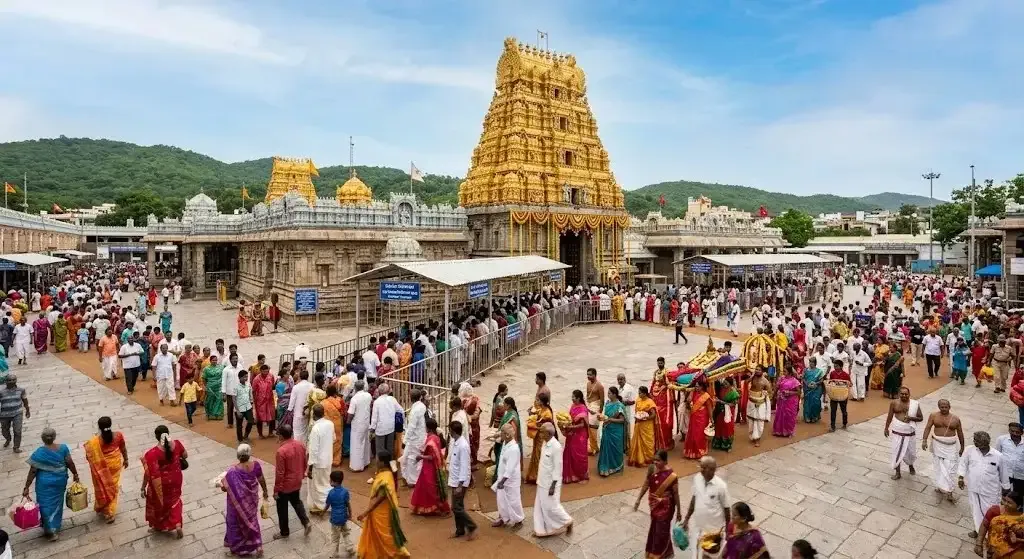
Ramanujacharya — Life, Teachings & Relevance in 2026: The Saint Who Opened Sri Vaishnavism to Every Hindu
Ramanujacharya — life of the 11th-century saint who systematised Vishishtadvaita Vedanta, opened temple worship to all castes, and revived Sri Vaishnavism.
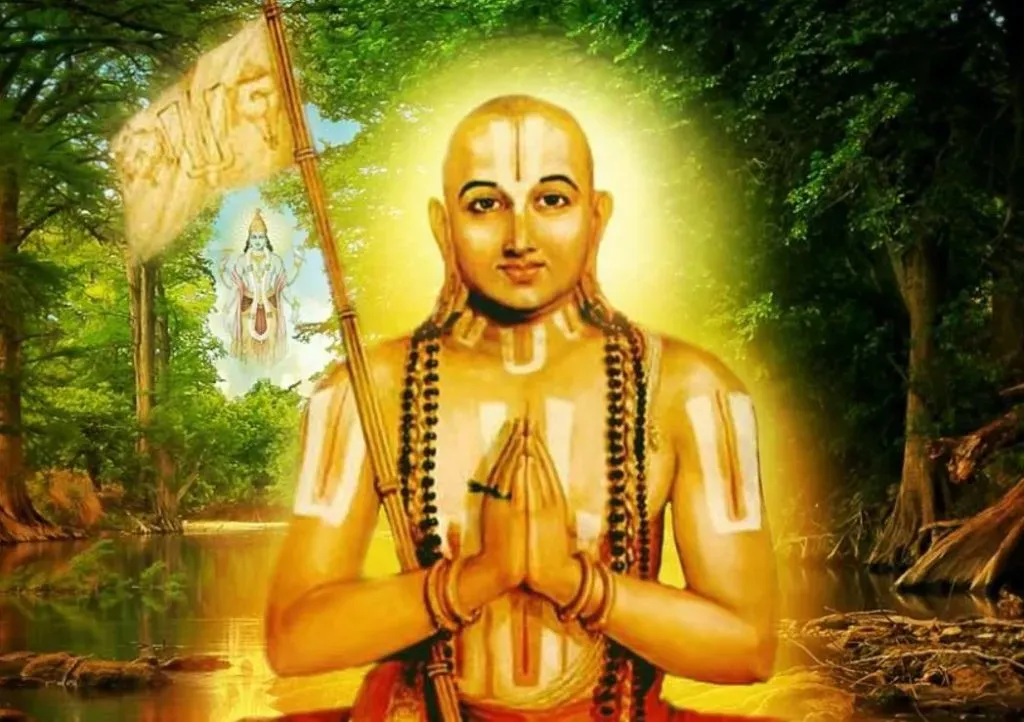
Ramanujacharya — life of the 11th-century saint who systematised Vishishtadvaita Vedanta, opened temple worship to all castes, and revived Sri Vaishnavism.
Quick Answer: Sri Ramanujacharya (1017-1137 CE), commonly known as Ramanuja, was the 11th-12th century South Indian acharya who systematised Vishishtadvaita Vedanta (qualified non-dualism), revitalised Sri Vaishnavism, wrote the foundational Sri Bhashya commentary on the Brahma Sutras, and famously opened the secret Tirumantra to all castes. Living 120 years, he travelled across India debating, teaching, and establishing temple-based devotional networks. The recently consecrated 216-foot Statue of Equality in Hyderabad (2022) memorialises his legacy as Hinduism's foundational advocate for spiritual access regardless of birth.
For NRI Hindus in 2026 — navigating debates about caste, access, women's roles, and the question of who is "qualified" to engage Hindu tradition — Ramanuja's life is the foundational rejoinder. His radicalism was not modernist; it was scripturally grounded. His doctrine that every soul is equally a participant in Vishnu's family remains the most authoritative Hindu doctrine of universal dignity.
1. Early Life — Yajamoorthy of Sriperumbudur
Ramanuja was born in 1017 CE in Sriperumbudur, Tamil Nadu (near present-day Chennai), to Asuri Kesava Somayaji and Kantimati. The child was named Lakshmana at birth but came to be called Ilaiya Perumal (the young Lord) and later, in his monastic life, Ramanujacharya.
His birth fell during a Chaitra Punarvasu Nakshatra — the same nakshatra as Lord Rama. Tradition holds this not as coincidence but as the karmic mark of his life-mission.
Ramanuja's youth was marked by extraordinary intellectual gifts combined with deep devotion. At a young age, he was sent to Kanchipuram to study under Yadavaprakasha, a renowned Advaita Vedanta teacher. The teacher-student relationship soon fractured — Ramanuja's pre-existing Vaishnava orientation could not accept Advaita's identification of jiva (individual soul) with Brahman as ultimately identical without distinction.
2. The Five Gurus and the Great Initiations
Ramanuja's spiritual formation involved five major teachers:
- Yadavaprakasha — his initial Advaita teacher in Kanchipuram (eventually abandoned)
- Periya Nambi — initiation into Sri Vaishnava sampradaya at Srirangam
- Tirukotyur Nambi — granted Ramanuja the supreme Tirumantra (Om Namo Narayanaya) and the Charama Shloka (Bhagavad Gita 18.66 — sarva-dharman parityajya)
- Tiruvarangaperumal Araiyar — refined his understanding of Nalayira Divya Prabandham (the 4,000 Tamil hymns)
- Tirumalai Nambi — taught him Ramayana esoteric meanings
The most famous initiation was with Tirukotyur Nambi. The acharya, before granting the Tirumantra, made Ramanuja take a vow of secrecy under threat of going to hell. Ramanuja accepted. Tirukotyur Nambi then whispered the supreme mantra in his ear and dismissed him.
What Ramanuja did next changed the history of Hinduism.
3. The Radical Act — Sharing the Tirumantra Publicly
After receiving the secret Tirumantra under solemn vow, Ramanuja climbed the temple tower (gopuram) of the local Vishnu temple and, before a crowd of waiting devotees, shouted the secret mantra at the top of his voice.
His teacher, Tirukotyur Nambi, rushed up. "What have you done? You are now bound for hell."
Ramanuja's reply, recorded in the tradition: "If even one soul is liberated by this mantra, my going to hell is a small price. If every devotee can chant Om Namo Narayanaya, why should it be hoarded by a few?"
Tirukotyur Nambi, understanding the magnitude of what his disciple had grasped, embraced him: "Ramanuja, this is why I chose you. The mantra was always meant for all. The vow was a test of your dharma, and you have passed it greater than I could have imagined."
This single act made Ramanuja's reputation. The Tirumantra — Om Namo Narayanaya — became, from that day forward, the universal Sri Vaishnava mantra accessible to every devotee regardless of caste, gender, or social standing. The Sri Vaishnava tradition retains this universal-access principle to the present day.
4. Vishishtadvaita Vedanta Explained
Ramanuja's philosophical contribution was the systematisation of Vishishtadvaita — "qualified non-dualism."
The position in summary:
- Reality is ultimately One (Brahman) — but with internal differentiation
- Brahman is identified with Vishnu (Sriman Narayana) — personal Supreme Lord
- The universe consists of three categories: Ishvara (the Supreme), chit (conscious souls), achit (insentient matter)
- Conscious souls (jivas) are eternal, distinct, yet inseparable parts of Brahman — like cells of a body or attributes of a person
- Liberation (moksha) is not absorption into impersonal Brahman (as Advaita teaches) but eternal blissful service to Vishnu in His personal form
Where it differs from Advaita (Shankara):
- Advaita: jiva = Brahman, ultimately; difference is illusion (maya)
- Vishishtadvaita: jiva is part of Brahman, eternally distinct yet inseparable; difference is real
Where it differs from Dvaita (Madhva):
- Dvaita: jiva and Brahman are eternally separate, even in liberation
- Vishishtadvaita: jiva is eternally part of Brahman's body, never separate but also never identical
The Vishishtadvaita view enables bhakti (devotion) as the highest path — because the personal relationship between devotee and Lord remains real even in liberation.
5. The Sri Bhashya and Other Works
Ramanuja's literary output includes:
- Sri Bhashya — his magnum opus, the Vishishtadvaita commentary on Badarayana's Brahma Sutras. Considered one of the three foundational commentaries of Vedanta alongside Shankara's and Madhva's.
- Gita Bhashya — commentary on the Bhagavad Gita
- Vedartha Sangraha — concise summary of Vishishtadvaita position
- Vedanta Sara — essence of Vedanta
- Vedanta Dipa — light of Vedanta
- Three stotras — Sharanagati Gadya, Sriranga Gadya, Vaikuntha Gadya — devotional surrender poems
These works together establish Sri Vaishnavism as a rigorously articulated philosophical system, not merely a devotional movement.
6. Travels and Temple Reforms
After his Srirangam initiation period, Ramanuja undertook extensive travels across India:
- Tirupati / Tirumala — established temple administration reforms (some of which persist)
- Melukote, Karnataka — established a major Sri Vaishnava centre during exile from Tamil country
- Northern Indian tirthas — visits to Varanasi, Mathura, Vrindavan, Puri
- Gujarat and Rajasthan — debates with various non-Vaishnava traditions
His temple reforms included:
- Standardising worship procedures (Pancharatra agama)
- Establishing the Acharya Purusha tradition (lineage of temple acharyas)
- Opening temple worship roles to non-Brahmin communities (within scriptural limits)
- Codifying the Bhattar lineage of Srirangam priests
7. The Srirangam Years and Final Disappearance
Ramanuja's primary base for the last decades of his life was the Sri Ranganatha Swamy Temple at Srirangam, Tamil Nadu — the largest functioning Hindu temple complex in the world. He systematised the temple's administration, established the daily worship protocols still followed, and built the Sri Vaishnava community network.
In 1137 CE, at the age of 120, Ramanuja entered samadhi at Srirangam. His mortal form is preserved — not as relics but as a living deity — in the form of his statue in the Ramanuja shrine at Srirangam. According to tradition, the statue was made during his lifetime and consecrated with his own breath at his request.
To this day, Srirangam's Ramanuja shrine receives the daily offerings due to a living acharya — including food, milk, and devotional service.
8. The Statue of Equality (2022) and Modern Memorialisation
In February 2022, the 216-foot Statue of Equality was consecrated in Hyderabad, Telangana, by Chinna Jeeyar Swamy — a major modern Sri Vaishnava acharya. The statue depicts Ramanuja in a teaching pose and stands as a monumental tribute to his teaching of universal spiritual access.
Surrounding the statue is a complex of 108 Divya Desam shrines (replicas of the 108 sacred Vishnu temples celebrated in the Nalayira Divya Prabandham). The site has become a major pilgrimage destination since opening.
For modern Hindu Americans, the Statue of Equality represents a crucial reframing: Hinduism's foundational saint of equal access is celebrated at monumental scale by 21st-century Indian society. The dialogue with caste, modernity, and inclusion finds its scriptural anchor in Ramanuja.
9. Lessons for NRI Hindus in 2026
Lesson 1: Equal access is foundational, not progressive
Ramanuja's opening of the Tirumantra to all was not a 21st-century reform — it was an 11th-century act grounded in scripture. NRIs explaining Hindu universalism to Western audiences can ground the conversation in Ramanuja's example.
Lesson 2: Tradition can be radical
The most authoritative defender of tradition can also be its most radical transformer. Ramanuja did not break with tradition; he revealed tradition's deeper meaning. Modern Hindus who want to engage tradition meaningfully can follow this model: depth, not departure.
Lesson 3: Bhakti and intellectual rigor are not opposed
The Sri Bhashya is among the most intellectually demanding texts in the Hindu canon. Ramanuja was simultaneously the foremost devotional saint and the foremost philosopher of his tradition. The modern NRI engineer or scientist need not choose between intellectual life and devotional life — Ramanuja's example shows the integration.
Lesson 4: Service to the community is the highest devotion
Ramanuja's life was not principally personal samadhi — it was institutional building, temple reform, and community service. The NRI Hindu's most meaningful contribution often lies in supporting institutions, building local Vedanta groups, contributing to temples.
Lesson 5: Vishishtadvaita as a bridge for Western audiences
For Western friends struggling with Advaita's seeming dissolution of the individual self, Vishishtadvaita's "eternal distinct soul in Vishnu's family" framework is often more accessible. NRIs explaining Hindu philosophy can deploy this depending on audience.
Lesson 6: Acharya tradition as a model of spiritual mentorship
Ramanuja's lineage continues through unbroken acharya succession to the present day. The acharya-shishya model — long-term spiritual mentorship — is the missing element in many NRI spiritual lives. Local Vedanta centres in major US, UK, Canadian, Australian cities offer this connection.
10. FAQs
Q: When is Ramanuja Jayanti?
A: Chaitra Punarvasu Nakshatra — typically April-May in the Gregorian calendar. In 2026: Wednesday, April 22 (Chaitra Shukla Punarvasu).
Q: What is the difference between Ramanuja and Madhvacharya?
A: Both are Vaishnava acharyas. Ramanuja established Vishishtadvaita (qualified non-dualism — souls eternally distinct yet part of Brahman). Madhva established Dvaita (eternal dualism — souls and Brahman permanently separate even in liberation).
Q: Where can I learn Sri Vaishnava tradition as an NRI?
A: ISKCON has Vaishnava elements; the Ramanuja-tradition specifically is taught at JIVA centres in US, UK; the Statue of Equality complex in Hyderabad; Sri Mutts in Srirangam, Melukote, Ahobilam.
Q: Are women equally accessible to Sri Vaishnavism?
A: Yes — Ramanuja explicitly included women in spiritual access. The 12 Alvars (Tamil Vaishnava saints whose works Ramanuja systematised) include Andal, the female saint whose Tiruppavai is the central Sri Vaishnava text.
Q: Is Sri Vaishnavism only for South Indians?
A: No — although the tradition is centred in South India, it is followed globally. There are Sri Vaishnava acharyas and temples in USA, UK, Australia, Singapore, Malaysia.
Q: What's the Sri Bhashya about and is it readable?
A: The Sri Bhashya is Ramanuja's commentary on the Brahma Sutras. English translations exist (Thibaut, Vedanta Press); accessible to a serious reader with prior Vedanta background.
Q: Can the Tirumantra be chanted without formal initiation?
A: This is debated. Ramanuja's act of public proclamation suggests anyone may chant it. Traditional Sri Vaishnavism still values formal initiation (samashrayanam) for deeper progression.
Final Words
Sri Ramanujacharya stands as the supreme Hindu witness to a single proposition: that the spiritual is fundamentally democratic. Not in the modern political sense — but in the deeper sense that no soul, by virtue of birth, gender, or social position, is barred from the highest divine reality. His 120-year life translated this conviction into systematic philosophy, institutional reform, and the lived example of an acharya who climbed a temple tower to break a vow he had been asked to keep.
For the 21st-century NRI Hindu — explaining tradition to interfaith spouses, justifying Hindu inclusiveness to Western secular friends, providing children with role models — Ramanuja offers what no modern reformer can: the saint of universal access who lived a millennium before modernity demanded it.
Sharanagati gadya — the prayer of surrender at Srirangam
Bhagavate Sriman Narayanaya saranam aham prapadye
I take refuge in Lord Sriman Narayana.
Jai Sri Ramanuja! Sri Ranganatha Mahima! Om Namo Narayanaya!
HinduTone Editorial Team · Tags: Ramanujacharya, Sri Vaishnavism, Vishishtadvaita, Srirangam, Sri Bhashya, Tirumantra, Statue of Equality, NRI Saints
Frequently Asked Questions
What is Ramanujacharya?
Sri Ramanujacharya (1017-1137 CE), commonly known as Ramanuja , was the 11th-12th century South Indian acharya who systematised Vishishtadvaita Vedanta (qualified non-dualism), revitalised Sri Vaishnavism , wrote the foundational Sri Bhashya commentary on the Brahma Sutras, and famously opened the secret Tirumantra to all castes . Living 120 years, he travel
What are the key points about Ramanujacharya?
The recently consecrated 216-foot Statue of Equality in Hyderabad (2022) memorialises his legacy as Hinduism's foundational advocate for spiritual access regardless of birth. For NRI Hindus in 2026 — navigating debates about caste, access, women's roles, and the question of who is "qualified" to engage Hindu tradition — Ramanuja's life is
Why does Ramanujacharya matter in Hinduism?
It reflects core values of Sanatana Dharma and offers practical and spiritual guidance that remains relevant across generations.
How can devotees apply Ramanujacharya in daily life?
By reflecting on its teaching, incorporating the related practices or observances into daily routine, and approaching it with sincere devotion and understanding.
You might also like
Sadhguru — Life, Teachings, Isha Foundation & Relevance for NRI Hindus in 2026
Nammalwar Utsavams at Tirumala 2026: Tiruvaymozhi Recitations, Processions & Sattumora Schedule
Rudrashtakam Stotram: Tulsidas's 8-Verse Shiva Hymn — Lyrics, Meaning & Benefits