Ayyappa and Vavar Swamy – A Lesson of Hindu-Muslim Unity from Sabarimala
In the sacred hills of Sabarimala, where millions of devotees undertake their annual pilgrimage, lies one of the most profound examples of religious harmony in…
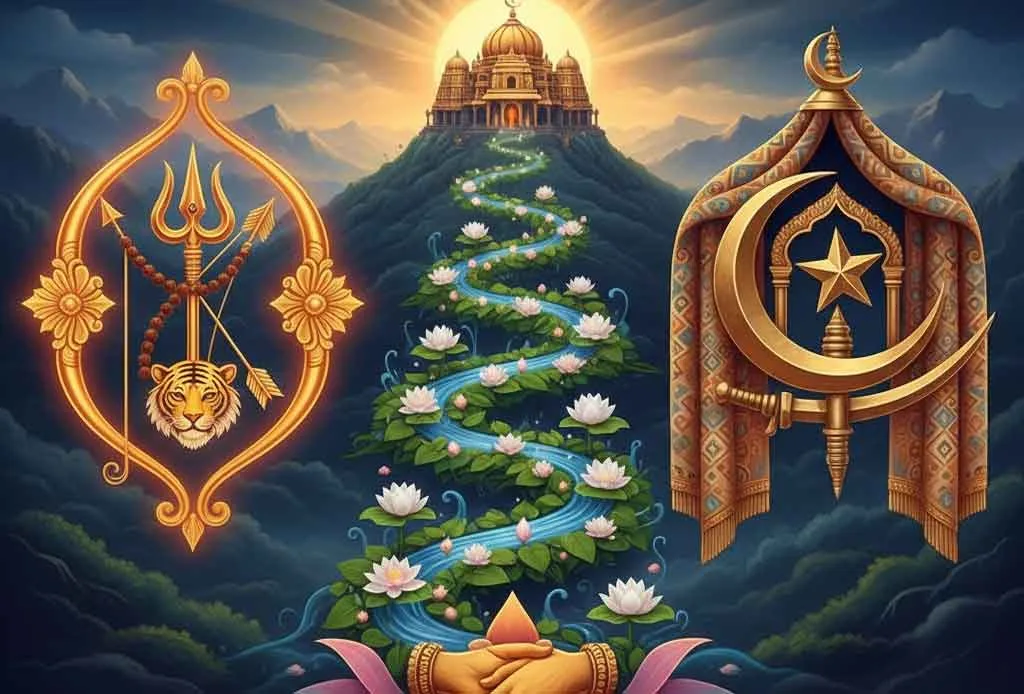
In the sacred hills of Sabarimala, where millions of devotees undertake their annual pilgrimage, lies one of the most profound examples of religious harmony in…
In the sacred hills of Sabarimala, where millions of devotees undertake their annual pilgrimage, lies one of the most profound examples of religious harmony in Indian spirituality. The divine friendship between Lord Ayyappa and Vavar Swamy stands as an eternal testament to the truth that devotion transcends the boundaries of religion, caste, and creed. This is not merely a story from the past but a living tradition that continues to inspire unity and brotherhood among people of all faiths.
The Divine Birth of Lord Ayyappa
Lord Ayyappa, also known as Manikandan or Dharma Sastha, was born from the divine union of Lord Shiva and Mohini, the enchanting female form of Lord Vishnu. This unique origin itself symbolizes unity, bringing together the energies of two supreme deities. He was born with a divine purpose: to restore dharma and protect the innocent from evil forces.
As an infant, Ayyappa was found by King Rajashekhara of Pandalam kingdom on the banks of the Pampa River. The childless king, recognizing the divine radiance of the baby, adopted him with great joy. The child wore a golden bell around his neck, earning him the name Manikandan (one with a golden bell).
Growing up in the palace, young Ayyappa displayed extraordinary wisdom, strength, and compassion. He mastered all scriptures and martial arts with remarkable ease, revealing glimpses of his divine nature to those around him.
The Queen's Treachery and Divine Mission
When the king and queen had a biological son, the queen, influenced by her minister, grew anxious about the succession. She devised a plan to send Ayyappa away on an impossible mission. Feigning illness, she claimed that only the milk of a tigress could cure her ailment.
Without hesitation, the young prince agreed to venture into the dangerous forest to fulfill this seemingly impossible task. Little did the queen know that this journey was destined by the divine forces themselves. Ayyappa's mission was not merely to procure tiger's milk but to vanquish the demoness Mahishi, who had been terrorizing the three worlds.
The Battle with Mahishi
Mahishi, the buffalo-headed demoness, had received a boon that she could only be killed by a child born of Shiva and Vishnu. Drunk with power, she had unleashed chaos across the realms, and the gods themselves were helpless against her tyranny.
In the depths of the forest, Ayyappa confronted Mahishi in an epic battle. The earth trembled, the skies darkened, and divine weapons clashed in a cosmic struggle between good and evil. With his supreme martial prowess and divine strength, Ayyappa finally vanquished the demoness, liberating the universe from her terror.
After completing his divine mission, Ayyappa returned to Pandalam not with tiger's milk, but riding on a tigress, surrounded by a pride of tigers and other wild animals bowing to him. The entire kingdom witnessed his divine glory, and the queen realized the grave mistake she had made.
The Arrival of Vavar
It was during his forest sojourns that Ayyappa encountered Vavar, a noble Muslim warrior of great valor and piety. According to tradition, Vavar was a skilled fighter who commanded respect throughout the region. Some accounts describe him as a merchant or a Sufi mystic who had traveled from distant lands.
The meeting between Ayyappa and Vavar was destined. Initially, they faced each other as opponents, testing each other's strength and skill in combat. The duel was fierce and magnificent, with both warriors displaying extraordinary prowess. However, as they fought, Vavar began to recognize the divine aura surrounding the young prince.
The Sacred Bond of Friendship
When the combat reached its peak, something extraordinary happened. Vavar, with his spiritual insight, realized that he was facing no ordinary mortal but a divine incarnation. Overwhelmed by this recognition, he laid down his weapons and surrendered not in defeat, but in devotion.
Ayyappa, recognizing the pure heart and noble spirit of Vavar, embraced him as a dear friend and spiritual companion. This moment marked the birth of one of the most beautiful friendships in Indian mythology, a bond that transcended religious identities and celebrated the universal essence of devotion.
Vavar pledged his eternal friendship and loyalty to Ayyappa. He declared that he would forever be his companion and guardian, standing by his side in spirit even after their earthly existence. This promise became the foundation of an extraordinary tradition that continues to this day.
The Promise and the Pilgrimage Tradition
Before Ayyappa ascended to his celestial abode at Sabarimala, he made a sacred promise to Vavar. He declared that every devotee who came seeking his blessings would first pay respects to Vavar. This was not merely a gesture of friendship but a profound spiritual teaching about the unity of all paths leading to the divine.
Ayyappa established that no pilgrim would be complete in their spiritual journey to Sabarimala without first visiting Vavar's shrine at Erumely. This tradition ensures that millions of devotees, regardless of their religious background, pay homage to a Muslim saint before worshipping the Hindu deity, creating a living bridge of interfaith harmony.
The friendship was so deep that it is said Vavar requested that his shrine be placed at a location where every Ayyappa devotee would have to pass and offer their respects. Thus, the Vavar mosque at Erumely became an integral part of the Sabarimala pilgrimage.
The Erumely Tradition
Erumely, located about 12 kilometers from Sabarimala, holds a special place in the hearts of Ayyappa devotees. It is here that the Vavar mosque stands, maintained with equal reverence by both Hindu and Muslim communities. Before proceeding to Sabarimala, pilgrims stop at this mosque to offer their respects to Vavar Swamy.
At Erumely, devotees perform the traditional "Petta Thullal," a dance that symbolizes the joy of Ayyappa's victory over Mahishi and celebrates his friendship with Vavar. Devotees, dressed in their black attire and carrying their irumudikettu (sacred bundle), dance with abandon, breaking down barriers of caste, creed, and social status.
The atmosphere at Erumely is electric with devotion. Hindu devotees prostrate before the mosque, Muslim caretakers welcome them with open arms, and the air resonates with chants of "Swamiye Saranam Ayyappa" alongside prayers from the Islamic tradition. This scene, repeated millions of times during the pilgrimage season, is perhaps the most beautiful demonstration of religious harmony in India.
The Spiritual Significance
The friendship between Ayyappa and Vavar carries profound spiritual symbolism:
Unity in Diversity: Their bond teaches that the divine truth is one, though sages call it by different names. Whether one follows the Hindu path or the Islamic tradition, the destination remains the same—the realization of the supreme truth.
Mutual Respect: Ayyappa and Vavar respected each other's paths while celebrating their common ground. They did not seek to convert or convince each other but honored the authenticity of each other's spiritual journey.
Brotherhood Beyond Labels: Their friendship demonstrates that true spirituality transcends religious labels, social categories, and cultural boundaries. At the highest level of consciousness, there is only love, devotion, and unity.
Humility and Surrender: Both Ayyappa and Vavar exemplified humility. Despite being powerful warriors, they recognized the divine in each other and surrendered their egos at the altar of friendship and devotion.
The Living Legacy
Today, the tradition continues with unbroken vigor. Every year, during the pilgrimage season from November to January, millions of devotees undertake the sacred journey to Sabarimala. And every single one of them stops at Erumely to pay respects to Vavar Swamy.
The Vavar mosque is maintained jointly by Hindu and Muslim communities. Muslim families have been the traditional custodians of the shrine for generations, performing this service with devotion and pride. They consider it an honor to serve the devotees of Ayyappa, viewing it as service to their own friend and companion, Vavar.
Hindu devotees approach the mosque with the same reverence they would show to any temple. They offer coconuts, garlands, and prayers, and many light candles at the shrine. The Muslims welcome them with grace and facilitate their worship, creating a space where religious boundaries dissolve in the ocean of devotion.
The Vavar Shrine at Sabarimala
Besides the main mosque at Erumely, there is also a Vavar shrine near the Sabarimala temple. Pilgrims visiting the Ayyappa temple make it a point to visit Vavar's shrine as well, acknowledging the eternal friendship between the two companions.
This shrine stands as a silent witness to centuries of communal harmony, where devotees of different faiths have come together in the spirit of love and brotherhood. It reminds us that Ayyappa and Vavar continue to reside together, watching over their devotees with compassion and grace.
Lessons for Modern Times
In an era marked by religious polarization and communal tensions, the story of Ayyappa and Vavar offers timeless wisdom:
Friendship Above Faith: True friendship and love know no religious boundaries. The bond between Ayyappa and Vavar teaches us that human connections based on mutual respect and admiration can transcend any divisive ideology.
Service Without Discrimination: The Muslim families serving at Vavar's shrine and the Hindu devotees paying respects there demonstrate how service to humanity is service to God, regardless of religious differences.
Celebrating Differences: Rather than seeing differences as threats, Ayyappa and Vavar celebrated their unique paths while recognizing their common spiritual foundation.
Leadership in Unity: Both Ayyappa and Vavar, as leaders and warriors, chose unity over division. They used their influence to build bridges rather than walls.
Shared Sacred Spaces: The tradition shows that sacred spaces can be shared with reverence and respect, creating islands of peace in troubled times.
The Pilgrimage Experience
For the modern pilgrim undertaking the Sabarimala journey, the visit to Vavar's shrine is not merely a ritual obligation but a transformative experience. As devotees stand before the mosque, something profound happens within their hearts. The act of bowing before a shrine of a different faith, while on a pilgrimage to their own deity, opens up new dimensions of understanding and compassion.
Many devotees report feeling a deep sense of peace and unity at Vavar's shrine. The experience breaks down internal barriers and prejudices, replacing them with an expansive sense of brotherhood. This is the true gift of Ayyappa and Vavar's friendship—it doesn't just teach us about unity; it makes us experience it directly.
The Eternal Companions
According to tradition, Ayyappa and Vavar remain eternal companions in the spiritual realm. They watch over their devotees together, blessing those who come with sincere hearts. Their friendship is not confined to history but continues to inspire and guide millions of people.
Devotees often say that when they visit Sabarimala with devotion, they receive the combined blessings of both Ayyappa and Vavar. This belief reinforces the idea that divine grace flows through all genuine paths of devotion, regardless of religious affiliation.
A Message of Hope
The story of Ayyappa and Vavar is more than a religious narrative; it is a message of hope for humanity. At a time when religion is often used to divide people, this tradition demonstrates that religion, at its essence, is meant to unite.
The millions of devotees who participate in this tradition every year are living proof that communal harmony is not just an idealistic dream but a practical reality. They show that when approached with the right spirit, different religious traditions can coexist not just peacefully but joyfully, enriching each other in the process.
The Swamiye Saranam Ayyappa Chant
The sacred chant "Swamiye Saranam Ayyappa" (Lord Ayyappa, I surrender unto you) is chanted by devotees throughout their journey. This chant represents complete surrender to the divine, letting go of ego, prejudices, and worldly attachments. When devotees chant this before Vavar's shrine, it takes on an even deeper meaning—it becomes a declaration that surrender to the divine transcends all human-made boundaries.
Conclusion: The Eternal Teaching
The divine friendship between Ayyappa and Vavar is a beacon of light in our times. It teaches us that:
- Divinity manifests in many forms across traditions
- True spirituality celebrates unity while respecting diversity
- Friendship and love are the highest expressions of devotion
- Religious harmony is not just possible but natural when approached with an open heart
- Service to humanity is the greatest worship
As we reflect on this beautiful story, let us remember that Ayyappa and Vavar did not just preach unity—they lived it. They didn't just talk about tolerance—they embodied love. Their friendship was not a political statement but a spiritual truth.
Every year, as millions of devotees make their way through Erumely, bowing before Vavar's shrine before proceeding to Sabarimala, they participate in a sacred ritual that is hundreds of years old. They become living links in a chain of unity that stretches back through centuries and will continue into the future.
The story of Ayyappa and Vavar reminds us that our religious identities, while important, need not divide us. Instead, they can become sources of mutual enrichment, understanding, and celebration. In the end, we are all seekers on the same path, striving toward the same divine truth that Ayyappa and Vavar embodied in their eternal friendship.
Swamiye Saranam Ayyappa! Vavar Swamy Ki Jai!
May the divine friendship of Lord Ayyappa and Vavar Swamy inspire us all to build bridges of understanding, compassion, and love across all boundaries. May their story remind us that at the heart of all religions lies the same truth—the truth of universal love and brotherhood.
Om Swamiye Saranam Ayyappa Vavar Swamy Saranam
Also read: Hinduism and Islam compared.
Frequently Asked Questions
Who is Vavar Swamy in the Ayyappa story?
As commonly told, Vavar was a noble Muslim warrior of great valor and piety whom Ayyappa met during his forest sojourns. After a fierce duel he recognized Ayyappa's divine aura, laid down his weapons and became his lifelong friend.
Why do Sabarimala pilgrims visit the Vavar mosque at Erumely?
As the tradition goes, Ayyappa promised Vavar that every devotee seeking his blessings would first pay respects to Vavar. Pilgrims therefore stop at the Vavar mosque in Erumely before proceeding to Sabarimala.
What is Petta Thullal at Erumely?
Petta Thullal is a dance performed at Erumely by devotees in black attire carrying the irumudikettu, the sacred bundle. It symbolizes the joy of Ayyappa's victory over Mahishi and celebrates his friendship with Vavar.
Is there a Vavar shrine at Sabarimala itself?
Yes. Besides the mosque at Erumely, a Vavar shrine stands near the Sabarimala temple, and pilgrims make it a point to visit it as well, acknowledging the friendship of the two companions.
Who looks after the Vavar mosque at Erumely?
The mosque is maintained jointly by Hindu and Muslim communities. Muslim families have been its traditional custodians for generations, and devotees offer coconuts, garlands and prayers there.
When do pilgrims visit Erumely and Sabarimala?
The pilgrimage season runs from November to January, when millions of devotees travel to Sabarimala. Erumely is about 12 kilometers from Sabarimala and is the stop before the journey continues.