Sabarimala Mandala Pooja 2026: Expected Date (27 December), Meaning of the 41-Day Mandalam, Thanka Anki and How to Observe It Abroad
Mandala Pooja 2026 at Sabarimala is expected on Sunday 27 December 2026, the 41st day of the Mandala season (confirm with the Travancore Devaswom Board). What Mandalam means, why the vratham lasts 41 days, the Thanka Anki tradition, and how devotees at home and abroad mark the day.
Mandala Pooja 2026 at Sabarimala is expected on Sunday 27 December 2026, the 41st day of the Mandala season (confirm with the Travancore Devaswom Board). What Mandalam means, why the vratham lasts 41 days, the Thanka Anki tradition, and how devotees at home and abroad mark the day.
Quick answer: Sabarimala Mandala Pooja 2026 is expected on Sunday 27 December 2026, the 41st day of the Mandala season, which is expected to begin on Tuesday 17 November 2026 (Vrischikam 1). These dates are worked out from the Malayalam solar calendar; the Travancore Devaswom Board (TDB) had not published official 2026-27 dates when we wrote this, so please confirm with the Travancore Devaswom Board before you book anything. Virtual-Q online booking is mandatory for all pilgrims, according to the TDB.
For lakhs of Ayyappa devotees, Mandala Pooja is the day the long Mandalam reaches its fullness. Forty-one days of black or blue clothing, cold baths, simple food, celibacy and the constant chant of Swamiye Saranam Ayyappa come to a point on this single day at the hill shrine. Whether you are climbing the Pathinettam Padi this year or keeping the vratham in an apartment in New Jersey, Dubai or Melbourne, this guide explains the expected date, what Mandala Pooja means, the Thanka Anki tradition, and how to honour the day wherever you are.
For the full picture of the season, from Mala Dharana to the closing of the temple, see our Sabarimala 2026-27 season guide.
Sabarimala Mandala Pooja 2026: expected dates at a glance
Every date below is expected, based on the Malayalam solar calendar (Kollavarsham 1202) and HinduTone's own calculation. TDB notifications refer to the Kollavarsham 1202 Mandala-Makaravilakku festival, but official dates for 2026-27 were not yet published as of 7 October 2026. Please confirm every date with the Travancore Devaswom Board.
| Event | Expected date (confirm with TDB) |
|---|---|
| Temple opens for the Mandalam | Evening of Monday 16 November 2026 |
| Mandala season begins (Vrischikam 1) | Tuesday 17 November 2026 |
| Mandala Pooja (41st day) | Sunday 27 December 2026 |
| Temple reopens for Makaravilakku | Wednesday 30 December 2026 |
| Makaravilakku | Thursday 14 January 2027 |
| Season closes | Around Wednesday 20 January 2027 |
We deliberately do not list pooja clock times, fees or crowd estimates. These are set and announced by the TDB, and they change. Use the official Sabarimala site for anything operational.
What does 'Mandalam' mean?
In the Sabarimala tradition, a mandalam is a cycle of 41 days. The word also carries the sense of a complete circle, something whole and closed. The Mandala season at Sabarimala is the 41-day period that begins on the first day of the Malayalam month of Vrischikam and ends with Mandala Pooja.
Devotees often explain the 41 days in practical spiritual terms: it is long enough for a new discipline to stop feeling like an effort and become part of who you are. Many elders say that a vratham kept for a full mandalam changes the devotee from the inside, and that the pilgrimage is the outward completion of an inner journey. This is a traditional understanding rather than a rule written in any single text, and families explain it in their own ways.
The 41-day vratham behind Mandala Pooja
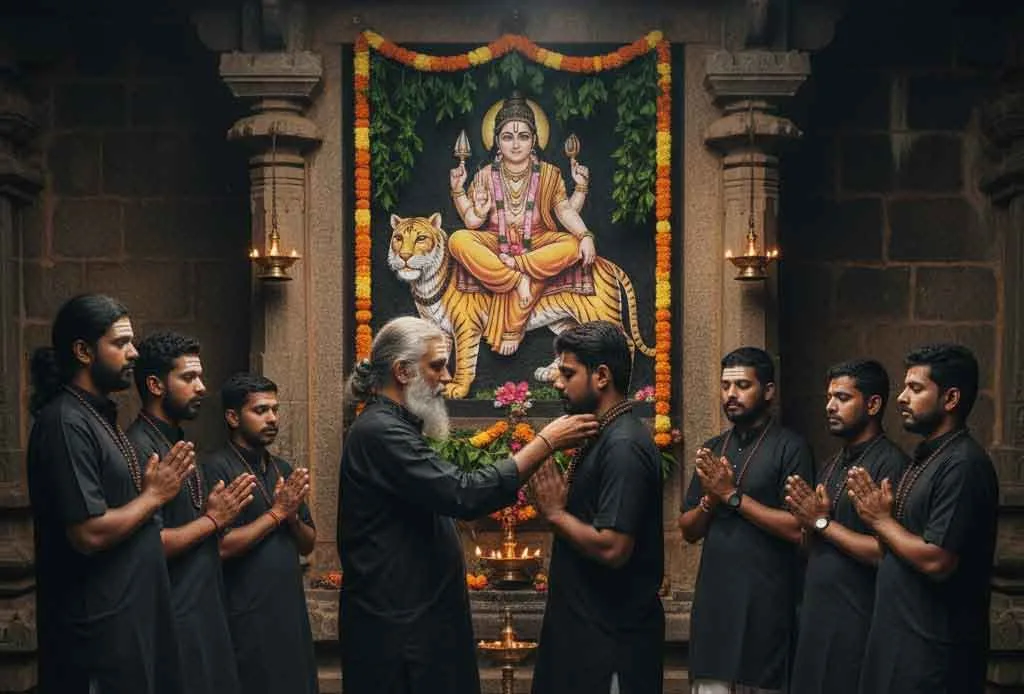
Mandala Pooja only makes full sense when you see the vratham that leads up to it. The 41-day Mandala vratham traditionally begins with Mala Dharana, when the devotee wears the Ayyappa mala under a Guru Swami or a priest. From that moment the devotee is addressed as Swami, and every other person is also seen as Swami.
As commonly practised, the vratham includes:
- Wearing the mala throughout the 41 days and dressing simply, usually in black, blue or saffron.
- Bathing before prayer, morning and evening, and keeping a daily time for Ayyappa bhajans or the sharanam chant.
- A sattvic vegetarian diet, with no alcohol, tobacco or intoxicants.
- Celibacy, gentle speech, and avoiding anger, gossip and harsh words.
- Simple living: many devotees avoid luxuries, sleep on a mat and walk barefoot where it is practical and safe.
- Treating every person met during the vratham as a form of the Lord.
Read more in our Ayyappa mala dharana guide and in the spiritual significance of wearing the Ayyappa mala.
Before setting out, the devotee's Irumudi Kettu is prepared under the Guru Swami in the Kettunirakkal ceremony. Its front pouch holds the ghee-filled coconut for Neyyabhishekam, the offering of ghee to Lord Ayyappa. By tradition, only pilgrims carrying the Irumudi climb the Pathinettam Padi, the 18 sacred steps. Our Irumudi Kettu guide, Sabarimala 18 steps guide and Neyyabhishekam explainer go deeper into each.
What happens on Mandala Pooja day
Mandala Pooja is the culminating worship of the Mandala season. By tradition the deity is decorated with special care, and the day is regarded as one of the most auspicious of the year at the shrine. For pilgrims who have kept the full 41-day vratham, offering worship on or around this day is especially meaningful, though the pilgrimage is equally valid on any day of the season.
The day carries a sense of completion. Pilgrims who have walked from Erumeli, bathed in the Pamba river and climbed the 18 steps with the Irumudi on their heads offer their ghee coconut for Neyyabhishekam, take darshan, and return home carrying prasadam for family. As at every closing of the temple, Harivarasanam is sung when the sanctum closes, the lullaby with which the Lord is put to rest.
We do not give timings for the individual poojas of the day. The TDB fixes and announces these; please check the official Sabarimala site.
Thanka Anki: the golden attire, as tradition holds
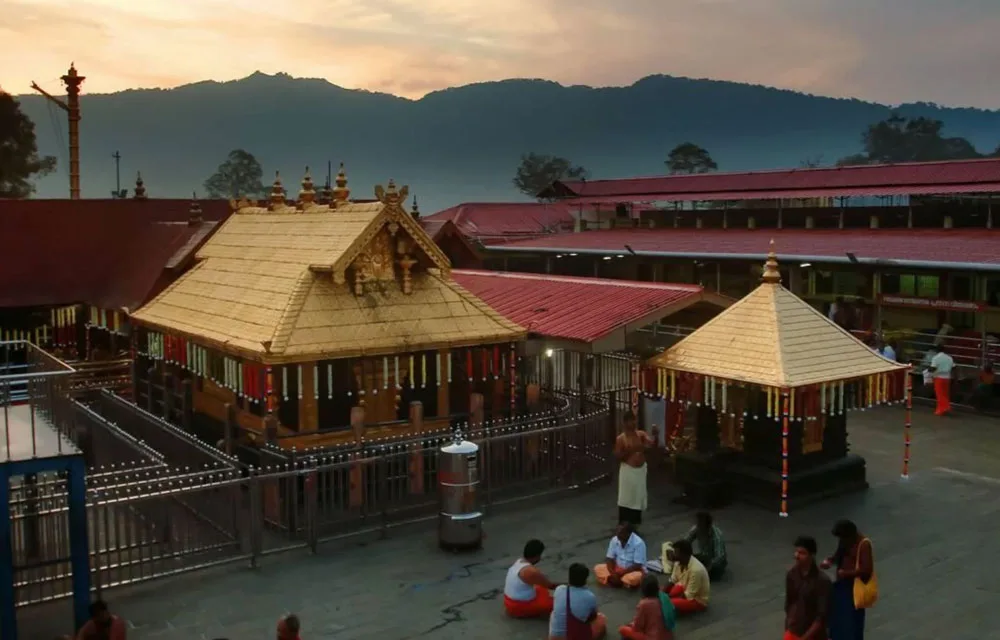
A cherished part of Mandala Pooja is the Thanka Anki, a golden attire (anki) with which Lord Ayyappa is adorned for the occasion. As commonly told, the Thanka Anki was offered to the Lord by the Travancore royal family and is kept safely away from the hill for most of the year. Ahead of Mandala Pooja it is brought to the sannidhanam in a devotional procession, received with reverence by devotees along the way, and used to adorn the deity for the Mandala Pooja worship.
Devotees often see the Thanka Anki as a sign of the Lord as a king being honoured at the close of the Mandalam, a fitting image for Ayyappa, who in the traditional story grew up as the prince of Pandalam. We have not given procession routes or timings here, because these are arranged and announced each year by the authorities. If you hope to see the procession, follow official TDB announcements.
The Thanka Anki for Mandala Pooja should not be confused with the Thiruvabharanam, the sacred ornaments brought from Pandalam in procession for Makaravilakku in January. Read about that tradition in our Thiruvabharanam procession guide.
After Mandala Pooja: the road to Makaravilakku
By the usual pattern, the temple closes after Mandala Pooja for a short break and then reopens for the Makaravilakku festival. For 2026-27 the reopening is expected on Wednesday 30 December 2026, with Makaravilakku 2027 expected on Thursday 14 January 2027, Makara Sankranti. The season is expected to close around Wednesday 20 January 2027. All of these are expected dates; please confirm with the TDB.
Some devotees keep their vratham through Mandala Pooja; others continue it, or begin later, so that their pilgrimage falls in the Makaravilakku period. Your Guru Swami will guide you on what is right for your group. If you are curious about the evening light that so many pilgrims hope to see in January, read Makara Jyothi 2027: meaning.
First time at Sabarimala? A note for Kanni Ayyappans
If this is your first pilgrimage, you are a Kanni Ayyappan or Kanni Swami. First-time pilgrims traditionally rely closely on their Guru Swami for every step, from Mala Dharana and Kettunirakkal to the Erumeli tradition and the visit to the Vavar shrine. Many Kanni Swamis also offer prayers at the shrine of Malikappuram Devi near the sannidhanam.
Our Kanni Ayyappan and Guru Swami guide walks through what to expect, and the Malikappuram Devi guide explains her place in the story.
Observing Mandala Pooja at home or abroad
Many Ayyappa devotees in the USA, UK, Canada, the Gulf, Singapore and Australia keep the full 41-day vratham even when they cannot travel to Kerala that year. Mandala Pooja day is a natural point to mark the completion of that mandalam. A simple home observance, as many families keep it, might look like this:
- Bathe early and wear your vratham clothes and mala.
- Clean your prayer space and place a picture of Lord Ayyappa; light a lamp (an electric diya is fine in apartments and dorms).
- Offer flowers, a little fruit and, if your family does so, a small portion of ghee or payasam as naivedyam.
- Chant Swamiye Saranam Ayyappa 108 times, or recite the Ayyappa 108 names together as a family.
- Sing or play Harivarasanam in the evening to close the day's worship.
- Do an act of seva: feed someone, help at your local temple, or donate food to a shelter in your city.
Many Ayyappa temples outside India hold special bhajans and poojas through the Mandala season. Check your local temple's own announcements. Our guides to keeping Ayyappa deeksha in the USA and UK and Ayyappa temples in the USA may help.
If you are flying in from the USA or the Gulf for the pilgrimage, plan around the expected dates but keep flexibility, since the TDB's official calendar may differ. Book Virtual-Q only through the official channel, and allow for jet lag before the climb. Talk to your Guru Swami about whether to begin the vratham abroad and complete it in Kerala; many NRIs do exactly that.
Frequently asked questions
Sabarimala Mandala Pooja 2026 date?
Mandala Pooja 2026 is expected on Sunday 27 December 2026, the 41st day of the Mandala season that is expected to begin on Tuesday 17 November 2026 (Vrischikam 1). The Travancore Devaswom Board (TDB) had not published official 2026-27 dates when this guide was written, so please confirm with the TDB before you plan travel.
When does the Sabarimala Mandala season start in 2026?
The temple is expected to open for the Mandalam on the evening of Monday 16 November 2026, with the Mandala season expected to begin on Tuesday 17 November 2026, the first day of the Malayalam month of Vrischikam. These are expected dates; confirm with the Travancore Devaswom Board.
What is Mandala Pooja at Sabarimala?
Mandala Pooja is the culminating worship of the 41-day Mandala season at the Sabarimala Ayyappa temple. By tradition, Lord Ayyappa is adorned with the Thanka Anki, a golden attire, for the occasion. For devotees it marks the completion of a full mandalam of vratham, prayer and discipline.
Why is the Ayyappa vratham 41 days?
A mandalam is traditionally understood as a 41-day cycle, a period long enough for a discipline to settle into body and mind. Ayyappa devotees keep the vratham for this full cycle after Mala Dharana under a Guru Swami, living simply, praying daily and treating every person as Swami.
Is Sabarimala open after Mandala Pooja?
By the usual pattern the temple closes after Mandala Pooja and reopens a few days later for the Makaravilakku festival. For 2026-27 the reopening is expected on Wednesday 30 December 2026, with Makaravilakku expected on Thursday 14 January 2027. Confirm both with the TDB.
Do I need Virtual-Q booking for Mandala Pooja?
Yes. The Travancore Devaswom Board's official site states that online booking of Virtual-Q is mandatory for all pilgrims visiting Sabarimala. Book through the official channel only and check the TDB site for the current process before you travel.
Sources and verification
Dates in this guide are expected dates calculated by HinduTone from the Malayalam solar calendar for Kollavarsham 1202; they match our Sabarimala 2026-27 season guide. The Travancore Devaswom Board (TDB) and the official Sabarimala website are the only authorities for the temple's calendar, pooja schedule and Virtual-Q booking. As of 7 October 2026 the TDB homepage stated that online booking of Virtual-Q is mandatory for all pilgrims visiting Sabarimala. Please confirm dates and Virtual-Q with the TDB before travel.
Editor's note (7 October 2026)
This guide was written on 7 October 2026, before the Travancore Devaswom Board published official dates for the 2026-27 Mandala-Makaravilakku season, and the official Sabarimala site was temporarily unavailable when we checked. All dates are expected and should be confirmed with the TDB. Traditions are described as they are commonly told; customs vary between families, regions and Guru Swamis, so follow your own Guru Swami's guidance. We will update this page once official dates are announced.
Related guides
You might also like
Makaravilakku 2027 at Sabarimala: Expected Date (14 January), Thiruvabharanam, Makara Sankranti and How NRIs Observe It
Neyyabhishekam at Sabarimala: Meaning of the Ghee Coconut and How the Ritual Is Done
Sabarimala 18 Steps (Pathinettam Padi): Meaning, the Irumudi Rule and Padi Pooja