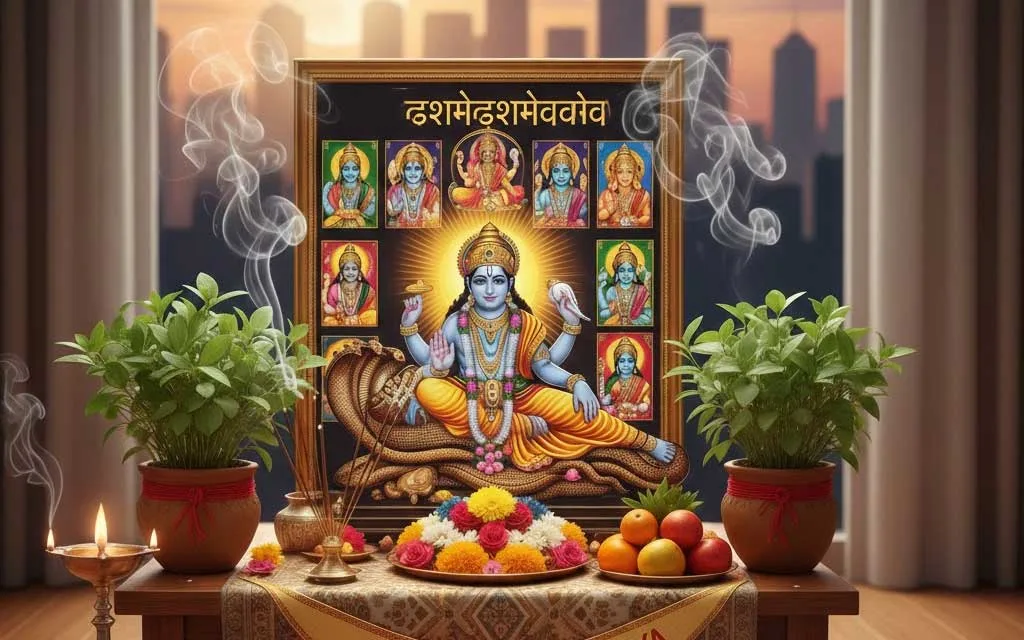
The Devotion of Prahlad: A Tale of Faith and Divine Protection
Welcome to www.hindutone.com, where we dive into the timeless treasures of Sanatana Dharma.
Welcome to www.hindutone.com, where we dive into the timeless treasures of Sanatana Dharma.
Welcome to www.hindutone.com, where we dive into the timeless treasures of Sanatana Dharma. Today, we share the divine story of Prahlad, a young devotee whose unwavering faith in Lord Vishnu triumphed over unimaginable trials, reminding us that true devotion invites the eternal presence of the Divine.
The Spark of Devotion
In an ancient kingdom, ruled by the mighty demon king Hiranyakashipu, a child named Prahlad was born. Hiranyakashipu, blessed with a boon that made him nearly invincible, declared himself the supreme god, demanding worship from all. Yet, Prahlad’s heart belonged solely to Lord Vishnu, the Cosmic Preserver. From a tender age, Prahlad chanted “Om Namo Narayanaya,” his soul alight with love for the Lord, undeterred by his father’s tyranny.
Hiranyakashipu’s rage grew as Prahlad refused to worship him. “Where is your Vishnu?” he thundered. Prahlad, with serene conviction, replied, “My Lord is everywhere—in the sky, the earth, and every heart.” This unshakable faith infuriated the king, who devised cruel punishments to break his son’s devotion.
Trials of Faith
Hiranyakashipu ordered Prahlad to be trampled by elephants, but the beasts bowed before the boy, sensing the divine aura around him. He was cast into a pit of venomous snakes, yet they coiled harmlessly at his feet, enchanted by his chants. Enraged, Hiranyakashipu commanded his sister Holika, who was immune to fire, to sit with Prahlad in a blazing pyre. As flames roared, Prahlad meditated on Vishnu, and a miracle unfolded: Holika was consumed by the fire, while Prahlad emerged unscathed, protected by the Lord’s grace.
Each trial only deepened Prahlad’s faith. His serene smile and ceaseless prayers baffled the king, who mocked, “If your Vishnu is everywhere, why don’t I see Him in this pillar?” Prahlad replied, “He is in every atom, even in that pillar.”
The Divine Intervention
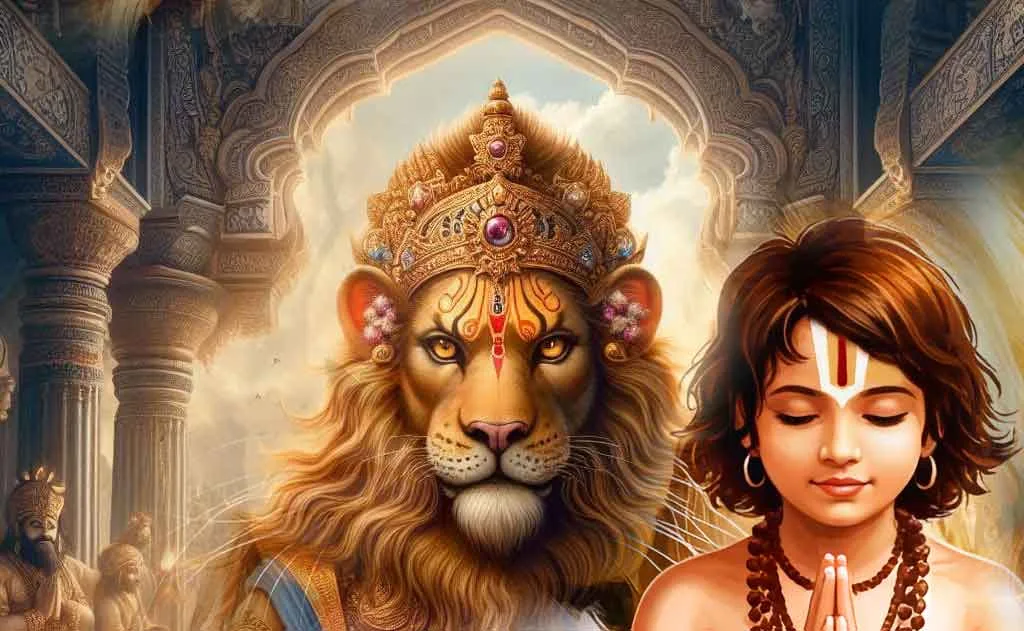
Hiranyakashipu, in a fit of fury, struck the pillar with his mace. A deafening roar filled the air as the pillar split, and Lord Vishnu emerged in the fierce form of Narasimha—half-man, half-lion. Neither man nor beast, appearing at twilight, Narasimha fulfilled the boon’s conditions, defeating Hiranyakashipu with divine might. As the demon king fell, peace returned, and Prahlad bowed before Narasimha, tears of devotion streaming down his face. The Lord blessed him, saying, “Your faith has moved the cosmos, Prahlad. You are forever under my protection.”
Timeless Lessons from Prahlad’s Devotion
Prahlad’s story, rooted in the Bhagavata Purana, teaches us the power of bhakti (devotion). His life reminds us:
- Faith Over Fear: Prahlad faced unimaginable trials, yet his trust in Vishnu never wavered. In our struggles, chanting the Lord’s name can anchor us.
- Divine Presence Everywhere: Like Prahlad, we can find God in every moment, every place, if we open our hearts.
- Surrender Brings Grace: Prahlad’s complete surrender invited Vishnu’s protection, showing that true devotion transforms lives.
Connect with Sanatana Dharma
At www.hindutone.com, we invite you to immerse yourself in the divine flow of Hindu traditions. Chant “Om Namo Narayanaya,” visit sacred temples like Tirumala, or share Prahlad’s story with loved ones to inspire faith. Join our community to explore more sacred tales, rituals, and spiritual insights that uplift the soul.
May Lord Vishnu’s grace guide you toward peace and purpose. Share your thoughts in the comments or explore more at www.hindutone.com.
The Scriptural Sources Behind the Story of Prahlad
The narrative of Prahlad is not a folk legend but a firmly embedded scriptural account found in the Bhagavata Purana, specifically in the Seventh Skanda (Saptama Skandha), which dedicates several chapters to his life, his teachings to other children in Hiranyakashipu's court, and the appearance of Narasimha. The Vishnu Purana also contains a detailed account, portraying Prahlad not merely as a passive sufferer but as an active teacher of Bhakti even while still a child enrolled in the gurukula of the asura preceptors Shanda and Amarka.
In the Bhagavata Purana (7.4–7.9), Prahlad enumerates nine forms of devotion — Navavidha Bhakti — that remain the foundational taxonomy of Vaishnava spiritual practice to this day. These nine forms are: Shravana (hearing the Lord's glories), Kirtana (singing His names), Smarana (remembering Him), Pada-sevana (serving His feet), Archana (ritual worship), Vandana (obeisance), Dasya (servitude), Sakhya (friendship), and Atma-nivedana (complete self-surrender). Prahlad himself exemplified every single one even under conditions of mortal danger.
Who Was Hiranyakashipu and Why Did He Hate Vishnu
Hiranyakashipu's hatred of Vishnu was deeply personal. According to the Bhagavata Purana, his twin brother Hiranyaksha had been slain by Lord Vishnu in the Varaha (divine boar) avatara. This loss transformed grief into a consuming obsession: Hiranyakashipu performed severe tapasya directed at Lord Brahma and obtained the celebrated Panchabhuta boon — that he could not be killed by man or beast, inside or outside, by day or by night, on earth or in the sky, nor by any weapon that was living or non-living.
Armed with this boon, he conquered the three worlds (triloka) and outlawed the worship of any deity other than himself. This is why Prahlad's devotion to Vishnu was not merely a domestic disagreement but a direct political and theological challenge to the entire order Hiranyakashipu had established. The Bhagavata Purana frames this as the cosmic tension between asuric ego (ahamkara) and divine surrender (sharanagati), with a child becoming the instrument through which the universe is rebalanced.
Narasimha: The Avatar Designed to Answer Every Clause of the Boon
The appearance of Lord Narasimha — the half-man, half-lion fourth avatara of Vishnu — is understood in Hindu theology as a direct, precise response to every condition of Hiranyakashipu's boon. The Lord appeared at twilight (neither day nor night), on the threshold of a courtyard (neither inside nor outside), placed the demon across his lap (neither on earth nor in the sky), and tore him apart with his claws (neither a living weapon nor a non-living one). The Bhagavata Purana (7.8.19–33) describes this event in vivid detail, emphasising that the Lord's intelligence encompasses and transcends every loophole a mortal mind can conceive.
The specific pillar from which Narasimha emerged carries enormous theological significance. Prahlad's declaration that Vishnu is present in every atom — sarvatra samam brahma — is vindicated at that precise moment. The Sanskrit phrase used in the Purana, 'स्तम्भे साधारणे' (in an ordinary pillar), underscores that the Divine requires no consecrated space; the Lord is equally present in a palace column and in the heart of a devotee. This teaching is central to the non-dual (advaita-influenced) reading of Bhakti that later saints such as Ramanuja and Madhvacharya each interpreted within their own philosophical frameworks.
The Holika Episode and Its Connection to the Festival of Holi
The burning of Holika is commemorated every year on the full moon night of the month of Phalguna (February–March) in the festival known as Holika Dahan, the night preceding the colour festival of Holi. Communities across India light a bonfire that symbolises the destruction of Holika and, by extension, the victory of devotion over demonic arrogance. The ritual is observed from Mathura and Vrindavana in Uttar Pradesh to Dwarka in Gujarat and well beyond, though regional customs vary.
The Holika episode carries a specific moral teaching: a boon obtained through piety can be lost when that same piety is deployed to harm the innocent. Holika possessed a divine shawl (vastra) that protected her from fire, but according to the Narada Purana, the shawl flew off and wrapped itself around Prahlad because divine grace cannot be wielded as a weapon against a pure devotee. This principle — that spiritual power earned through tapasya remains conditional on righteous use — appears repeatedly in both the Ramayana and the Mahabharata as a recurring ethical boundary.
Living Temples That Keep Prahlad's Memory Alive
The town of Multan, in present-day Pakistan, was historically known as Prahlad-puri and was believed by tradition to be the site of Hiranyakashipu's capital. A Narasimha temple stood there for centuries before its destruction in the medieval period. In India, the Ahobilam temple complex in the Nandyal district of Andhra Pradesh is among the most sacred sites associated with the Narasimha avatara: it comprises nine shrines (Nava Narasimha Kshetram) spread across upper and lower Ahobilam, and devotees believe this is the very forest hill where Narasimha appeared.
In Jaipur, Rajasthan, the locality of Prahlad Ghat and a temple dedicated to Narasimha perpetuate local devotional traditions tied to the story. The Narasimha temple at Simhachalam in Visakhapatnam district, Andhra Pradesh, is another major pilgrimage centre where the deity is worshipped in a combined Varaha-Narasimha form. At all these sites, the story of Prahlad is recited during festivals, reinforcing to pilgrims that the same divine protection that shielded the child-devotee remains available to any sincere seeker.
What Prahlad's Life Teaches About the Nature of True Bhakti
Prahlad's devotion is distinguished in Vaishnava theology precisely because it was spontaneous and unconditional — it did not arise from any desire for reward, fear of punishment, or social encouragement. The Bhagavata Purana (7.9.8) records Prahlad's own words: 'naivodvije para duratyaya-vaitaranyas' — 'I do not fear this ocean of worldly suffering.' This fearlessness (abhaya) is presented as a natural fruit of total surrender (prapatti) to the Lord, not as a product of personal courage alone.
Later Bhakti poets drew deeply from this archetype. The Alvar saint Nammalvar alludes to the Narasimha episode in the Thiruvaimozhi, and the sixteenth-century poet-saint Mirabai cited her own trials — persecution by a royal household — as parallel to Prahlad's ordeal, calling Narayana her sole protector. The story thus functions not as ancient mythology frozen in a text but as a living template: a devotee surrounded by hostile forces, sustained entirely by the name of the Lord, and ultimately protected not because the world became kind, but because the Divine proved omnipresent in it.
Frequently Asked Questions
Who was Prahlad and why is he remembered?
Prahlad was the young son of the demon king Hiranyakashipu who stayed devoted to Lord Vishnu despite his father's tyranny. As commonly told, he chanted 'Om Namo Narayanaya' and survived elephants, snakes and fire through Vishnu's grace.
Where is the story of Prahlad found in scripture?
It appears in the Seventh Skanda of the Bhagavata Purana, with Narasimha's appearance described at 7.8.19-33. The Vishnu Purana also gives a detailed account, and the Narada Purana mentions Holika's shawl.
How did Narasimha defeat Hiranyakashipu despite his boon?
Hiranyakashipu could not be killed by man or beast, inside or outside, or by day or night. Narasimha, half-man and half-lion, appeared at twilight on a courtyard threshold, placed him across his lap and tore him apart with his claws.
What is the connection between Prahlad and Holi?
Holika, who was immune to fire, sat with Prahlad in a pyre, yet she was consumed while Prahlad emerged unharmed. Holika Dahan on the full moon night of Phalguna (February-March) commemorates this the night before Holi.
What are the nine forms of devotion Prahlad describes?
Navavidha Bhakti: Shravana (hearing), Kirtana (singing His names), Smarana (remembering), Pada-sevana (serving His feet), Archana (ritual worship), Vandana (obeisance), Dasya (servitude), Sakhya (friendship) and Atma-nivedana (self-surrender).
Which temples are associated with Narasimha and Prahlad's story?
Ahobilam in Nandyal district, Andhra Pradesh, has nine Narasimha shrines and is believed to be where Narasimha appeared. The Simhachalam temple in Visakhapatnam district and a Narasimha temple at Prahlad Ghat in Jaipur are also linked to the story.
You might also like
Vaishaka Masam Rituals: Complete Devotional Guide with Mythological Stories from Puranas | HinduTone
Vasudhaiva Kutumbakam: Meaning, Maha Upanishad Origin, Sanskrit Shloka & Modern Relevance for Bharat
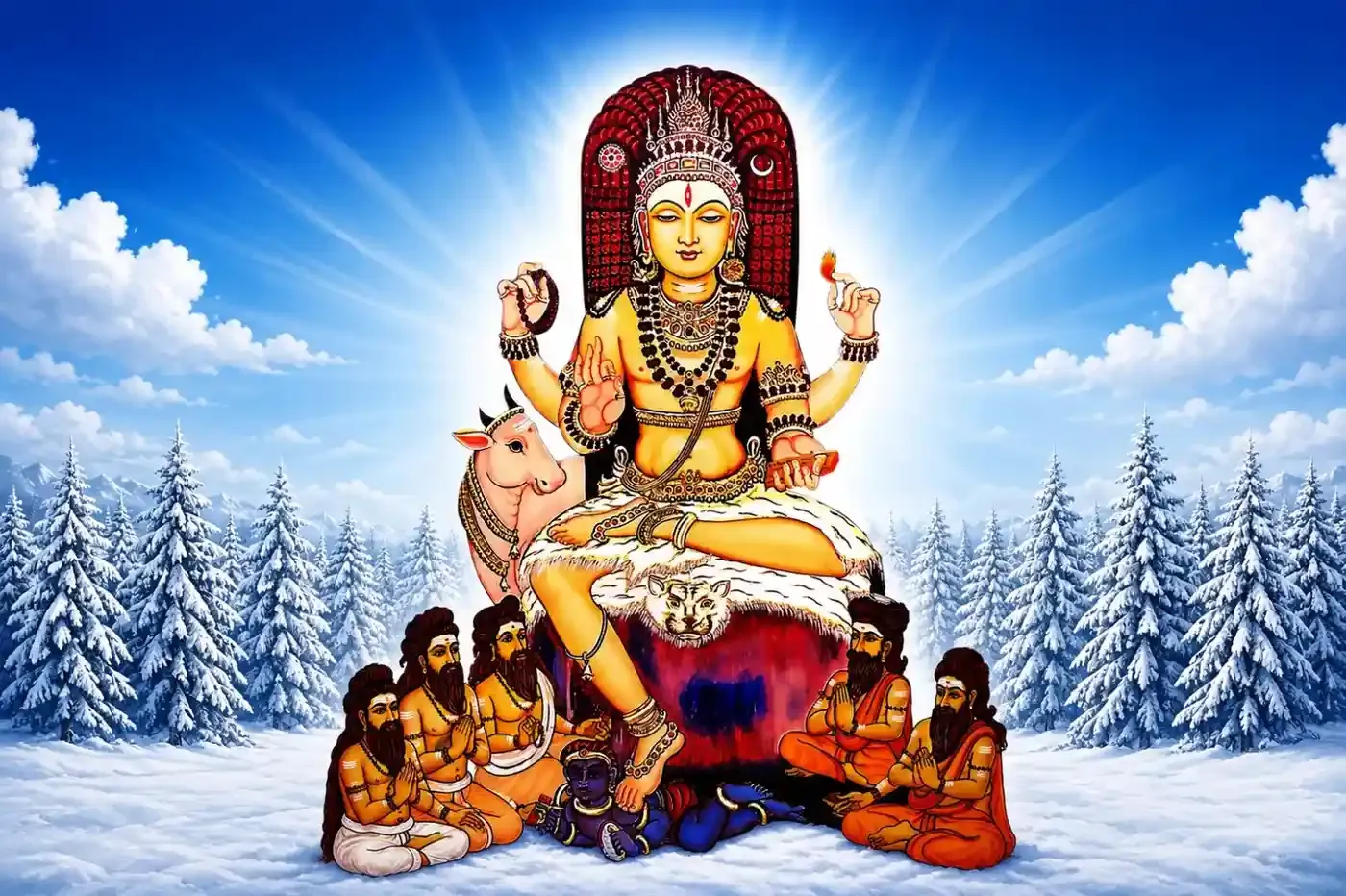
Sri Medha Dakshinamurthy Swami Dhyanam | Meditation Sloka for Intelligence, Eloquence & Self-Realization