Top 10 Hindu Mythological Stories Every Child Should Know
Hindu mythology is rich with tales that impart virtues, ethics, and life lessons.
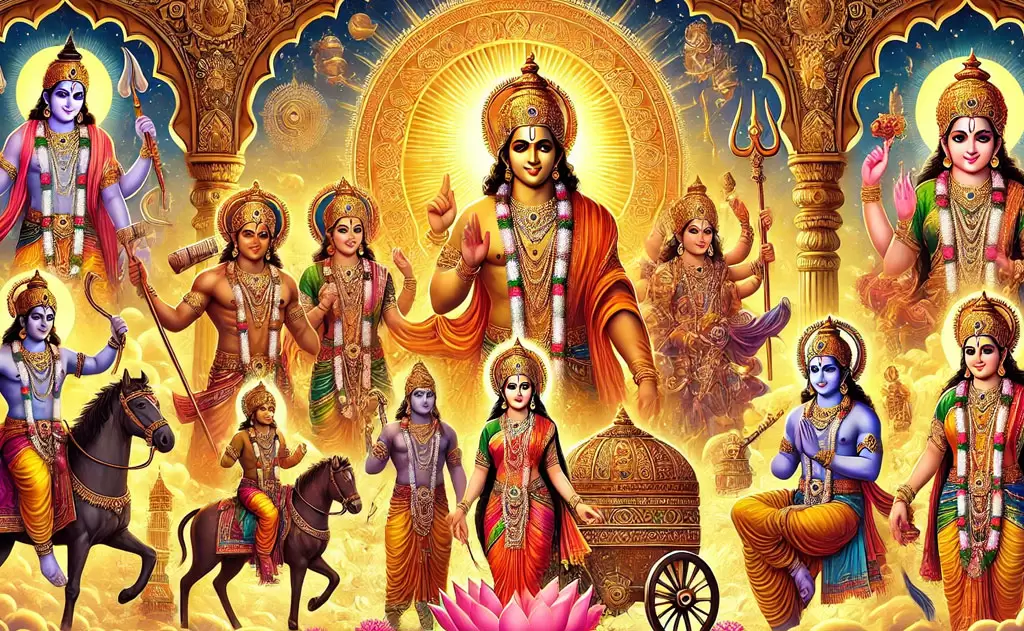
Hindu mythology is rich with tales that impart virtues, ethics, and life lessons.
Hindu mythology is rich with tales that impart virtues, ethics, and life lessons. These stories are not just entertaining but also provide moral guidance that shapes a child’s character and worldview. Below are the top 10 Hindu mythological stories every child should know, each offering valuable lessons that remain relevant across generations.
1. The Ramayana: The Story of Lord Rama
- Overview: The epic story of Lord Rama, Sita, and Lakshmana, focusing on Rama’s exile, Sita’s abduction by Ravana, and her rescue with the help of Hanuman.
- Key Lesson: Righteousness (Dharma), loyalty, truth, and duty.
2. The Mahabharata: The Epic Battle Between Good and Evil
- Overview: The battle between the Pandavas and Kauravas, guided by Lord Krishna, showcasing the consequences of greed and jealousy.
- Key Lesson: Justice, faith, standing up for righteousness, and moral responsibility.
3. Krishna Leela: Childhood Adventures of Lord Krishna
- Overview: Stories of young Krishna’s playful tricks, love for butter, and his triumph over demons.
- Key Lesson: Love, compassion, humor, and the victory of good over evil.
4. The Story of Prahlad and Hiranyakashipu
- Overview: Prahlad’s unwavering devotion to Vishnu despite his father’s cruelty. Vishnu appears as Narasimha to save him.
- Key Lesson: The power of faith and the ultimate triumph of good over evil.
5. Ganesha and the Race Around the World
- Overview: Ganesha outsmarts his brother Kartikeya by circling his parents instead of the world.
- Key Lesson: Intelligence and wisdom are more valuable than brute strength.
6. The Churning of the Ocean (Samudra Manthan)
- Overview: The gods and demons churn the ocean to obtain the nectar of immortality.
- Key Lesson: Cooperation, perseverance, and patience lead to great rewards.
7. The Birth of Goddess Durga and the Defeat of Mahishasura
- Overview: Goddess Durga defeats the demon Mahishasura, symbolizing the triumph of good over evil.
- Key Lesson: Strength, courage, and female empowerment.
8. The Story of Savitri and Satyavan
- Overview: Savitri uses intelligence and devotion to bring her husband Satyavan back from the dead.
- Key Lesson: Determination, love, and overcoming challenges with wisdom.
9. The Story of Hanuman and the Sanjeevani Herb
- Overview: Hanuman lifts an entire mountain to bring the healing Sanjeevani herb to save Lakshmana.
- Key Lesson: Determination, loyalty, and selfless service.
10. The Story of King Harishchandra
- Overview: The tale of a king who never strayed from truth and honesty despite hardships.
- Key Lesson: Integrity, truthfulness, and standing by one’s principles.
Conclusion
These Hindu mythological stories provide not only entertainment but also essential life lessons. By introducing children to these tales, we instill values of courage, truth, devotion, and righteousness while preserving India’s rich cultural heritage.
FAQs
Why are Hindu mythological stories important for children? Hindu mythology teaches moral values such as honesty, courage, and devotion, shaping a child’s character positively.
What is the lesson from the Ramayana? The Ramayana emphasizes duty, righteousness, and loyalty to family.
What can children learn from Krishna’s childhood stories? Krishna’s childhood stories highlight love, compassion, humor, and the power of good over evil.
Why is the Mahabharata significant for children? It teaches the consequences of greed and the importance of standing up for righteousness.
What is the lesson from the story of Ganesha’s race? Wisdom and creative thinking often triumph over physical strength.
What makes these stories spiritually authentic, not just moral fables?
Each of these ten narratives is rooted in specific sacred texts — the Ramayana in Valmiki's 24,000-verse Adi Kavya, the Mahabharata in Vyasa's 100,000-shloka Itihasa, and the Krishna Leela stories primarily in the Bhagavata Purana's Tenth Skandha. This textual grounding means the stories carry what the tradition calls shruti-smriti pramana — the authority of heard and remembered revelation — rather than being invented folk tales.
The Samudra Manthan, for instance, is narrated in both the Vishnu Purana and the Bhagavata Purana, and its geography is precise: Mount Mandara serves as the churning rod, the serpent Vasuki as the rope, and the tortoise avatar Kurma supports the mountain from below. When children learn these specific details, they absorb a layered cosmology, not merely a lesson about teamwork.
Even the Ganesha race story, often treated as a charming children's anecdote, appears in the Shiva Purana (Rudra Samhita) and encodes a deep philosophical point: the Sanskrit word 'pradakshina' (circumambulation) applied to one's parents equals the merit of circling the entire world, because parents embody all creation according to the Taittiriya Upanishad's teaching 'Matru devo bhava, Pitru devo bhava.'
How do living temples keep these stories alive for children today?
Across India, specific temple complexes serve as three-dimensional textbooks for these narratives. The Hampi Virupaksha Temple complex in Karnataka and the Rameshwaram Ramanathaswamy Temple in Tamil Nadu both preserve stone panel carvings (known as shilpa-shastra reliefs) that illustrate key episodes of the Ramayana in sequential order, allowing children to 'read' the story by walking around the outer walls.
The Vitthal-Rukmini Temple at Pandharpur in Maharashtra hosts annual Wari pilgrimages where Kirtankars — traditional performer-narrators — retell Krishna Leela and Prahlad's devotion through song and movement. Similarly, the Durgiana Temple in Amritsar and the Chamundeshwari Temple atop Chamundi Hills in Mysuru conduct Navratri celebrations where the story of Durga and Mahishasura is enacted nightly for nine consecutive evenings.
These living traditions ensure the stories are not confined to books. The Sanskrit term 'ithihasa-purana' literally means 'thus indeed it was,' signalling that the tradition intends these accounts to feel immediate and present, not distant and archival — an intention that temple art and festival performance sustain across generations.
Which Sanskrit concepts within these stories are worth teaching children directly?
Several precise Sanskrit terms embedded in these stories reward direct teaching. In the Ramayana, Rama's conduct is described as 'Maryada Purushottama' — the supreme upholder of boundaries and propriety. Explaining that 'maryada' means rightful limit, not mere rule-following, helps children understand why Rama's choices involve sacrifice rather than convenience.
In the Mahabharata, Lord Krishna's guidance to Arjuna is centred on the concept of 'Nishkama Karma' — action without attachment to its fruits, as articulated in Bhagavad Gita Chapter 2, verse 47: 'Karmanyevadhikaraste ma phaleshu kadachana.' Even young children can grasp this as 'do your best and leave the result to God,' a principle that guards against both laziness and anxiety.
Prahlad's story introduces 'Bhakti' not as mere religious ritual but as unwavering inner orientation toward the Divine regardless of external circumstances. The Narasimha avatar — half-man, half-lion — teaches the Sanskrit logic of 'neither-nor' conditions: Hiranyakashipu's boon excluded death by day or night, indoors or outdoors, by man or beast, and Vishnu satisfied every clause simultaneously, demonstrating that divine intelligence transcends contractual loopholes.
What do the female figures in these stories teach beyond conventional bravery?
Goddess Durga's victory over Mahishasura, recorded in the Devi Mahatmya (Markandeya Purana, chapters 81–93), is not merely a battle story. The text states explicitly that all the male devas had been defeated and only when their combined 'shakti' — divine energy — converged into a single feminine form did Durga arise. This teaches that collective strength, when unified with clarity of purpose, produces a power greater than any individual force.
Savitri's story from the Mahabharata's Vana Parva shows a different kind of female power — 'viveka' (discernment) and 'satya' (truthful speech) wielded in direct negotiation with Yama, the god of death. Savitri does not fight; she outwits through precise words, winning back Satyavan's life by accepting boons that logically compelled Yama to grant what he had withheld. Her model is that of the 'dhira' — the courageous and composed thinker.
Sita's 'Agni Pariksha' (trial by fire) in the Valmiki Ramayana has been read variously across centuries, but the Agni deva's testimony affirms her as 'nirMala' — absolutely pure. For children, Sita's endurance models 'titiksha,' the virtue of patient forbearance, while her eventual return to the earth (Bhumidevi, her mother) in the Uttara Kanda is presented not as defeat but as the ultimate assertion of self-respect.
How can parents and teachers use these stories as ongoing conversations, not one-time readings?
The Bhagavata Purana's framing device is itself instructive here: the sage Shuka narrates the entire Purana to King Parikshit over seven days, with questions driving each session forward. Parents can replicate this by asking 'what would you have done?' after each story — a method the tradition calls 'manana' (reflection), which it treats as the essential step between hearing (shravana) and internalising (nididhyasana).
For the Samudra Manthan, a practical discussion might explore why the gods agreed to share the churning labor with demons in the first place — introducing children to the idea that even morally complex alliances can serve a larger purpose, and that 'amrita' (the nectar of immortality) represents any goal worthy of sustained cooperative effort.
The story of Ganesha and the race offers a memorable entry point into the concept of 'upaya' — a skillful, situation-specific solution rather than a brute-force one. Teachers can connect this to Chanakya's Arthashastra principle that the wisest response to a problem is always the one that achieves the highest outcome with the least unnecessary effort, making the mythological narrative a bridge to Indian philosophical pragmatism.
Frequently Asked Questions
What is Top 10 Hindu Mythological Stories Every Child Should?
Hindu mythology is rich with tales that impart virtues, ethics, and life lessons. These stories are not just entertaining but also provide moral guidance that shapes a child’s character and worldview.
What are the key points about Top 10 Hindu Mythological Stories Every Child Should?
Below are the top 10 Hindu mythological stories every child should know, each offering valuable lessons that remain relevant across generations. The Ramayana : The Story of Lord Rama Overview: The epic story of Lord Rama, Sita, and Lakshmana, focusing on Rama’s exile, Sita’s abduction by Ravana, and her rescue with the help of Hanuman.
Why does Top 10 Hindu Mythological Stories Every Child Should matter in Hinduism?
It reflects core values of Sanatana Dharma and offers practical and spiritual guidance that remains relevant across generations.
How can devotees apply Top 10 Hindu Mythological Stories Every Child Should in daily life?
By reflecting on its teaching, incorporating the related practices or observances into daily routine, and approaching it with sincere devotion and understanding.
You might also like
The Ramayana Simplified: The Story of Lord Rama That Leads to Dussehra
Moral Lessons from Panchatantra: The Best Tales for Young Minds
Animals in Hindu Mythology: Fascinating Stories That Teach Compassion