Varaha Avatar — The Boar Incarnation of Vishnu: Rescue of Earth from Hiranyaksha, Cosmic Geography & Significance
Varaha Avatar — Vishnu's boar incarnation rescuing Goddess Earth (Bhudevi) from the cosmic ocean after demon Hiranyaksha kidnapped her. Complete story, temples, significance.
Varaha Avatar — Vishnu's boar incarnation rescuing Goddess Earth (Bhudevi) from the cosmic ocean after demon Hiranyaksha kidnapped her. Complete story, temples, significance.
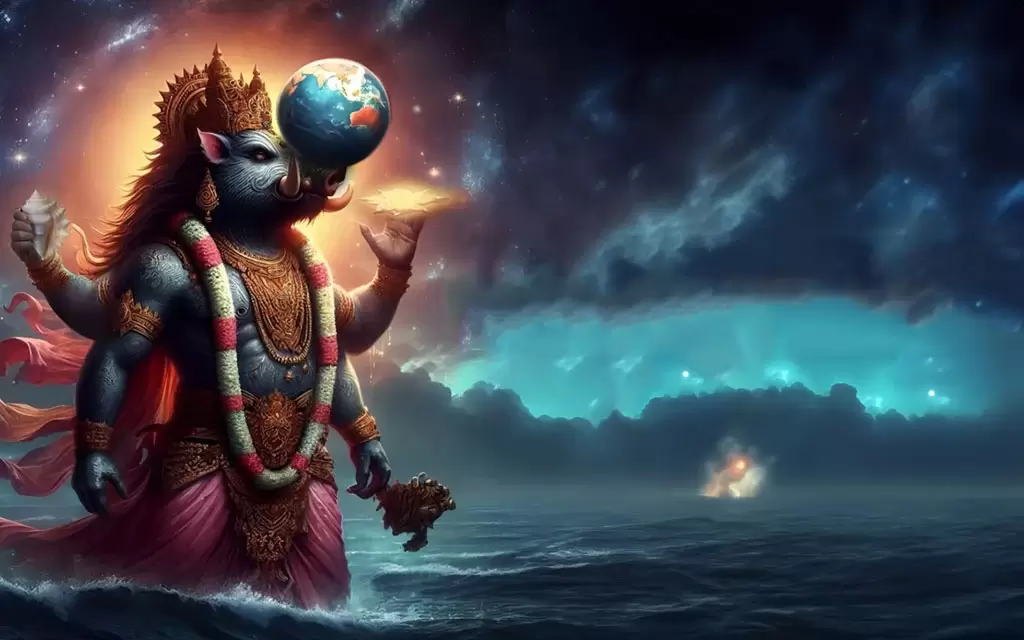
Quick Answer: Varaha — meaning "boar" in Sanskrit — is the third of Vishnu's ten avatars. The avatar manifested to rescue Goddess Bhudevi (Mother Earth) from the cosmic ocean after the demon Hiranyaksha kidnapped her and submerged her beneath the waters. Vishnu took the form of a massive boar, dove into the cosmic ocean, fought Hiranyaksha for 1,000 years, killed him, and lifted Bhudevi back to her cosmic position on his tusks. The Varaha Avatar appears in the Vishnu Purana, Bhagavata Purana, and Varaha Purana. Sri Varaha Swamy Temple at Tirumala (which devotees visit before Sri Venkateswara's main darshan) is one of the most spiritually significant Varaha sites. The Khajuraho Varaha sculpture (Madhya Pradesh, 11th century) is among Hindu civilisation's most iconic artistic representations.
1. The Varaha Story
In the early stages of cosmic creation, two demon brothers — Hiranyaksha and Hiranyakashipu — were born to sage Kashyapa and Diti. Both were once gatekeepers of Vaikuntha (Vishnu's abode), cursed to incarnate as demons due to a transgression against sages Sanaka, Sanandana, Sanatana, and Sanatkumara. The brothers' cosmic destiny was to be killed by Vishnu in successive avatars — Hiranyaksha by Varaha, Hiranyakashipu by Narasimha.
Hiranyaksha became powerful through tapas (austerity) and was granted near-invincibility. Drunk with power, he committed an act of cosmic transgression: he kidnapped Goddess Bhudevi (Mother Earth) and plunged her into the cosmic ocean (the primordial waters beneath creation), severing her from her proper cosmic position.
With Earth submerged, all life on Earth was endangered. The devas appealed to Brahma; Brahma appealed to Vishnu. Vishnu took the form of a giant boar — Varaha — and dove into the cosmic ocean.
2. The 1,000-Year Cosmic Battle
The combat lasted 1,000 years of cosmic time. Hiranyaksha was no ordinary demon; he was powerful, intelligent, and granted protections from his austerities. Varaha pursued, fought, and ultimately killed Hiranyaksha by piercing his chest with his tusks.
With Hiranyaksha defeated, Varaha lifted Bhudevi from the depths of the cosmic ocean. The image of Varaha emerging from the waters with Bhudevi balanced on his tusks is one of the most powerful images in Hindu iconography. Bhudevi was returned to her cosmic position; Earth was reestablished; life on Earth was preserved.
3. Symbolic Meaning of the Boar Form
The boar form carries multiple symbolic resonances:
- Power and tenacity: The wild boar is among the most physically powerful land animals; its tusks are weapons. Vishnu in boar form represents divine power applied to cosmic purpose.
- Penetration into depths: The boar form is built for digging. Varaha dives into the cosmic ocean — the depths of dissolution. The divine descends to where the loss has occurred.
- Earth-relationship: The boar's natural environment is the earth (mud, roots, depths). Varaha's natural affinity for the underworld where Earth is hidden is structural.
- Evolution: In Dasavataram-as-evolution interpretation, the boar is mammalian — the next evolutionary step after the amphibian tortoise.
4. The Varaha Avatar in Temple Iconography
Varaha is depicted in two main forms in temple art:
Adi Varaha — Theriomorphic (full boar form)
The complete boar form, often shown lifting Bhudevi from the cosmic ocean. The Tirumala Sri Varaha Swamy Temple deity is in this form.
Yajna Varaha / Bhuvaraha — Anthropomorphic (boar-headed human body)
The half-boar, half-human form with multiple arms, often shown holding the mace, conch, discus, and lotus, with Bhudevi as a small female figure on one tusk. This form features in the famous Khajuraho Varaha sculpture and at many South Indian temples.
The Bhuvaraha form is the more commonly worshipped iconographic representation in temples; Adi Varaha is more often featured in narrative panels.
5. Major Varaha Temples
Tier 1 — Cultural landmarks
- Sri Varaha Swamy Temple, Tirumala — adjacent to Sri Venkateswara temple; tradition holds that pilgrims must visit Varaha before Venkateswara. Lord Venkateswara himself is said to have requested this protocol.
- Khajuraho Varaha Temple, Madhya Pradesh — the iconic 11th-century Chandela-era stone sculpture; UNESCO World Heritage Site
- Bhuvaraha Temple, Srimushnam, Tamil Nadu — one of the 108 Divya Desams; major Vaishnava pilgrimage site
- Sri Bhuvaraha Lakshmi Narasimha Temple, Simhachalam, Andhra Pradesh — combined Varaha-Narasimha shrine; major pilgrimage destination
Tier 2 — Major community temples
- Sri Varaha Narasimha Temple, Simhachalam (Visakhapatnam)
- Adi Varaha Perumal Temple, Mahabalipuram, Tamil Nadu — coastal site
- Sri Bhumi Varaha Swamy Temple, Tirupati region
- Adi Varaha Mandir, Hyderabad
Outside India
- BAPS Mandir Abu Dhabi and other major BAPS temples globally feature Varaha sculptures in Dasavataram sequences
- Sri Venkateswara temples worldwide include Varaha veneration
6. Modern Lessons — Varaha in 2026
Lesson 1: Some battles take 1,000 years
The Varaha-Hiranyaksha fight lasted a thousand years of cosmic time. The teaching: certain transformative battles — personal, communal, civilisational — are long. The NRI Hindu pursuing a 30-year green-card backlog, the family restoring relationships across decades, the community building institutions over generations — all are Varaha-scale work. Patience is not optional.
Lesson 2: The divine descends to where the loss occurred
Bhudevi was beneath the ocean. Vishnu did not call her up from his celestial throne — he became a boar and dove. The teaching: when something is lost in the depths (a child's faith, a marriage in distress, a community's identity), the recovery often requires descending into that depth personally, not calling from above.
Lesson 3: Earth itself is a goddess
Bhudevi is the personification of the Earth as a divine feminine being. The Varaha story rests on the assumption that Earth is not inert material but a conscious goddess deserving rescue. For 2026 Hindus navigating climate change, this theological framing is direct: ecological action is not just about resources or sustainability — it is about honouring Bhudevi.
Lesson 4: Strength applied to dharmic purpose
The boar is one of the strongest land animals; in the wild, it can be destructive. But applied to dharma (rescuing Bhudevi), the same strength becomes redemptive. The lesson for ambitious modern Hindus: power, ambition, intensity are not inherently negative — they require alignment with dharmic purpose.
Lesson 5: The Tirumala protocol — Varaha before Venkateswara
At Tirumala, pilgrims traditionally visit Varaha Swamy before Sri Venkateswara. The teaching: certain debts must be paid first. The labour of those who recovered cosmic order (Varaha) must be acknowledged before approaching the cosmic Lord (Venkateswara). Modern application: honour the teachers, mentors, parents who held the foundation before celebrating your own achievements.
7. Mantras and Practice
Varaha bija mantra:
Om Varahaaya Namah
Adi Varaha mantra (for those who recite scripture):
Om Hreem Bhumi Varahaaya Hreem Namah
Dasavatara Stotra verse for Varaha (Jayadeva):
Vasati dasana shikhare dharani tava lagna
Shashini kalanka kaleva nimagna
Kesava dhrita Sukara rupa Jaya Jagadisha Hare
(O Keshava, who in the form of Varaha bore the earth on the tip of your tusk like a mark on the moon — victorious is the Lord of the universe.)
Practice for devotees:
- Recite the Dasavatara Stotra
- Visit Sri Varaha Swamy Tirumala before Sri Venkateswara
- Observe Varaha Jayanti (Bhadrapada Shukla Tritiya — typically September)
- Tend a garden or plant trees as a Bhudevi-honouring practice
8. FAQs
Q: When is Varaha Jayanti 2026?
A: Bhadrapada Shukla Tritiya — September 14, 2026 (Monday).
Q: Why visit Varaha before Venkateswara at Tirumala?
A: Tradition holds that Sri Venkateswara himself requested this protocol — Varaha had the temple at Tirumala first, and pilgrims must honour him before approaching the Lord.
Q: Is Hiranyaksha the same as Hiranyakashipu?
A: They are brothers — both demon-sons of Kashyapa and Diti. Hiranyaksha was killed by Varaha; Hiranyakashipu was later killed by Narasimha (the next avatar).
Q: Where is the most famous Varaha sculpture?
A: The Khajuraho Varaha temple's stone sculpture (Madhya Pradesh, 11th century) is the most iconic artistic representation. The Tirumala Varaha deity is the most worshipped.
Q: What is the relationship between Varaha and Bhudevi?
A: Bhudevi (Mother Earth) is Vishnu's consort — alongside Sridevi (Lakshmi) and Niladevi. Varaha is the form in which Vishnu rescued Bhudevi when she was lost.
Q: How do NRIs honour Varaha at home?
A: Maintain a Tulsi plant; tend a garden; recite Bhudevi-honouring mantras; visit Sri Varaha Swamy Tirumala if travelling to South India; observe Varaha Jayanti in September.
Final Words
Varaha Avatar represents Vishnu's willingness to descend into the depths to recover what has been lost. Hiranyaksha's act of stealing Bhudevi and submerging her in cosmic waters is among the most violating actions imaginable; Vishnu's response was not anger from a distance but a thousand-year personal descent in boar form. The recovery was complete; the Earth was restored; life continued.
For NRI Hindus in 2026 — facing your own depths, whether immigration backlogs that feel endless, family relationships needing recovery, or cultural transmission to children growing up in foreign lands — the Varaha teaching is that the divine response to lostness is descent, not abandonment. What has been submerged can be lifted. The labour may take a thousand years of cosmic time (or its modern equivalent in your daily life). The recovery is structurally possible.
Om Varahaaya Namah. Jaya Jagadisha Hare!
Jai Varaha Bhagavan! Jai Bhudevi! Jai Vishnu Avatar 3 of 10!
HinduTone Editorial Team · Tags: Varaha Avatar, Vishnu Boar, Hiranyaksha, Bhudevi, Tirumala Varaha Swamy, Khajuraho, Adi Varaha, Bhuvaraha, Simhachalam, Dasavataram
Frequently Asked Questions
What is Varaha Avatar?
Varaha — meaning "boar" in Sanskrit — is the third of Vishnu's ten avatars . The avatar manifested to rescue Goddess Bhudevi (Mother Earth) from the cosmic ocean after the demon Hiranyaksha kidnapped her and submerged her beneath the waters.
What are the key points about Varaha Avatar?
Vishnu took the form of a massive boar, dove into the cosmic ocean, fought Hiranyaksha for 1,000 years , killed him, and lifted Bhudevi back to her cosmic position on his tusks. The Varaha Avatar appears in the Vishnu Purana , Bhagavata Purana , and Varaha Purana .
Why does Varaha Avatar matter in Hinduism?
It deepens a devotee's connection with Lord Vishnu and with the values of Sanatana Dharma — clarity, devotion and dharmic living.
How can devotees apply Varaha Avatar in daily life?
By reflecting on its teaching, incorporating the related practices or observances into daily routine, and approaching it with sincere devotion and understanding.
You might also like
Matsya Avatar — The First Incarnation of Vishnu: Story, Significance, Sacred Geography & Lessons for 2026

Kalki Avatar — The Tenth Incarnation of Vishnu: Prophecy, Signs of Kali Yuga, Sambhal Birthplace & The End of the Cosmic Cycle
Parashurama Avatar — The Axe-Wielding Warrior-Sage: Story, the Kshatriya Annihilation, Coastal Geography & Modern Significance