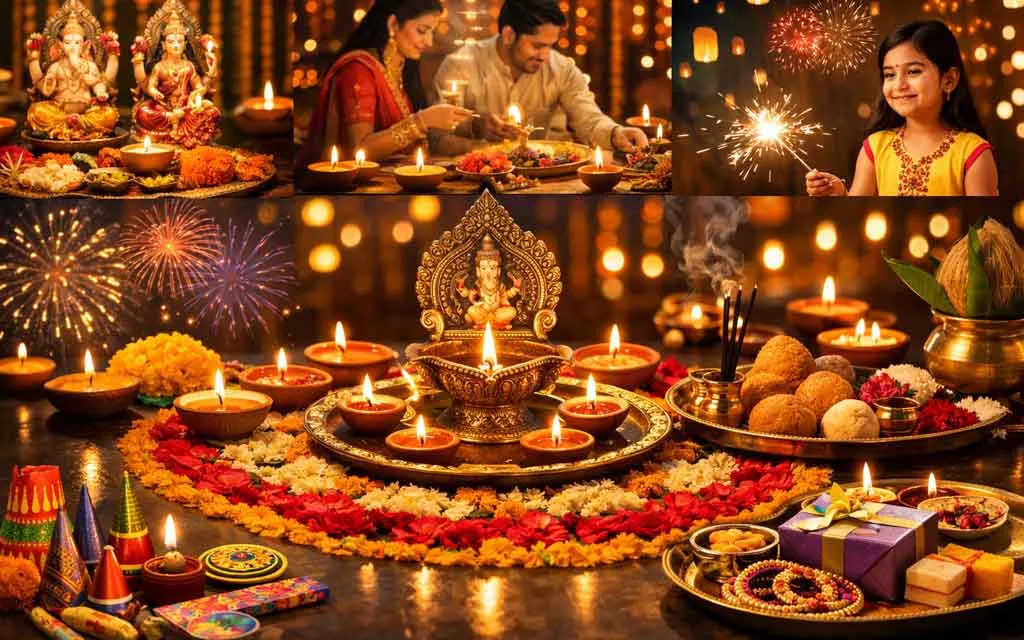
Diwali 2026 in New Zealand: Auckland and Wellington's Indian Festivities, Puja Times and Temples
Diwali (Lakshmi Puja) 2026 in New Zealand is Sunday 8 November, with the puja window after 8:38 PM in Auckland and 8:48 PM in Wellington. Here are times for five cities, the 2026 Auckland and Wellington festivals, verified temples and practical tips for Kiwi Hindu families.
Diwali (Lakshmi Puja) 2026 in New Zealand is Sunday 8 November, with the puja window after 8:38 PM in Auckland and 8:48 PM in Wellington. Here are times for five cities, the 2026 Auckland and Wellington festivals, verified temples and practical tips for Kiwi Hindu families.
Quick answer
Diwali (Lakshmi Puja) 2026 in New Zealand is Sunday 8 November. In Auckland the Lakshmi Puja window is 8:38 PM – 10:02 PM, and in Wellington 8:48 PM – 10:07 PM (New Zealand Daylight Time). Dhanteras is Friday 6 November. Auckland's public Diwali festival comes a week early, on 31 October and 1 November, and Wellington's on Sunday 25 October.
Editor's note: this page was updated on 10 October 2026. The puja times were calculated by HinduTone for each city using the Drik Panchang method (Pradosh Kaal with the Vrishabha lagna) and checked against Drik Panchang for major world cities to within one to two minutes. They are not India's times converted to New Zealand time. Festival and event details come only from organisers' own 2026 announcements. Please confirm puja timings with your temple or pandit.
Diwali in Aotearoa has an unusual shape. While families in India celebrate in the cool of autumn, New Zealand is in late spring with daylight saving, so Lakshmi Puja starts after half past eight in most cities, and later still in the south. The big public festivals in Auckland and Wellington are held on the weekends before Diwali, so many Kiwi Hindu families have two celebrations: a festival day out at Aotea Square or on the Wellington waterfront, then a quiet, late puja at home or at the mandir on Sunday 8 November.
Diwali 2026 in New Zealand: the five days
| Day | Date | What is observed |
|---|---|---|
| Dhanteras (Yama Deepam) | Friday 6 November | Puja to Dhanvantari and Lakshmi, buying a new utensil or a little gold or silver, and a lamp for Yama at dusk |
| Kali Chaudas | Saturday 7 November | Gujarati tradition of protection prayers; many families clean the house and prepare sweets |
| Diwali / Lakshmi Puja | Sunday 8 November | Lakshmi and Ganesh puja in the evening, diyas and lights; Narak Chaturdashi and Tamil Deepavali oil bath in the morning; Kali Puja for Bengali families; Chopda / Sharda Puja for business families |
| Govardhan Puja / Annakut | Tuesday 10 November (India) | Annakut offerings of many dishes to Krishna; Bali Pratipada; Gujarati New Year |
| Bhai Dooj / Yama Dwitiya | Wednesday 11 November (India) | Sisters do tilak and aarti for brothers, who give gifts and promise protection |
The dates above are from the Drik Panchang calendar for India. In New Zealand, Dhanteras on Friday 6 November and Lakshmi Puja on Sunday 8 November are confirmed for every city in this guide. The Amavasya tithi, the new moon on which Diwali is held, runs in India from 11:27 AM IST on Sunday 8 November to 12:31 PM IST on Monday 9 November, which is why there is a gap on Monday 9 November in India's list. For Govardhan Puja and Bhai Dooj we give India's dates; your local mandir may announce its own day, so check its calendar.
Each day carries its own story. Diwali celebrates Rama's return to Ayodhya after fourteen years in exile, when the people lit rows of lamps to welcome him. Lakshmi, goddess of prosperity and good fortune, is worshipped on the new-moon night. Narak Chaturdashi remembers Krishna's victory over the demon Narakasura, which is why South Indian families take an early oil bath. Bali Pratipada honours King Bali, whom Vishnu as Vamana sent to the netherworld but allowed to return once a year. Bengali families worship Kali on the same night, Jains mark the nirvana of Mahavira, and Sikhs celebrate Bandi Chhor Divas.
Lakshmi Puja muhurat 2026, city by city
All times are New Zealand Daylight Time (NZDT) on the dates shown. They were calculated by HinduTone using the Drik Panchang method (Pradosh Kaal with the Vrishabha lagna) and checked against Drik Panchang for major world cities to within one to two minutes. Confirm with your temple.
| City | Region | Lakshmi Puja (Sun 8 Nov) | Pradosh Kaal | Dhanteras puja (Fri 6 Nov) |
|---|---|---|---|---|
| Auckland | Auckland | 8:38 PM – 10:02 PM | 8:00 PM – 10:02 PM | 8:46 PM – 10:00 PM |
| Wellington | Wellington | 8:48 PM – 10:07 PM | 8:09 PM – 10:07 PM | 8:56 PM – 10:06 PM |
| Hamilton | Waikato | 8:38 PM – 10:01 PM | 8:00 PM – 10:01 PM | 8:46 PM – 9:59 PM |
| Christchurch | Canterbury | 9:02 PM – 10:19 PM | 8:23 PM – 10:19 PM | 9:10 PM – 10:17 PM |
| Dunedin | Otago | 9:18 PM – 10:31 PM | 8:38 PM – 10:31 PM | 9:26 PM – 10:29 PM |
Sunset on Sunday 8 November is at 8:00 PM in Auckland and Hamilton, 8:09 PM in Wellington, 8:23 PM in Christchurch and 8:38 PM in Dunedin. On Dhanteras, Friday 6 November, the sun sets at 7:58 PM in Auckland and Hamilton, 8:07 PM in Wellington, 8:20 PM in Christchurch and 8:35 PM in Dunedin.
What is Pradosh Kaal? Pradosh Kaal is the period of roughly two hours that begins at sunset. Lakshmi is traditionally worshipped in the evening, as darkness falls on the new-moon night, so the puja belongs inside this window. In Auckland it runs from 8:00 PM – 10:02 PM on 8 November.
What is the Vrishabha lagna? The lagna is the zodiac sign rising on the eastern horizon, and it changes about every two hours. Vrishabha (Taurus) is called a 'fixed' sign, and tradition holds that Lakshmi worshipped during a fixed lagna stays in the home. The best window is where Pradosh Kaal and the Vrishabha lagna overlap. In New Zealand this year, Vrishabha rises some 40 minutes after sunset, so the puja window starts later than sunset and ends with Pradosh Kaal. That is why Auckland's window is 8:38 PM – 10:02 PM, not from sunset.
Because the windows depend on local sunset and the rising sign, never convert India's muhurat into New Zealand time. If you cannot manage the full window, light the diyas and begin the puja inside it; the rest of the evening's celebrations can follow. For more detail see our Lakshmi Puja muhurat 2026 for New Zealand cities.
The Hindu community in New Zealand
New Zealand's Indian community has grown quickly, and it is now one of the country's main Asian communities. In the 2023 Census, Stats NZ counted 255,261 people in the 'Indian (not further defined)' ethnic group and a further 23,808 who identified as Fijian Indian. People could choose more than one ethnicity. Among all New Zealanders of Asian ethnicity, Hinduism was the most common religion, at 16.3 percent, and Hindi was among the most commonly spoken languages after English, with 76,275 speakers in that group. India and Fiji were among the five most common overseas birthplaces for Asian New Zealanders, at 16.6 and 6.3 percent.
Those numbers describe a community with several strands. Fijian Indian families, whose ancestors went to Fiji from India generations ago, keep a strong North Indian Sanatan tradition with Hindi bhajans and Ramayan mandalis. Newer migrants come straight from every Indian state, so Diwali in Auckland may mean a Gujarati Annakut at one mandir, a Tamil Deepavali oil bath in a family home, a Telugu or Kannada family worshipping at a Venkateswara temple, and a Bengali Kali Puja in a hired hall. About 60 percent of New Zealand's Asian population lives in the Auckland region, according to the same Stats NZ census summary, so that is where most temples and Diwali events are; Wellington, Waikato and Canterbury have smaller but active communities.
Where to celebrate: temples and community organisations
We list only temples and organisations whose own website or an official listing we have checked. Name and area only; check their websites and social pages for timings. Temples and community associations usually announce Diwali programmes from mid-October — check their websites and social pages.
Auckland
Auckland has New Zealand's largest Hindu community and the widest choice of mandirs. On Diwali night temples hold Lakshmi Puja and aarti, often followed by prasad, and the days after usually bring Annakut and Gujarati New Year gatherings.
- Bharatiya Mandir — Balmoral Road, central Auckland. Run by Bharatiya Mandir Incorporated.
- Shree Swaminarayan Temple — Papatoetoe, South Auckland. Run by the International Swaminarayan Satsang Organisation NZ (ISSO NZ), with a mainly Gujarati congregation.
Public event: BNZ Auckland Diwali Festival, Saturday 31 October and Sunday 1 November 2026, Aotea Square and Queen Street, central Auckland. The organiser's page lists free entry, street performances, Indian food, a festival marketplace and a public fireworks display. Announced by Tātaki Auckland Unlimited, which delivers it for Auckland Council (2026 announcement); check before you go.
Wellington
The capital's Hindu community is smaller but long established. The city has both North and South Indian temples.
- Wellington Indian Association and Gita Mandir — Bharat Bhavan, Wellington. The Wellington Indian Association was established in 1925, and Bharat Bhavan is home to both the association and its Gita Mandir.
- Kurinchi Kumaran Temple — Newlands, Wellington. Owned and run by the New Zealand Hindu Association, a registered charity; a South Indian temple.
Public event: Diwali Festival of Lights, Sunday 25 October 2026, TSB Arena and Shed 6 on the Wellington waterfront, with a fireworks finale over the harbour. The listing describes it as a free festival. Announced on WellingtonNZ; check before you go.
Hamilton and Waikato
- Sri Balaji Temple — Frankton, Hamilton. Dedicated to Sri Venkateswara and run by the Sri Balaji Temple Trust.
Hamilton's Lakshmi Puja window, 8:38 PM – 10:01 PM, is almost the same as Auckland's, so families who travel up for the Auckland festival can still be home for puja on 8 November.
Christchurch and Canterbury
- Sri Ganesha Trust (Christchurch) — Christchurch. A registered charity whose purposes include building and running the Sri Ganesha Temple in Christchurch and holding Hindu festivals.
Christchurch's window starts later, at 9:02 PM, so Canterbury families should plan for a late evening on a Sunday before school and work.
Dunedin and Otago
We could not confirm a dedicated Hindu temple in Dunedin with an official website, so we do not list one. Families here often hold Diwali at home and join student and community gatherings, which are usually announced on social media in October. Dunedin has the latest window in this guide: 9:18 PM – 10:31 PM.
Celebrating at home in New Zealand
A simple Lakshmi Puja at home, inside your city's window:
- Clean the house and puja area during the day, and make a rangoli at the entrance.
- Set up a raised platform with a red or yellow cloth, an image or murti of Lakshmi and Ganesh, a kalash of water topped with mango leaves and a coconut, and a plate of rice.
- Light the main diya at the start of the window. Begin with a prayer to Ganesh, then invoke Lakshmi.
- Offer flowers, kumkum, haldi, rice, coins or notes, sweets, fruit and dry fruit. Recite the Lakshmi mantra or a Lakshmi aarti; business families may worship their account books.
- Finish with aarti, then light the diyas around the house and share prasad.
Apartments and rentals: many Auckland and Wellington families rent apartments or townhouses. Check your tenancy agreement and any body corporate rules before using open flames on balconies or in common areas. Electric or LED diyas and fairy lights are a safe choice for windows and balconies, and you can keep one real ghee or oil lamp at the puja place, on a metal tray, never left alone.
Smoke alarms: incense, camphor aarti and ghee lamps can set them off. Open a window, keep the puja away from the alarm, and never disable or cover it.
Weather: early November is late spring. Evenings are mild in the north but can be cool in Canterbury and Otago, and Wellington is famous for wind. Wind can blow out outdoor diyas and blow flames sideways, so keep real flames indoors or sheltered and use electric lights outside.
Food and decorations you can find locally
Indian grocers are easy to find in Auckland, Wellington, Hamilton and Christchurch, and supermarkets in many areas stock basics such as ghee, besan, basmati rice and paneer. In the weeks before Diwali, Indian shops usually bring in clay diyas, rangoli colours, puja items, marigold garlands and boxed mithai, and stock runs short close to the day, so shop early. In smaller towns, order online or ask your temple, which often sells puja items. Spring flowers such as chrysanthemums and roses make good offerings when marigolds are hard to find.
Diwali with children and second-generation families
Diwali in 2026 falls in a normal school and working week, with Dhanteras on a Friday and Lakshmi Puja on a Sunday night. Because the windows start after half past eight in most cities, younger children may be in bed before the puja ends. Some families do a short puja with the children at the start of the window, then finish the aarti once they are asleep.
The weekend festivals in Auckland and Wellington are a good way to share Diwali with school friends, neighbours and colleagues. Many New Zealand schools invite families to share festival traditions, so talk to the teacher about bringing diyas, rangoli or sweets in the week of 2 November.
Keeping heritage languages alive matters to many families. Diwali is a natural time to teach children the Lakshmi aarti in Hindi, Gujarati, Tamil or Telugu, to tell the Ramayana story in your home language, and to call grandparents in India or Fiji. Temples and associations often run language and culture classes; ask at yours.
Fireworks, safety and local rules
Fireworks rules in New Zealand are set nationally and locally, and Fire and Emergency New Zealand and local councils can restrict fireworks, sky lanterns and open fires in particular areas and seasons. We have not been able to open a current official page for 2026, so we do not quote specific rules here. Check the guidance from Fire and Emergency New Zealand and your council before you buy, light or release anything, and follow any fire ban in your area.
Diwali week in 2026 comes straight after Guy Fawkes on 5 November, so expect fireworks noise in many suburbs. Some safety basics: supervise children closely, keep water and a fire extinguisher nearby, think of neighbours and pets, and never point fireworks at people or homes. The easiest way to enjoy fireworks is at the public displays at the Auckland and Wellington Diwali festivals.
Celebrating far from family
For many NRI and Fijian Indian families, Diwali is when distance hurts most. Time zones make it harder still: New Zealand is many hours ahead of India, so your Lakshmi Puja ends before families in India have started theirs. Some families do the puja at their own time and then join a video call when relatives in India begin, or record their aarti for grandparents. Many large temples in India stream darshan and aarti online. Diwali is also a good time for seva: volunteer at your mandir, give to a temple or charity food drive, or invite international students and new migrants who are spending their first Diwali in New Zealand.
Diwali checklist for New Zealand
- Note your city's Lakshmi Puja window for Sunday 8 November (Auckland 8:38 PM – 10:02 PM).
- Note the Dhanteras puja window for Friday 6 November after work.
- Check your mandir's website for Diwali, Annakut and New Year programmes.
- Plan a trip to the Auckland festival (31 October – 1 November) or the Wellington festival (25 October).
- Buy diyas, rangoli colours, puja items and sweets early from Indian grocers.
- Use LED diyas on balconies and in rentals; keep real flames indoors and supervised.
- Test your smoke alarms and ventilate during aarti.
- Check Fire and Emergency New Zealand and council guidance before using fireworks.
- Tell your child's school and your workplace about Diwali week.
- Set up a video call with family in India or Fiji.
- Plan some seva or a donation to your temple or a local charity.
Frequently asked questions
When is Diwali 2026 in New Zealand?
Lakshmi Puja, the main night of Diwali, is on Sunday 8 November 2026 in every New Zealand city. Dhanteras is Friday 6 November. In India, Govardhan Puja is Tuesday 10 November and Bhai Dooj is Wednesday 11 November; local temples may announce their own day.
What time is Lakshmi Puja in Auckland and Wellington on 8 November 2026?
Auckland 8:38 PM – 10:02 PM and Wellington 8:48 PM – 10:07 PM, New Zealand Daylight Time. These windows were calculated by HinduTone using the Drik Panchang method (Pradosh Kaal with the Vrishabha lagna); please confirm with your temple.
Why does Lakshmi Puja start so late in New Zealand?
Because daylight saving is in force and New Zealand is well into spring, the sun sets around 8:00 PM in Auckland and after half past eight in Dunedin. The puja window begins only after sunset, once the fixed Vrishabha lagna rises, so South Island families in particular should plan for a late evening on a school night.
Is the Auckland Diwali Festival on Diwali night?
No. In 2026 the BNZ Auckland Diwali Festival is announced for Saturday 31 October and Sunday 1 November at Aotea Square and Queen Street, a week before Diwali itself. Wellington's Diwali Festival of Lights is listed for Sunday 25 October at TSB Arena and Shed 6. Families usually enjoy the public festival and then hold Lakshmi Puja at home or at the mandir on 8 November.
Is Diwali a public holiday in New Zealand?
No. Diwali is not a public holiday in New Zealand. In 2026, 8 November is a Sunday, and the rest of Diwali week, including Dhanteras on Friday 6 November, is a normal working and school week.
Can I let off fireworks for Diwali in New Zealand?
Fireworks sales and use are controlled by national rules, and councils and Fire and Emergency New Zealand can restrict where and when fireworks are used. Check the official guidance for your area before buying or lighting anything; the public displays at the Auckland and Wellington festivals are the easiest way to enjoy fireworks.
Related guides
- Diwali / Deepavali 2026: complete 5-day guide
- The 5 days of Diwali 2026 explained
- Lakshmi Puja muhurat 2026, New Zealand city-wise
- Diwali 2026 events in Australia and New Zealand
- Bhai Dooj 2026 in Singapore, Malaysia and New Zealand
- Diwali in Fiji 2026
- Diwali 2026 in Australia
- Dussehra 2026 in New Zealand, city by city
Sources
- Stats NZ: People of Asian ethnicities living in Aotearoa New Zealand (2023 Census)
- Tātaki Auckland Unlimited: BNZ Auckland Diwali Festival returns for 2026
- Auckland NZ: BNZ Auckland Diwali Festival
- WellingtonNZ: Diwali Festival of Lights
- Bharatiya Mandir, Auckland
- ISSO NZ: Shree Swaminarayan Temple, Papatoetoe
- Wellington Indian Association
- Charities Register: New Zealand Hindu Association (Kurinchi Kumaran Temple)
- Sri Balaji Temple, Hamilton
- Charities Register: Sri Ganesha Trust (Christchurch)
- Muhurat: HinduTone calculation (Drik Panchang method)
You might also like
Diwali 2026 Celebrations in Dubai: Complete Guide to Events, Temples, Fireworks & Festivities in the Desert City
Diwali 2026 Celebrations in New York: Complete Guide to Events, Temples, and Grand Festivities in the Big Apple
Diwali 2026 Celebrations in London: Complete Guide to Events, Temples, and Grand Festivities in the UK Capital