
Nagula Chavithi Vratha Katha: The Traditional Stories Told in Telugu Homes, What They Teach and How to Read Them on the Day
Quick answer: The story most often read as the Nagula Chavithi vratha katha tells of a family who unknowingly kill young serpents. The mother serpent bites them in revenge, and the one daughter who was away saves them by praying to the Naga Devata and offering milk. In the version given by Telugu de
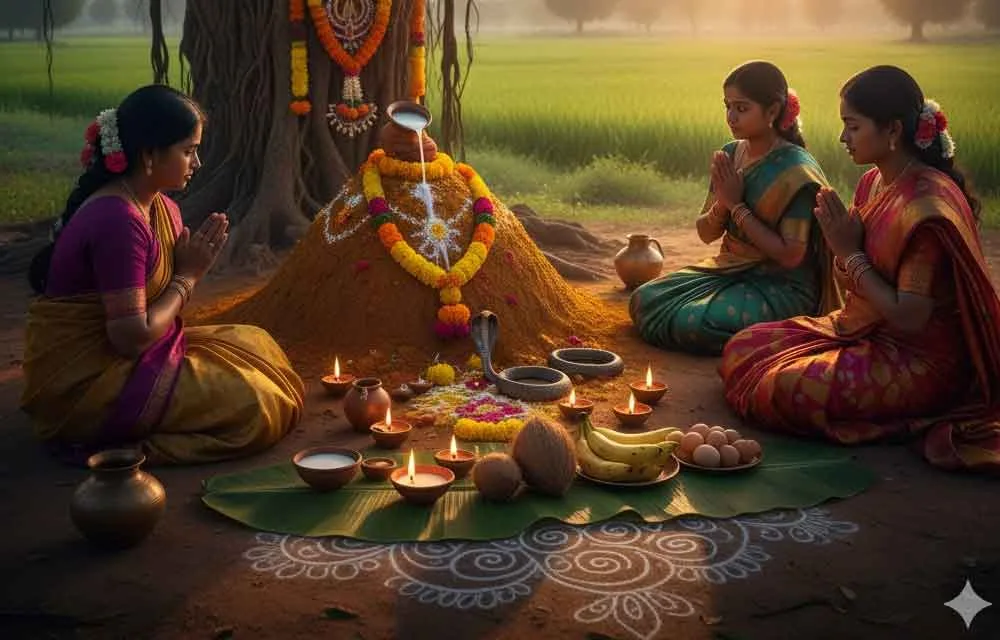
Quick answer: The story most often read as the Nagula Chavithi vratha katha tells of a family who unknowingly kill young serpents. The mother serpent bites them in revenge, and the one daughter who was away saves them by praying to the Naga Devata and offering milk. In the version given by Telugu devotional publishers such as Bhaktinidhi, the serpent was killed by a water pot at a well and the daughter is told to worship on Karthika Shukla Chavithi. In a widely told folk version, the serpents are killed by a plough. Telugu writers also connect the day with the story of Astika, who stopped King Janamejaya's serpent sacrifice, and with the Brahma Purana's story of King Shurasena's serpent son. The stories differ in detail but teach the same things: harm done without knowing still needs to be set right, a sincere prayer is heard, and the serpent is to be respected, not hurt.
Nagula Chavithi falls on Karthika Shukla Chaturthi, four days after Deepavali Amavasya. In 2026 it is Friday 13 November in India and Thursday 12 November in the USA and Canada; dates, city muhurat times and the full puja vidhi are on our Nagula Chavithi 2026 guide. This page is only about the katha.
How this page tells the stories
Vrata kathas are handed down by word of mouth and in small booklets, so the same story is told in more than one way. We tell only what at least two independent sources agree on; where they differ, we give both versions and say so. What the stories are believed to teach is given as the tradition's reading, and our own comment is marked separately. Names appear only where a source gives them; the most-read katha has no named characters, and we have added none.
The best-known katha: the daughter who saved her family
What every version agrees on
In each telling we checked, the story has the same shape:
- A member of a household kills young serpents without meaning to.
- The mother serpent, grieving and angry, comes to the house at night and bites the family, who die.
- One daughter was away from home and survives.
- She does not curse the serpent. She grieves, admits the wrong her family did, and asks the Naga Devata, or the mother serpent herself, for forgiveness.
- Pleased by her humility, the serpent forgives the family, and her parents (and in some versions her brothers) are brought back to life.
- Women have kept the worship ever since, for the safety of their families and children.
Version one: the water pot at the well
This is the form given by the Telugu devotional site Bhaktinidhi, in both Telugu and English. A truthful and devout Brahmin couple live in a village. One day the wife goes to the well to draw water, and her pot strikes and kills a baby cobra that lived there. Frightened, she tells her husband, who warns that serpents do not forget a wrong, and the two pray to God.
That night the mother serpent comes to the house in her own form and bites the couple, and both die. Their daughter, who had been away, comes home the next morning and finds them dead. In her grief she prays to the Naga Devata, saying that her parents sinned without knowing it and asking that they be forgiven. Nagaraja, the king of the serpents, is moved by her devotion and humility. He tells her to worship him on the Chavithi of the bright fortnight of Karthika with milk, turmeric, kumkum and naivedyam. She keeps the vratam, and by its merit her parents return to life. From then on, the katha says, women have kept Nagula Chavithi for the welfare of their families.
Version two: the plough in the field
The other common form is a farmers' tale. A farmer has two sons and a daughter. While one son is ploughing, the blade kills three young serpents in their nest. That night the mother serpent bites the farmer, his wife and the two sons, and all of them die. The next day the daughter brings the mother serpent a bowl of milk, asks her forgiveness and begs her to restore her parents and brothers. The serpent is pleased, forgives them, and the family is brought back to life.
This version is told for Nagula Chavithi on a Telugu vrata blog (Vrathalu Nomulu), and the same tale appears in folklore collections of Naga Panchami worship in other parts of India. Families who keep both days may know it from either.
Where the two versions differ
| Point | Water pot version | Plough version |
|---|---|---|
| Family | A Brahmin couple and their daughter | A farmer, his wife, two sons and a daughter |
| How the young serpents die | Struck by a water pot at the well | Cut by the plough in the field |
| Who is bitten | Both parents | The parents and both sons |
| Whom the daughter prays to | Nagaraja, the Naga Devata | The mother serpent, with a bowl of milk |
| How the family returns | By the merit of the Chavithi vratam she is told to keep | The serpent forgives them directly |
| Date in the story | Karthika Shukla Chavithi, named in the katha | No date given |
Neither version names a Purana as its source, and we have not given it one. Treat both as family kathas, not scripture.
The story of Astika and the serpent sacrifice
Telugu writers on Nagula Chavithi, including articles in Sakshi and Telugu Webdunia, also tell the story of Astika, and say that many believe hearing it on this day frees a person from naga dosha. Sakshi gives the Bharatam (the Mahabharata) as the source.
What the sources agree on: King Parikshit died of a snakebite. His son, King Janamejaya, began a sarpa yagam, a sacrifice meant to destroy all serpents, and serpents in great numbers fell into the fire. The young sage Astika came to the sacrifice, won the king over with his words, and asked only one thing: that the sacrifice end and the serpents be spared. Janamejaya agreed, and the serpents were saved.
Where they differ: Sakshi says Astika's mother was Jaratkaru, a woman of the Naga race, and that the surviving serpents begged her to send her son; Webdunia calls him the son of Jaratkaru. Hindu Blog and a Telugu vrata blog name his mother as Manasa (Manasa Devi), wife of the sage Jaratkaru, and add that Takshaka, the serpent who killed Parikshit, had taken shelter with Indra, and that Indra himself was being drawn towards the fire when Astika stopped the rite. Hindu Blog ends with the serpents giving Manasa a boon that anyone who hears her story or recites her name will be safe from snakebite. Some writers tie this story to Naga Panchami rather than to Nagula Chavithi; families keep it on either day.
King Shurasena's serpent son
TeluguOne's article on Nagula Chavithi retells a story it attributes to the Brahma Purana, and we found the same story in the Gautami Mahatmya section of the Brahma Purana (chapter 41, on Nagatirtha, in G. P. Bhatt's English translation).
What the two agree on: King Shurasena of the Lunar dynasty and his queen pray for a long time for a child, and a son is born to them in the form of a serpent. The serpent son speaks like a man, asks for his upanayanam and then for a bride, and a princess is married to him. When she learns he is a serpent, she is not afraid. He tells her that he is living under a curse of Lord Shiva. The couple bathe in the Gautami (the Godavari) and worship Shiva, and Shiva frees him from the curse.
Where they differ: TeluguOne says the couple kept the Chavithi vratam before their bath. The Purana chapter we read does not mention a Chaturthi vow; it names the princess Bhogavati and the holy place Nagatirtha, where she installed Nageshvara. Tradition links the story to serpent worship and the blessing of children.
A belief told alongside: Shiva and the halahala
Some accounts link Nagula Chavithi to the churning of the ocean, when a serpent served as the churning rope and Lord Shiva held the poison halahala in his throat to save the world. In one telling a few drops fell to earth, and the serpent is worshipped so that its poison does no harm. This is a belief about the day, given in a line or two, not a katha with a vratam.
What the stories teach
The tradition's reading. In each story a wrong is done without knowing, and it is set right by humility rather than by force. The daughter does not fight the serpent; she asks forgiveness on behalf of her family. Astika does not defeat the king; he persuades him. That is why the katha is read by mothers praying for their children: it is a prayer that the family be kept from harm, and that any harm they have done without knowing be forgiven. Telugu writers also note that snakes protect fields by eating the pests that eat the crops, so the old restraint of the day, not digging or ploughing, belongs with the stories.
Our comment. Read today, the plough and the water pot are reminders that ordinary work can disturb living things we do not see. The kindest way to honour the stories is to protect real snakes, not to feed or handle them.
How families read the katha on the day
Customs differ from home to home, and your elders' way comes first. A simple order that suits most households:
| When | What to do |
|---|---|
| After the puja | Sit before the Naga image with the lamp still lit and the naivedyam in front |
| Before reading | Give each listener a few grains of akshata (rice with turmeric) to hold |
| Reading | One person reads the katha aloud, slowly, in the family's language; children sit close |
| After reading | Listeners place the akshata before the image and fold their hands |
| Then | Share the prasadam; those keeping the fast break it as the family custom directs |
Read one katha, or all three. If time is short, the daughter's story alone is enough. Many families follow the reading with the Nava Naga Stotram and Nagula Chavithi mantras, and offer the traditional naivedyam of chalimidi, chimmili and vadapappu.
For children, it helps to end with one plain sentence: we honour the Naga Devata by never hurting a snake.
Safety: worship the image, never a real snake
The daughter in the story offers milk to a serpent, but the story is a prayer, not an instruction to approach snakes.
- Worship a Naga idol, a Naga stone, a picture, or a serpent drawn in turmeric or rice flour at home, or join a temple's Naga puja.
- Never pour milk into an anthill or burrow, and never offer milk or food to a live snake. Snakes do not drink milk, and milk poured into a burrow can harm the animals inside. Our page Do snakes really drink milk? explains why.
- Do not dig into, block or break a mound, and keep children and pets away from mounds and long grass.
- Do not pay snake charmers. A snake kept in a basket is suffering, not being worshipped.
- If you see a snake, keep your distance and let it move away. If someone is bitten, keep them still and go to a hospital at once.
Families abroad can find more ideas in our guide to celebrating Nagula Chavithi abroad.
Frequently asked questions
What is the Nagula Chavithi vratha katha?
The most-read katha tells of a family whose members unknowingly killed young serpents and were bitten by the mother serpent. Their daughter, who was away, prayed to the Naga Devata for forgiveness, and her family was restored to life. In the version given by Telugu devotional publishers, she was told to worship on Karthika Shukla Chavithi, which became Nagula Chavithi.
Is there only one Nagula Chavithi story?
No. The daughter's story has at least two versions: in one the serpent is killed by a water pot at a well, in the other by a plough. Telugu writers also connect the day with the story of Astika and the serpent sacrifice, and with King Shurasena's serpent son from the Brahma Purana.
When should the katha be read?
Most families read it after the puja and before sharing the prasadam or breaking the fast. Follow your family custom.
Which Purana is the Nagula Chavithi katha from?
The daughter's story is a family vrata katha, and the sources we checked do not name a Purana for it. The Astika story is told in the Mahabharata, and the Shurasena story is in the Gautami Mahatmya of the Brahma Purana.
Should I pour milk into an anthill as the daughter in the story did?
No. Offer the milk at a Naga idol, stone or picture, or join a temple's Naga puja. Never pour milk into a burrow or offer it to a live snake.
Sources
Stories checked against: Bhaktinidhi, Nagula Chavithi Katha in Telugu and in English; Vrathalu Nomulu (vrathanomu.wordpress.com), Nagula Chavithi; Wikipedia, Nag Panchami (folktales section, citing Alter 1992); Sakshi, Nagula Chavithi visishtata (2024); Telugu Webdunia, Nagula Chaviti ante emiti; Hindu Blog, Nagula Chavithi Story; TeluguOne, Nagula Chavithi visishtata; Brahma Purana, Gautami Mahatmya, chapter 41 (G. P. Bhatt translation, wisdomlib.org); Mahanandi and Wikipedia, Nagula Chavithi, for the halahala belief. Dates from our Nagula Chavithi 2026 guide, computed with HinduTone's panchang engine (Drik Panchang method).
Share this with family and friends
Send it on WhatsApp, post it, or copy the link.
More from Festivals
- Karthika Masam 2026 in Qatar, Oman, Bahrain, Kuwait and Saudi Arabia: Dates, Somavarams and a Home Worship Guide
- Karthika Masam 2026 in South Africa: Dates, Somavarams and Pournami Times for Durban, Pietermaritzburg, Johannesburg, Pretoria and Cape Town
- Kanakadasa Jayanti 2026: Date (27 November), the Life of the Haridasa Saint-Poet and How Karnataka Observes It
- Dattatreya's 24 Gurus: Spiritual Lessons from Nature, from the Bhagavata Purana
- Kalashtami December 2026: Date, Ashtami Time, and Why It Is 30 December, Not 31
You might also like

Nagula Chavithi 2026 in the UAE: Friday 13 November in Dubai and Abu Dhabi, Same Day as India, with a Puja for Flats and Shared Homes
Nagula Chavithi 2026 in Canada: Thursday 12 November, a Day Before India, and How to Keep It in a Canadian November
Nagula Chavithi 2026 in Australia: Friday 13 November, Same Day as India, in the Middle of Snake Season