
Nagula Chavithi vs Naga Panchami: How the Two Naga Festivals Differ in Month, Tithi, Region and Custom
Quick answer: Both festivals honour the Naga devatas, but they fall in different seasons. Nagula Chavithi is on Karthika Shukla Chaturthi, the fourth day of the bright fortnight after Deepavali, and is kept mainly by Telugu families in Andhra Pradesh, Telangana and abroad. Naga Panchami is on Shrava
Quick answer: Both festivals honour the Naga devatas, but they fall in different seasons. Nagula Chavithi is on Karthika Shukla Chaturthi, the fourth day of the bright fortnight after Deepavali, and is kept mainly by Telugu families in Andhra Pradesh, Telangana and abroad. Naga Panchami is on Shravana Shukla Panchami, in the monsoon, and is kept across much of India and in Nepal, with some regions observing it on a different day. In 2026 Nagula Chavithi is on Friday 13 November in India (Thursday 12 November in the USA and Canada), and Naga Panchami fell around 17 August. Many families keep both, and the core of the worship (milk, turmeric and prayer before a Naga image, no digging, no harm to any creature) is shared.
Read next: Do snakes really drink milk? Why milk is offered at the snake mound
This page sets the two festivals side by side. For the full puja of each, see our Nagula Chavithi 2026 guide and our Naga Panchami 2026 page.
Nagula Chavithi and Naga Panchami side by side
| Nagula Chavithi | Naga Panchami | |
|---|---|---|
| Lunar month | Karthika | Shravana |
| Tithi | Shukla Chaturthi (4th day of the bright fortnight) | Shukla Panchami (5th day of the bright fortnight); some regions keep a Krishna paksha date |
| Season | Early winter, October or November | Monsoon, July or August |
| Place in the calendar | Four days after Deepavali Amavasya, in the first week of Karthika Masam | Within Shravana Masam |
| 2026 date in India | Friday 13 November | Around 17 August (confirm with your local panchangam) |
| 2026 abroad | Thursday 12 November in the USA and Canada; Friday 13 November in the UK, Europe, UAE, Singapore and Australia | Follow your local panchangam |
| Main regions | Andhra Pradesh and Telangana, Telugu families everywhere, and some families in parts of Karnataka | Much of India, including Maharashtra, Karnataka, northern India and Kerala, and Nepal |
| Puja time | Traditionally the midday (madhyahna) window; 10:52 AM to 1:08 PM in Hyderabad in 2026 | Follow your local panchangam or temple |
| Where the puja is done | Traditionally at a putta (snake mound) or a Naga stone; today often at home or a temple | At a Naga image, a snake drawn or painted at home, a clay idol, a Naga stone or an anthill |
| Typical offerings | Milk, turmeric, kumkum, chimmili (sesame and jaggery), chalimidi (rice flour and jaggery), soaked chana, fruit; eggs in some families | Milk, turmeric, flowers and naivedyam; foods vary widely by region |
| Who keeps the fast | Mainly mothers, praying for their children | Many women and families, for the household's wellbeing |
| Companion day | Nagula Panchami the next day, kept by some families (Saturday 14 November in 2026) | Garuda Panchami on the same day in some regions |
| Stories told | The family prayer for children; Adishesha, Vasuki and Subrahmanya in serpent form | Astika halting Janamejaya's serpent sacrifice; Krishna and Kaliya; Kadru, mother of the Nagas |
| Shared customs | No digging or ploughing, no harm to any creature, prayers such as the Nava Naga Stotram | The same |
Different months, different tithis
The simplest difference is the calendar. Naga Panchami comes in Shravana, the monsoon month, on the fifth day of the bright fortnight. Nagula Chavithi comes about three months later, in Karthika, on the fourth day of the bright fortnight, which in 2026 is five days after Diwali on Sunday 8 November.
Note the change of tithi as well as month: Chaturthi (the fourth) for Nagula Chavithi, Panchami (the fifth) for Naga Panchami. That is why Telugu families who keep a second day in Karthika call it Nagula Panchami, the Panchami that follows Nagula Chavithi. In 2026 that is Saturday 14 November. It is a family custom, not a second Naga Panchami.
Some regions do not keep Naga Panchami in the bright fortnight at all. Accounts of the festival note that parts of Rajasthan, Bihar and Gujarat observe it on the Panchami of the dark fortnight (Krishna paksha), and Gujarati calendars place Nag Pancham about a fortnight after the date kept in most other states. Punjab has a related observance, Guga Navami, in Bhadrapada.
How each date is fixed
For Nagula Chavithi, the day is the one on which the Chaturthi tithi covers the midday window, which is when the Naga puja is traditionally done. In 2026 Chaturthi runs from 6:09 PM IST on Thursday 12 November to 8:42 PM IST on Friday 13 November, so in India the midday window falls on Friday. In New York, Chaturthi begins on Thursday morning local time, so the USA and Canada keep Thursday 12 November. Our main guide has times by city.
For Naga Panchami, we give the 2026 date as around 17 August and ask families to confirm the exact day with their local panchangam, especially outside India.
Where each festival is kept
Nagula Chavithi is above all a Telugu festival. It is a major day in Andhra Pradesh and Telangana, and Telugu families in the USA, the UK, the Gulf, Singapore, Malaysia and Australia keep it at home or at their temple. It is also kept by some families in parts of Karnataka.
Naga Panchami is far more widespread. It is kept in Maharashtra, Karnataka, much of northern India and Nepal, with strong local traditions:
- In Karnataka, Naga Panchami is the main Naga festival for many families; accounts describe clay Naga images and a turmeric thread tied on the wrist.
- In Kerala, serpent worship is tied to the sarpa kavu, the sacred serpent grove, where families make offerings.
- In eastern India, the serpent goddess Manasa is worshipped in a related tradition.
- In Gujarat, Nag Pancham is kept on its own date in the Gujarati calendar.
Many Telugu families keep both festivals. Which one is a family's main Naga puja depends on the family and the region it comes from, so follow your elders.
Customs: what is different and what is shared
What is distinctive about Nagula Chavithi
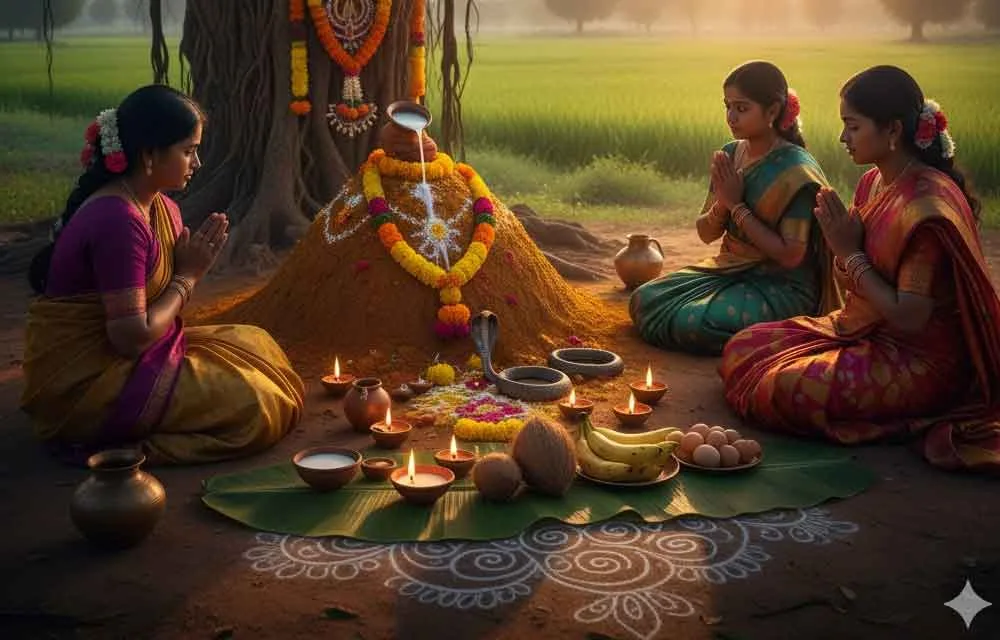
- The putta. The best-known custom is offering milk at a snake mound, called puttalo palu. Today many families offer it at a Naga stone, a temple shrine or an idol at home, and never pour it into a burrow. Our article on whether snakes drink milk explains why.
- Telugu naivedyam. Chimmili and chalimidi are the signature offerings, with soaked chana and fruit.
- A prayer for children. Mothers pray to the Nagas for their children's health and safety, and some tie a turmeric thread on the children's wrists after the puja.
- Small family customs, such as touching a pinch of the mound's soil to the ears after the puja.
- The Karthika setting. The day opens a busy festival week, with Skanda Sashti two days later; see the Karthika Masam 2026 calendar.
What is distinctive about Naga Panchami
- Images rather than mounds. In many homes, families draw a snake with rangoli or paint one on the wall or doorway, or make a clay image, and worship it.
- A wider set of stories. Naga Panchami is linked with the sage Astika, who stopped King Janamejaya's serpent sacrifice and saved the Nagas, and with Krishna's subduing of Kaliya in the Yamuna.
- Regional names and companion days, such as Garuda Panchami on the same day in some regions.
What both festivals share
- The Naga devatas are worshipped as guardians of the earth, water and family line, and with them Shiva, who wears Vasuki, Vishnu, who rests on Adishesha, and Subrahmanya, worshipped in serpent form.
- The earth is left undisturbed: families avoid digging and ploughing, and avoid harming any creature.
- Milk, turmeric, kumkum and flowers are offered to a Naga image, stone or mound.
- Many families recite the Nava Naga Stotram, which names nine Nagas from Ananta to Kaliya. Our page on Nagula Chavithi mantras explains its meaning.
Why two Naga festivals?
The scriptures do not explain why the Telugu calendar has its own Naga day in Karthika, and we will not invent a reason. A reading often offered, which is commentary rather than scripture, is that both festivals fall at times when people and snakes meet: in the monsoon, when rain floods burrows and drives snakes towards homes, and in the farming calendar of the Telugu country, where the earth is left unploughed for a day. Either way, both festivals carry the same message: respect for the serpent, and for the land it shares with us.
Keeping either festival safely
Whichever festival your family keeps, the safety rules are the same:
- Never pour milk into an anthill or burrow, and never offer milk to a live snake. Snakes do not drink milk.
- Do not pay snake charmers who display captive snakes. In India, snakes are protected by law.
- Keep children and pets away from mounds and long grass, and do not dig into or block a mound.
- If you see a snake, step back and let it move away; call a trained rescuer if it is inside a home.
- If anyone is bitten, keep them still and get them to hospital at once.
- If you fast, eat normally if you are pregnant, elderly, diabetic or unwell, and check with your doctor first.
Abroad, keep the puja at home with a picture or idol, or join your temple's Naga puja. Our guide to celebrating Nagula Chavithi abroad has more ideas.
Frequently asked questions
Are Nagula Chavithi and Naga Panchami the same festival?
No. Both honour the Nagas, but Nagula Chavithi is on Karthika Shukla Chaturthi (October or November) and is mainly Telugu, while Naga Panchami is on Shravana Shukla Panchami (July or August) and is kept across much of India.
When are Nagula Chavithi and Naga Panchami in 2026?
Nagula Chavithi is on Friday 13 November 2026 in India and Thursday 12 November in the USA and Canada. Naga Panchami fell around 17 August 2026; families should confirm the exact day with their local panchangam.
What is Nagula Panchami?
Nagula Panchami is the day after Nagula Chavithi, kept as a second day by some Telugu families. In 2026 it is Saturday 14 November. It is not the same as Naga Panchami in Shravana.
Can I keep both festivals?
Yes. Many Telugu families keep both, and nothing in either tradition forbids it. Follow your family's custom on which is the main day.
Is the puja different for the two festivals?
The heart of it is the same: milk, turmeric and flowers before a Naga image, prayers for the family, no digging and no harm to any creature. Nagula Chavithi adds Telugu customs such as chimmili, chalimidi and the putta offering; Naga Panchami customs vary by region.
Sources
Dates and customs for each festival are from our pillar pages, Nagula Chavithi 2026 and Naga Panchami 2026. Regional facts: Wikipedia, "Nag Panchami" (regional customs, Krishna paksha observance, Guga Navami); Vedantu, "Nag Panchami 2026" (Gujarat's later date); Encyclopaedia Britannica, "naga". Local times computed with HinduTone's panchang engine (Drik Panchang method).
Related guides
Share this with family and friends
Send it on WhatsApp, post it, or copy the link.
More from Festivals
- Karthika Masam 2026 in Qatar, Oman, Bahrain, Kuwait and Saudi Arabia: Dates, Somavarams and a Home Worship Guide
- Karthika Masam 2026 in South Africa: Dates, Somavarams and Pournami Times for Durban, Pietermaritzburg, Johannesburg, Pretoria and Cape Town
- Kanakadasa Jayanti 2026: Date (27 November), the Life of the Haridasa Saint-Poet and How Karnataka Observes It
- Dattatreya's 24 Gurus: Spiritual Lessons from Nature, from the Bhagavata Purana
- Kalashtami December 2026: Date, Ashtami Time, and Why It Is 30 December, Not 31
You might also like
Nagula Chavithi Mantras: the Nava Naga Stotram and Its Meaning, the Sarva Naga Prayer and the Naga Gayatri

Nagula Chavithi 2026 in the UK: Friday 13 November, the Same Day as India, with a Home Naga Puja for a British Winter
Nagula Chavithi 2026: Date (Friday 13 November), Puja Muhurat by City, Naga Puja Vidhi, Samagri and Dates Abroad