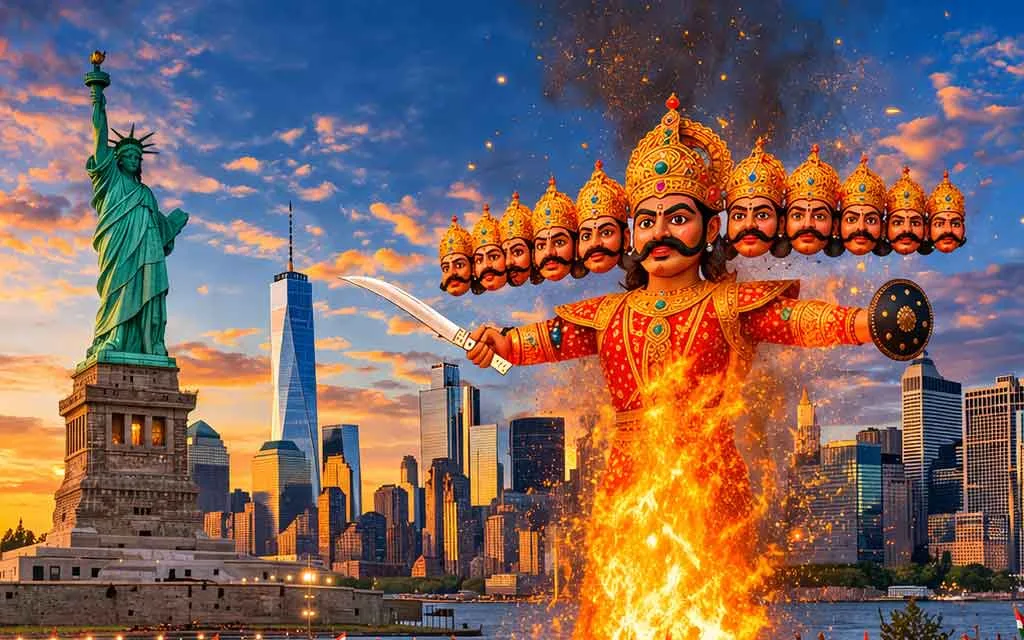
Navratri in Canada: How Gujaratis & South Indians Celebrate Abroad
Published on HinduTone | Festival & Culture "When the dhol beats in Toronto or Vancouver, it doesn't matter that there's a chill in the air or leaves are…
Published on HinduTone | Festival & Culture "When the dhol beats in Toronto or Vancouver, it doesn't matter that there's a chill in the air or leaves are…
Published on HinduTone | Festival & Culture
"When the dhol beats in Toronto or Vancouver, it doesn't matter that there's a chill in the air or leaves are falling — for those nine nights, we are home." — Priya Shah, Gujarati community organiser, Toronto
Introduction: Nine Nights, One Diaspora, Many Traditions
Every autumn, as Canadian skies turn grey and the leaves begin to fall (or the West Coast enjoys milder evenings), something extraordinary happens in Toronto, Brampton, Mississauga, Vancouver, Calgary, Edmonton, Montreal, and dozens of other cities across Canada. Tens of thousands of Canadian Hindus transform community halls, temple grounds, convention centres, and parks into blazing celebrations of Navratri — one of Hinduism's most beloved and electrifying festivals.
But here is what makes Navratri in Canada uniquely fascinating: this is not one celebration. It is two. Sometimes side by side. Sometimes intertwined. Sometimes in the same family.
Gujaratis — predominantly from Gujarat and via East Africa — bring the thunder of Garba and Dandiya Raas. South Indians — Tamil, Telugu, Kannada, and Malayalam communities — honour the festival through Golu (the sacred doll display), Saraswati Puja, and Vijaya Dasami prayers. Both traditions trace back to the same nine sacred nights honouring the Divine Mother, Goddess Durga. Yet they look, sound, taste, and feel entirely different.
This article explores both — from first-hand community experiences to the logistics of celebrating a post-monsoon festival in a country where October often brings crisp fall weather or early winter chills.
Part One: The Gujarati Celebration — Garba, Glamour & the Global Stage
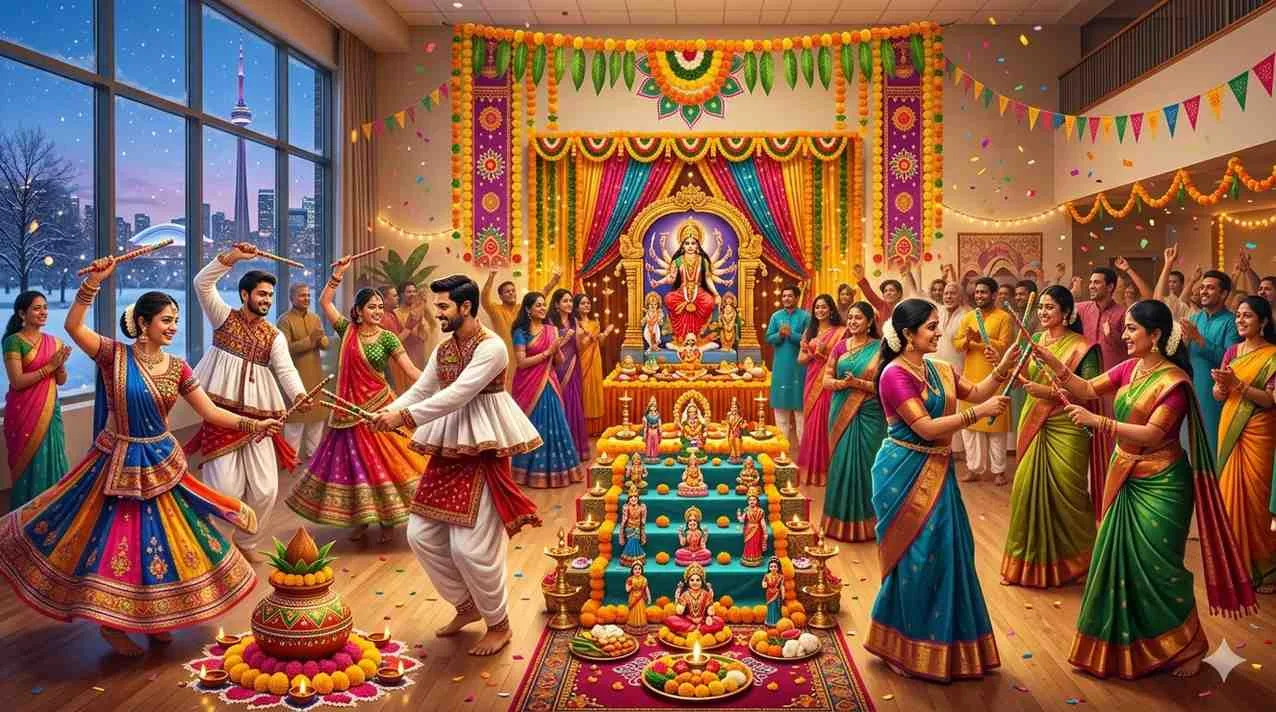
What Is Garba? Garba is a circular folk dance originating from Gujarat, performed around an earthen lamp or image of the Goddess Amba (a form of Durga). The word garba derives from the Sanskrit garbha deep — a clay lamp with holes, representing life emerging from within. The dance is devotional at its core, though it has evolved into a spectacular cultural performance.
Dandiya Raas is performed alongside Garba on certain nights — a stick dance symbolising the mock battle between Goddess Durga and the demon Mahishasura.
How It Started in Canada The Gujarati diaspora in Canada is highly organised and culturally vibrant. Many families arrived directly or via East Africa in the late 20th century. What began as small gatherings in rented halls or temple basements has grown into some of the largest Garba events in North America.
The Scale of Canadian Garba Today Today, Canadian Garba has become a major cultural phenomenon:
- Toronto’s Navrang Navratri Festival at the Enercare Centre (Exhibition Place) draws massive crowds with top artists like Kinjal Dave, Atul Purohit, Geeta Rabari, and Aditya Gadhvi — often called one of the biggest Garba celebrations in North America.
- Brampton and Mississauga host vibrant community Garba events, including outdoor nights at parks like Chinguacousy Park.
- Vancouver’s Navratri Festival Society organises large-scale events with thousands of participants.
- Calgary, Edmonton, and Montreal also host ticketed arena-style Garba nights featuring live dhol and professional productions.
The Dress: Chaniya Choli as Cultural Expression Women wear chaniya choli — a three-piece ensemble of flared skirt, blouse, and dupatta — often richly embroidered with mirrors or bandhani. Men wear kediyu and dhoti or churidar.
In Canada, Navratri fashion thrives in areas like Gerrard Street (Toronto), South Asian markets in Brampton, and Indian boutiques in Vancouver and Calgary. Families often order custom outfits from Gujarat or buy from local diaspora designers. Social media influencers showcase “navrang” — nine different outfits for nine nights.
Community Voice: “I’ve been going to Garba since I was a child in Toronto. My mum would stitch my first chaniya choli. Now we shop locally, but the energy when you step into the circle — that feeling is exactly the same.” — Heena Patel, 34, Toronto
The Music: Dhol, Synthesiser & Remix Culture Traditional Garba fuses with Bollywood, electronic beats, and bhangra influences in Canada. Large events feature LED lighting, professional sound systems, and both folk and contemporary artists.
Navratri Food: Fasting & Feasting Many observe vrat (fasting) during the day. Evening meals feature sabudana khichdi, rajgira puri, makhana curry, farali pattice, and more. Late-night feasts often include Gujarati snacks at community halls or Indian restaurants.
Part Two: The South Indian Celebration — Golu, Goddess & Scholarly Devotion
A Different Navratri Entirely For Tamil, Telugu, Kannada, or Malayalam families, Navratri centres on quiet artistry, family rituals, and the beautiful tradition of Golu. There is no Garba or Dandiya — instead, there is sacred display and devotional focus.
What Is Golu? Golu (Bommai Kolu / Bommala Koluvu) is a display of dolls and figurines arranged on stepped shelves (usually odd numbers: 3, 5, 7, 9, or 11). It represents a divine court with Goddess Durga at the top, followed by deities, saints, and scenes from daily life.
Golu collections are often multi-generational heirlooms, with families adding new pieces from trips to Chennai, Hyderabad, or Bengaluru.
Golu in Canadian Homes: Adapting a Sacred Tradition Canadian homes (suburban houses, townhomes, or apartments in the GTA, Vancouver, or Calgary) adapt with creative solutions — using staircases, bay windows, or compact 3–5 step setups. Dolls are sourced during India visits, from Indian stores in Toronto’s Gerrard Street or Brampton, online, and through community WhatsApp groups.
Homes with Golu welcome visitors, offering sundal (spiced legumes), kumkum, and tamboolam.
Community Voice: “Golu connects me to my grandmother in Mylapore. Now I set it up in my living room in Scarborough or Surrey, and when my daughters help, I feel her presence. It’s quieter than Garba, but it touches the heart deeply.” — Kavitha Krishnaswamy, 47, Toronto
The Nine Days & Special Rituals The festival is divided into triads for Durga, Lakshmi, and Saraswati. Saraswati Puja (Ashtami) involves placing books, instruments, laptops, and tools before the Goddess. Vijaya Dasami is auspicious for new beginnings — starting music/dance classes (Carnatic or Bharatanatyam), new ventures, or Vidyarambham for children.
Sundal: The Sacred Food of Golu A different legume sundal is prepared and offered each day (black chickpeas, white chickpeas, moong, peanuts, etc.).
Part Three: Where the Two Traditions Meet
Shared Roots, Different Flowers Both celebrate Shakti in her many forms. In multicultural Canadian Hindu families (increasingly common with Gujarati–Tamil or North–South marriages), homes often feature both Golu and weekend Garba attendance. Children grow up experiencing both joyful dance and intimate devotion.
Key Canadian Venues & Community Hubs Gujarati Garba:
- Navrang Navratri Festival at Enercare Centre, Toronto
- BAPS Shri Swaminarayan Mandir, Toronto (and other BAPS centres)
- Navratri Festival Society events in Vancouver
- Community events in Brampton, Mississauga, Calgary, and Edmonton
South Indian Navratri / Golu Events:
- Local Tamil, Telugu, and Malayalam cultural associations
- Sri Venkateswara or Murugan temples in the GTA, Vancouver, and other cities
- Community Golu displays and Saraswati Puja programs organised by Tamil Sangams
Part Four: The Experience of Celebrating Abroad
What Canada Gets Right The Canadian diaspora has created vibrant, large-scale celebrations that strengthen community bonds across vast distances. Production values in Toronto and Vancouver Garba events often rival major concerts. Intergenerational participation is strong, as children actively learn their heritage.
What Is Lost — And What Communities Do About It Challenges include adapting to Canadian fall weather (instead of post-monsoon freshness), lack of spontaneous street celebrations, and language/cultural drift in second- and third-generation families. Communities counter this with language classes, cultural programs, live-streaming Garba, virtual Golu tours, and Instagram/WhatsApp sharing.
Technology as Bridge Families stay connected with relatives in India through live streams, Zoom Golu viewings, and online communities.
Navratri Across Canadian Cities: A Quick Guide (Scale: ★★★★★ = Major hub)
The Deeper Meaning: Why Navratri Matters in the Diaspora Navratri in Canada is an anchor — proof that culture and devotion thrive far from the homeland. Whether through thunderous Garba in a Toronto arena or a serene Golu in a Scarborough or Surrey home, the Divine Mother is honoured with equal sincerity.
The dual traditions beautifully represent the spectrum of Hindu devotion: exuberant joy and quiet reflection. Neither is “more” Hindu — both are fully Hindu.
Practical Guide: Celebrating or Attending Navratri in Canada
For First-Time Garba Attendees
- Traditional Indian attire is encouraged (chaniya choli or kediyu). Hiring/borrowing is common.
- Book tickets in advance for large events like Navrang Navratri — they sell out quickly.
- Learn basic steps via YouTube — the circle is welcoming and easy to join.
For First-Time Golu Visitors
- Visit community or neighbour homes displaying Golu (most welcome guests warmly).
- Accept sundal and tamboolam graciously.
- Remove shoes before approaching the display and feel free to ask about the dolls.
How to Find Events Near You
- Gujarati Garba: Check BAPS Swaminarayan temples, local Gujarati Samaj, Navrang Navratri updates, or Facebook groups (“Navratri Garba ”).
- South Indian events: Contact Tamil/Telugu/Kannada cultural associations or nearby temples.
Conclusion: The Festival as Living Tradition Navratri in Canada is a powerful example of tradition evolving while keeping its soul. Adapted, amplified, and sometimes reinvented by the diaspora, the Goddess remains at the centre — invoked through dance or stillness, sound or silence, community or family.
It is not a lesser version of the festival “back home.” It is its own vibrant expression — shaped by migration, memory, and deep devotion.
Jai Mata Di.
Frequently Asked Questions
Q: When is Navratri 2026 in Canada? Shardiya Navratri 2026 falls between October 11–20, 2026 (Ghatasthapana around October 11), with Vijaya Dasami (Dussehra) around October 20–21 (exact timings may vary slightly by panchang). Major Garba events will concentrate on the weekends within these dates.
Q: Can non-Hindus attend Garba events? Absolutely. Most Canadian Garba events are open to all and warmly welcome non-Hindu friends and neighbours.
Q: Do I need to know how to dance to enjoy Garba? No. The circular format and simple repetitive steps make it easy to learn on the floor — many join in within minutes.
Q: Is Golu only for South Indians? Primarily a Tamil, Telugu, Kannada, and Malayalam tradition, though some other communities have adapted versions.
Q: Where can I buy chaniya choli in Canada? Popular spots include Indian boutiques on Gerrard Street (Toronto), markets in Brampton/Mississauga, South Asian areas in Vancouver/Surrey, and stores in Calgary and Edmonton — especially well-stocked in September–October.
Written for HinduTone.com — Celebrating the living traditions of the global Hindu community.
© HinduTone.com — For republication permissions, contact editorial@hindutone.com
Also read: Garba 2026 events in Canada.
Frequently asked questions
How do Gujaratis celebrate Navratri in Canada?
Gujarati communities celebrate with Garba and Dandiya Raas in community halls, parks and large arenas, wearing chaniya choli and kediyu. Toronto's Navrang Navratri Festival at the Enercare Centre is one of the biggest in North America.
What is Golu and how do South Indian families in Canada set it up?
Golu is a display of dolls on stepped shelves, usually in odd numbers like 3, 5, 7, 9 or 11, with Goddess Durga at the top. Canadian homes adapt it using staircases, bay windows or compact 3 to 5 step setups.
Is Dandiya Raas the same as Garba?
No. Garba is a circular folk dance performed around a lamp or image of Goddess Amba, while Dandiya Raas is a stick dance symbolising the mock battle between Durga and Mahishasura. Both are performed during Navratri.
What do people eat during Navratri in Canada?
Many fast during the day and eat sabudana khichdi, rajgira puri, makhana curry and farali pattice in the evening. Golu homes offer sundal, a different legume each day, along with kumkum and tamboolam.
What should first-time Garba attendees in Canada wear?
Traditional Indian attire such as chaniya choli or kediyu is encouraged, and hiring or borrowing outfits is common. Shops on Gerrard Street in Toronto, in Brampton and in Vancouver and Calgary sell them.
How do Canadian communities keep Navratri alive across generations?
They run language classes and cultural programs, live-stream Garba, hold virtual Golu tours and share through WhatsApp and Instagram. Intergenerational participation is strong, with children learning their heritage.
You might also like
Navratri Aarti Lyrics in Hindi & English – 2026 Special Collection for NRIs
Navratri 2026 Apartment-Friendly Puja Vidhi: 9-Day Diaspora Guide for NRIs in USA, UK, Canada, Australia & UAE
Navratri 2026: Complete Guide to the Nine Days of Worship, Dates, Colors, Goddesses & Rituals