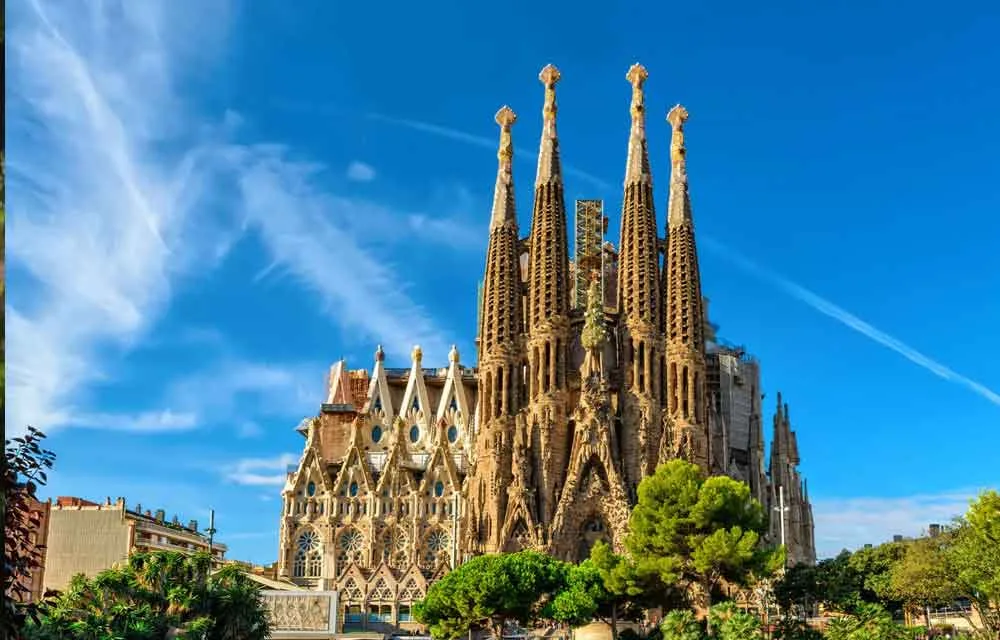
Sagrada Familia, Barcelona: Is Gaudí's Unfinished Masterpiece the Modern World's Greatest Temple?
Meta Description: Discover Barcelona's Sagrada Familia, Gaudí's breathtaking temple of art and faith.
Meta Description: Discover Barcelona's Sagrada Familia, Gaudí's breathtaking temple of art and faith.
Meta Description: Discover Barcelona's Sagrada Familia, Gaudí's breathtaking temple of art and faith. Get tickets, tower access tips, and the story behind this architectural miracle. Plan your visit!
When Architecture Becomes Prayer
Light explodes through stained glass like liquid color, transforming the soaring stone columns into a forest of kaleidoscopic trees. Above, the vaulted ceiling blooms like a canopy of geometric flowers, each surface carved with mathematical precision that somehow feels utterly organic. This is not a church—it's a hymn frozen in stone, a prayer sung in light, a temple where art and faith become inseparable.
Did you know that when construction began in 1882, critics called it "the most monstrous of temples"? Today, over 140 years later and still unfinished, the Sagrada Familia welcomes 4.5 million visitors annually and stands as humanity's most ambitious architectural undertaking—a temple that has outlived its creator by nearly a century and won't be completed until 2026 at the earliest.
This guide explores why the Sagrada Familia transcends categorization as mere "church" or "museum" to become something unprecedented: a living temple where medieval craftsmanship meets futuristic vision, where Catholic symbolism merges with natural geometry, and where the boundary between sacred space and artistic masterpiece dissolves completely.
A Brief History & Mythology: The Architect Who Spoke with God
The Vision: In 1882, a modest neo-Gothic church was planned as an "Expiatory Temple"—funded entirely by donations, built slowly as penance and devotion. The original architect resigned after one year. In 1883, a young, relatively unknown architect named Antoni Gaudí took over. He was 31 years old.
The Obsession: Gaudí would spend the next 43 years—the remainder of his life—consumed by this project. He abandoned all other commissions, moved into his workshop on-site, and begged for donations on the streets of Barcelona. When asked why construction was so slow, he famously replied: "My client is not in a hurry." His client was God.
The Tragic End: On June 7, 1926, Gaudí was struck by a tram while walking to his daily prayers. So disheveled and unrecognized, he was mistaken for a beggar and received delayed medical care. He died three days later at age 73. Barcelona gave him a funeral befitting royalty, with thousands lining the streets. He was buried in the crypt of his unfinished masterpiece.
The Destruction: In 1936, during the Spanish Civil War, anarchists set fire to Gaudí's workshop, destroying many of his original plans, models, and drawings. What remains are fragments, photographs, and Gaudí's revolutionary ideas embedded in the existing structure—forcing architects to become archaeological detectives, interpreting the master's intentions.
The Legend: Gaudí claimed the temple's design came to him through divine inspiration, that he was merely the instrument of God's vision. He studied nature obsessively—trees, bones, seashells, honeycombs—believing geometric truths revealed God's architectural language. He once said, "Originality consists in returning to the origin"—for Gaudí, that origin was the natural world as divine blueprint.
The Spiritual & Cultural Significance: A Temple Beyond Religion
More Than a Church: Pope Benedict XVI consecrated the Sagrada Familia as a minor basilica in 2010, declaring it a place of worship. Yet it transcends traditional religious architecture—it's simultaneously a temple of Catholic faith, a cathedral of nature worship, a shrine to human creativity, and a monument to persistence itself.
The Three Facades as Sacred Narrative:
- Nativity Facade (east): Life, birth, joy—Gaudí's only completed facade, exuberant with organic forms
- Passion Facade (west): Death, suffering, redemption—stark, angular, deliberately harsh
- Glory Facade (south): The path to eternal glory—still under construction, will be the main entrance
Symbolism Everywhere: Each of the 18 planned towers represents a biblical figure:
- 12 towers: The Apostles (4 on each facade)
- 4 towers: The Evangelists (surrounding the central towers)
- 1 tower: The Virgin Mary
- 1 tower: Jesus Christ—the tallest at 172.5 meters (still under construction), deliberately one meter shorter than Barcelona's Montjuïc hill because "God's creation should not be surpassed by man's"
A Living Temple: Unlike ancient temples frozen in time, the Sagrada Familia evolves. Contemporary architects continue Gaudí's work using 3D printing, computer modeling, and modern materials. Some purists object; others see it as Gaudí intended—a multi-generational offering, each era contributing its gifts.
Cultural Icon: For Catalans, it represents resilience through civil war, dictatorship, and economic hardship. For artists worldwide, it's proof that visionary madness can outlive skepticism. For believers, it's a space where faith becomes tangible geometry.
Planning Your Visit: Essential Visitor Information
How to Get There
Location: Carrer de Mallorca, 401, Eixample district, Barcelona
By Metro:
- L2 (Purple Line): Sagrada Familia station—exit directly at the temple
- L5 (Blue Line): Sagrada Familia station—same stop, two line options
By Bus: Lines 19, 33, 34, 43, 44, 50, 51, B20, B24
By Taxi/Uber: Easily accessible from anywhere in Barcelona ($10-20 USD from city center)
Walking Distance:
- From La Rambla: 30 minutes
- From Park Güell: 20 minutes
- From Gothic Quarter: 25 minutes
Pro Tip: The neighborhood around the temple offers stunning photo opportunities from multiple angles. Walk the perimeter before entering.
Best Time to Visit
Season:
- Shoulder Season (April-May, September-October): Pleasant weather, manageable crowds, perfect light
- Summer (June-August): Peak crowds, long lines, intense heat—book months ahead
- Winter (November-March): Fewer tourists, dramatic light, but some days are overcast
- Avoid: August (Barcelona's busiest month), major Catholic holidays (extremely crowded)
Time of Day:
- Morning (9:00-11:00 AM): Best light through the Nativity Facade (east side) stained glass—blues, greens, cool tones
- Afternoon (3:00-5:00 PM): Magical light through Passion Facade (west side)—reds, oranges, warm tones flooding the nave
- First Entry (9:00 AM): Least crowded, peaceful atmosphere for contemplation
- Last Entry (6:00-7:00 PM depending on season): Golden hour light, fewer visitors
The Light Show: The stained glass is the star. Visit on a sunny day for the full transcendent experience—cloudy days dramatically reduce the color spectacle.
Opening Hours and Entrance Fees
Operating Hours:
- November-February: 9:00 AM - 6:00 PM
- March, October: 9:00 AM - 7:00 PM
- April-September: 9:00 AM - 8:00 PM
- December 25-26, January 1, 6: 9:00 AM - 2:00 PM
CRITICAL BOOKING INFORMATION:
- Book online 2-4 weeks minimum in advance—tickets often sell out
- Official website: sagradafamilia.org
- Choose specific time slots—arrive 15-20 minutes early
- Tower tickets are most limited—book immediately when planning
- Student/senior discounts available (ID required)
- Children under 11 free (with adult ticket)
What to Wear (Dress Code)
This is an Active Basilica—Strict Dress Code Enforced:
- Shoulders covered: No tank tops, spaghetti straps, or bare shoulders
- Knees covered: No shorts above the knee, short skirts, or torn/ripped jeans
- No see-through clothing: Even if something is worn underneath
- No hats inside: Remove caps and headwear in the basilica
- Appropriate footwear: No beach attire or flip-flops
They Will Turn You Away: Security strictly enforces these rules. Carry a light scarf or cardigan in summer.
Practical Considerations:
- Tower Access: Requires climbing narrow spiral stairs—wear comfortable shoes, no high heels
- Elevator Available: For descent only (not for ascent)
- Photo-Friendly Clothing: Solid colors work best—avoid busy patterns that distract in photos
Exploring the Temple: A Journey Through Genius
The Exterior: Three Facades, Three Stories
Nativity Facade (East Side): The Birth of Hope
Gaudí's only completed facade during his lifetime, this is organic architecture at its wildest—dripping with life, literally and figuratively.
What to See:
- The Tree of Life: Central cypress tree crowned with white doves (the Holy Spirit)
- Hundreds of Sculptures: Angels, animals, plants—donkeys, sheep, even ducks and tortoises
- The Grotto: Hidden chamber at the base, easy to miss
- Four Towers: Representing apostles Barnabas, Jude, Simon, and Matthew
- Natural Details: Real plaster casts of plants, animals, even a stillborn baby (Gaudí believed in absolute realism)
Pro Tip: Look for the devil handing a bomb to a worker—Gaudí's subtle commentary on anarchist violence.
Passion Facade (West Side): The Geometry of Suffering
Designed by Gaudí but executed by sculptor Josep Maria Subirachs (1987-2005), this facade shocks visitors with its stark, angular brutality—intentionally harsh.
What to See:
- The Flagellation: Christ tied to a column, all sharp angles
- The Crucifixion: Suspended against stark stone
- The Magic Square: Hidden 4x4 number grid that sums to 33 (Christ's age) in multiple ways
- The Kiss of Judas: Subirachs' controversial labyrinth-like betrayal scene
- Four Towers: Apostles James, Thomas, Philip, and Bartholomew
Controversial Opinion: Many critics despise Subirachs' work as too modern, too angular, betraying Gaudí's organic vision. Others argue its harshness perfectly captures the Passion's agony—a deliberate contrast to the joyful Nativity.
Glory Facade (South Side): Still Under Construction—The Grand Entrance
This will be the main facade, representing humanity's path to God through trials and tribulations.
Coming Soon: Death, Final Judgment, Hell, and Glory—the most ambitious facade, expected completion 2026-2030.
The Interior: A Forest Made of Light
The Revolutionary Column Design:
Gaudí rejected traditional Gothic flying buttresses. Instead, he created tree-like columns that branch as they rise—inspired by studying forest canopies. Each column is unique, tilted at specific angles to distribute weight naturally, just as trees do.
Column Types:
- Porphyry (red): Heaviest load-bearing, at the center
- Basalt (dark): Medium strength, inner ring
- Granite (gray): Outer ring, lighter loads
The Nave: This 90-meter-long space feels like standing in a petrified forest beneath a geometric canopy. The ceiling rises to 45 meters (15-story building height).
The Stained Glass Symphony:
This is where mortals meet the divine:
- Morning: Blue and green glass on the Nativity side fills the space with cool, oceanic light
- Afternoon: Red, orange, and yellow glass on the Passion side ignites the interior in warm fire
- The Effect: As the sun moves, the color balance shifts—the space transforms throughout the day
Hidden Details:
- The Latin Inscription: Running along the ceiling beams—the Lord's Prayer in Latin
- The Organ: Custom-designed with 4 organs eventually combining into one (still incomplete)
- The Acoustics: Designed for perfect choral sound—attend a mass to experience this
Can't-Miss Interior Spot: Stand at the exact center of the crossing (where nave meets transept) around 4:00 PM on a sunny day—you'll be bathed in rainbow light from all directions simultaneously.
The Towers: Ascending to Heaven
Tower Access (Limited Capacity):
- Nativity Tower: Ascend 400+ steps via elevator, descend 300+ narrow spiral stairs
- Passion Tower: Similar setup, different views
- Only one tower per ticket—you cannot visit both
Nativity Tower Views:
- Overlooks the ornate Nativity Facade details
- Views toward the Mediterranean Sea
- Close-up of fruit-topped spires (symbolizing apostolic bounty)
Passion Tower Views:
- Overlooks the angular Passion sculptures
- City views toward Montjuïc and the mountains
- See the construction equipment on Jesus Christ tower
Tower Tips:
- Not for Claustrophobics: Stairs are extremely narrow (single file)
- Descent is Mandatory: No elevator down—spiral stairs only
- Children Under 6: Not permitted in towers
- Amazing Photography: Bring a wide-angle lens for the architectural details
Coming Soon: The Tower of Jesus Christ (172.5m) will have a viewing platform at 60 meters—offering 360° views of Barcelona. Expected 2026.
The Museum & Crypt
The Museum (Included in Ticket): Located in the basement, this often-overlooked treasure contains:
- Gaudí's original drawings and models (rescued fragments)
- Hanging chain models showing how Gaudí calculated structural loads (genius reversed gravity)
- Plaster casts and design evolution
- Photos of construction through decades
The Crypt:
- Where Gaudí is buried—simple tomb, inscription reads "Antonius Gaudí Cornet. Reusensis. Natus 25 Junii 1852. Mortuus Barcinone 10 Junii 1926"
- Active worship space—masses held regularly
- Pre-Gaudí neo-Gothic section—shows what the temple would have been without him
Tips for a Better Experience: Insider Strategies
How to Avoid the Crowds at Sagrada Familia
Booking Strategy:
- First entry (9:00 AM): Most peaceful, fewer tour groups, best morning light
- Last entry (7:00-8:00 PM in summer): Golden hour magic, thinning crowds
- Weekday mornings: Significantly fewer visitors than weekends
- Off-season (November-February): 50% fewer tourists than summer
Inside Navigation:
- Start in the nave center: Experience the full light effect first
- Move against the flow: Most tours go clockwise—go counter-clockwise
- Linger in the museum: 90% of visitors skip it or rush through—it's always quiet
The Best Photo Spots Most Tourists Miss
Exterior Shots:
- Plaça de Gaudí (across the pond): Classic reflection shot of Nativity Facade
- Corner of Carrer de Sardenya & Carrer de Provença: Both facades in one frame
- From Hospital de Sant Pau rooftop (15-minute walk): Elevated city context shot
- Inside the surrounding park at night: Illuminated towers against dark sky
Interior Shots:
- Looking straight up from the nave center: The branching columns create mandala patterns
- Silhouette through stained glass: Position people against the colorful windows
- The spiral staircase in the towers: Abstract geometric Instagram gold
- The museum's hanging models: Gaudí's engineering genius visualized
The Golden Hour Secret: Book the last entry slot (summer 7-8 PM). As the sun sets, warm light floods through the Passion Facade while the Nativity side glows in twilight blues—the interior becomes a supernatural color symphony with minimal crowds.
Photography Rules:
- No flash inside—ruins the natural light experience
- No tripods or professional equipment without special permits
- Respect worshippers—during mass, be discreet
A Local's Secret: What to See Nearby
Within Walking Distance:
Hospital de Sant Pau (5 minutes):
- Another UNESCO World Heritage Site by architect Lluís Domènech i Montaner
- Stunning Modernist complex, far fewer tourists
- Combined ticket available with Sagrada Familia
Park Güell (20-minute walk or short metro):
- Gaudí's whimsical park—another Barcelona must-see
- Book timed tickets separately, visit in the same day
Where Locals Eat:
La Paradeta (10-minute walk):
- Seafood market-style restaurant—choose your fish, they cook it
- Authentic Barcelona experience, reasonable prices ($$)
Els Quatre Gats (15 minutes toward Gothic Quarter):
- Historic cafe where Picasso had his first exhibition
- Art Nouveau interior, traditional Catalan cuisine ($$$)
Cervecería Catalana (5 minutes):
- Tapas bar beloved by locals—arrive early or expect waits
- Try patatas bravas and jamón ibérico ($$)
Street Food Near the Temple:
- La Boqueria Market (30 minutes): Barcelona's famous food market
- Avoid tourist traps immediately around Sagrada Familia—walk 5 blocks in any direction for authentic prices
Cultural Context & Controversial Questions
The Completion Debate:
Purists argue: The temple should remain unfinished, as Gaudí left it—a monument to incompletion, more authentic to his vision.
Pragmatists respond: Gaudí expected it to take generations; continuation honors his intent. Modern technology enables what he imagined but couldn't execute.
Your Take? When completed in 2026 (142 years after groundbreaking), will it be Gaudí's masterpiece or a modern interpretation? Decide for yourself after visiting.
Sacred Space or Tourist Attraction?
With 4.5 million annual visitors paying entry fees, some critics call it a "religious Disneyland." Yet the €26 ticket? Every euro funds construction—this remains a donation-funded expiatory temple, exactly as originally intended.
During Your Visit: Attend a morning mass (free, no ticket required, Sunday at noon). Experience the space as intended—a place of worship, not just architectural tourism.
A Temple Beyond Time
Standing beneath Gaudí's branching columns as light pours through stained glass, you witness something unprecedented in human history: a medieval cathedral built with 21st-century technology, a sacred space conceived by a man who died in 1926 but whose vision continues to materialize nearly a century later.
The Sagrada Familia is not architecture—it's a philosophy. It argues that creation itself is prayer, that patience is sacred, that beauty can be both wildly organic and mathematically precise. It's a temple that exists in perpetual becoming, never finished because perfection itself is a journey, not a destination.
Gaudí once said, "There are no straight lines or sharp corners in nature. Therefore, buildings must have no straight lines or sharp corners." But he was wrong about one thing: this temple does have straight lines—the line connecting earth to heaven, humanity to divinity, the mundane to the transcendent.
Have you visited the Sagrada Familia? Did it feel more like a church, a museum, or something entirely new? Share your experience in the comments below!
Pin this guide for your Barcelona adventure! Exploring more of Gaudí's Barcelona? Check out our guides to Park Güell: A Fairy Tale Garden and Casa Batlló: Living Inside Gaudí's Dreams.
Essential Resources:
- Official Sagrada Familia Website
- UNESCO World Heritage - Works of Antoni Gaudí
- Best Apps: TMB (Barcelona metro), Google Maps, "Sagrada Familia Official" app
- Live Construction Webcam
Responsible Travel: The Sagrada Familia receives no government funding—it's built entirely from donations and entrance fees. Your visit directly funds construction, restoration, and the completion of Gaudí's 142-year-old dream. Respect the space as both a active basilica and living architectural laboratory. This is where faith, art, and human ambition become one.
Frequently Asked Questions
Where is Sagrada Familia, Barcelona located?
Meta Description: Discover Barcelona's Sagrada Familia, Gaudí's breathtaking temple of art and faith. Get tickets, tower access tips, and the story behind this architectural miracle.
Who is the presiding deity of Sagrada Familia, Barcelona?
The temple's presiding deity and its significance are described in the guide above.
What are the timings and how do I reach Sagrada Familia, Barcelona?
Temples typically open early morning and evening; confirm current darshan timings before visiting. The nearest airport, railway station and road routes are covered in the guide above.
What is the best time to visit Sagrada Familia, Barcelona?
Major festival days and the cooler months are popular, though weekday mornings offer a calmer darshan. Plan around the temple's key festivals for the most vibrant experience.
You might also like
Shani Deva Temples Worldwide & Must-Performed Rituals — Complete Devotee's Guide

Sacred Hindu Festivals & Temple News: Divine Week — May 2026
Shani Jayanti 2026: Date, Significance, Rituals & Powerful Mantras