India and Global Hindu Diaspora Joyously Celebrate Hanuman Jayanti 2026 with Devotion and Grand Processions
New Delhi/Hyderabad, April 2, 2026 — Millions of devotees across India and the world are celebrating Hanuman Jayanti today with immense faith, fervour, and…
New Delhi/Hyderabad, April 2, 2026 — Millions of devotees across India and the world are celebrating Hanuman Jayanti today with immense faith, fervour, and…
New Delhi/Hyderabad, April 2, 2026 — Millions of devotees across India and the world are celebrating Hanuman Jayanti today with immense faith, fervour, and traditional rituals, marking the birth anniversary of Lord Hanuman — the immortal vanara warrior, epitome of strength, unwavering devotion, loyalty to Lord Rama, and selfless service.
Observed on Chaitra Purnima, Hanuman Jayanti fell on Thursday, April 2, 2026. In North India, the festival is being celebrated with great enthusiasm, while South Indian temples are also marking the day with special pujas and bhajans.
Significance of Hanuman Jayanti
Lord Hanuman, also revered as Bajrangbali, Sankat Mochan, and Pavan Putra, is worshipped for his extraordinary physical and mental strength, humility, and complete surrender to Lord Rama. Devotees believe that sincere prayers to Hanuman on this auspicious day grant courage to face life’s challenges, protection from obstacles, and success in righteous endeavours.
Traditional Celebrations Across India
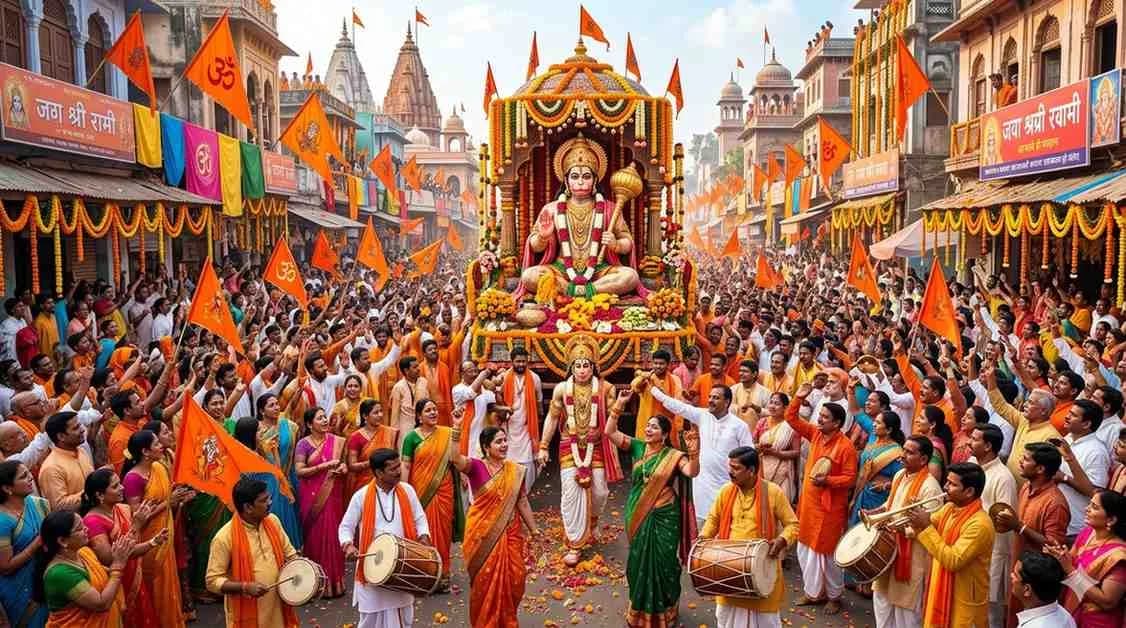
Temples and homes were beautifully decorated with marigold flowers, saffron flags, and images of Lord Hanuman. Common rituals include:
- Fasting or consuming sattvic food
- Applying sindoor to Hanuman idols
- Offering laddus, jaggery, bananas, and betel leaves
- Reciting the Hanuman Chalisa 108 times or more
- Organising Akhand Path (continuous recitation) of sacred texts
Grand Shobha Yatras (processions) were taken out in many cities, with beautifully decorated tableaux, bhajan groups, and devotees chanting “Jai Shri Ram” and “Jai Bajrangbali.”
In Gujarat, the famous Kashtabhanjan Dev Hanuman Temple in Salangpur witnessed massive crowds. Special abhishekams and large-scale community events were organised throughout the day.
Other major temples such as the Hanuman Mandir in Connaught Place (Delhi), Shri Sankat Mochan Hanuman Temple in Varanasi, and temples in Ayodhya, Mumbai, Hyderabad, and Bengaluru saw heavy footfall with devotees queuing up for darshan from early morning.
Police and local administrations in major cities deployed additional forces to ensure smooth conduct of processions and maintain peace during the festivities.
Global Celebrations by Indian Diaspora
The Indian diaspora, particularly NRIs in the USA, UK, Canada, Australia, and the Middle East, also observed Hanuman Jayanti with traditional zeal. Many temples organised special events including:
- Mass recitation of the Hanuman Chalisa
- Sundar Kand path
- Cultural programs highlighting Hanuman’s ideals of bhakti, shakti, and seva (selfless service)
Communities emphasised Lord Hanuman’s message of courage, discipline, and devotion as a guiding light amid modern-day challenges.
A Day of Strength and Inspiration
Hanuman Jayanti serves as an annual reminder of the power of pure devotion and the importance of performing one’s duty without expectation. From schoolchildren participating in fancy dress competitions as Hanuman to elderly devotees narrating stories from the Ramayana, the festival brought together people across age groups and regions.
As chants of “Jai Hanuman” echoed in temples and streets across the country and abroad, devotees prayed for strength, peace, and prosperity for their families and the nation.
Jai Bajrangbali! Jai Shri Ram!
What do the Valmiki Ramayana and Puranas reveal about Hanuman's birth and divine origin?
The Valmiki Ramayana (Kishkindha Kanda and Sundara Kanda) identifies Hanuman as the son of Anjana, an apsara who was born on earth due to a curse, and Kesari, a mighty vanara chieftain. The wind-god Vayu — also called Pavana — is held to be Hanuman's divine progenitor, which is why he carries the revered epithets Pavan Putra and Vayu Putra. This dual parentage, one terrestrial and one celestial, symbolises the union of earthly devotion with cosmic power.
The Shiva Mahapurana presents a complementary account in which Lord Shiva himself, in his Rudra aspect, took partial incarnation through Vayu to form the being who would become Hanuman — making Hanuman a Shiva-amshavatara. This theology explains why Hanuman is simultaneously worshipped as a supreme Vaishnava devotee and as a manifestation of Shiva's eleventh Rudra. The Ananda Ramayana further describes the celestial circumstances of his birth on the full-moon day of Chaitra month, the very occasion commemorated as Hanuman Jayanti.
Which scriptural texts are specifically recited on Hanuman Jayanti and why do they carry special potency on this day?
The Hanuman Chalisa, composed by the 16th-century saint-poet Goswami Tulsidas in Awadhi, remains the most widely recited text on this day. Its forty chaupais (verses) compress Hanuman's entire biography — from his childhood prank of leaping toward the sun to his role in the Lanka campaign — into a devotional framework that is accessible to every worshipper regardless of scholarly background. Tulsidas himself attests in the concluding doha that whoever recites the Chalisa with faith will receive Hanuman's personal grace.
Beyond the Chalisa, the Sundara Kanda of the Valmiki Ramayana — the fifth book, dedicated almost entirely to Hanuman's solo mission in Lanka — is considered especially auspicious for recitation on Jayanti. Temples in Varanasi, Ayodhya, and Tirupati organise Akhand Sundara Kanda Paath, uninterrupted group recitations lasting several hours. The Hanuman Ashtak and the Bajrang Baan, another Tulsidas composition invoking Hanuman's fierce protective form, are also chanted in large congregations to ward off fear and negative energies.
How is Hanuman Jayanti observed differently in South India, and what makes temples like Namakkal and Kondagattu uniquely significant?
In Tamil Nadu, Hanuman is venerated as Anjaneyar, and his Jayanti is sometimes observed on the Margazhi month full moon following a distinct regional calendar tradition, though many temples also celebrate on Chaitra Purnima in alignment with the national observance. The Sri Anjaneyar Temple in Namakkal, Tamil Nadu, houses one of the largest monolithic Hanuman sculptures in India — a rock-cut image carved directly from a hillside — and draws lakhs of pilgrims on Jayanti, with the deity adorned in elaborate flower vadam (floral garlands) stretching the full height of the image.
In Telangana, the Kondagattu Anjaneya Swamy Temple, situated on a hillock near Jagtial, is considered among the most powerful Hanuman shrines in the Deccan region. Devotees undertake the climb barefoot as an act of penance and surrender. On Hanuman Jayanti, the temple trust organises annadanam (mass feeding of pilgrims) for thousands of visitors, embodying the spirit of nishkama seva — selfless service — that Hanuman himself exemplifies. The Yadadri Lakshmi Narasimha Temple complex in Yadadrigutta also conducts special Hanuman sevas on this day, given Hanuman's inseparable connection to Vishnu's avatars.
How does the global Hindu diaspora mark Hanuman Jayanti, and what role does the celebration play in cultural identity abroad?
In the United States, major Hindu temples such as the Sri Venkateswara Temple in Bridgewater, New Jersey, and the Shiva Vishnu Temple in Livermore, California, conduct Hanuman abhishekam, Sundara Kanda recitations, and community bhajans on Jayanti. In the United Kingdom, the Shree Sanatan Hindu Mandir in Wembley and similar institutions in Leicester host processions through local streets, often drawing participation from non-Hindu neighbours and local civic leaders, making the event a moment of interfaith visibility.
For diaspora communities separated from India's sacred geography, Hanuman Jayanti functions as a powerful anchor of Sanatana Dharma identity. Reciting the Hanuman Chalisa together in a foreign country becomes an act that is simultaneously devotional and cultural — a re-affirmation of values of strength, loyalty, and selfless service that devotees consciously seek to transmit to younger generations born outside India. Community organisations in Mauritius, Trinidad, Fiji, and South Africa — nations with deep Indo-Hindu heritage — organise some of the largest Jayanti processions outside the Indian subcontinent.
What is the inner or adhyatmika significance of Hanuman's qualities that devotees are invited to internalise on this day?
Classical Vedantic commentators describe Hanuman as the ideal of dasya bhakti — the path of devotion expressed through loving service and complete surrender to the Divine. His famous declaration to Lord Rama in the Valmiki Ramayana — 'deha-buddyaa tu daaso'ham' (at the level of body I am your servant, at the level of soul I am yourself) — encapsulates the progression from ego-bound identity to non-dual realisation, making Hanuman a figure who bridges the devotional and the philosophical.
The application of sindoor to Hanuman's image carries its own symbolic depth: legend recorded in the Uttara Kanda tradition holds that when Sita applied sindoor to her hair for the longevity of Rama, Hanuman smeared his entire body with sindoor out of pure love, understanding that if a small mark aided Rama's well-being, a full covering would serve him infinitely more. Devotees applying sindoor on Jayanti thus participate in this memory of boundless love. Spiritual teachers often use the occasion to remind worshippers that Hanuman's strength — whether lifting the Dronagiri mountain for the sanjeevani herb or tearing open his chest to reveal Rama and Sita within — is not mere physical prowess but the irresistible force of one-pointed, ego-free devotion.
Frequently Asked Questions
When is India and Global Hindu Diaspora Joyously Celebrate 2026?
India and Global Hindu Diaspora Joyously Celebrate 2026 falls on April 2, 2026.
What is the significance of India and Global Hindu Diaspora Joyously Celebrate?
New Delhi/Hyderabad, April 2, 2026 — Millions of devotees across India and the world are celebrating Hanuman Jayanti today with immense faith, fervour, and traditional rituals, marking the birth anniversary of Lord Hanuman — the immortal vanara warrior, epitome of strength, unwavering devotion, loyalty to Lord Rama, and selfless service. Observed on Chaitra
How is India and Global Hindu Diaspora Joyously Celebrate celebrated?
Devotees observe it with puja, fasting or special offerings, visiting temples, chanting mantras, and gathering with family. Customs vary by region and tradition.
What should devotees do on India and Global Hindu Diaspora Joyously Celebrate?
Worship Lord Hanuman, perform the day's puja and offerings, observe the fast where prescribed, and chant the associated mantras with devotion.
You might also like

Lord Parashurama — The Warrior-Sage Avatar of Vishnu

Hanuman Worship on Saturday: Powerful Rituals & Remedies for Shani Dosha
Hanuman Chalisa: Complete Lyrics, Meaning of All 40 Verses & Benefits