
From Kitchen to Kingdom: The Role of Powerful Women in the Ramayana and Mahabharata
Celebrating the wisdom, courage, and strength of often-overlooked female characters in Hindu epics Introduction: Beyond the Celebrated Queens While names like…
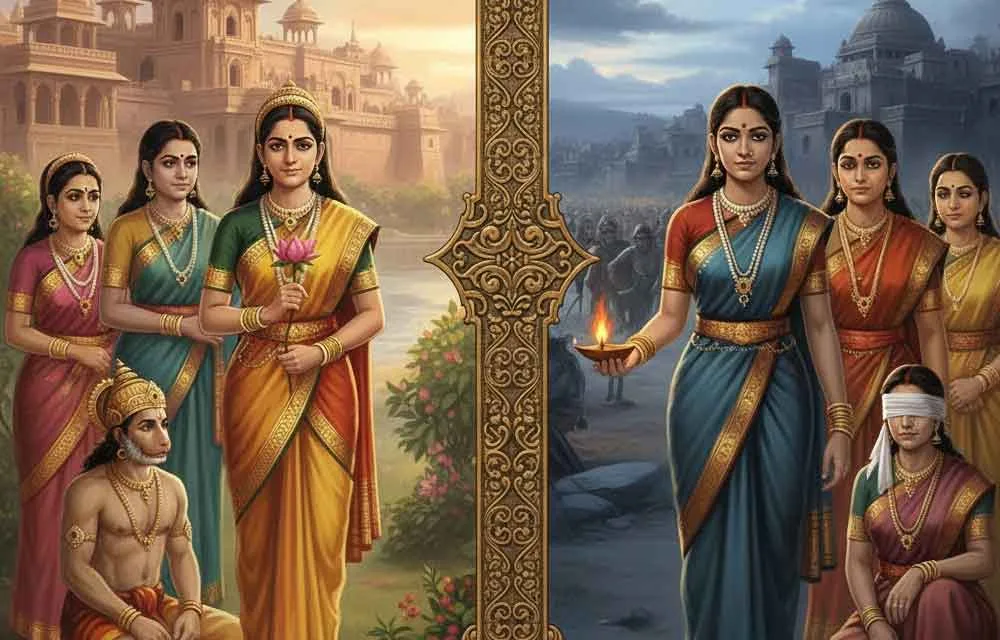
Celebrating the wisdom, courage, and strength of often-overlooked female characters in Hindu epics Introduction: Beyond the Celebrated Queens While names like…
Celebrating the wisdom, courage, and strength of often-overlooked female characters in Hindu epics
Introduction: Beyond the Celebrated Queens
While names like Sita, Draupadi, and Kunti resonate through the ages, the great epics of Ramayana and Mahabharata are rich with stories of remarkable women whose wisdom, devotion, and courage shaped kingdoms and destinies. These lesser-known characters—from humble backgrounds to royal courts—demonstrate that strength comes in many forms, and that true power often lies in devotion, wisdom, and unwavering dharma.
Shabari: The Devotion That Moved Lord Rama
The Ascetic's Journey
In the dense forests of the Dandakaranya, there lived a woman named Shabari, born into the Bhil tribe, considered outcast by society. Yet her story became one of the most touching episodes in the Ramayana, demonstrating that divine grace recognizes only the purity of devotion, not the accidents of birth.
A Life Transformed by Faith
Shabari's transformation began when, as a young woman, she fled from her own wedding after witnessing the cruel sacrifice of animals for the ceremony. Horrified by the violence, she ran into the forest where she encountered the sage Matanga. Recognizing her pure heart, he accepted her as his disciple—a revolutionary act in those times.
Under Matanga's guidance, Shabari spent years in intense devotion and service. She would rise before dawn, sweep the ashram paths, gather fresh flowers, and prepare for the day when her guru's prophecy would come true: that Lord Rama himself would visit her.
The Sacred Meeting
Years passed. Matanga attained moksha, but before leaving his mortal body, he reminded Shabari of Rama's promised visit. Now elderly, with silver hair and bent back, Shabari continued her daily rituals with even greater devotion. Each day, she would:
- Clear the forest paths of thorns, thinking, "What if the Lord's feet are hurt?"
- Collect the sweetest berries, tasting each one first to ensure only the best would be offered
- Sit at her ashram entrance, waiting with unwavering faith
When Rama and Lakshmana finally arrived, Shabari's joy knew no bounds. With tears streaming down her weathered face, she offered them the berries she had taste-tested—an act that might have been considered impure by orthodox standards. But Rama, recognizing her pure devotion, accepted them with love, declaring them the sweetest he had ever tasted.
The Ultimate Liberation
Shabari then requested Rama to share spiritual wisdom with her. The Lord spoke of nine forms of bhakti (devotion), explaining that true devotion transcends caste, gender, and social status. Her heart fulfilled, Shabari entered the sacred fire and attained moksha, her body transforming into divine light.
The Lesson: Shabari teaches us that devotion and purity of heart matter more than social status, and that patient faith is always rewarded.
Paushya (Vidura's Mother): The Silent Strength Behind a Wise Man
A Palace Maid's Destiny
The Mahabharata tells us that Vidura, renowned as the wisest counselor in Hastinapur, was born to Paushya, a palace maid serving in the royal household. Her story, though briefly mentioned, carries profound significance about dignity, wisdom, and the power of silent strength.
The Sacred Duty
When the sage Vyasa was called upon to father children to continue the Kuru lineage, Queen Ambika and Ambalika both failed to receive him properly—one closed her eyes in fear, another turned pale with apprehension. It was then that a maid, sent as a substitute, received the sage with complete composure and respect.
This maid was Paushya. Unlike the queens, she showed no fear or revulsion. She understood her dharma in that moment and performed it with grace and dignity. Her composed demeanor and respectful attitude impressed Vyasa, who blessed her with a son who would be the embodiment of dharma and wisdom.
The Mother of Dharma
Paushya gave birth to Vidura, who despite being classified as of lower status due to his mother's position, became the moral compass of the Kuru court. His wisdom is recorded in the famous "Vidura Niti," counseling righteousness even when it meant opposing kings.
What did Paushya teach her son? Though the texts don't elaborate, we can infer from Vidura's character:
- Dignity in all circumstances: Never let circumstances diminish your self-worth
- Wisdom over status: True nobility comes from character, not birth
- Fearless truth: Speak dharma regardless of consequences
- Compassion: Remember those who suffer from social hierarchies
The Lesson: Paushya reminds us that greatness can emerge from any circumstances, and that how we raise our children matters more than what we can give them materially.
Ulupi: The Naga Princess Who Chose Her Own Destiny
Beyond Conventional Marriage
Ulupi's story in the Mahabharata is remarkable for her agency, passion, and the depth of her devotion to Arjuna. A Naga (serpent) princess, daughter of Kauravya, the king of serpents, Ulupi represents a woman who defied conventions while maintaining her dharma.
The Encounter at the Ganges
During Arjuna's twelve-year exile (a self-imposed punishment for interrupting Yudhishthira and Draupadi), he was wandering through various sacred places. One evening, as he performed his ablutions in the Ganges near present-day Haridwar, Ulupi saw him and was immediately captivated by his noble bearing and divine presence.
Taking her serpent form, she pulled him gently into the waters and brought him to her magnificent palace in the Naga realm beneath the river. There, resuming her beautiful form, she stood before him and spoke with startling directness:
"I am Ulupi, daughter of the Naga king Kauravya. The moment I saw you, O Arjuna, Manmatha (the god of love) has pierced my heart with his arrows. Please accept me, for I am consumed by desire for you. You are bound by brahmacharya to Draupadi alone for this year—being with me will not violate that vow."
Arjuna's Dilemma and Ulupi's Wisdom
Arjuna was torn. He explained his vow of celibacy during his exile. But Ulupi, learned in dharma herself, argued persuasively:
"Your vow pertains to Draupadi and your brothers' agreed arrangement. I am not asking you to break that. Moreover, refusing a woman who offers herself in love is considered adharma by the learned. Save me from the fire of unfulfilled desire."
Convinced by her reasoning and moved by her genuine feelings, Arjuna spent the night with Ulupi. True to her word and understanding of dharma, she asked nothing more than this one night. She blessed him, saying:
"You shall be invincible in water, and I shall always protect you in aquatic battles."
The Devoted Wife Across Realms
Ulupi's story didn't end there. She became one of Arjuna's eight principal wives, but unlike others, she never demanded his constant presence. Instead, she:
- Bore him a son, Iravan, who would later sacrifice himself in the Kurukshetra war
- Remained in her realm, ruling with wisdom
- Came to Arjuna's aid during crucial moments
- Maintained contact with his other wives, especially befriending Chitrangada
The Ultimate Sacrifice and Devotion
The most extraordinary chapter of Ulupi's story came after the great war. When Arjuna's son Babruvahana (born to Chitrangada) unwittingly killed his own father in battle, fulfilling a curse, it was Ulupi who:
- Arrived at the scene immediately
- Revealed the curse that led to this tragedy
- Used the miraculous Nagamani (serpent jewel) to restore Arjuna to life
- Reconciled father and son
- Ensured Arjuna completed his destiny
The Philosopher Queen
Ulupi also appears in another significant episode where she saves Arjuna from a false accusation of brahmahatya (killing a Brahmin). When Arjuna was cursed and about to enter fire in repentance, Ulupi emerged from the Ganges and testified to his innocence, explaining the true circumstances. Her knowledge of dharma and courage to speak truth saved the great warrior.
The Lesson: Ulupi teaches us that a woman can be passionate yet principled, desire love while respecting boundaries, and that true devotion means supporting your beloved's dharma, even from a distance.
Sulabha: The Yogini Who Challenged a King
The Philosopher Queen
Sulabha's story appears in the Shanti Parva of the Mahabharata, during Bhishma's discourse to Yudhishthira. She was a woman who renounced her kingdom to become a wandering ascetic philosopher, seeking ultimate truth.
The Great Debate
Hearing that King Janaka of Mithila claimed to have attained moksha while still ruling his kingdom, Sulabha decided to test his claim. Using her yogic powers, she entered his court, merged her consciousness with his, and examined his mind directly.
When she emerged, she challenged him: "You claim detachment, yet you are proud of your kingdom, your learning, and your spiritual achievement. You claim to have transcended gender and status, yet you question my right as a woman to challenge you."
Janaka was initially angered by her audacity and her direct mental intrusion. But Sulabha's profound arguments about the nature of the self, the illusion of gender and status distinctions, and true detachment eventually humbled him.
The Lesson: Sulabha represents intellectual fearlessness and challenges us to question whether our spiritual achievements are genuine or merely sophisticated forms of ego.
Anusuya: The Power of Pativrata
The Devoted Wife's Shakti
Anusuya, wife of sage Atri, is celebrated as one of the seven most virtuous women in Hindu tradition. Her story appears in both epics and demonstrates how devotion generates extraordinary spiritual power.
The Test by the Trinity
In one famous episode, the divine trinity—Brahma, Vishnu, and Shiva—decided to test Anusuya's legendary pativrata (devotion to her husband). Disguised as wandering ascetics, they came to her ashram when Atri was away and demanded that she serve them food while completely naked, claiming this was their peculiar spiritual practice.
Understanding their divine nature and the test, Anusuya remained unperturbed. Through the power of her pativrata dharma, she sprinkled water on them, chanting mantras, and transformed the three gods into infants. She then nursed them lovingly as babies and served them food as they had requested—but as innocent children, not as men before whom nakedness would be inappropriate.
When their divine consorts—Saraswati, Lakshmi, and Parvati—came searching for their husbands, they found them transformed by Anusuya's power. Humbled and impressed, they requested Anusuya to restore the gods to their original forms. She did so graciously.
Pleased with her devotion, wisdom, and power, the trinity blessed her with three sons who were partial incarnations of themselves: Dattatreya (from all three), Durvasa (from Shiva), and Chandra (the moon, from Brahma).
The Compassionate Savior
In the Ramayana, when Rama, Sita, and Lakshmana visit Anusuya's ashram during their exile, she receives Sita with great warmth. Seeing the princess wearing simple hermit's clothing, Anusuya uses her spiritual powers to create beautiful, divine garments and ornaments for Sita that would never fade or decay.
More importantly, she counsels Sita on the duties of a devoted wife, sharing wisdom about patience, forgiveness, and steadfastness—advice that would sustain Sita through her upcoming trials.
The Lesson: Anusuya exemplifies how spiritual power comes from devotion, but true strength lies in using that power with wisdom and compassion.
Ahalya: The Stone That Became Divine
The Curse and the Wait
Ahalya's story is one of transformation through patience and devotion. Married to the sage Gautama, she was cursed to become stone after an incident involving Indra's deception. The details vary across texts, but the core remains: she waited in stone form for ages until Lord Rama's touch could liberate her.
The Blessing in Disguise
What seems like a curse was actually a blessing. Gautama's "curse" ensured that:
- Ahalya would be preserved until the divine avatar arrived
- She would be liberated by Rama himself
- Her story would teach countless generations about forgiveness, patience, and redemption
When Rama's foot touched the stone during his journey with Vishwamitra, Ahalya emerged in her divine form, her penance complete. She praised Rama and was reunited with her husband, both having learned profound lessons about judgment, forgiveness, and divine timing.
The Lesson: Ahalya's story teaches us that apparent setbacks may be preparations for greater blessings, and that patience and faith can transform even the hardest circumstances.
Kunti: The Mother Who Shaped History
Beyond Royalty to Wisdom
While Kunti is relatively well-known, her full story reveals depths often overlooked. Born as Pritha to the Yadava dynasty, given in adoption to her childless uncle Kuntibhoja, she represents a woman who navigated impossible choices with grace.
The Boon and the Burden
As a young girl serving sage Durvasa in her foster father's palace, Kunti impressed the notoriously short-tempered sage with her impeccable service. He granted her a boon: a mantra to invoke any god and bear his child.
Curious about the mantra's power, young Kunti invoked Surya (the sun god). The god appeared and insisted that the boon must bear fruit. Terrified of social disgrace, Kunti gave birth to Karna and abandoned him in a basket in the river—a decision that would haunt her life and shape the Mahabharata's tragic core.
The Mother's Secret
Throughout her life, Kunti carried this secret. When she later used the boon to give Pandu three sons (Yudhishthira from Dharma, Bhima from Vayu, and Arjuna from Indra) and shared the mantra with Madri (resulting in Nakula and Sahadeva from the Ashwini twins), only she knew that the enemy general Karna was her eldest son.
The Moment of Truth
Before the great war, Krishna revealed Karna's identity to him and suggested he could claim his rightful position as the eldest Pandava. Kunti, desperate to prevent her sons from killing each other, approached Karna and revealed the truth.
Karna's response was heartbreaking: "You come to me now, as a mother? When I was rejected and humiliated for my supposed low birth? When I needed a mother's defense? You seek me only to save your other sons."
Yet he promised: "I will not kill any of your sons except Arjuna. You will still have five sons after the war—either with me and four Pandavas, or without me and five Pandavas."
The Burden of Choices
Kunti lived to see her eldest son die at Arjuna's hands, knowing she could never reveal the truth publicly without devastating her other sons. She performed Karna's last rites in secret, her tears mingling with her unspoken words of maternal love that came too late.
The Lesson: Kunti's story is a complex meditation on the consequences of our choices, the weight of secrets, and how societal pressures can force even the wise into impossible decisions.
Mandodari: The Wise Queen of Lanka
The Righteous Voice in a Doomed Kingdom
Mandodari, wife of Ravana, represents the tragedy of wisdom ignored. Daughter of the celestial architect Mayasura and the apsara Hema, she was beautiful, learned, and deeply devoted to dharma.
The Counselor Unheeded
Throughout the Ramayana, Mandodari repeatedly counseled Ravana:
- Against abducting Sita: "This is adharma and will bring doom to our kingdom"
- After Kumbhakarna's death: "Return Sita and beg Rama's forgiveness"
- Before his final battle: "Your pride will destroy everything we have built"
Her wisdom was impeccable, her devotion to her husband unwavering, yet she could not save him from himself.
The Dignity in Defeat
After Ravana's death, when Vibhishana became king, Mandodari's conduct was exemplary. She:
- Performed Ravana's last rites with full dignity
- Acknowledged Rama's righteousness
- Supported Vibhishana's just rule
- Maintained the welfare of Lanka's people
Some versions say Vibhishana married her to legitimize his rule and protect her honor—a marriage she accepted with grace, putting Lanka's welfare above personal feelings.
The Lesson: Mandodari teaches us that we can be right and wise yet powerless to prevent tragedy, and that true strength lies in maintaining dignity and dharma even in defeat.
Tara: The Diplomat Queen
From Vali to Sugriva
Tara, wife of the vanara king Vali, is one of the Ramayana's most intelligent characters. When Rama killed Vali to help Sugriva, Tara's response revealed extraordinary character.
The Widow's Wisdom
Rather than cursing Rama or drowning in grief, Tara:
- Understood the complexities of dharma that led to her husband's death
- Counseled her stepson Angada to not seek revenge
- Advised Sugriva on governance and military strategy
- Became Sugriva's wife (following vanara custom) and his most trusted advisor
The Voice of Reason
Before the war with Ravana, when Sugriva grew complacent, it was Tara who:
- Reminded him of his promises to Rama
- Organized the vanara forces
- Advised on battle strategies
- Counseled Angada when his youthful pride endangered him
During the war itself, when Rama's brother Lakshmana appeared dead, Tara's knowledge of herbs and healing supported the mission to find the Sanjeevani herb.
The Lesson: Tara exemplifies resilience, political wisdom, and the ability to transcend personal tragedy to serve a greater purpose.
Draupadi: The Unconventional Queen
Beyond the Polyandrous Wife
While Draupadi is relatively well-known, certain aspects of her character deserve deeper exploration. Born from fire, daughter of King Drupada, she was meant for extraordinary purpose.
The Woman Who Questioned
Draupadi is unique in her willingness to question:
- She questioned her husbands: "Where were you when I needed you?"
- She questioned Yudhishthira: "Did you have the right to stake me after losing yourself?"
- She questioned dharma itself: "What kind of dharma allows this humiliation?"
Her questions, raised during her vastraharan (disrobing), are recorded in detail in the Mahabharata and are considered some of the most profound legal and philosophical inquiries in the epic.
The Woman Who Remembered
Unlike her husbands, who were willing to forgive and forget for political peace, Draupadi never forgot her humiliation. She:
- Kept her hair unbound as a vow until washed in Duhshasana's blood
- Reminded her husbands daily of their duty to avenge her honor
- Refused to let the trauma be swept aside for convenience
Her refusal to forget ensured that the Mahabharata war happened—for better or worse.
The Devoted Yet Independent
Despite being wife to five brothers, Draupadi maintained:
- Individual relationships with each husband
- Her own counsel in court matters
- Fierce independence of thought
- Deep spirituality and devotion to Krishna
The Lesson: Draupadi teaches us that questioning is not weakness, that trauma should be acknowledged not buried, and that a woman can be both devoted and fiercely independent.
The Common Thread: Redefining Strength
These women—from tribal devotee to warrior princess, from palace maid to philosopher queen—share common qualities:
1. Devotion as Power
They understood that true devotion (whether to God, husband, or dharma) generates spiritual strength that transcends physical limitations.
2. Wisdom Over Force
They chose wisdom, patience, and strategic thinking over brute force, often achieving what warriors could not.
3. Dignity in All Circumstances
Whether in a palace or forest, honored or humiliated, they maintained their essential dignity and self-worth.
4. Agency and Choice
Within the constraints of their times, they exercised remarkable agency—choosing their paths, speaking their truths, and shaping destinies.
5. Compassion and Service
Their strength was not just for themselves but in service of others—whether family, kingdom, or dharma itself.
Contemporary Relevance: Ancient Wisdom for Modern Times
For Today's Women
These stories offer:
- Validation that women's strength takes many forms
- Courage to question unjust systems while maintaining integrity
- Wisdom that devotion and independence aren't contradictory
- Perspective that setbacks may be preparations for greater purposes
For Everyone
These narratives teach:
- Respect for diverse forms of strength and contribution
- Recognition that true nobility comes from character, not birth
- Understanding that wisdom often resides in unexpected places
- Appreciation for those who serve dharma quietly, without fanfare
Conclusion: From Kitchen to Kingdom and Beyond
The journey from kitchen to kingdom is not about physical location but about the recognition of inherent power and worth. These women of the epics—whether they cooked in ashrams or counseled in courts—possessed and wielded extraordinary power through:
- Devotion that moved gods
- Wisdom that guided kings
- Courage that shaped wars
- Compassion that healed kingdoms
- Integrity that defined dharma
Their stories remind us that every woman contains multitudes—the devotee and the warrior, the mother and the philosopher, the servant and the sovereign. True strength isn't about choosing one identity over another but about integrating all aspects of ourselves in service of dharma.
In celebrating these often-overlooked women of the Ramayana and Mahabharata, we don't diminish the famous queens and warriors. Instead, we enrich our understanding of what feminine power truly means—diverse, multi-faceted, and eternally relevant.
May their stories inspire us to recognize and honor the Shabaris, Paushyas, and Ulupis in our own lives—women whose quiet strength, unwavering devotion, and timeless wisdom continue to shape our world, often from places we least expect to find greatness.
Om Sarva Mangala Mangalaye, Shive Sarvartha Sadhike
Sharanye Tryambake Gauri, Narayani Namostute
Salutations to Her who is the auspiciousness of all that is auspicious, who is the consort of Shiva, who is the means of accomplishing all desires, who is the refuge of all, who has three eyes, and who is Gauri, the Mother of the universe.
© HinduTone.com - Illuminating Ancient Wisdom for Modern Times
Frequently Asked Questions
What is From Kitchen to Kingdom?
Celebrating the wisdom, courage, and strength of often-overlooked female characters in Hindu epics Introduction: Beyond the Celebrated Queens While names like Sita , Draupadi, and Kunti resonate through the ages, the great epics of Ramayana and Mahabharata are rich with stories of remarkable women whose wisdom, devotion, and courage shaped kingdoms and desti
What are the key points about From Kitchen to Kingdom?
Shabari: The Devotion That Moved Lord Rama The Ascetic's Journey In the dense forests of the Dandakaranya, there lived a woman named Shabari, born into the Bhil tribe, considered outcast by society. Yet her story became one of the most touching episodes in the Ramayana, demonstrating that divine grace recognizes only the purity of devotio
Why does From Kitchen to Kingdom matter in Hinduism?
It reflects core values of Sanatana Dharma and offers practical and spiritual guidance that remains relevant across generations.
How can devotees apply From Kitchen to Kingdom in daily life?
By reflecting on its teaching, incorporating the related practices or observances into daily routine, and approaching it with sincere devotion and understanding.
You might also like

Purushottam Maas 2026: Lord Vishnu's Sacred Gift of Spiritual Multiplication & Divine Grace
Hindu Priest Jobs New Zealand 2026 — Auckland, Wellington, Christchurch Vacancies & NZ Religious Worker Visa Guide
Hindu Priest Jobs Malaysia 2026 — Batu Caves, KL, Penang Vacancies & Tamil Hindu Career Guide