Did NASA Say Sanskrit Is the Best Language for Computers? What Rick Briggs' 1985 Paper Actually Said
No NASA statement says Sanskrit is the best language for computers. The claim grew out of a single 1985 AI Magazine paper by Rick Briggs, a researcher at a NASA Ames institute, which made a much more interesting point about Sanskrit grammarians and knowledge representation. Here is what he actually wrote, how the story mutated, and what is genuinely remarkable.
No NASA statement says Sanskrit is the best language for computers. The claim grew out of a single 1985 AI Magazine paper by Rick Briggs, a researcher at a NASA Ames institute, which made a much more interesting point about Sanskrit grammarians and knowledge representation.
Quick answer: NASA has never said Sanskrit is the best or most suitable language for computers. The claim grew from one 1985 paper, "Knowledge Representation in Sanskrit and Artificial Intelligence" by Rick Briggs in AI Magazine, whose author worked at RIACS, an institute based at NASA Ames. Briggs argued something narrower and more interesting: that classical Sanskrit grammarians analysed the meaning of sentences in a way that closely parallels AI semantic nets. The paper is a researcher's article, not a NASA statement, and it does not call Sanskrit a programming language. What is real is the depth of the Sanskrit grammatical tradition, and that deserves to be told accurately.
A surprising true fact to start
The paper at the root of the myth is real and still online. AI Magazine, published by the AAAI, lists it in Vol. 6, No. 1 (Spring 1985), pp. 32-39, published 15 March 1985 (Source: AI Magazine (AAAI) article page). Its abstract makes a bold claim, but not the one you see on social media. Briggs wrote that the grammarians developed "a method for paraphrasing Sanskrit in a manner that is identical not only in essence but in form with current work in Artificial Intelligence" (Source: Rick Briggs, AI Magazine 6(1), p. 32).
What the paper actually said
| Question | What the paper shows |
|---|---|
| Who wrote it? | Rick Briggs, printed affiliation 'RIACS, NASA Ames Research Center, Moffett Field, California' |
| Where was it published? | AI Magazine (AAAI), Vol. 6 No. 1, Spring 1985, pp. 32-39 |
| Is it a NASA report? | No. One researcher's paper in an AAAI magazine; not a NASA policy, report or project |
| Which Sanskrit? | 'Shastric Sanskrit', the technical Sanskrit of later grammarians such as Nagesha Bhatta (1730-1810) |
| Main argument | Grammarians' karaka (semantic role) paraphrase matches semantic-net knowledge representation |
| Conclusion | 'a natural language can serve as an artificial language also' |
| Does it rank languages? | No. It does not call Sanskrit the 'best' language for computers or propose it as a programming language |
RIACS is the Research Institute for Advanced Computer Science, based at NASA Ames (Source: Briggs, AI Magazine 6(1), p. 32 (PDF)).
A worked example from the paper: 'Caitra goes to the village'
Briggs' central illustration is Nagesha Bhatta's paraphrase of the simple sentence "Caitra goes to the village". The Sanskrit grammarians break a sentence into karaka roles, the semantic jobs each word does in the action. Briggs lists roles such as agent, object, instrument, recipient, point of departure and locality, and compares them with the triples used in AI semantic nets (Source: Briggs, AI Magazine 6(1), pp. 34-38).
To make the idea concrete, here is our simplified illustration of the comparison, not Briggs' exact notation:
| Element of 'Caitra goes to the village' | Grammarian's view (karaka role) | Semantic-net style triple (illustrative) |
|---|---|---|
| going | The action the roles attach to | event: go |
| Caitra | Agent | go, agent, Caitra |
| the village | Object | go, object, village |
Briggs found the two analyses "not only theoretically equivalent but close in form as well". That is a genuine and striking observation about how carefully Indian grammarians analysed meaning.
His conclusion was openly speculative. He suggested the Indian analysis "may throw light on how research in AI may finally solve the natural language understanding and machine translation problems", wrote that "it is tempting to think of them as computer scientists without the hardware", and remarked that AI had been "reinventing a wheel millenia old" (Source: Briggs, AI Magazine 6(1), p. 39). That is admiration for an analytical tradition, not a claim that NASA uses Sanskrit.
How the claim mutated
Fact-checkers and journalists have tracked several versions of the story as it spread:
| Version | Where it appeared | What checkers found |
|---|---|---|
| Sanskrit is 'the most suitable language for computer software' | Viral text often citing a '1987 Forbes report' | Dilip D'Souza could not find any such Forbes report and called the claim 'an essentially meaningless statement'. Source: Scroll.in, 2015 |
| NASA's Sanskrit remark (2019) | Reports of a speech by Minister Ramesh Pokhriyal | The ministry (then MHRD) clarified: 'Minister is making reference to the scientific work of NASA scientist Rick Briggs.' Source: ETV Bharat, 12 August 2019 |
| NASA found programming in Sanskrit 'flawless' | BJP MP Ganesh Singh, Lok Sabha, December 2019 | The Wire rated it false and suggested a misread 2010 blog post copied across websites. Source: The Wire, 13 December 2019 |
| The US is building 6th- and 7th-generation Sanskrit supercomputers | Viral claim; also linked to a 2015 speech | Factly rated it false; nothing on NASA or NASA Advanced Supercomputing sites. Source: Factly |
| Briggs 'reported Sanskrit is one of the most suitable languages for computers' | A New Jersey resolution | Mark Liberman says the paper is genuine but does not support the resolution's wording. Source: Language Log, 25 July 2025 |
A pattern emerges. Each retelling drops a qualifier: "a researcher at an institute at NASA Ames" becomes "NASA", "parallels semantic nets" becomes "best for computers", and "knowledge representation" becomes "programming" or "supercomputers". Factly also reports that when Rajnath Singh made a NASA-supercomputer claim in 2015, his own website's report of that speech did not mention NASA.
Myth vs fact
| Myth | What the evidence says |
|---|---|
| NASA says Sanskrit is the best language for computers. | No NASA statement says this; the source is one researcher's 1985 paper. D'Souza: Briggs nowhere claimed Sanskrit was 'the most suitable language for computer software'. Source: Scroll.in |
| NASA found programming in Sanskrit 'flawless'. | False. Briggs discusses how a natural language could serve as an artificial language, 'but nowhere does he assert' this. Source: The Wire |
| The US is building Sanskrit-based supercomputers. | False. No such project found. Pawan Goyal: Sanskrit 'is definitely not directly usable as a programming language'. Source: Factly |
| A 1987 Forbes report called Sanskrit the most suitable language for software. | No such report found. D'Souza: if it were true, 'we'd have seen software written in Sanskrit by now'. Source: Scroll.in |
Why the real story is better than the myth
Strip away the NASA label and something genuinely impressive remains. Long before computers, Sanskrit grammarians built a system for stating, precisely and without ambiguity, who did what to whom in a sentence. A 20th-century AI researcher looked at that system and found it matched his own field's tools closely enough to write a paper about it. That says something about the Indian analytical tradition, which reaches back to Panini, whose Ashtadhyayi Paul Kiparsky calls "the most complete generative grammar of any language yet written" (Source: Paul Kiparsky (Stanford)).
Repeating a false NASA claim does that tradition no favours. When a fact-check debunks the claim, readers can come away thinking the whole subject is hype. Sharing the accurate version protects the reputation of Sanskrit scholarship.
What to say when the forward arrives
- NASA never said it. The claim comes from one 1985 paper in AI Magazine by Rick Briggs, a researcher at an institute at NASA Ames.
- The paper compared Sanskrit grammarians' analysis of meaning (karaka roles) with AI semantic nets and found them strikingly similar.
- It did not say Sanskrit is the best language for computers or a programming language.
- The grammatical tradition behind it, from Panini onward, is one of the great intellectual achievements in any language, and that is worth sharing.
Frequently asked questions
Did NASA say Sanskrit is the best language for computers?
No. No NASA statement says this. The claim traces back to Rick Briggs' 1985 paper in AI Magazine, written by one researcher at RIACS, an institute at NASA Ames. The paper compared Sanskrit grammarians' semantic analysis with AI semantic nets; it did not rank languages or call Sanskrit the best for computers.
Who was Rick Briggs?
The author of 'Knowledge Representation in Sanskrit and Artificial Intelligence', AI Magazine Vol. 6, No. 1 (Spring 1985), pp. 32-39. His printed affiliation was 'RIACS, NASA Ames Research Center, Moffett Field, California'.
What did Briggs' paper actually argue?
That the traditional Sanskrit grammarians' way of paraphrasing sentences into semantic roles (karaka analysis) closely parallels AI knowledge representation with semantic nets, and that 'a natural language can serve as an artificial language also'.
Can you write computer programs in Sanskrit?
Not directly. Pawan Goyal of IIT Kharagpur, quoted by Factly, says Sanskrit, like English or Hindi, 'is definitely not directly usable as a programming language'. Sanskrit is, however, an active subject of computational linguistics.
Is there a NASA project building Sanskrit supercomputers?
No. Factly found nothing on NASA's website or the NASA Advanced Supercomputing Division site about any such project and rated the claim false.
Why do politicians keep repeating the claim?
It has been retold many times. In 2019 the Education Ministry clarified that Ramesh Pokhriyal's remark referred to Briggs' work, not to NASA, and a New Jersey resolution has also cited Briggs. Fact-checkers have traced versions of the claim to distorted retellings and copied blog posts.
Related guides
- Panini's Ashtadhyayi and computer science
- AI and the Sanskrit revival in 2026
- Pingala, binary-like numbers and the Meru Prastara
- Vedic Mathematics: myth vs fact
- AI Gita chatbots: accuracy and ethics
Editor's note (9 October 2026)
This article is based on Rick Briggs' 1985 paper itself (AAAI archive) and on the fact-checks and reports linked in the text, from Scroll.in, The Wire, Factly, ETV Bharat and Language Log, checked on 9 October 2026. Quotations from Briggs are verbatim from the paper. The 'Caitra goes to the village' triple table is our simplified illustration of the comparison he makes, not his notation. We make no claim that ancient grammarians anticipated computers; the parallels discussed are those Briggs drew between two analytical systems.
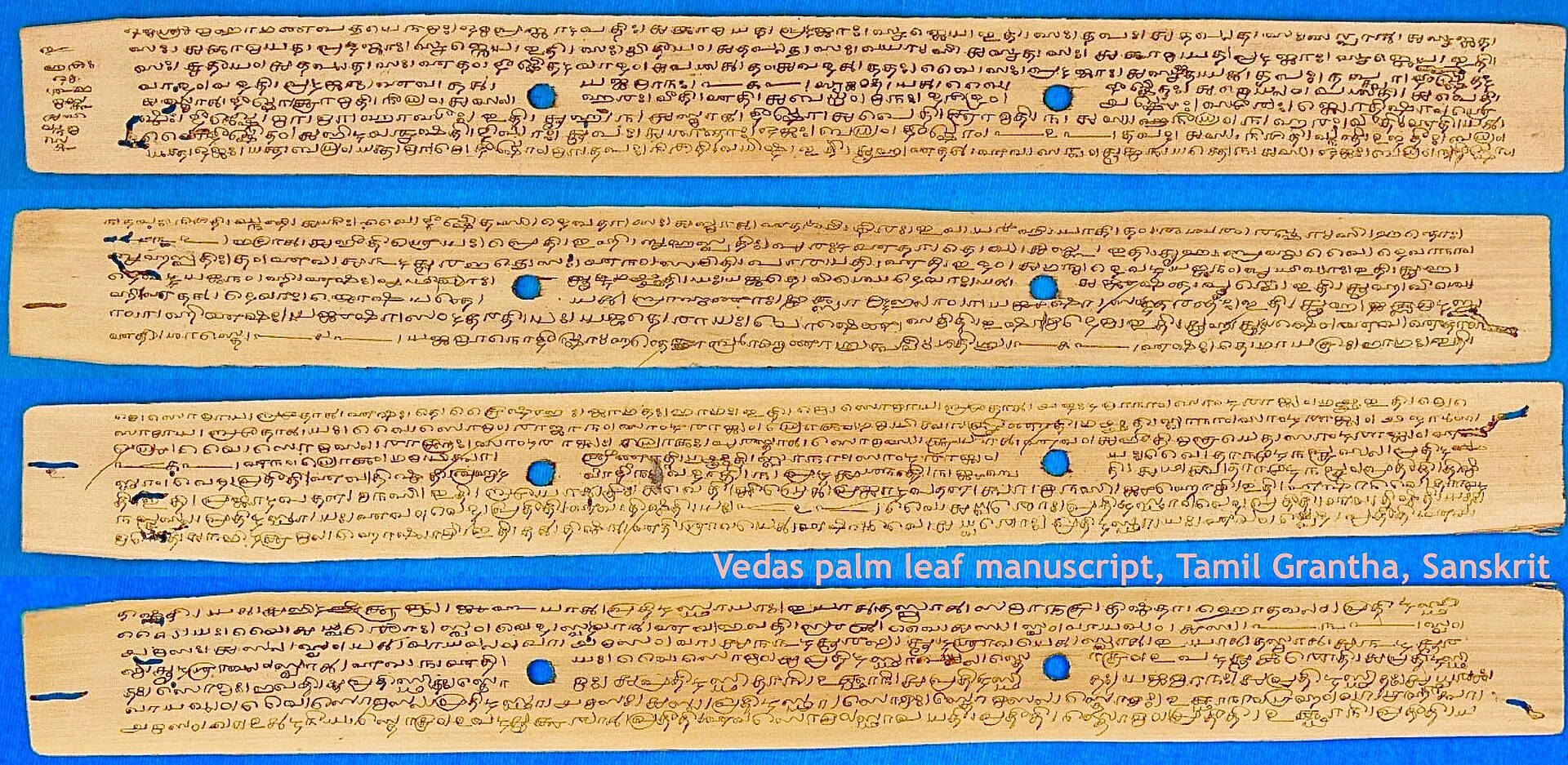
Image credit: Ms Sarah Welch, CC BY-SA 4.0, via Wikimedia Commons (https://commons.wikimedia.org/wiki/File:Vedas_palm_leaf_manuscript,_Tamil_Grantha_Script,_Sanskrit,_Tamil_Nadu.jpg).
You might also like

AI and the Sanskrit Revival in 2026: Language Models, Manuscript OCR, Translation Tools and What AI Still Gets Wrong
Vedic Mathematics: Myth vs Fact. Bharati Krishna Tirtha's 16 Sutras, Where They Come From, and What Still Works
Panini and Computer Science: How the Ashtadhyayi Works Like a Formal Rule System, and the 'Panini-Backus Form' Story