
Panini and Computer Science: How the Ashtadhyayi Works Like a Formal Rule System, and the 'Panini-Backus Form' Story
About 4,000 terse rules, a sound list compressed into 14 lines, rules that carry words forward silently and metarules that decide which rule wins: Panini's Ashtadhyayi is one of the most remarkable intellectual works ever written. Here is how it works, with a worked example, what the 1967 'Panini-Backus Form' letter really said, and where popular claims go too far.
About 4,000 terse rules, a sound list compressed into 14 lines, rules that carry words forward silently and metarules that decide which rule wins: Panini's Ashtadhyayi is one of the most remarkable intellectual works ever written. Here is how it works, with a worked example, what the 1967 'Panini-Backus Form' letter really said, and where popular claims go too far.
Quick answer: Panini's Ashtadhyayi is a Sanskrit grammar of about 4,000 sutras, usually dated to roughly the 6th to 4th century BCE (the date is uncertain). It works like a formal rule system: a coded sound inventory (the Shiva Sutras), abbreviations for sound classes, words that carry silently from rule to rule, and metarules that govern how rules apply and in what order. In 1967 P. Z. Ingerman suggested calling the programming-language notation BNF "Panini-Backus Form" to honour Panini, but Backus devised BNF independently, and scholars say the comparison simplifies how Panini's grammar really works. The real achievement needs no myth.
A surprising true fact to start
Paul Kiparsky of Stanford, one of the leading modern scholars of Panini, calls the Ashtadhyayi "the most complete generative grammar of any language yet written". It was composed in ancient India, transmitted for centuries, and still underpins how Sanskrit is analysed today (Source: Paul Kiparsky, 'Panini' (Stanford)). Widely quoted lines attributed to the linguist Leonard Bloomfield call Panini's grammar "one of the greatest monuments of human intelligence", though that attribution is secondary and its exact page has not been checked (Source: Learnsanskrit.org, 'Panini').
What the Ashtadhyayi is
Britannica describes the Ashtadhyayi ("eight chapters") as about 4,000 sutras in eight chapters, each split into quarter-chapters (Source: Encyclopaedia Britannica). Kiparsky counts 3,981 short rules, totalling 9,737 words; other sources say 3,959, so "about 4,000" is a fair round figure. He describes the full system as four parts:
| Component | What it contains | Rough computing analogy (metaphor only) |
|---|---|---|
| Ashtadhyayi | 3,981 short rules in eight chapters | The rule set |
| Dhatupatha | About 2,000 verbal roots | A lexicon of base entries |
| Ganapatha | Lists of stems | Named lists the rules refer to |
| Shiva Sutras | The sounds of Sanskrit in 14 groups | A coded alphabet |
The right-hand column is our analogy to help modern readers, not a claim that Panini thought in these terms (Source: Kiparsky).
As for when, MacTutor says "the dates given for Panini are pure guesses" and that "experts give dates in the 4th, 5th, 6th and 7th century BC" (Source: MacTutor, 'Panini').
Four design ideas that make it feel like a formal system
1. A coded sound list: the Shiva Sutras
The Shiva Sutras (also called Maheshvara Sutras) list Sanskrit sounds in 14 groups, each ending in a marker letter. Kiparsky explains the convention: a sound followed by a later marker stands for every sound from the first up to that marker. So aK means a, i, u, ṛ, ḷ. Classes defined this way "are referred to in hundreds of rules in the Astadhyayi". Tradition says the list came from the drum of Shiva; that is a sacred legend, not history (Source: Kiparsky, 'Economy and the Construction of the Sivasutras').
2. Dittoing (anuvṛtti) and headings (adhikāra)
A word stated once carries forward into the rules that follow, so it need not be repeated. Headings set the scope for long blocks: the heading padasya (8.1.16) covers more than 200 rules, and some headings stretch over "over a thousand rules in some cases". Kiparsky shows rules 8.2.23 to 8.2.30 written with the repeated words left out (Source: Kiparsky).
3. Metarules (paribhāṣā)
Some rules govern other rules. Kiparsky calls 1.1.62 a metarule: it says a deleted suffix still has effects. Rule 8.2.1, pūrvatrāsiddham, makes the last part of the grammar, the Tripadi, apply strictly in order (Source: Kiparsky).
4. Rule interaction
Many principles of how rules compete are not stated outright; later commentators worked them out, and Kiparsky says "much remains poorly understood". That honesty matters: the grammar is brilliant, but it is not a finished machine specification.
Worked example: one rule, step by step
Here is a textbook illustration of how pratyaharas let one short rule cover many cases. Rule 6.1.77 of the Ashtadhyayi reads iko yaṇ aci. Unpacked with the Shiva Sutra abbreviations:
| Piece | Pratyahara | Sounds it covers |
|---|---|---|
| ikaḥ ("in place of iK") | iK | i, u, ṛ, ḷ |
| yaṇ ("yaṆ is substituted") | yaṆ | y, v, r, l |
| aci ("before aC") | aC | any vowel |
Read as an instruction: when i, u, ṛ or ḷ is followed by a vowel, replace it with the matching semivowel (i becomes y, u becomes v, ṛ becomes r, ḷ becomes l).
- Input: dadhi + atra ("curd" + "here")
- The final i of dadhi is in iK, and the next sound a is in aC, so the rule applies
- i is replaced by its matching member of yaṆ, which is y
- Output: dadhy atra, written together as dadhyatra
Three syllables of rule text, plus a shared sound list, handle a whole family of vowel junctions. Anyone who has written a pattern-matching rule in software will feel the family resemblance; that resemblance is an analogy, not a historical connection.
The 1967 'Panini-Backus Form' letter
BNF (Backus Normal Form or Backus-Naur Form) is a notation for writing the grammar of programming languages. In a letter to Communications of the ACM, vol. 10, no. 3 (March 1967), P. Z. Ingerman proposed calling it "Panini-Backus Form". He argued that Panini's notation "is equivalent in its power to that of Backus" and that Panini was "the earlier independent inventor of the notation" (Source: INDOLOGY list reproduction of Ingerman, CACM 10(3)).
Notice the word independent. MacTutor says Backus came up with his notation independently in 1959. Indologist Dominik Wujastyk adds that Ingerman's claim "rests on a simplified view of how Panini's grammar works", ignoring rule ordering, blocking and scoping, but "nevertheless, the general idea of BNF-style rewriting rules is there" (Source: INDOLOGY list, Dominik Wujastyk, April 2020).
Chomsky, generative grammar and how powerful Panini's system is
In the preface to Aspects of the Theory of Syntax (1965), Noam Chomsky wrote that "even Panini's grammar can be interpreted as a fragment of such a "generative grammar," in essentially the contemporary sense of this term". A stronger line, "The first generative grammar in the modern sense was Panini's grammar", is attributed to a 2001 Kolkata speech but appears only in secondary reports. Oxford Sanskritist John Lowe (2021) disputes claims that Panini's system has full context-sensitive power and argues that Panini assumed acyclicity, which limits it (Source: John J. Lowe, 'Revisiting Panini's generative power').
Sanskrit in computational linguistics today
The most concrete link between Panini and computing today runs the other way: computer scientists build tools to analyse Sanskrit, often using Indian grammatical theory.
- Gérard Huet (Inria) built the Sanskrit Heritage platform: dictionaries, declension and conjugation, lemmatising and a Sanskrit Reader that splits and tags sentences, released as open-source (LGPL) software in 2012 (Source: Sanskrit Heritage Site, University of Hyderabad mirror).
- Amba Kulkarni founded the Department of Sanskrit Studies at the University of Hyderabad (2006); her group built Samsaadhanii, applying Indian grammatical theory including shabdabodha (Source: Dharmamitra profile).
- The International Sanskrit Computational Linguistics Symposium began at Inria Paris-Rocquencourt on 29-31 October 2007; the 8th met at IIT Roorkee in March 2026, and a 9th is announced for Pune in January 2027 (Source: ACL Anthology).
Myth vs fact
| Myth | What the evidence says |
|---|---|
| BNF was taken from Panini, or Panini's grammar is the same thing as BNF. | Backus worked independently in 1959; Ingerman only proposed a name. Wujastyk: the comparison ignores rule ordering, blocking and scoping. Source: INDOLOGY list |
| Panini's date is firmly known, for example the 7th century BC. | MacTutor calls the dates 'pure guesses'; proposals run from the 7th to the 4th century BCE. Source: MacTutor |
| Chomsky said Panini's grammar is a modern generative grammar. | His 1965 wording says it 'can be interpreted as a fragment of' one; its power is still debated. Source: Lowe (2021) |
| Ancient grammarians foresaw computers. | No source says so. The parallels are structural analogies noticed by modern scholars. |
Frequently asked questions
Did programming languages copy BNF from Panini?
No. MacTutor says John Backus devised his notation independently in 1959. In 1967 P. Z. Ingerman proposed renaming BNF 'Panini-Backus Form' to honour Panini as 'the earlier independent inventor of the notation'. It was a naming suggestion, not evidence of borrowing.
How many rules are in the Ashtadhyayi?
About 4,000. The exact count depends on the edition: Kiparsky counts 3,981 rules and other sources say 3,959. Britannica describes eight chapters, each split into quarter-chapters.
When did Panini live?
Nobody knows exactly. MacTutor calls the dates 'pure guesses', with experts proposing anything from the 7th to the 4th century BCE. Britannica gives the 6th to 5th century BCE, and Kiparsky places Panini's Sanskrit at approximately 500 BC.
Did Chomsky say Panini wrote a generative grammar?
In 1965 Chomsky wrote, cautiously, that 'even Panini's grammar can be interpreted as a fragment of such a "generative grammar," in essentially the contemporary sense of this term'. A stronger line attributed to a 2001 Kolkata speech appears only in secondary reports.
Is Sanskrit used in computational linguistics today?
Yes, as a language to be processed by computers. Gérard Huet's Sanskrit Heritage platform and Amba Kulkarni's Samsaadhanii tools analyse Sanskrit text, and the International Sanskrit Computational Linguistics Symposium, begun in 2007, held its 8th meeting at IIT Roorkee in March 2026.
What is a pratyahara?
A short abbreviation for a class of sounds, built from the Shiva Sutras: take a sound and a later marker letter, and the pair stands for every sound in between. For example, aK means a, i, u, ṛ, ḷ.
Related guides
- Pingala, binary-like numbers and the Meru Prastara
- The NASA-Sanskrit computer myth and Rick Briggs (1985)
- AI and the Sanskrit revival in 2026
- Vedic Mathematics: myth vs fact
- Madhava and the Kerala school
- Gayatri Mantra: complete meaning
Editor's note (9 October 2026)
Historical facts, dates and quotations on this page come from the sources linked in the text, chiefly Paul Kiparsky's Stanford papers, MacTutor, Britannica, the reproduced Ingerman letter, Dominik Wujastyk and John Lowe, checked on 9 October 2026. The worked example of rule 6.1.77 is a standard teaching illustration; the computing comparisons in this article are analogies, clearly labelled, and we make no claim that Panini anticipated modern computers. The Bloomfield quotation is widely cited but secondary, as noted.
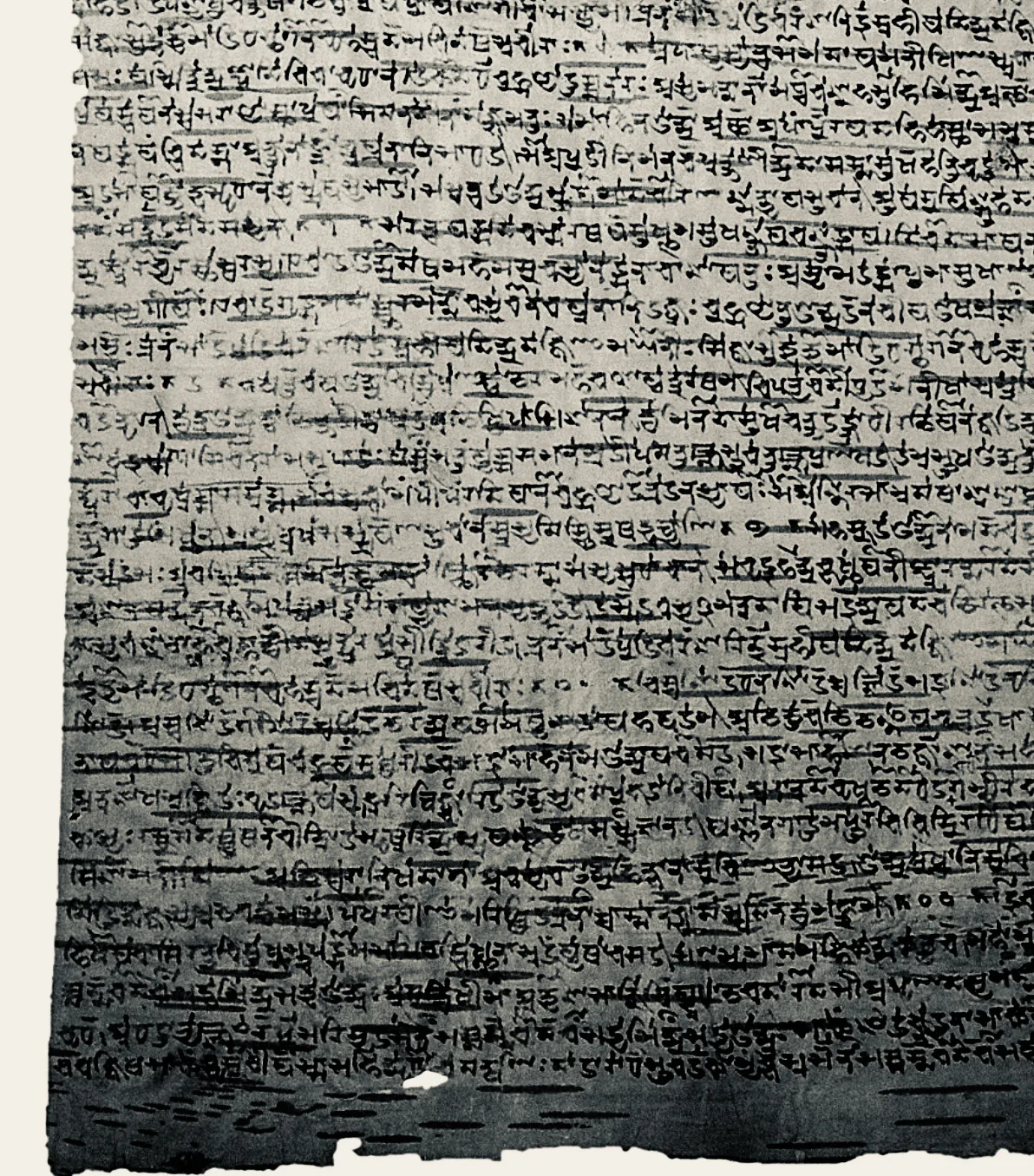
Image credit: Ms Sarah Welch, CC0, via Wikimedia Commons (https://commons.wikimedia.org/wiki/File:Rigveda_palm_leaf,_Sanskrit_language,_Sharada_script,_Kashmir.jpg).
You might also like
AI and the Sanskrit Revival in 2026: Language Models, Manuscript OCR, Translation Tools and What AI Still Gets Wrong
Did NASA Say Sanskrit Is the Best Language for Computers? What Rick Briggs' 1985 Paper Actually Said
Vedic Mathematics: Myth vs Fact. Bharati Krishna Tirtha's 16 Sutras, Where They Come From, and What Still Works
