Madhava of Sangamagrama and the Kerala School: The Infinite Series for Pi, Sine and Arctangent, Worked Out Step by Step
Around 1400, Madhava of Sangamagrama in Kerala found infinite series for pi, sine, cosine and arctangent that Europe rediscovered in the 1670s. Here is what is documented, the Madhava-Leibniz series worked out term by term, and what the evidence says about the 'Kerala invented calculus' claim.
Around 1400, Madhava of Sangamagrama in Kerala found infinite series for pi, sine, cosine and arctangent that Europe rediscovered in the 1670s. Here is what is documented, the Madhava-Leibniz series worked out term by term, and what the evidence says about the 'Kerala invented calculus' claim.
Quick answer: Around 1400, Madhava of Sangamagrama in Kerala found infinite series equivalent to the expansions of sine, cosine and arctangent. Setting x = 1 in the arctangent series gives pi/4 = 1 - 1/3 + 1/5 - 1/7 + ..., now often called the Madhava-Leibniz series. Europe found these series again in the 1670s (Gregory 1671, Leibniz 1673). Madhava's priority is well supported; the popular claim that Kerala's results were carried to Europe is not backed by direct evidence.
Here is a surprising true fact to start with: the series that most students first meet under the name of Leibniz was being studied in Kerala more than two centuries before Leibniz published it in 1673, and the man credited with it left no surviving book on it. We know Madhava's series because his students and their students wrote them down, explained them, and attributed them to him. This guide separates what is documented from what is popularly claimed, and then works through the actual numbers so you can see what Madhava was dealing with.
Who was Madhava? What the sources actually say
Madhava is conventionally dated c. 1340 to c. 1425, but there is no definite evidence for these dates. His astronomical work Venvaroha uses 1400 CE as its epoch. MacTutor gives 1350 to 1425, and the mathematician David Mumford says he lived from approximately 1350 to 1425 (Source: V. N. Krishnachandran, arXiv:2405.11134, 2024).
Even his village is debated. Sangamagrama is commonly identified with Irinjalakuda in Kerala, but Krishnachandran writes that there is "not much concrete ground for this belief" and prefers Kudallur on the Nila river. MacTutor says Madhava was born near Cochin (Source: Krishnachandran, arXiv:2405.11134).
Madhava founded the Kerala school, but none of his mathematical writings on the series survive. Nilakantha and Jyesthadeva attribute the series to him, and Mumford notes that "a large proportion" of the school's results were credited by later writers to Madhava. Some historians remain cautious about whether every series credited to him is his own or came from his followers (Source: MacTutor, Madhava of Sangamagramma).
The Kerala school as astronomers
These were mathematician-astronomers. Their series served calculations in astronomy, which is why the 2008 critical edition of Jyesthadeva's great text carries the subtitle "Rationales in Mathematical Astronomy" (Source: Springer, Ganita-Yukti-Bhasa). The lineage that preserved Madhava's work runs through a few key names:
| Person / text | Date (as given in sources) | What it contributes |
|---|---|---|
| Madhava of Sangamagrama | c. 1340 to c. 1425 (uncertain) | Series for sine, cosine, arctangent and pi; correction terms; pi to 11 decimals |
| Nilakantha Somayaji, Tantrasangraha | Born 1444; text written 1501 | Presents and extends Madhava's results; faster series for pi/4 |
| Jyesthadeva, Ganita-Yuktibhasa (Malayalam) | c. 1530, about 1540 or about 1550, by source | Derivations (yukti) of the school's series |
| C. M. Whish, Transactions of the Royal Asiatic Society | 1834 | Cited by some sources as the first Western notice |
| Gregory; Leibniz; Newton (Europe) | 1671; 1673; c. 1676 | Independent rediscovery of arctan, pi/4 and sine/cosine series |
Nilakantha's Tantrasangraha of 1501 derives the arctangent series and adds several series for pi/4 that converge faster than the basic one, results MacTutor notes appear "nearly three hundred years" before Leibniz and Gregory (Source: MacTutor, Nilakantha Somayaji). Jyesthadeva's Ganita-Yuktibhasa, written in Malayalam rather than Sanskrit verse, gives derivations of the series; its date is given variously as c. 1530, perhaps about 1540, and about 1550 (Source: Springer).
The three series, in modern notation
Madhava found infinite series equivalent to what we now call the Maclaurin expansions of sin x, cos x and arctan x. In Europe these reappeared more than two centuries later (Source: MacTutor). In modern symbols (Madhava himself expressed results in verse and words, not this notation):
- Sine: sin x = x - x^3/3! + x^5/5! - x^7/7! + ...
- Cosine: cos x = 1 - x^2/2! + x^4/4! - x^6/6! + ...
- Arctangent: arctan x = x - x^3/3 + x^5/5 - x^7/7 + ... (for x between -1 and 1)
Put x = 1 into the arctangent series. Since arctan 1 = pi/4, you get pi/4 = 1 - 1/3 + 1/5 - 1/7 + ... Recent literature also calls this the Madhava-Gregory or Madhava-Newton series to recognise Madhava's priority (Source: Wikipedia, Madhava series).
Worked example: the Madhava-Leibniz series term by term
Multiply both sides by 4: pi = 4 x (1 - 1/3 + 1/5 - 1/7 + ...). Now add terms one at a time. The values below were computed exactly and rounded to six decimals; pi is 3.141593 to six places.
| Terms used | Partial sum x 4 | Distance from pi |
|---|---|---|
| 1 | 4.000000 | 0.858407 |
| 2 | 2.666667 | 0.474926 |
| 3 | 3.466667 | 0.325074 |
| 4 | 2.895238 | 0.246355 |
| 5 | 3.339683 | 0.198090 |
| 6 | 2.976046 | 0.165546 |
| 10 | 3.041840 | 0.099753 |
| 100 | 3.131593 | 0.010000 |
| 1,000 | 3.140593 | 0.001000 |
| 10,000 | 3.141493 | 0.000100 |
Two things jump out. First, the sums swing above and below pi, overshooting and undershooting in turn. Second, the series is painfully slow: after 10,000 terms you still have only four correct decimal places, and every extra correct digit costs about ten times as many terms. Krishnachandran notes that "a very large number of terms" are needed even for modest accuracy (Source: Krishnachandran, arXiv:2405.11134).
How Madhava got around the slowness
Correction terms. Madhava added correction terms after cutting the series off, to estimate the remaining tail. Three correction terms attributed to him give highly precise values. Krishnachandran concludes that the reasons Kerala authors gave for them do not fully satisfy modern standards, and MacTutor suggests the corrections may come from continued fractions (Source: Krishnachandran). The table above actually hints at why a correction works: the error after n terms is very close to 1/n (0.0001 after 10,000 terms), so a well-chosen tail estimate removes most of it.
A faster series. Madhava is credited with pi correct to 11 decimal places, 3.14159265359, using 21 terms of a faster series based on the square root of 12 (Source: MacTutor). Some secondary sources quote a 13-decimal value, 3.1415926535922, so the exact figure depends on which text is followed. You can check the idea yourself with the series pi = sqrt(12) x (1 - 1/(3x3) + 1/(5x3^2) - 1/(7x3^3) + ...), which follows from the same arctangent series at x = 1/sqrt(3):
| Terms used | Value | Distance from pi |
|---|---|---|
| 1 | 3.464102 | 0.32 |
| 2 | 3.079201 | 0.062 |
| 3 | 3.156181 | 0.015 |
| 5 | 3.142605 | 0.0010 |
| 10 | 3.14159051 | 0.0000021 |
| 21 | 3.141592653596 | about 0.000000000006 |
With 21 terms the error is about six trillionths, consistent with 11 correct decimal places. Compare that with the 10,000 terms needed for four decimals above. Choosing a smarter series, rather than grinding through more terms, is a lesson that still holds in numerical computation: the speed of convergence matters more than raw effort.
How good was the reasoning? What historians say
Mumford describes the Kerala school's methods as "recursion, induction, and careful passage to the limit" and finds it "fair" to compare Madhava with Newton and Leibniz. He judges the Yuktibhasa derivation of the sine series "completely correct" but "not a rigorous proof by modern standards", adding that it can be made rigorous with standard epsilon-delta methods (Source: David Mumford, Notices of the AMS, 2010).
Kim Plofker describes the Kerala school as responsible for important results on infinite series and infinitesimal methods that European mathematicians later rediscovered. She says the school first became known to European historians in the mid-19th century, while other sources point to C. M. Whish's 1834 paper as the first Western notice (Source: Kim Plofker, Aestimatio 10, 2013).
Myth vs fact: did Kerala give calculus to Europe?
This is where enthusiasm often runs ahead of evidence. The real achievement does not need exaggeration.
| Popular claim | What the evidence says |
|---|---|
| "It is established that Kerala invented calculus and passed it to Europe." | In 2007 George Gheverghese Joseph and colleagues claimed circumstantial evidence that Kerala results reached Jesuit missionaries. Their own archive search, reported in 2009, "yielded no direct evidence of the conjectured transmission". Ugo Baldini found no serious sign of scientific exchange "more than occasional". |
| "Indians predated Newton, and transmission is shown." | The 2007 Manchester release headline said "Indians predated Newton discovery by 250 years". The priority for the series is well supported; the transmission claim was explicitly circumstantial and was not confirmed by the follow-up work. |
| "Leibniz or Gregory copied Madhava." | No document shows either had access to Kerala texts. Standard histories treat the 1670s European results as independent rediscoveries, while recognising Madhava's priority by about 250 to 300 years. |
| "The Kerala texts contain fully rigorous modern calculus." | The Yuktibhasa uses careful limiting arguments, but Mumford calls the sine derivation correct yet not rigorous by modern standards. The achievement is the series and limit-based reasoning, not a full formal calculus. |
Sources for the table: Source: Kim Plofker, Aestimatio 10 (2013); Source: University of Manchester news release (2007); Source: David Mumford, Notices of the AMS (2010). To be fair to both sides: Joseph argues that historians demand a higher standard of proof for East-to-West transmission than for West-to-East, while Plofker calls the remaining idea of indirect transmission through craftsmen or navigators "a very vague and speculative conjecture".
Why Madhava still matters
- Priority is real: the series for sine, cosine and arctangent, and the pi/4 series, were known in Kerala around 1400, roughly 250 to 300 years before Europe.
- The method was modern in spirit: summing infinitely many terms, estimating the leftover tail and taking careful limits are core ideas of analysis.
- The lesson is practical: Madhava saw that a slow series is not enough and looked for corrections and faster series, the same instinct behind every efficient numerical method.
- The texts are readable: the Yuktibhasa explains why the results hold, not just what they are, and an English translation exists.
For families teaching children about India's place in the history of science, Madhava is an ideal example: a documented, checkable achievement that holds up under expert scrutiny. Pair it with the stories of Pingala and binary-like enumeration and Panini's grammar.
Frequently asked questions
Who was Madhava of Sangamagrama?
A mathematician-astronomer from Kerala, conventionally dated c. 1340 to c. 1425, though the dates are uncertain. He founded what historians call the Kerala school. None of his own writings on the series survive; his results are known through later members of the school such as Nilakantha Somayaji and Jyesthadeva.
What is the Madhava-Leibniz series?
It is pi/4 = 1 - 1/3 + 1/5 - 1/7 + 1/9 - ..., the arctangent series evaluated at x = 1. It is also called the Madhava-Gregory or Madhava-Newton series in recent literature, recognising that Madhava had it about 250 to 300 years before Gregory (1671) and Leibniz (1673).
Did Madhava invent calculus?
He and his school found infinite series for sine, cosine and arctangent and used limit-based reasoning. Mumford finds it fair to compare Madhava with Newton and Leibniz, but the Kerala texts do not contain a full modern formal calculus, and their derivations are not rigorous proofs by modern standards.
Did Europe copy the Kerala school's results?
There is no direct evidence. A search of European Jesuit archives reported in 2009 found no direct evidence of transmission, and standard histories treat the 1670s European results as independent rediscoveries while recognising Madhava's priority.
How accurate was Madhava's value of pi?
He is credited with 3.14159265359, correct to 11 decimal places, using 21 terms of a faster series based on the square root of 12. Some secondary sources quote a 13-decimal value, so the exact figure depends on which text is followed.
Where can I read the Kerala school's derivations?
Jyesthadeva's Ganita-Yuktibhasa, written in Malayalam, gives the derivations. A critical edition with English translation by K. V. Sarma, with notes by K. Ramasubramanian, M. D. Srinivas and M. S. Sriram, was published by Springer and Hindustan Book Agency in 2008.
Related guides
- Panini's Sanskrit grammar and computer science
- Pingala, binary numbers and the Meru Prastara
- Vedic Mathematics: myth vs fact
- The NASA-Sanskrit computer myth and Rick Briggs (1985)
- Quantum computing explained for Hindus, with Vedanta analogies
- AI and the Sanskrit revival in 2026
Editor's note (9 October 2026)
Every historical date, name and quotation on this page comes from the sources linked in the text: MacTutor (University of St Andrews), V. N. Krishnachandran's 2024 arXiv paper, David Mumford's 2010 review in the Notices of the AMS, Kim Plofker's 2013 review, the 2008 Springer edition of the Ganita-Yuktibhasa and the 2007 University of Manchester release. Where sources disagree (Madhava's dates and birthplace, the Yuktibhasa's date, the first Western notice, the number of decimals) we give each version. The partial sums in the two tables were calculated by us and can be checked with any calculator.
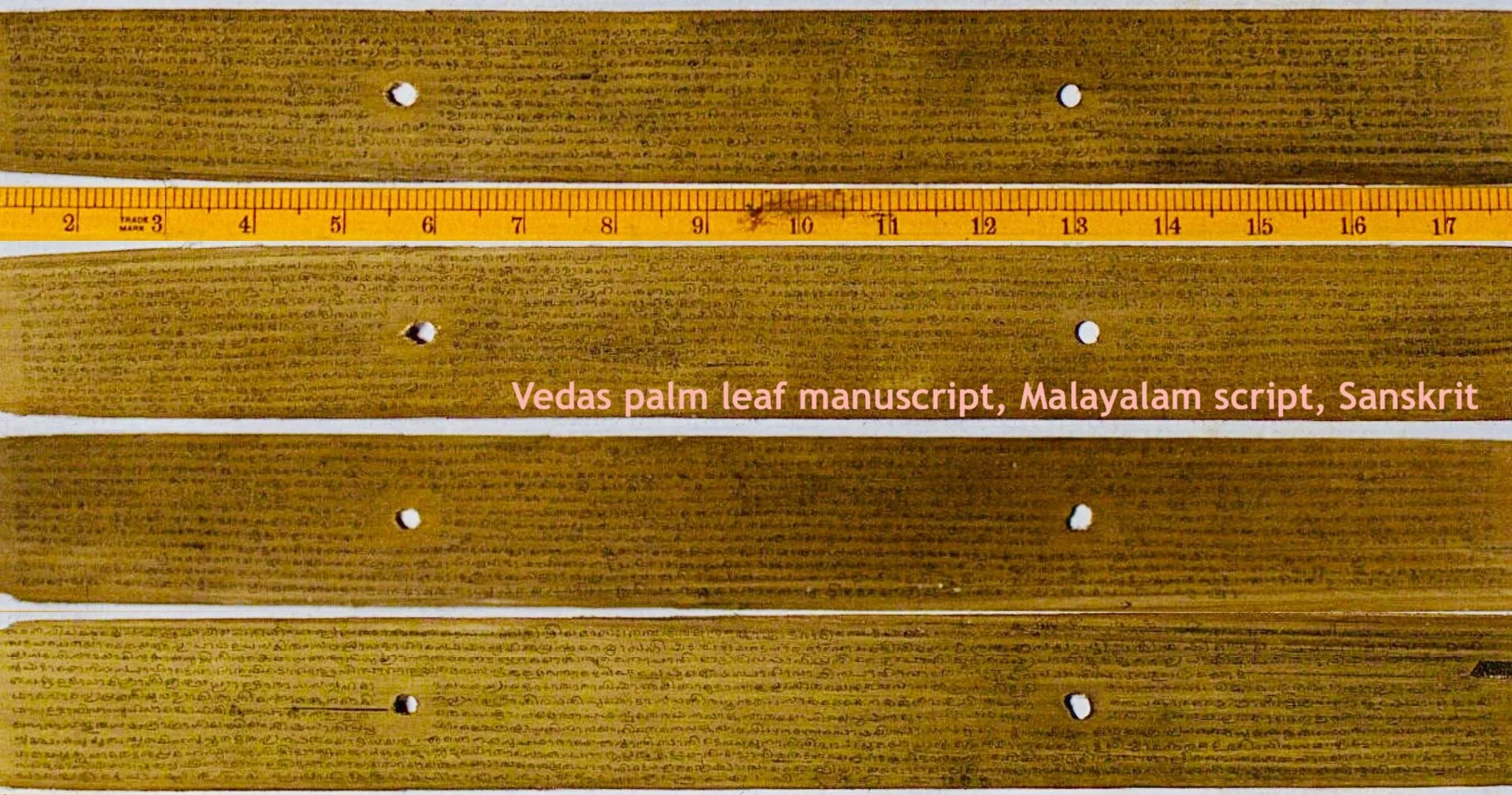
Image credit: Ms Sarah Welch, CC BY-SA 4.0, via Wikimedia Commons (https://commons.wikimedia.org/wiki/File:16th_century_Vedas_palm_leaf_manuscript,_Malayalam_Script,_Sanskrit,_Kerala.jpg).
You might also like

Robotic Elephants and AI in Hindu Temples: Kerala's Mechanical Tuskers, Tirumala's AI Command Centre and the Debate

AI and the Sanskrit Revival in 2026: Language Models, Manuscript OCR, Translation Tools and What AI Still Gets Wrong

Can a Robot Perform Puja? Robot Aarti, AI in Rituals and What Hindu Tradition Says