Quantum Computing Explained for Hindus: Qubits, Superposition and Entanglement, with Vedanta Analogies (Not Equivalences)
What is a qubit, what does entanglement really mean, and what can quantum computers do in 2026? A plain-language guide for Hindu families, with clearly labelled Vedanta analogies, the documented story of Schrodinger and Oppenheimer, and an honest myths section.
What is a qubit, what does entanglement really mean, and what can quantum computers do in 2026? A plain-language guide for Hindu families, with clearly labelled Vedanta analogies, the documented story of Schrodinger and Oppenheimer, and an honest myths section.
Quick answer: A quantum computer uses qubits, which can be in a superposition of 0 and 1 and can be entangled with each other. In 2026 these machines are still small and error-prone; they have shown advantage only on narrow scientific tasks, and builders expect commercially useful machines around the end of this decade. Hinduism and quantum computing meet in two honest ways: as philosophical analogies that help some people think about the science, and through the documented history of physicists such as Schrodinger and Oppenheimer who read the Upanishads and the Gita. The Vedas did not describe quantum mechanics.
A surprising true fact: in 1944, in the closing pages of a short book about the physics of living cells, one of the founders of quantum mechanics wrote about the Upanishads. Erwin Schrodinger, whose equation every physics student learns, explained that in Indian thought the identity of the personal self with the eternal self was considered "to represent the quintessence of deepest insight into the happenings of the world." That is a real, checkable link between modern physics and Hindu philosophy, and it is far more interesting than the myths. This guide explains the science first, then the analogies, clearly labelled, then the history and the myths.
Part 1: The science, in plain language
What is a qubit?
An ordinary computer bit is always either 0 or 1. IBM's explainer puts the quantum version this way: "A qubit can act like a bit, storing either a zero or a one," but superposition "represents a combination of all possible configurations of the qubit." When you measure a qubit, the superposition collapses and you get a definite 0 or 1 (Source: IBM Think, What is quantum computing?).
A simple picture: think of a coin. A bit is a coin lying on the table, heads or tails. A qubit in superposition is more like a coin whose outcome is not yet settled, described by how strongly it leans toward each result. Quantum algorithms are designed so that, when you finally look, the useful answers are the likely ones. The picture is imperfect, but it captures the key point: before measurement, a combination; after, one definite value.
What is entanglement?
Caltech explains that when two particles "such as a pair of photons or electrons, become entangled, they remain connected even when separated by vast distances." Measure one, and you learn something about the other. Bell's theoretical work in the 1960s and experiments by John Clauser and others from the 1970s ruled out local hidden-variable explanations. But entanglement cannot carry a message faster than light. Caltech's Thomas Vidick sums it up: "There can be correlation without communication." (Source: Caltech Science Exchange)
Why it is hard: errors
Qubits are fragile, so errors are the central engineering problem. In December 2024 Google's 105-qubit Willow chip showed "below threshold" error correction, which Google defines as "being able to drive errors down while scaling up the number of qubits": as encoded grids grew from 3x3 to 5x5 to 7x7, the error rate halved at each step (Source: Google blog, Meet Willow, 9 December 2024). These are Google's own claims, with the error-correction work published in Nature.
What quantum computers can and cannot do in 2026
| Milestone | Date | What it means |
|---|---|---|
| Google Willow: below-threshold error correction; benchmark task in under five minutes | December 2024 | Engineering progress; the benchmark has no practical use |
| Google 'Quantum Echoes' on Willow (65 qubits) | October 2025 | Verifiable advantage on a physics measurement, about 13,000 times faster than a supercomputer by Google's estimate; real-world use still ahead |
| IBM roadmap: Starling, 200 logical qubits, 100 million gates | Target 2029 | A planned fault-tolerant machine, not yet built |
| Google adds neutral-atom hardware | March 2026 | Expects commercially relevant machines 'by the end of this decade' |
| IBM and Algorithmiq advantage claim on a Heron processor | 30 July 2026 | Quantum-material simulation; open to challenge, on a noisy machine |
Sources: Source: Google Research, A verifiable quantum advantage; Source: IBM Quantum blog, path to fault-tolerant quantum computing; Source: Google blog, superconducting and neutral atom quantum computers; Source: IBM Newsroom. Google admits the related molecular-structure demonstration "is not yet beyond classical", and Algorithmiq's CEO calls establishing advantage "an ongoing process, not a single moment."
The bottom line from IBM itself: for most tasks "classical computers are expected to remain the best solution", and the two kinds of machine will work together (Source: IBM Think).
India's quantum push
- National Quantum Mission: approved by the Union Cabinet on 19 April 2023 for 2023-24 to 2030-31, with a budget of Rs 6,003.65 crore. Targets: 20-50 physical qubits in 3 years, 50-100 in 5 years and 50-1000 in 8 years. Four Thematic Hubs: Quantum Computing (IISc Bengaluru), Quantum Communication (IIT Madras with C-DOT), Quantum Sensing and Metrology (IIT Bombay) and Quantum Materials and Devices (IIT Delhi) (Source: PIB, National Quantum Mission).
- QpiAI-Indus: on World Quantum Day 2025, Bengaluru startup QpiAI, one of eight startups selected under the mission, launched a 25-qubit superconducting system the government portal calls "India's first full-stack quantum computer". It is a small, noisy machine (Source: India Science, Technology & Innovation portal).
- Amaravati Quantum Valley: Andhra Pradesh is to host an IBM Quantum System Two with a 156-qubit Heron processor. An October 2026 report says it is now "expected to become operational in the city in early 2027" (Source: APAC News Network, 6 October 2026).
Part 2: Vedanta analogies (analogy, not equivalence)
Please read this label carefully: the parallels below are metaphors that some readers find helpful for thinking about quantum ideas. They are not claims that Vedanta contains physics, and physics does not prove Vedanta. Quantum theory rests on mathematics and measurements; Vedanta is a path of inquiry into the Self. Use the analogies as bridges for conversation, not as evidence.
| Quantum idea | Vedanta idea (analogy only) | Where the analogy breaks |
|---|---|---|
| Superposition: a state is a combination until measured | Maya: the world as it appears is not the final word on reality | Superposition is precise mathematics with testable predictions; Vedanta makes no such predictions |
| Entanglement: separated particles share one correlated state | Tat tvam asi: the individual is not truly separate from the whole | Entanglement is a physical correlation between particles, not a statement about consciousness or the Self |
| No faster-than-light signals despite correlation | Neti neti: describing reality by saying what it is not | A loose parallel of humility about language; physics states its limits as exact laws |
Some popular writing also invokes 'Indra's net' as a picture of entanglement. That image comes from the Buddhist Avatamsaka tradition rather than Vedanta, so we leave it aside here.
Part 3: The documented history: physicists who read Hindu texts
Schrodinger and the Upanishads
In the epilogue "On Determinism and Free Will" of What is Life? (1944), Schrodinger wrote that "From the early great Upanishads" the recognition of Atman = Brahman ("the personal self equals the omnipresent, all-comprehending eternal self") was in Indian thought considered, far from blasphemous, "to represent the quintessence of deepest insight into the happenings of the world." He called the epilogue his subjective philosophical addendum, separate from the book's biology (Source: Schrodinger, What is Life?, via Fermat's Library).
His book My View of the World ends in a chapter called "The Vedantic Vision". A 2025 study quotes him: "this life of yours which you are living is not merely a piece of the entire existence but is in a certain sense the whole", which the Brahmins express in the formula "Tat tvam asi, this is you." The study notes that he first met Indian thought through Schopenhauer in 1918 and that his reading follows Shankara's Advaita Vedanta (Source: Thijs Latten, Berichte zur Wissenschaftsgeschichte, 2025).
Oppenheimer and the Gita
Oppenheimer learned Sanskrit at Berkeley from Professor Arthur W. Ryder and read the Gita in the original. On 7 October 1933 he wrote to his brother Frank that he was reading the Gita with two other Sanskritists. Ryder's own translation of 11.32 reads "Death am I, and my present task Destruction" (Source: Vasudha Narayanan, The Conversation / University of Florida News, 2023).
In NBC's 1965 documentary The Decision to Drop the Bomb, Oppenheimer recalled the Trinity test with the line "Now, I am become Death, the destroyer of worlds," introducing it as a line from the Gita. It paraphrases Gita 11.32, where Krishna calls himself kala (time, also death). MIT Technology Review cautions that the recollection "may have been theater" (Source: MIT Technology Review, Oppenheimer's Ghost, 2007).
Heisenberg and Tagore
Werner Heisenberg visited Rabindranath Tagore in Calcutta on 4 October 1929. The idea that this shaped his thinking rests mainly on Fritjof Capra's later account of 1972 conversations, in which Heisenberg said afterwards that "some of the ideas that had seemed so crazy suddenly made much more sense." Capra notes that Heisenberg's wife said he "was not too much impressed by his [Tagore's] thoughts" (Source: Fritjof Capra, Heisenberg and Tagore).
Myth vs fact
| Myth | What the evidence says |
|---|---|
| The Vedas described quantum mechanics. | Quantum theory was built in 1925-27 on physical measurements. Eastern ideas of oneness helped Heisenberg and Bohr come to terms with the uncertainty principle after it was made: "They did not lead up to it." (Scroll.in) |
| Schrodinger got his wave equation from the Vedas. | MacTutor credits de Broglie's thesis on matter waves, read in late 1925, as "a turning point"; he published the equation in 1926. His Vedanta interest appears in his philosophical writings. |
| Heisenberg got the uncertainty principle from Tagore. | He published it in 1927 and met Tagore in October 1929. |
| Oppenheimer said the Gita line aloud at Trinity in 1945. | The on-camera words are from 1965. His brother Frank recalled him saying simply "It worked." |
| Entanglement allows instant communication. | "There can be correlation without communication." (Caltech) |
| Quantum computers can already break all encryption. | A 2025 estimate puts RSA-2048 at just under a million noisy qubits running for about a week, far beyond today's 105 to 120 qubit chips. NIST finalised quantum-resistant standards in August 2024. |
Sources: Source: Scroll.in; Source: MacTutor, Erwin Schrodinger; Source: The Wire Science; Source: Craig Gidney, arXiv:2505.15917. The Wire Science judges it "unlikely that it helped him frame mathematical equations", and says Indian philosophy "soothed his soul".
Frequently asked questions
Did the Vedas describe quantum mechanics?
No. No ancient text contains the mathematics or experiments of quantum theory, which was built in 1925 to 1927 on physical measurements. The documented link runs the other way: some physicists later drew philosophical comfort from Upanishadic ideas.
What is a qubit in simple words?
A qubit is the basic unit of a quantum computer. Like an ordinary bit it can store a 0 or a 1, but it can also be in a superposition, a combination of possibilities. When you measure it, you get a definite 0 or 1.
Can entanglement send messages faster than light?
No. Entangled particles stay correlated even when far apart, but this cannot be used to send signals faster than light. As Caltech's Thomas Vidick puts it, there can be correlation without communication.
Was Schrodinger influenced by Vedanta?
Yes, in his philosophy. He first met Indian thought through Schopenhauer in 1918, cited the Upanishadic identity of Atman and Brahman in What is Life? (1944), and closed My View of the World with a chapter called The Vedantic Vision. His wave equation, however, grew out of de Broglie's work on matter waves, not Vedic texts.
Did Oppenheimer really quote the Gita at the Trinity test?
The famous words 'Now, I am become Death, the destroyer of worlds' come from his 1965 NBC recollection, which he introduced as a line from the Gita. The quote does not appear in a 1945 account of the test and first appears in print in 1948. He did learn Sanskrit at Berkeley and read the Gita in the original.
Does India have a quantum computer?
Small ones. Under the National Quantum Mission, the Bengaluru startup QpiAI launched a 25-qubit superconducting system in April 2025. An IBM Quantum System Two planned for Amaravati was reported in October 2026 as expected to become operational in early 2027.
Related guides
- Madhava and the Kerala school: infinite series for pi
- AI and the Sanskrit revival in 2026
- Panini's grammar and computer science
- The NASA-Sanskrit computer myth
- Bhagavad Gita: complete guide to the 18 chapters
- Adi Shankaracharya and Advaita Vedanta
Editor's note (9 October 2026)
Every scientific claim, date, number and quotation on this page comes from the sources linked in the text, including IBM, Google, Caltech, the Press Information Bureau, MacTutor, MIT Technology Review, peer-reviewed studies and Schrodinger's own book. Company claims of quantum advantage are presented as the companies' claims. The Vedanta parallels in Part 2 are our own analogies, labelled as such; they are not historical or scientific claims. The status of the Amaravati system reflects reporting from 6 October 2026 and may change.
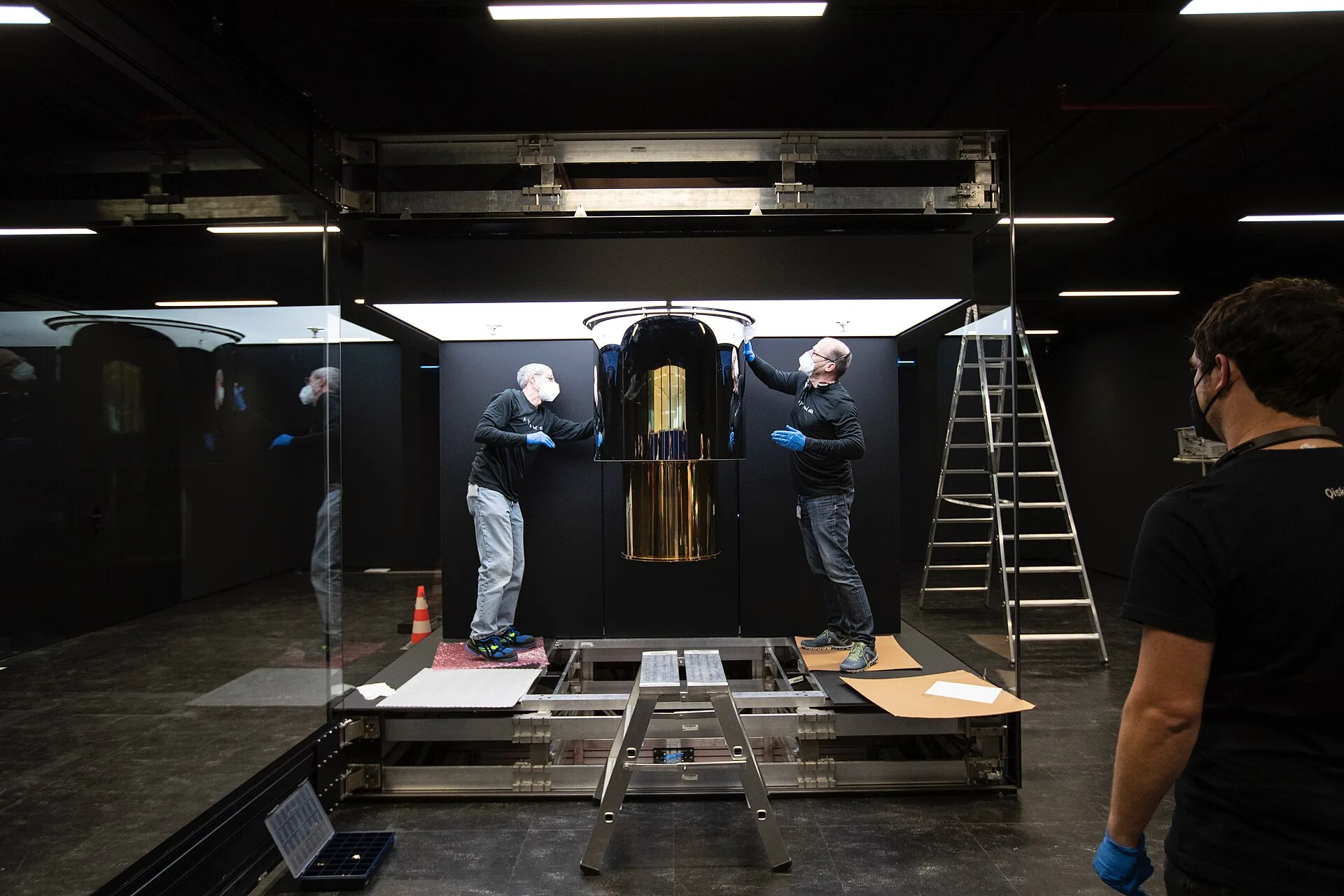
Image credit: IBM Research, CC BY 2.0, via Wikimedia Commons (https://commons.wikimedia.org/wiki/File:IBM_Q_System_One_(Fraunhofer)_installation.jpg).
You might also like
AI & Quantum Computing in the Vedas: How Ancient Hindu Wisdom Predicted Modern Science

Quantum, AI & Vedanta: Ancient Hindu Wisdom Meets Science
Hinduism and Science: How Ancient Rishis Knew Quantum Physics