Advaita, Vishishtadvaita and Dvaita Explained: The Three Great Schools of Vedanta Compared
Quick answer: All three are schools of Vedanta, built on the Upanishads, the Bhagavad Gita and the Brahma Sutras. They differ on how the individual soul (jiva) relates to God or Brahman. Advaita (Adi Shankaracharya) says they are ultimately one, non-dual. Vishishtadvaita (Ramanujacharya) says the so
Quick answer: All three are schools of Vedanta, built on the Upanishads, the Bhagavad Gita and the Brahma Sutras. They differ on how the individual soul (jiva) relates to God or Brahman. Advaita (Adi Shankaracharya) says they are ultimately one, non-dual. Vishishtadvaita (Ramanujacharya) says the soul is a real, inseparable part of God, like a body is of its soul: qualified non-dualism. Dvaita (Madhvacharya) says God and souls are eternally distinct: dualism. All three see liberation as the highest goal and honour devotion, though they explain it differently.
If you have ever wondered why a Smarta family, a Sri Vaishnava (Iyengar) family and a Madhva family can read the same Gita verse differently, the answer lies here. These three schools shape the theology of millions of Hindus, the major mathas and many temples in South India and beyond.
This guide compares them fairly and simply. It does not try to rank them. Each is a living tradition with centuries of scholarship and devotion behind it.
The Three Schools at a Glance
| Advaita | Vishishtadvaita | Dvaita | |
|---|---|---|---|
| Meaning | Non-dual | Qualified non-dual (non-duality of the qualified) | Dual |
| Main acharya | Adi Shankaracharya | Ramanujacharya | Madhvacharya (Ananda Tirtha) |
| Dates | Historians: late 7th to early 8th century CE (older estimate 788–820); some matha traditions place him much earlier | Traditional: 1017–1137 CE; recent scholarship: c. 1077–1157 CE | 1238–1317 CE (another reckoning: 1199–1278) |
| Birthplace | Kalady, Kerala | Sriperumbudur, Tamil Nadu | Near Udupi, Karnataka |
| Brahman is | Nirguna, beyond all attributes (also worshipped as Saguna Ishvara at the practical level) | Saguna: Narayana, full of auspicious qualities | Vishnu, supreme, independent, perfect |
| The soul (jiva) is | Ultimately identical with Brahman | Real; an inseparable mode or "body" of Brahman | Real; eternally distinct from and dependent on God |
| The world is | Real at the practical level; mithya (not ultimately real) from the highest standpoint | Real; the body of God | Real |
| Cause of bondage | Ignorance (avidya) of one's true nature | Karma and ignorance, beginningless | Ignorance and karma, under God's will |
| Main means to moksha | Knowledge (jnana), prepared by karma and bhakti | Bhakti and prapatti (surrender), by grace | Bhakti with right knowledge, by God's grace |
| Moksha is | Realising oneness; possible while living (jivanmukti) | Eternal loving service of Narayana in Vaikuntha, after the body falls | Eternal bliss in God's presence, each soul by its own nature |
| Key texts by the acharya | Brahma Sutra Bhashya, Upanishad and Gita commentaries, Vivekachudamani (attributed) | Sri Bhashya, Gita Bhashya, Vedartha Sangraha | Commentaries on the Brahma Sutras, Upanishads and Gita, Anuvyakhyana |
| Main institutions | Sringeri, Dwarka, Puri and Jyotirmath peethams; Kanchi Kamakoti | Srirangam, Melkote, Tirumala traditions; Vadakalai and Tenkalai lineages | Udupi Sri Krishna Matha and the eight (Ashta) Mathas |
Shared Ground: What All Three Agree On
Before the differences, it helps to see how much they share.
- The same scriptures. All accept the Prasthana Traya: the Upanishads, the Bhagavad Gita and the Brahma Sutras.
- Brahman is real and supreme.
- The soul is eternal and not the body.
- Karma and rebirth bind the soul until liberation.
- Moksha is the highest human goal.
- Devotion and ethical life are essential. Shankara himself is credited with many devotional hymns, such as the Bhaja Govindam.
The disagreements are about how to read the same Upanishadic sayings. A good example is Tat Tvam Asi, "You are That" (Chandogya Upanishad).
1. Advaita Vedanta: Non-Dualism
The teacher
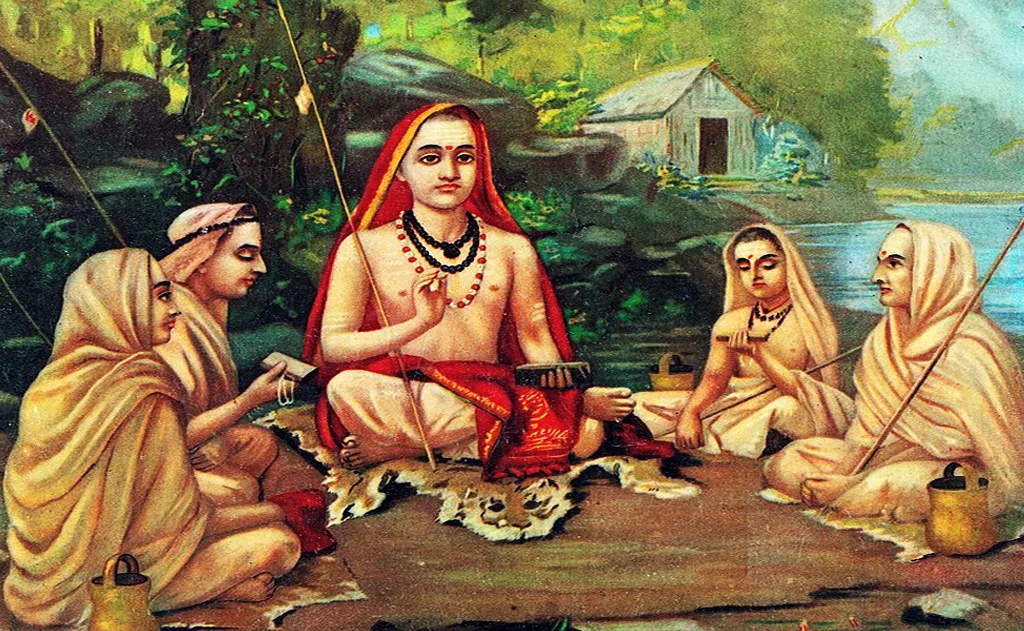
Adi Shankaracharya, born in Kalady (Kerala), is dated by most historians to the late 7th or 8th century CE; the traditional reckoning of some mathas places him many centuries earlier. In a short life he wrote commentaries on the principal Upanishads, the Gita and the Brahma Sutras. According to tradition he also travelled across India debating scholars and established the four amnaya peethams: Sringeri (south), Dwarka (west), Puri (east) and Jyotirmath (north). Read more in Adi Shankaracharya: Life, Teachings and Legacy.
The teaching
- Only Brahman is ultimately real. Brahman is pure existence, consciousness and bliss, without parts or attributes (nirguna).
- The self is Brahman. Tat Tvam Asi is read as literal identity: the "you" behind body and mind is the infinite Brahman.
- Maya. The world of many things is an appearance, like a rope mistaken for a snake. It is real for practical purposes (vyavaharika) but not ultimately real (paramarthika).
- Ishvara. The personal God is Brahman seen through maya, and is fully worthy of worship at the practical level.
- Liberation is not going somewhere. It is waking up to what one always was. It comes through knowledge (jnana) after the mind is purified by selfless action and devotion. One can be liberated while living (jivanmukta).
For a deeper beginner's introduction, read What Is Advaita Vedanta?.
2. Vishishtadvaita: Qualified Non-Dualism
The teacher
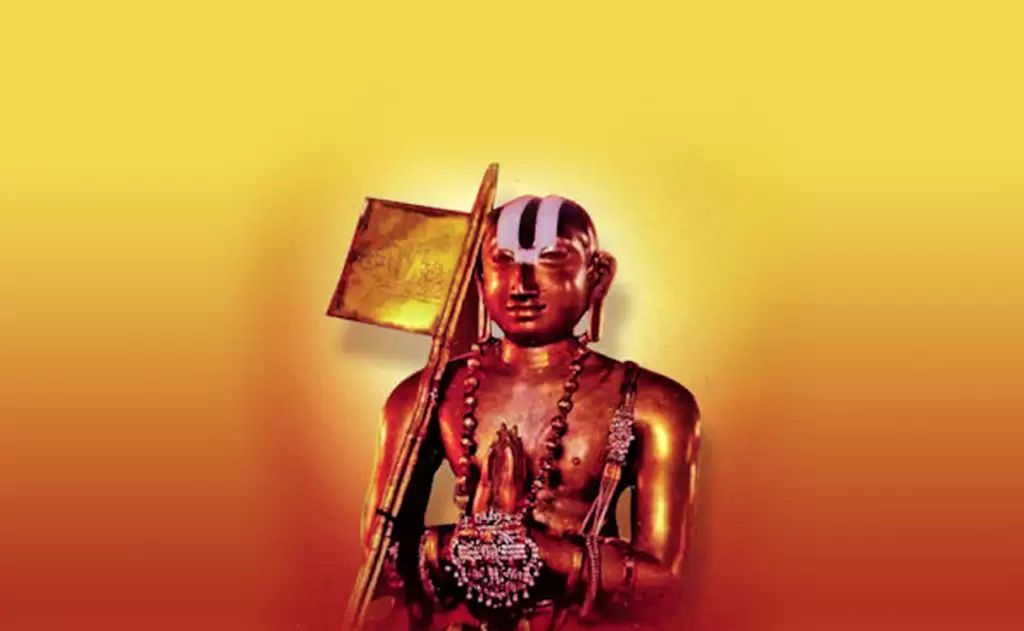
Ramanujacharya, traditionally dated 1017–1137 CE (some scholars now suggest c. 1077–1157), was born at Sriperumbudur near Chennai. He built on the teachings of the Alvars and of Yamunacharya. He became the leading acharya of Sri Vaishnavism at Srirangam, and tradition credits him with organising temple worship and opening the path of devotion widely, regardless of birth. His Sri Bhashya on the Brahma Sutras is the central text of the school. See Ramanujacharya: Life, Teachings and Relevance.
The teaching
- Three realities (tattva-traya): chit (conscious souls), achit (non-conscious matter) and Ishvara (God). All three are real.
- Body and soul. Souls and matter are the "body" (sharira) of God, and God is their indwelling soul. They are inseparable from God yet not identical with Him. This is the "qualification" in qualified non-dualism: one Brahman, qualified by souls and the world.
- God is Narayana (Vishnu) with Lakshmi, full of infinite auspicious qualities. He is not attributeless.
- The world is real, not an illusion. It is the glory of God's body.
- *Tat Tvam Asi* means that the same Brahman who is the cause of the world is also the inner controller of you, not that you are God.
- The path: bhakti, loving meditation on God joined with doing one's duties without attachment; the Sri Vaishnava tradition gives central place to prapatti or sharanagati, complete surrender to God's grace.
- Liberation comes after this life. The liberated soul enjoys God's presence in Vaikuntha in eternal loving service. It shares God's bliss but never becomes God.
3. Dvaita: Dualism
The teacher
Madhvacharya, also called Ananda Tirtha and Purnaprajna, was born near Udupi in Karnataka in the 13th century (commonly 1238–1317; another reckoning gives 1199–1278). He founded the Sri Krishna Matha at Udupi, whose worship is shared among eight mathas (the Ashta Mathas) by rotation. Later great teachers of the tradition include Jayatirtha, Vyasatirtha and Raghavendra Swami. See Madhvacharya: Life, Dvaita Philosophy and Udupi.
The teaching
- God (Vishnu) alone is independent (svatantra). Everything else, souls and matter, is dependent (paratantra) on Him.
- Five eternal differences (pancha-bheda):
- God and souls
- God and matter
- Soul and soul
- Soul and matter
- One piece of matter and another
- Souls are many and different, each with its own nature. Madhva taught a gradation (taratamya) among souls, even in liberation.
- The world is real, created and sustained by God.
- *Tat Tvam Asi* is read in ways that preserve the distinction between soul and God. For example, some read the phrase as "Atat tvam asi", "you are not That".
- The path: bhakti grounded in correct knowledge of God's supremacy, with God's grace as the final cause of liberation.
- Liberation is eternal bliss in God's presence. Each soul enjoys bliss according to its own capacity, without ever becoming one with God.
Other Vedanta Schools Worth Knowing
The "big three" are not the only schools. Other important Vedanta traditions include:
- Dvaitadvaita (Nimbarkacharya): difference and non-difference.
- Shuddhadvaita (Vallabhacharya): pure non-dualism, centred on Krishna, the basis of the Pushti Marga.
- Achintya Bhedabheda (the tradition of Chaitanya Mahaprabhu): inconceivable oneness and difference. It is followed by Gaudiya Vaishnavas, including ISKCON.
- Shaiva Siddhanta and Kashmir Shaivism are major Shaiva philosophical traditions with their own scriptures (the Agamas), alongside the Vedanta schools.
See also Six Schools of Hindu Philosophy Explained.
A Simple Analogy (and Its Limits)
Teachers often use images like these:
- Advaita: waves and the ocean. The waves seem separate, but they are nothing but water.
- Vishishtadvaita: the body and the soul. Your body is truly yours and inseparable from you, yet you are not your body. In the same way, the world and souls are God's body.
- Dvaita: a servant and master, or a reflection and its source. The reflection depends entirely on the source but is never the source.
Every analogy breaks down somewhere. The acharyas wrote whole commentaries because the subject is subtle.
How These Schools Shape Hindu Life Today
| You may notice... | Likely tradition |
|---|---|
| Worship of five deities (Ganesha, Surya, Vishnu, Shiva, Devi) as forms of one Brahman | Smarta households, often linked with Advaita mathas |
| Thiruman (urdhva pundra) with Sri Churnam, recitation of the Divya Prabandham, Ramanuja Jayanti | Sri Vaishnava (Vishishtadvaita) |
| Gopi chandana namam, the Udupi Paryaya festival, devotion to Raghavendra Swami | Madhva (Dvaita) |
| Hare Krishna kirtan, Bhagavatam classes | Gaudiya (Achintya Bhedabheda) |
Many Hindu families mix practices from more than one tradition. That is normal, and in everyday life the schools coexist peacefully.
For NRI Readers: Finding Your Family's Tradition
- Ask your elders which matha or acharya your family follows (for example Sringeri, Kanchi, Ahobila Matha, Vanamamalai, or one of the Udupi or Mantralayam mathas). It will tell you which commentary of the Gita your family traditionally reads.
- Diaspora temples often reflect one tradition in their rituals. Sri Venkateswara temples abroad usually follow Vaishnava agamas, while many Ganesha and Shiva temples follow Smarta or Shaiva practice.
- Study across traditions. Reading Shankara, Ramanuja and Madhva on the same Gita verse is an excellent way for students to understand Hindu philosophy deeply.
- Avoid sectarian arguments online. Each school is a respected path with a long scholarly tradition.
Frequently Asked Questions
What is the main difference between Advaita and Dvaita?
Advaita teaches that the soul and Brahman are ultimately one. Dvaita teaches that the soul and God are eternally distinct, with the soul wholly dependent on God.
Is Vishishtadvaita closer to Advaita or Dvaita?
It is in between. Like Advaita, it holds that there is one Brahman with nothing outside it. Like Dvaita, it holds that souls and the world are real and that souls never become identical with God.
Did Shankaracharya reject devotion?
No. Advaita treats devotion as a vital purifier of the mind, and many popular hymns, such as the Bhaja Govindam, are attributed to Shankara. Advaita holds that final liberation is knowledge of non-duality.
Which school does ISKCON follow?
ISKCON follows the Gaudiya Vaishnava tradition of Chaitanya Mahaprabhu, whose philosophy is called Achintya Bhedabheda, "inconceivable oneness and difference".
Which school is correct?
Each tradition holds its own view to be the correct reading of the scriptures, and each has argued its case carefully for centuries. HinduTone presents them side by side so that readers can study them respectfully.
Do all three accept the Bhagavad Gita?
Yes. Shankara, Ramanuja and Madhva each wrote a commentary on the Gita, and it is one of the three foundational texts of all Vedanta schools.
What is jivanmukti?
Liberation while still living in the body. Advaita accepts it. Vishishtadvaita and Dvaita hold that full liberation comes after the present body falls.
Related Reading on HinduTone
- What Is Sanatana Dharma? A Complete Beginner's Guide
- What Are the 108 Upanishads?
- Swami Ramanuja: The Father of the Bhakti Movement
- Raghavendra Swami: The Madhva Saint of Devotion
- The Divine Legacy of Adi Shankaracharya: The Four Amnaya Peethams
Sources
- Stanford Encyclopedia of Philosophy, Śaṅkara (dates, Kalady, mathas, maya, jivanmukti): plato.stanford.edu/entries/shankara/
- Internet Encyclopedia of Philosophy, Rāmānuja (traditional and scholarly dates, body-soul relation, Sri Bhashya, bhakti and prapatti): iep.utm.edu/ramanuja/
- Internet Encyclopedia of Philosophy, Madhva (dates, five differences, independent and dependent reality, Udupi): iep.utm.edu/madhva/
- Internet Encyclopedia of Philosophy, Advaita Vedānta: iep.utm.edu/advaita-vedanta/
- Vedic Heritage Portal (Government of India), Upanishads: vedicheritage.gov.in/Upanishads/
- INFLIBNET e-PG Pathshala, Hinduism (study module): ebooks.inflibnet.ac.in/icp03/chapter/hinduism/
For deeper study, read the acharyas' own commentaries in reputable translations, ideally with a teacher from the respective tradition.
Last reviewed: 12 November 2026.
Share this with family and friends
Send it on WhatsApp, post it, or copy the link.
More from Hinduism
- A Hindu Day: Daily Practices from Waking to Sleep
- The Swastika in Hinduism: Meaning and History
- Hindu Symbols and Their Meanings
- Shiva Purana: Structure and Main Stories
- Atharvaveda: What It Contains and Why It Matters