What Is Advaita Vedanta? A Beginner's Guide to Shankara's Non-Dualism
A plain-language guide to Advaita Vedanta: what 'non-dual' means, who Adi Shankaracharya was, the ideas of Brahman, ignorance (adhyasa), maya and liberation through knowledge, and how to begin.
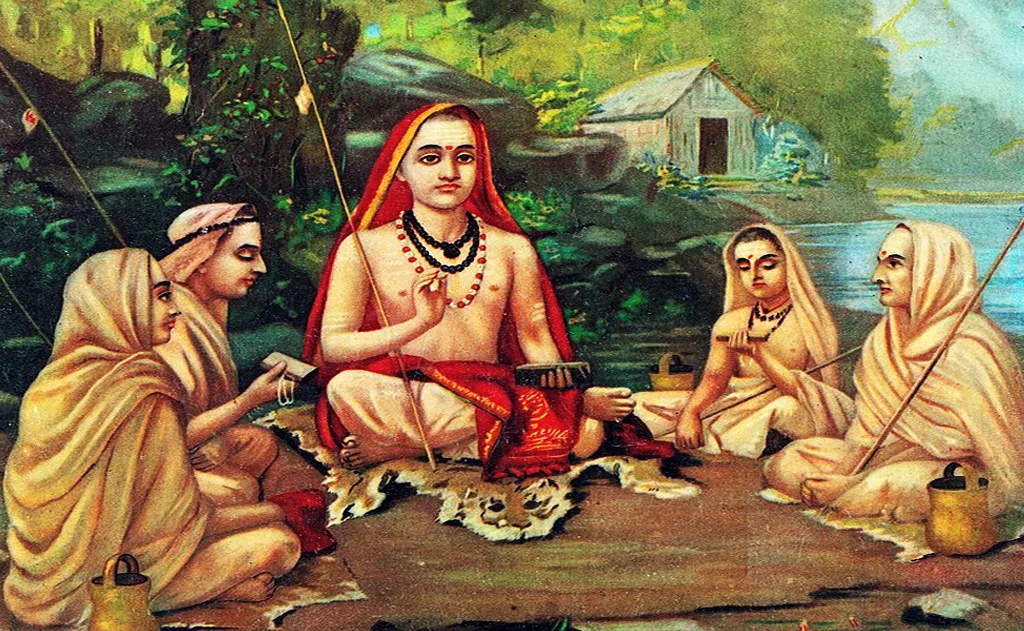
Quick answer: Advaita Vedanta is the school of Vedanta that teaches that the Self (Atman) and Brahman, the ultimate reality, are not two. 'Advaita' means 'not two'. Its best-known teacher is Adi Shankaracharya, and it rests on the Upanishads, the Bhagavad Gita and the Brahma Sutras. Our pillar guide on Atma and Paramatma tells the same idea through the lion story; this page is the beginner's map.
If you have heard words like 'maya', 'non-duality' or 'Tat Tvam Asi' and want to know how they fit together, this is the place to begin. We explain the main ideas in plain language, say where each comes from, and then point you to deeper guides such as What is Atma? and Tat Tvam Asi meaning.
What does Advaita mean?
The Sanskrit word advaita is 'a' (not) plus 'dvaita' (two-ness). The central statement is that there is one reality, Brahman, and that the individual Self is not other than it. The Upanishad that Advaita teachers often quote for this is the Chandogya, where the teacher begins by saying that in the beginning this was Being alone, one only, without a second (6.2.1):
सदेव सोम्येदमग्र आसीदेकमेवाद्वितीयम्
sad eva somyedam agra āsīd ekam evādvitīyam
Advaita is one of several schools of Vedanta, the tradition built on the end portions of the Vedas, the Upanishads. 'Vedanta' means 'the end of the Vedas'. The Advaita reading is the subject of this page; the other readings are summarised below.
Who was Adi Shankaracharya?
Shankara (Shankaracharya, 'Adi' meaning first) is traditionally said to have been born in Kalady, Kerala, and to have lived 788-820 CE. Some scholars propose slightly earlier dates, between the late seventh and the mid eighth century, and the Stanford Encyclopedia of Philosophy notes that there are no dependable historical records of his life other than his own works. He wrote the earliest complete commentaries that have survived on the Brahma Sutras, the Bhagavad Gita and ten principal Upanishads, and independent teaching works such as the Upadeshasahasri. Many other texts are attributed to him whose authorship is debated.
According to tradition he studied under Govinda Bhagavatpada, a disciple of Gaudapada, whose karikas on the Mandukya Upanishad Shankara also commented on. For his life and legacy see What Hindus and the world can learn from Adi Shankaracharya, Adi Shankaracharya Ji: life, teachings and legacy and Who was Adi Shankaracharya?.
The core ideas of Advaita Vedanta
1. Brahman is the one reality
Brahman is described in the Upanishads as existence, knowledge and limitlessness (Taittiriya 2.1.1: satyam jnanam anantam). In Advaita it is not a being among others, and it has no parts.
2. The Self is not different from Brahman
The mahavakyas, the great statements, say this directly: 'You are That' (Chandogya 6.8.7), 'I am Brahman' (Brihadaranyaka 1.4.10) and 'This Self is Brahman' (Mandukya 2). See Aham Brahmasmi meaning for how they fit together.
अयमात्मा ब्रह्म
ayam ātmā brahma
3. Ignorance and superimposition (avidya and adhyasa)
Why then does a person feel separate? Advaita answers with avidya, ignorance of one's real nature, and adhyasa, superimposition. In the introduction to his commentary on the Brahma Sutras, Shankara describes the basic human mistake of mixing up the Self (awareness) with the body-mind, so that 'I am the body' and 'my body is I' seem natural. Teachers use two familiar analogies: a rope in dim light taken for a snake, and a scratch on a mirror taken for a mark on one's own face. When the rope is seen, the snake does not go anywhere; it was never there.
4. Maya and levels of reality
Maya is often translated 'illusion', but this can mislead. In Advaita the world is not nothing: it is experienced and works at the everyday level (vyavaharika). It is, however, dependent on Brahman and changing, so it is not ultimate (paramarthika). The Stanford Encyclopedia describes this as a two-tier approach, with the everyday order as a provisional account and the ultimate order as the final one. Some later Advaita teachers also speak of a third, merely apparent level (pratibhasika), such as the snake seen in the rope; this is a teaching aid and the word is not generally used by Shankara himself.
5. Liberation through knowledge
For Advaita, moksha is not something that is produced by an act, because it is the Self's own nature. What is needed is knowledge that removes ignorance. The traditional path is shravana (listening to the teaching from a teacher), manana (reflecting on it until doubts are resolved) and nididhyasana (settling into it), drawn from Brihadaranyaka 2.4.5. Traditionally the student is also asked to have discrimination, dispassion, self-control and a strong wish for freedom. This is a path of understanding and not of belief or ritual alone; many Advaita teachers also encourage devotion, service and a disciplined life.
A familiar picture is the space in a pot and the space outside it (ghatakasha): when the pot breaks, the space inside is seen not to have been separate. We use this in the pillar guide as a note on how the Self appears limited by the body and mind. See also Mandukya Upanishad for the four-fold analysis of experience that Advaita uses.
How Advaita differs from other Vedanta schools
| School | Teacher (traditional) | Individual self and Brahman | World |
|---|---|---|---|
| Advaita | Adi Shankaracharya | Not different; separateness is due to ignorance | Dependent on Brahman; not ultimate |
| Vishishtadvaita | Ramanujacharya | Distinct but inseparable; the self is a mode (body) of Brahman | Real, a body of Brahman |
| Dvaita | Madhvacharya | Eternally distinct; dependent on the Lord | Real and distinct from the Lord |
All three are serious readings of the same texts, with their own commentaries and living monasteries. We describe the Advaita view as it is taught and do not argue against the others.
Advaita and devotion
It is sometimes said that Advaita has no place for devotion. The tradition does not say so. Hymns attributed to Shankara, including those we cover in Bhaja Govindam, are devotional, and the well-known verse that begins 'Shivaya Vishnu Rupaya' is often recited to express that Shiva and Vishnu share one heart. Its authorship is not firmly established, and we do not attribute it to Shankara, but it shows how Advaita thinkers have encouraged harmony between Shaiva and Vaishnava paths. For another perspective see Rama, Parashurama and the mystery of non-duality and Shankaracharya meets the Chandala.
The four Mathas and the living tradition
Tradition says Shankara established four monastic centres: Sringeri, Dwarka, Puri and Jyotirmath (Joshimath). Advaita is today taught by monastic orders, university departments and teachers abroad. Examples of well-known contemporary voices appear in our guide on Swami Sarvapriyananda, and Ramana Maharshi's practice of self-inquiry is explained in this guide. Advaita is related to, but not identical with, Ramana's method.
How to begin
- Read a short Upanishad such as the Mandukya, with a reliable commentary.
- Learn the vocabulary: Brahman, Atman, avidya, maya, moksha.
- Spend a few minutes each day on one question: who is aware of this thought?
- Join a recognised study group or class; well-known organisations such as the Ramakrishna Order's Vedanta Societies, Chinmaya Mission and Arsha Vidya groups run classes in many countries, and many offer online sessions. Check each one's own website for what it currently offers.
- Be cautious of anyone who promises quick enlightenment or results.
For a family routine that fits a working week, see Atma Vichara for Hindus abroad. For the women who are among the first named teachers of this knowledge, see Gargi and Maitreyi.
Frequently asked questions
What does Advaita mean in Advaita Vedanta?
Advaita means 'not two', non-duality. In Advaita Vedanta it means that the Self (Atman) and Brahman, the ultimate reality, are not two different things; the sense of being a separate individual comes from ignorance.
Who was Adi Shankaracharya and where was he born?
Adi Shankaracharya is the teacher most associated with Advaita Vedanta. Tradition places him in Kalady, Kerala, and gives his dates as 788-820 CE, though scholars have suggested earlier dates (late 7th to mid 8th century CE) and there are few dependable records of his life apart from his writings.
Which four Mathas did Adi Shankaracharya establish?
Tradition says he established four monastic centres: Sringeri (south), Dwarka (west), Puri (east) and Jyotirmath, also called Joshimath (north). Each continues today as a seat of the Advaita lineage, though accounts of their founding come from tradition.
What does the verse 'Shivaya Vishnu Rupaya' teach?
It is a well-known verse that speaks of Shiva and Vishnu as sharing one heart, so that neither is separate from the other. It is often quoted to encourage harmony between Shaiva and Vaishnava paths. We do not claim it is a work of Shankara.
Why is the world called maya in Advaita Vedanta?
Maya here does not mean that the world is nothing. In Advaita, the world is real at the everyday level but dependent, changing and not ultimate, like a dream is real while dreaming. Ultimate reality is Brahman alone. Teachers use the rope-and-snake illustration to explain how something can appear in place of what really is.
Is Advaita Vedanta the only school of Vedanta?
No. Vishishtadvaita (Ramanujacharya) and Dvaita (Madhvacharya), among others, are long-established Vedanta schools that read the same texts differently and give the individual self and the Lord a more distinct place. All are respected and have living traditions.
How can a beginner practice Advaita Vedanta in daily life?
Start small: read a short Upanishad or a good introduction, spend a few quiet minutes each day on the question 'who am I?', and find a qualified teacher or a recognised study group. Our NRI self-inquiry routine gives a step-by-step plan. No practice comes with guaranteed results.
Editor's note (31 October 2026)
This guide is part of HinduTone's series on atma jnana, built around our pillar article from Sri Sadguru Peetham. Upanishad references are given by chapter and verse so that you can check them in a translation by a recognised teacher; translations of verses on this page are our own faithful paraphrases, not quotations from any published translation. The Sanskrit lines were checked against the Upanishad texts on sanskritdocuments.org. HinduTone offers education and devotion, not medical, psychological or financial advice, and no spiritual practice here comes with a guaranteed result. This page was upgraded on this date from our earlier short introduction to Advaita Vedanta, with sources checked as noted in the series. The date range for Shankara is traditional and debated.
Last updated: 31 October 2026
Also read in this series
- Atma Paramatma Tattvam: the pillar guide (lion story, Tat Tvam Asi, Advaita Vedanta)
- What is Atma? The Self in the Upanishads
- Tat Tvam Asi meaning: Chandogya Upanishad 6.8.7
- Aham Brahmasmi meaning: why it is not ego
- Atma Vichara for Hindus abroad: a self-inquiry routine for busy families
- Gargi and Maitreyi: women seers of the Upanishads
- Why young Hindus should learn the Gita and the Upanishads
Share this with family and friends
Send it on WhatsApp, post it, or copy the link.
More from Spirituality
- Gargi and Maitreyi: Women Seers of the Upanishads
- Atma Vichara for NRIs: A Self-Inquiry Routine for Busy Families
- Aham Brahmasmi Meaning: Why It Is Not Ego
- Tat Tvam Asi Meaning: Chandogya Upanishad 6.8.7 Explained
- What Is Atma? The Self in the Upanishads, Explained
You might also like
Mandukya Upanishad: The Shortest Path to Liberation (Moksha) in Advaita Vedanta | HinduTone
Adi Shankaracharya Ji: Life, Teachings & Legacy of the Advaita Vedanta Master
Atma Paramatma Tattvam: Are They One? The Lion Story, Tat Tvam Asi and Advaita Vedanta