
What Is Atma? The Self in the Upanishads, Explained
Atma is the Self, the conscious presence the Upanishads say is beyond body, mind and ego. See what Katha, Mundaka, Mandukya, Brihadaranyaka and Chandogya teach, with verse references.
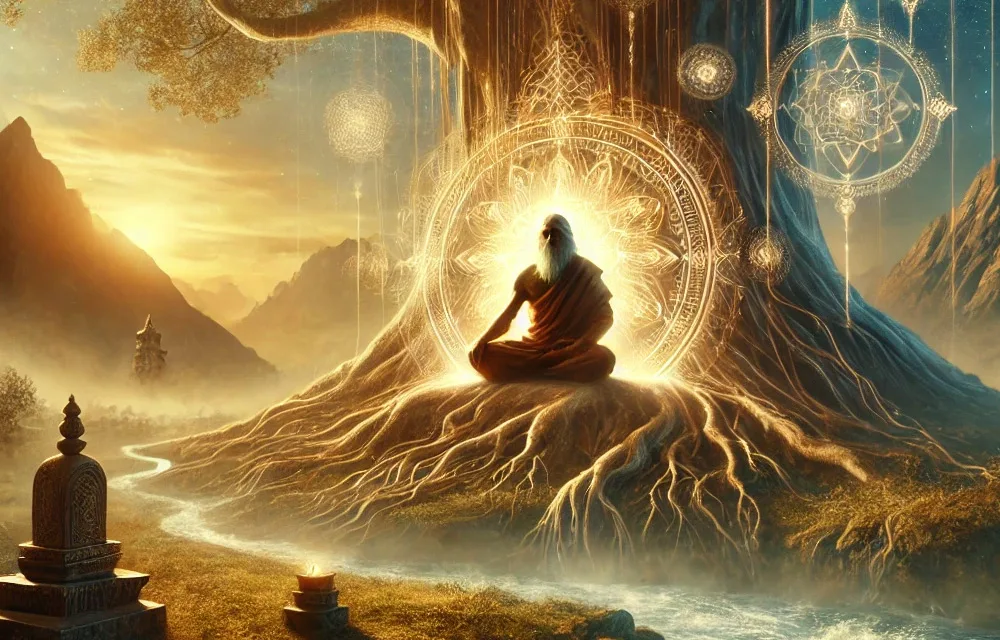
Quick answer: Atma (or Atman) is the Self. In the Upanishads it means the conscious presence at the centre of every person, said to be distinct from the body, the mind and the ego. It is the one who knows, not something that is known. For the wider picture and the lion story that many readers love, start with our pillar guide on Atma and Paramatma; this page goes line by line through what the Upanishads themselves say.
If you ask five Hindu families what the Atma is, you may hear five answers: the soul that travels from life to life, the spark of God within, the witness of the mind, the real 'I', or simply a word from the Gita. All of these are rooted in the Upanishads. Here we take the texts one at a time, say what each verse says and what it does not say, and point to our other guides, such as Hindu beliefs about the soul and rebirth and Atman Quest, for the parts we do not repeat.
What does the word Atma mean?
In Sanskrit, atman is used in ordinary speech for 'oneself' and in philosophy for the Self. Scholars connect the word with breath or with pervading, but its exact origin is debated, so it is safest to say that the meaning is fixed by usage in the Upanishads rather than by a single etymology. Over the centuries the word has been translated as Self, soul, spirit and consciousness; none of these is perfect.
The Upanishads use the word in three connected ways. First, as the individual Self, the 'I' that experiences life. Second, as the inner core that remains when body, breath, senses and mind are set aside. Third, in the strongest teachings, as the reality that is the support of everything, which they call Brahman. How these three relate is exactly where the Vedanta schools differ (see below).
Atma is not the body, mind or ego
The first step in every Upanishadic teaching is a separation. The body changes from childhood to old age; the mind moves from joy to worry in minutes; the ego (ahankara) keeps building an 'I am this, I own that' story. If any of these were the true Self, the Self would be changing all the time. Vedanta says the Self is what remains constant while these change. We discuss the ego in detail in our guide on Ahankara, the wall before self-knowledge. It is important to note that this teaching is not a rejection of the body or a lesson in dislike of life. It is a statement about identity: you use the body and mind, and you are more than they are.
The Atma in the Upanishads: five key passages
Katha Upanishad: the unborn Self (1.2.18)
In the Katha Upanishad, a young seeker named Nachiketa is given a conversation with Yama, the lord of death, about what remains after death. In 1.2.18 Yama says:
न जायते म्रियते वा विपश्चिन्नायं कुतश्चिन्न बभूव कश्चित् ।
अजो नित्यः शाश्वतोऽयं पुराणो न हन्यते हन्यमाने शरीरे ॥
na jāyate mriyate vā vipaścin nāyaṃ kutaścin na babhūva kaścit |
ajo nityaḥ śāśvato 'yaṃ purāṇo na hanyate hanyamāne śarīre ||
Our paraphrase: the knowing Self is not born and does not die; it did not come from anywhere and did not become anything; it is unborn, constant, everlasting and ancient, and it is not killed when the body is killed. The Bhagavad Gita (2.20) carries the same teaching, and we explain it in our Bhagavad Gita complete guide. Later in the same chapter (1.2.20) the Self is described as smaller than the smallest and greater than the greatest, resting in the heart of every living being. In 1.2.23 the text adds that the Self is not gained by teaching alone, by intellect, or by hearing a great deal. Traditional readers take this to mean that the teaching must be lived and assimilated, and some read it as the role of grace.
Mundaka Upanishad: two birds on one tree (3.1.1-2)
द्वा सुपर्णा सयुजा सखाया समानं वृक्षं परिषस्वजाते
dvā suparṇā sayujā sakhāyā samānaṃ vṛkṣaṃ pariṣasvajāte
Paraphrase: two birds, always together and friends, cling to the same tree. One eats the sweet fruit; the other does not eat but looks on. The following verse says that the one absorbed in the tree grieves, confused by its helplessness, and when it sees the other, the Lord, and his greatness, it is free from sorrow. Teachers use this image for the difference between the self that is busy with experience and the Self that is the witness. The text does not give a single reading of whether the two birds are two different beings or two aspects of one; the Vedanta schools read it differently.
Mandukya Upanishad: the Self has four quarters (2 and 3-7)
अयमात्मा ब्रह्म
ayam ātmā brahma
Mandukya 2 says that all this is Brahman and that this Self is Brahman, and that the Self has four quarters. Verses 3 to 5 name the first three as the waking state, the dream state and deep sleep. Verse 7 describes the fourth, often called turiya, as not inward-knowing, not outward-knowing, not a mass of consciousness, unseen and unspeakable, the cessation of the world's appearance, peaceful, auspicious and non-dual. The point is that the Self is present in all three states and is not limited to any one of them. We explore this in depth, along with the sacred syllable, in our Mandukya Upanishad guide and our Om (Aum) meaning guide.
Brihadaranyaka Upanishad: the Self cannot be made an object (3.9.26 and 2.4.5)
स एष नेति नेत्यात्मा
sa eṣa neti netyātmā
In 3.9.26, and again in 4.5.15, the sage Yajnavalkya describes the Self as 'not this, not this' (neti neti): it cannot be grasped, it is not itself grasped, it is unattached and does not suffer. This is the method known as neti neti, discussed below. In 2.4.5 and 4.5.6, the same teacher tells his wife Maitreyi that the Self is to be seen, heard, reflected on and meditated on, the origin of the traditional three steps of shravana, manana and nididhyasana. We follow that conversation in Gargi and Maitreyi: women seers of the Upanishads.
Chandogya Upanishad: that Self you are (6.8.7)
स आत्मा तत्त्वमसि श्वेतकेतो
sa ātmā tat tvam asi śvetaketo
In the Chandogya, the teacher Uddalaka tells his son Shvetaketu that the subtle essence of all things is the true Self, and then says 'you are that'. This is the mahavakya (great statement) Tat Tvam Asi. We have a full guide to it: Tat Tvam Asi meaning. In chapter 8 (sections 7 to 12), the same Upanishad tells of Indra approaching the creator Prajapati to learn about the Self, and being led stage by stage through the body, the dreaming self and the self in deep sleep, each being examined before the teaching reaches its end.
Neti neti: knowing the Self by setting aside what it is not
The Upanishads often teach by negation. Because the Self is the knower, you cannot find it among the things you know, in the same way that an eye cannot see itself. Brihadaranyaka 3.4.2 puts it this way: you cannot see the seer of seeing, hear the hearer of hearing, think the thinker of thinking or know the knower of knowing. The negation is not meant to leave you with nothing; the teachers say it clears away wrong identification so that what is self-evident is recognised.
A simple way to try this reflection, with no belief required: notice a thought and ask 'who is aware of this thought?' Notice the sense of the body and ask the same question. The one who is aware is not the thought or the sensation. Vedanta calls this inquiry atma vichara, and we offer a realistic daily routine in Atma Vichara for Hindus abroad.
Witness consciousness (sakshi)
Vedanta teachers use the word sakshi, witness, for the Self that is aware of everything in the three states without being changed by them. In the waking state we see the world; in dream we see a dream world; in deep sleep we see nothing, yet on waking we say 'I slept well', which shows a continuing awareness of the absence. The Self is the common factor. The witness is not another thing to be watched; it is the awareness in which watching happens.
Please note that this is a teaching about knowing, not about detachment from family and duty. The Upanishads were taught in the setting of householders and kings as well as renunciants, and the Gita (which we cover in our complete guide) applies the same Self-knowledge to action.
How the main schools of Vedanta understand the Atma
| School | Relation of Atma and Brahman | Founding teacher (traditional) |
|---|---|---|
| Advaita Vedanta | Not different; ignorance makes the individual seem separate | Adi Shankaracharya |
| Vishishtadvaita | The Atma is real and distinct, and is a 'body' or mode of Brahman, inseparable from it | Ramanujacharya |
| Dvaita | The Atma and Brahman are eternally distinct; the Atma depends on the Lord | Madhvacharya |
This guide gives the Advaita reading more space because the pillar article it supports is an Advaita reflection, but all three are long-established and serious readings of the same texts, and each has its own commentaries. If you belong to a Sampradaya that follows one of them, your teachers are the right authority for how it reads each verse. For a beginner's explainer on the first, see What is Advaita Vedanta?.
Common misunderstandings
- 'Atma means the mind.' No. The Upanishads treat the mind (manas) as something the Self is aware of.
- 'If I am the Self, I need not do my duties.' No. The teaching is about knowing; the Gita presents this knowledge together with dharma and action.
- 'Atma is only for sages.' Teachers across traditions say the questions are for every person; how one studies depends on one's situation.
- 'Self-knowledge guarantees a result.' Be cautious of anyone who promises specific results. The texts speak of freedom from sorrow, not of money, health or success.
Where to go next
If you are new to this, read the pillar guide first, then the meaning of the great statements in Tat Tvam Asi and Aham Brahmasmi. For a family-friendly practice see the Atma Vichara routine. For the people who first taught it, see Gargi and Maitreyi.
Frequently asked questions
What is Atma in simple words?
Atma (also written Atman) is the Self: the conscious presence that the Upanishads say is the real you, beyond the changing body, the restless mind and the sense of ego. Different Vedanta traditions disagree about how the Atma relates to the Supreme, but all treat it as more than the body and mind.
Is Atma the same as the soul?
They overlap but are not identical. 'Soul' in English carries meanings from other traditions. In Vedanta the Atma is not the personality or the mind, it is described as unborn and unchanging (Katha 1.2.18), and in Advaita it is not different from Brahman.
What is the difference between Atma and Paramatma?
Atma usually refers to the Self of an individual, Paramatma to the Supreme Self. Advaita Vedanta holds that they are ultimately one; Vishishtadvaita and Dvaita hold that the individual self and the Supreme remain distinct, in different ways. Our pillar guide on Atma and Paramatma explains the Advaita view with the lion story.
What does neti neti mean?
Neti neti means 'not this, not this'. In Brihadaranyaka 3.9.26 and 4.5.15 the Self is described this way because it cannot be grasped as an object. The method is to set aside what one is not (body, senses, thoughts) in order to recognise the one who is aware.
What is witness consciousness (sakshi)?
Witness consciousness is the Vedanta term for the awareness in which thoughts, feelings and experiences appear and disappear. Teachers use it to point to the Atma as the unchanging knower rather than something known. The Mundaka image of two birds on one tree (3.1.1) is often used to illustrate it.
Which Upanishads speak most about the Atma?
Almost all do. The Katha, Mundaka, Mandukya, Brihadaranyaka and Chandogya are the ones most often studied for the Atma, and the Mandukya is often called the shortest route into the subject.
Can one realise the Atma without a teacher?
Vedanta tradition says the teaching is received from a teacher through listening, reflection and meditation. Katha 1.2.23 also says the Self is not gained by cleverness alone. Beginners can read and listen widely, and look for a qualified teacher or a recognised study group when ready.
Editor's note (31 October 2026)
This guide is part of HinduTone's series on atma jnana, built around our pillar article from Sri Sadguru Peetham. Upanishad references are given by chapter and verse so that you can check them in a translation by a recognised teacher; translations of verses on this page are our own faithful paraphrases, not quotations from any published translation. The Sanskrit lines were checked against the Upanishad texts on sanskritdocuments.org. HinduTone offers education and devotion, not medical, psychological or financial advice, and no spiritual practice here comes with a guaranteed result.
Last updated: 31 October 2026
Also read in this series
- Atma Paramatma Tattvam: the pillar guide (lion story, Tat Tvam Asi, Advaita Vedanta)
- Tat Tvam Asi meaning: Chandogya Upanishad 6.8.7
- Aham Brahmasmi meaning: why it is not ego
- What is Advaita Vedanta? A beginner's guide
- Atma Vichara for Hindus abroad: a self-inquiry routine for busy families
- Gargi and Maitreyi: women seers of the Upanishads
- Atman Quest: a spiritual trend drawn from the Upanishads
- Hindu beliefs on the soul and rebirth
Share this with family and friends
Send it on WhatsApp, post it, or copy the link.
More from Spirituality
- Love vs Attachment: What the Ramayana, the Bhagavata and Vedanta Teach About Selfless Love
- Aham Brahmasmi Meaning: Why It Is Not Ego
- Not Wealth, Just Good Character: A Reflection on Daanam (Charity) | Selfless Giving in the Hindu Tradition
- Daiva Sankalpam (Divine Will): The Story of the Sadhu on the Sinking Boat
- Deeparadhana: Significance of Lighting the Lamp, Deepam Jyoti Parabrahma Meaning, Oil and Wicks
You might also like
Atma Vichara for NRIs: A Self-Inquiry Routine for Busy Families
Gargi and Maitreyi: Women Seers of the Upanishads
Ahankara, the Wall Before Self-Knowledge | True Knowledge Dawns When the Ego Goes