Om (Aum) Meaning: The Symbol, the Mandukya Upanishad's A-U-M, the Gita and How to Chant It
Om (Aum) is the most sacred sound in Hinduism. The Mandukya Upanishad explains its three sounds, A, U and M, as waking, dreaming and deep sleep, with the silence after them as the fourth state. Here is what the scriptures say, what the written symbol is said to mean, how Om opens mantras, its place in Buddhism, Jainism and Sikhism, and how to chant it.
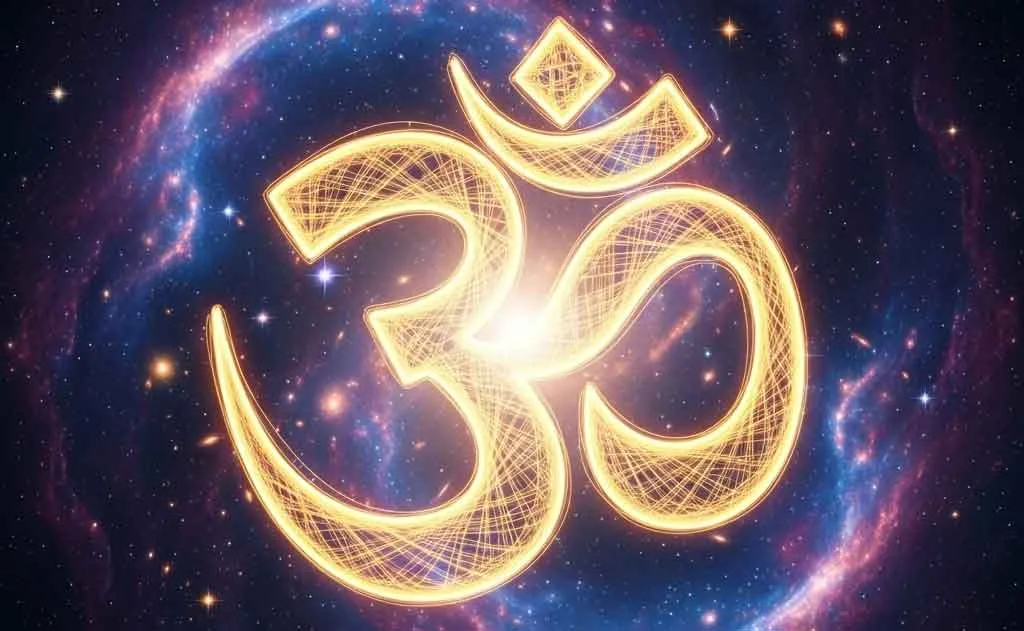
Om (Aum) is the most sacred sound in Hinduism. The Mandukya Upanishad explains its three sounds, A, U and M, as waking, dreaming and deep sleep, with the silence after them as the fourth state.
Quick answer: Om (Aum) is Hinduism's most sacred syllable, a sound-symbol for Brahman, the ultimate reality. The Mandukya Upanishad explains its three sounds, A, U and M, as waking, dreaming and deep sleep, and the silence after them as turiya, the fourth state of pure awareness. Om begins most mantras and prayers.
What Om means
Om is also called the pranava, often explained as "that which is ever new" or "the sound that sounds through everything". It is not a word with a dictionary meaning so much as a symbol of the whole of reality. The Upanishads describe it in several memorable ways:
- Katha Upanishad: the goal that all the Vedas declare is summed up in one word, Om; this syllable is Brahman, and knowing it one attains what one seeks.
- Mundaka Upanishad: Om is the bow, the self is the arrow and Brahman is the target; with a steady mind one should become one with it like an arrow in its mark.
- Taittiriya Upanishad: Om is Brahman; Om is all this.
- Chandogya Upanishad: it opens by meditating on Om as the udgitha, the essence of the chanted Sama Veda.
These are paraphrases of the ideas, not quotations; translations differ.
The Mandukya Upanishad: A, U, M and the silent fourth
The Mandukya Upanishad is the shortest of the principal Upanishads, only twelve verses, and it is entirely about Om. It begins by saying that Om is all of this: everything past, present and future, and whatever lies beyond the three times. It then says the Self (Atman) is Brahman and has four "quarters", which it maps onto the parts of Om:
| Sound | State | Name in the Upanishad | What it describes |
|---|---|---|---|
| A | Waking | Vaishvanara | Awareness turned outward, experiencing the physical world |
| U | Dreaming | Taijasa | Awareness turned inward, experiencing the mind's own images |
| M | Deep sleep | Prajna | Awareness without objects or desires, a mass of undivided consciousness |
| Silence after M | Turiya (the fourth) | Amatra (without measure) | Pure awareness, peaceful and non-dual, the ground of the other three |
The key teaching is that turiya is not a fourth experience to collect. It is the awareness present in waking, dreaming and sleep alike. Gaudapada's Karika on the Mandukya, and later Adi Shankaracharya's commentary, made this text central to Advaita Vedanta. Other Vedanta schools read the Upanishad in their own ways, but all treat Om as the supreme sacred sound.
Om in the Bhagavad Gita and the Yoga Sutras
In the Bhagavad Gita, Krishna returns to Om several times. Paraphrased:
- He says he is the syllable Om in all the Vedas (chapter 7).
- He teaches that one who leaves the body while uttering Om, the one-syllable Brahman, and remembering him reaches the highest goal (chapter 8).
- He explains Om Tat Sat as a threefold name of Brahman, and says that acts of sacrifice, charity and austerity are begun with Om (chapter 17).
Patanjali's Yoga Sutras (1.27 to 1.29) say that the word expressing Ishvara, the Lord, is the pranava, Om. Its repetition, together with reflection on its meaning, is recommended as a practice that turns the mind inward and removes obstacles on the path. See our sibling guide to ekagrata, one-pointedness in yoga.
How Om begins mantras
Om opens almost every Hindu mantra, across Shaiva, Vaishnava, Shakta and Smarta traditions. Familiar examples include Om Namah Shivaya, Om Namo Narayanaya, Om Gam Ganapataye Namah and the Gayatri Mantra. Traditional teachers explain that placing Om first consecrates what follows and links the particular deity to the one Brahman.
Vedic recitation traditionally begins and ends with Om, a practice mentioned in dharma texts such as the Manusmriti for students of the Veda. Prayers and classes also commonly end with "Om Shanti Shanti Shantihi", asking for peace on all levels. For one of the best-loved Om mantras, read Om Namah Shivaya: meaning and practice.
The Om symbol: what its parts are said to mean
The written Om symbol, a curved figure topped by a crescent and a dot, is a later development; the Upanishads discuss the sound, not the shape. A popular modern explanation, widely taught in yoga and Hindu classes, reads the symbol through the Mandukya Upanishad:
- Large lower curve: the waking state (A).
- Upper curve: deep sleep (M).
- Curve to the side: the dream state (U).
- Crescent: maya, the veil that separates us from the highest state.
- Dot (bindu): turiya, the fourth, untouched by the veil.
This is a helpful teaching device rather than something stated in scripture, and different teachers assign the curves slightly differently. The symbol is drawn differently in each Indian script; in Tamil and Telugu homes, for example, it looks quite different from the North Indian form.
Om in Buddhism, Jainism and Sikhism
Om is shared, in different ways, by other traditions that grew up in India. They each understand it on their own terms:
- Buddhism: Om appears at the start of many mantras, especially in Tibetan Buddhism, as in Om Mani Padme Hum, the mantra of compassion associated with Avalokiteshvara.
- Jainism: Om is commonly explained as formed from the initials of the five supreme beings (Pancha Parameshthi): the Arihants, Siddhas, Acharyas, Upadhyayas and Munis.
- Sikhism: the Guru Granth Sahib opens with Ik Onkar, "there is one Creator", the start of the Mul Mantar. Sikhs understand it as an affirmation of the oneness of God within Sikh teaching, and it is best described in their own words.
For more on these relationships, see Hinduism vs Buddhism, Hinduism vs Jainism and Hinduism vs Sikhism.
How to chant Om: a simple method
You do not need special training to begin. A simple, traditional-style practice:
- Sit comfortably with the back upright, on the floor or a chair. Close the eyes.
- Take a slow, natural breath in.
- On the out-breath, sound "A" (as in "father"), let it round into "U" (as in "put"), and close the lips into a long, humming "M".
- Let the sound fade, and rest for a few moments in the silence that follows. In the Mandukya view, that silence is part of Om.
- Repeat three times, or for a set count such as 108 with a japa mala.
Many people say chanting Om helps them feel calm and focused; that is a personal and devotional experience, not a medical claim. If you have breathing difficulties or a health condition, follow your doctor's advice about any practice.
Explaining Om to children and friends abroad
Om is probably the Hindu symbol most familiar outside India, thanks to yoga studios. For a child or a friend, a simple explanation works: "Om is a sacred sound that stands for everything that exists and the peace behind it. Hindus chant it at the beginning of prayers, a bit like opening a door." It is reasonable to ask that the symbol be treated respectfully, for example not printed on shoes, floor mats or bathroom items.
Frequently asked questions
What does Om mean in Hinduism?
Om is the sacred syllable that stands for Brahman, the ultimate reality. The Upanishads call it the sound that all the Vedas point to, and the Mandukya Upanishad says Om is everything: past, present, future and what lies beyond time. It is also called the pranava.
Why is Om written as Aum?
In Sanskrit the vowel o is formed by combining a and u, so Om can be analysed as A + U + M. The Mandukya Upanishad uses this to explain Om as three sounds standing for waking, dreaming and deep sleep, with the silence after them as the fourth state, turiya.
What are the four states of consciousness in the Mandukya Upanishad?
Waking (Vaishvanara, linked with A), dreaming (Taijasa, linked with U), deep dreamless sleep (Prajna, linked with M), and turiya, the fourth, which is not a state alongside the others but the pure awareness behind all three. Turiya is linked with the silence after the sound.
How many times should you chant Om?
There is no single rule. Many people chant Om three times at the start and end of prayer or yoga practice, and others chant it 108 times with a japa mala. What matters more, according to the Yoga Sutras, is repeating it with attention to its meaning.
Is Om the same as Ik Onkar?
No, though they are related in sound. Ik Onkar, the opening of the Mul Mantar in the Guru Granth Sahib, is a Sikh affirmation that there is one Creator. Sikhs understand it within their own theology, and it should not be described as simply a Sikh version of the Hindu Om.
Can anyone chant Om?
Today most Hindu teachers welcome anyone to chant Om respectfully, and it is widely used in yoga classes around the world. Some traditional schools historically restricted Vedic recitation, and some families have their own customs, so it is fine to follow your family's guidance.
Editor's note (9 October 2026)
This explainer was written in October 2026. The Mandukya, Katha, Mundaka, Taittiriya and Chandogya Upanishads, the Bhagavad Gita and the Yoga Sutras are paraphrased at the level of ideas; no verses are quoted. The meaning of the written symbol's parts is labelled as a popular explanation. Descriptions of Om in Buddhism, Jainism and Sikhism are brief and general; readers from those traditions may describe them more fully.
Related guides
You might also like

Types of Tilak and Their Meaning: Vaishnava Namam, Shaiva Tripundra, Shakta Kumkum, Bindi and Sindoor

Annaprashan Ceremony: A Complete Guide to Baby's First Rice Feeding, Rituals and Regional Customs
Navagraha: The Nine Planetary Deities of Hinduism Explained, with Colours, Days, Grains and Temples