33 Crore Gods Meaning: What "33 Koti Devatas" Really Means, from the Vedas to the One Brahman
Hindus are often said to have 33 crore (330 million) gods. The Vedic texts actually count 33 devas: 8 Vasus, 11 Rudras, 12 Adityas, Indra and Prajapati. Here is what the Brihadaranyaka Upanishad says, the koti debate, and how it all comes back to one Brahman.

Hindus are often said to have 33 crore (330 million) gods. The Vedic texts actually count 33 devas: 8 Vasus, 11 Rudras, 12 Adityas, Indra and Prajapati.
Quick answer: "33 crore gods" comes from the phrase 33 koti devatas. Koti can mean crore (ten million) or "type", and the Vedic texts actually count 33 devas: 8 Vasus, 11 Rudras, 12 Adityas, Indra and Prajapati. The Brihadaranyaka Upanishad then reduces even these to one: Brahman.
Where the number 33 comes from
The number 33 is old. Several hymns of the Rig Veda address the gods as thirty-three, and one hymn describes them as eleven in heaven, eleven on earth and eleven dwelling in the waters. The Shatapatha Brahmana and other ritual texts also list thirty-three deities. The clearest explanation, though, is in the Brihadaranyaka Upanishad, one of the oldest Upanishads.
There is no Vedic passage that says Hindus have 330 million gods. That figure grew out of the later phrase "trayastrimshat koti" (33 koti) and the everyday meaning of koti as crore.
The Brihadaranyaka Upanishad dialogue (3.9)
In the third chapter of the Brihadaranyaka Upanishad, at the court of King Janaka, the scholar Vidagdha Shakalya questions the sage Yajnavalkya: how many gods are there? Paraphrased, the exchange runs like this:
- Yajnavalkya first quotes a ritual formula: three hundred and three, and three thousand and three (3,306).
- Pressed again, he says thirty-three. Then six, then three, then two, then one and a half, and finally one.
- Asked to explain the thirty-three, he says the others are only their powers, and lists the 8 Vasus, 11 Rudras and 12 Adityas, which make thirty-one, plus Indra and Prajapati.
- Asked who the one god is, he answers: breath (prana), and it is called Brahman.
The dialogue is a teaching about unity. It deliberately starts with a large number and narrows it down, showing that many gods are many views of one reality.
The 33 devas: list and meaning
The Upanishad explains each group in terms of nature and life, while later texts such as the Mahabharata and Puranas give personal names. Both are shown below. Name lists vary between texts; these are the ones most commonly given.
| Group | Number | Upanishad's explanation | Names as commonly given |
|---|---|---|---|
| Vasus | 8 | Fire, earth, wind, atmosphere, sun, sky, moon and stars: the dwelling places of the world | Dhara, Anala, Anila, Apa (or Aha), Pratyusha, Prabhasa, Soma, Dhruva |
| Rudras | 11 | The ten breaths (life functions) in a person, with the self as the eleventh; they make people weep when they leave the body | Names vary widely between Puranas; the Rudras are linked with Shiva |
| Adityas | 12 | The twelve months of the year, which carry everything along | Dhata, Mitra, Aryaman, Indra (Shakra), Varuna, Amsha, Bhaga, Vivasvan, Pusha, Savita, Tvashta, Vishnu |
| Indra | 1 | Thunder (the thunderbolt) | King of the devas |
| Prajapati | 1 | The sacrifice (yajna) | Lord of creatures |
Some Vedic texts complete the thirty-three with the two Ashvins, or with Heaven and Earth (Dyaus and Prithivi), instead of Indra and Prajapati. Notice that Vishnu appears here as one of the Adityas: the Vedic pantheon is arranged differently from the later Puranic one, in which Vishnu and Shiva are supreme.
Koti: crore or category?
Sanskrit koti has several meanings. It can be the number ten million (a crore), the tip or highest point of something, or a class or category. So "33 koti devatas" can be read as "330 million gods" or as "33 kinds of gods".
- The "33 types" reading: many scholars and teachers prefer this, because the Vedic sources consistently give 33 and because it fits the grouping into Vasus, Rudras, Adityas and two others.
- The "33 crore" reading: in popular speech the phrase has long meant countless gods, a way of saying the divine is present everywhere and in everything. Some traditional teachers accept the large number in that devotional spirit.
It is honest to say the original intent of the phrase is debated. What is not debated is that the Vedic count is thirty-three, and that the Upanishads point beyond any number to one Brahman.
From many gods to one Brahman
The idea that many names point to one truth runs through Hindu scripture. A famous verse of the Rig Veda says that the one reality is called by many names by the wise: Indra, Mitra, Varuna, Agni and others. The Upanishads develop this into the teaching of Brahman, the one reality behind all things, and the Bhagavad Gita has Krishna say that whatever form a devotee worships with faith, it is he who strengthens that faith.
This is why Hindu worship can feel both many and one at once. A family may pray to Ganesha before any new work, to Lakshmi on Fridays and to Shiva on Mondays, while understanding all of them as forms of one divine reality. Each sampradaya names that reality in its own way: Vaishnavas as Vishnu or Krishna, Shaivas as Shiva, Shaktas as the Goddess, and Smartas as Brahman worshipped in five forms. Our explainer on the Trimurti: Brahma, Vishnu and Shiva shows how this works for the three best-known deities.
How the 33 relate to the deities Hindus worship today
Most of the Vedic 33 are rarely worshipped in temples today, although they remain in ritual. Agni is still the fire that carries every homam offering; Surya, closely linked with the Adityas, is honoured in Surya Namaskar and Chhath; Indra and Varuna appear in Vedic chants and festival stories; and the Rudras are invoked in the Sri Rudram used in Shiva abhishekam.
Meanwhile, the deities at the centre of popular devotion today, such as Ganesha, Hanuman, Rama, Krishna, Durga, Lakshmi and Murugan, come mainly from the epics and Puranas, along with countless village and family deities (gramadevatas and kuladevatas). The "33 crore" idea comfortably includes all of them. For the nine planetary deities, see our sibling guide to the Navagraha.
Explaining 33 crore gods to children and friends abroad
NRI parents often hear this question from teachers or classmates, sometimes with a laugh. A short, confident answer helps: "The old texts actually count thirty-three gods, groups linked with fire, earth, the sun, the months and life itself. The same texts then say they are all one reality. The '33 crore' saying is a way of expressing that God is everywhere."
Children can enjoy the Upanishad story as a puzzle: start at 3,306 and count down with Yajnavalkya to one. It is a good way to show that Hindu thought has always asked deep questions about the one and the many. For more context, read what makes Sanatana Dharma unique.
Frequently asked questions
Are there really 33 crore gods in Hinduism?
Not as a literal headcount. The Vedic texts speak of 33 devas, grouped as 8 Vasus, 11 Rudras, 12 Adityas, Indra and Prajapati. The later phrase "33 koti" is popularly read as 33 crore, but koti can also mean "kind" or "category", and many teachers read it as 33 types. Either way, the Upanishads say all of them are expressions of one reality.
What does koti mean in 33 koti devatas?
In Sanskrit, koti has several meanings, including the number ten million (a crore), the highest point or edge, and a class or category. Which meaning was intended in "33 koti" is debated. The Vedic sources themselves give the number 33, not 330 million.
Who are the 33 gods in the Vedas?
According to the Brihadaranyaka Upanishad (3.9), they are the 8 Vasus, the 11 Rudras, the 12 Adityas, plus Indra and Prajapati. Some other Vedic texts complete the 33 with different pairs, such as the two Ashvins or Heaven and Earth.
Is Hinduism polytheistic or monotheistic?
Neither label fits neatly. Hindus worship many deities, but the Rig Veda says the one truth is called by many names, and the Upanishads describe all gods as forms of one Brahman. Scholars sometimes use words such as henotheism or monism; most Hindus simply say there is one divine reality seen in many forms.
Which is the one god behind the 33 devas?
In the same Upanishad dialogue, Yajnavalkya finally says the one god is breath (prana), which is called Brahman. Different traditions name the Supreme differently, as Vishnu, Shiva or the Goddess, while Advaita Vedanta speaks of the formless Brahman.
Editor's note (9 October 2026)
This explainer was written in October 2026. The account of the Brihadaranyaka Upanishad (3.9) and the Rig Veda is paraphrased, not quoted. The names of the Vasus and Adityas follow lists commonly given in the Mahabharata and Puranas, which vary between texts. The meaning of koti in "33 koti" is presented as a genuine debate, not settled fact.
Related guides
- Trimurti: Brahma, Vishnu and Shiva explained
- Om (Aum): meaning, symbol and the Mandukya Upanishad
- Navagraha: the nine planets as Hindu deities
- Sacred Hindu numbers: the story of 108
- 12 Surya Namaskar mantras: meaning and steps
- Why is the cow sacred in Hinduism?
Image credit: MADHURANTHAKAN JAGADEESAN, CC BY-SA 4.0, via Wikimedia Commons (https://commons.wikimedia.org/wiki/File:S-TN-34_Meenakshi_Amman_Temple_South_Gopuram_enriched_with_delicate_Stucco_works.jpg).
You might also like

Types of Tilak and Their Meaning: Vaishnava Namam, Shaiva Tripundra, Shakta Kumkum, Bindi and Sindoor

Annaprashan Ceremony: A Complete Guide to Baby's First Rice Feeding, Rituals and Regional Customs
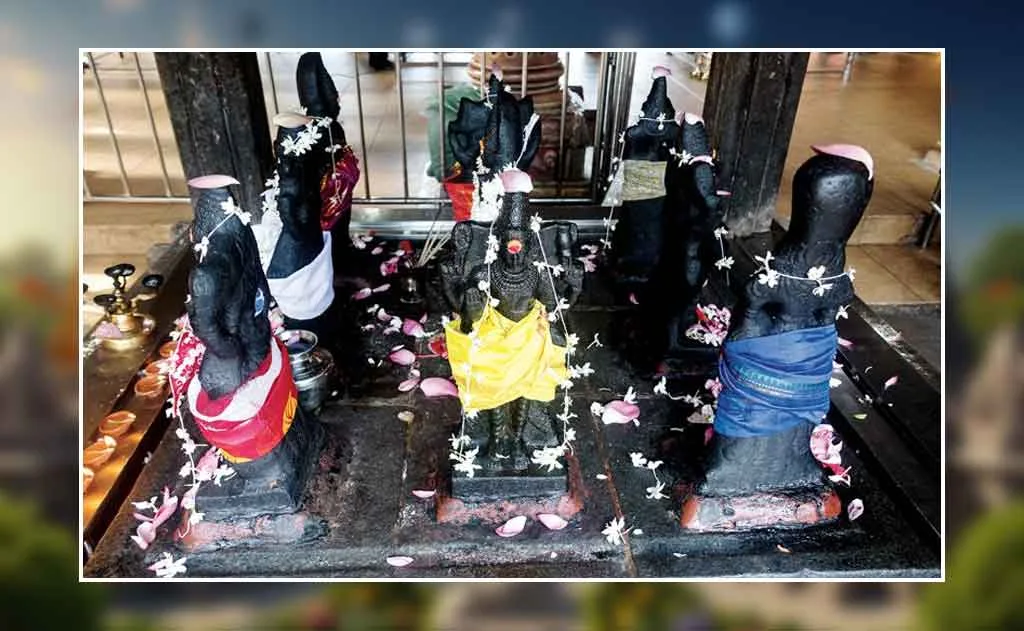
Navagraha: The Nine Planetary Deities of Hinduism Explained, with Colours, Days, Grains and Temples