
Veda Vyasa: Life, the Vedas and the Mahabharata
Veda Vyasa, also called Krishna Dvaipayana, is the sage whom Hindu tradition honours as the arranger of the Vedas into four, the author of the Mahabharata and the compiler of the Puranas. In the Mahabharata he is the son of the sage Parashara and Satyavati, and the grandfather of the Pandavas and Ka
Veda Vyasa, also called Krishna Dvaipayana, is the sage whom Hindu tradition honours as the arranger of the Vedas into four, the author of the Mahabharata and the compiler of the Puranas. In the Mahabharata he is the son of the sage Parashara and Satyavati, and the grandfather of the Pandavas and Kauravas. Guru Purnima, the full moon of Ashadha, is kept in his honour as Vyasa Purnima.
| Key facts | |
|---|---|
| Names | Vyasa ("the arranger"); Krishna Dvaipayana ("the dark one born on an island"); Veda Vyasa; Badarayana (in a tradition that identifies the two) |
| Parents | The sage Parashara and Satyavati |
| Son | The sage Shuka |
| Disciples | Paila, Vaishampayana, Jaimini, Sumantu; later Suta Romaharshana |
| Works attributed | Arrangement of the four Vedas; Mahabharata; the eighteen Mahapuranas; the Brahma Sutras (by the Badarayana identification) |
| Day | Guru Purnima (Vyasa Purnima), Ashadha Purnima |
| Dating | Traditional: the end of the Dvapara yuga. Historians: the Mahabharata grew over many centuries, roughly 400 BCE to 400 CE |
Birth on an island
The Adi Parva of the Mahabharata tells that the sage Parashara met Satyavati, a fisherman's daughter who ferried travellers across the Yamuna. Their son was born on an island in the river, and because he was dark he was called Krishna Dvaipayana. He grew up at once, as the story has it, and left to live as an ascetic, promising to come to his mother whenever she called him.
Dividing the Veda
The name Vyasa means "one who divides or arranges". Tradition, as told in the Vishnu and Bhagavata Puranas, says that he saw that people of the coming age would not be able to hold the whole Veda in memory, so he arranged it into four collections and taught each to a disciple: the Rigveda to Paila, the Yajurveda to Vaishampayana, the Samaveda to Jaimini and the Atharvaveda to Sumantu. The Puranas also speak of a Vyasa in every age, of whom Krishna Dvaipayana is the Vyasa of this one.
Grandfather of the Kuru line
Satyavati later married King Shantanu of Hastinapura. When both her sons by Shantanu died without heirs, she called Vyasa, and under the custom of niyoga he fathered Dhritarashtra and Pandu with the widowed queens Ambika and Ambalika, and Vidura with a maid of the palace. He therefore appears throughout the Mahabharata as the grandfather and adviser of the Kauravas and Pandavas. See the Adi Parva summary.
Author of the Mahabharata
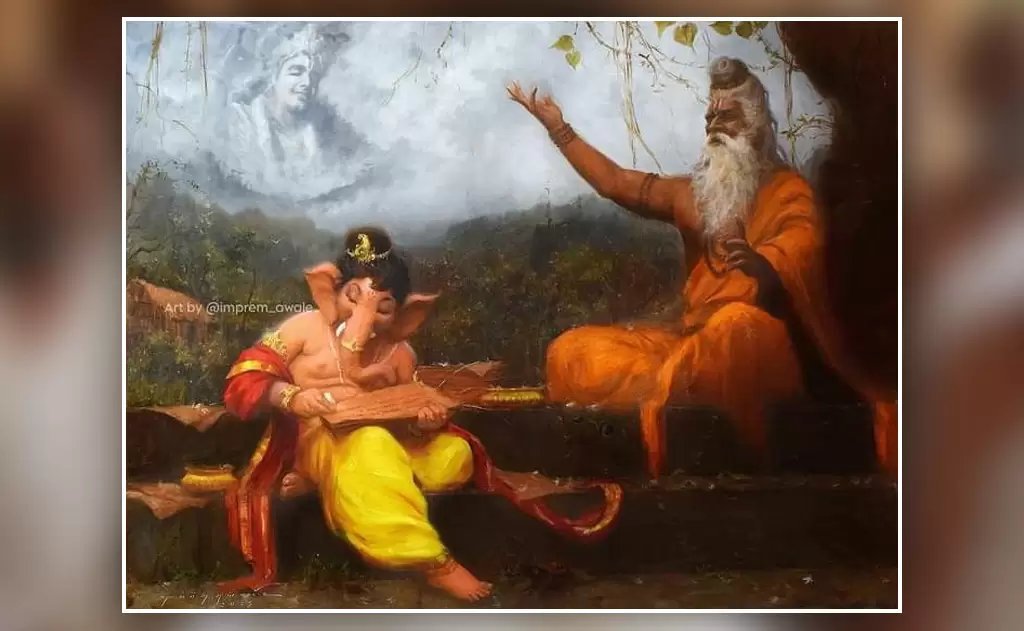
The Mahabharata names Vyasa as its composer. It says he taught it to his disciple Vaishampayana, who first recited it at the snake sacrifice of King Janamejaya, Arjuna's great-grandson; the version we read is retold again by the bard Ugrashravas. The popular story that Ganesha wrote the epic down as Vyasa dictated is found in many manuscripts, but the Bhandarkar Oriental Research Institute's critical edition leaves it out of its main text as a later addition.
Tradition counts the Mahabharata at 100,000 verses in eighteen parvas; the critical edition is shorter. Historians see the epic as the work of many hands growing over several centuries, while the tradition honours Vyasa as its single author. Read more: Mahabharata: the complete guide.
The Puranas and the Brahma Sutras
Tradition credits Vyasa with the eighteen Mahapuranas, among them the Bhagavata Purana, which begins with his own dissatisfaction after writing the Mahabharata and his turn to the praise of Vishnu. Many teachers also identify him with Badarayana, author of the Brahma Sutras, the root text of Vedanta; others treat them as two people. Historians date the Puranas and the Brahma Sutras to various later periods.
Guru Purnima
The full moon of the month of Ashadha is kept as Guru Purnima or Vyasa Purnima, the day to honour one's teachers, and tradition holds it to be Vyasa's birthday. Vyasa is also one of the chiranjivis, the long-lived ones who tradition says remain on earth. A cave near Mana village, above Badrinath, is shown to pilgrims as Vyasa Gufa, where tradition says he composed the epic. Read more: Guru Purnima.
Frequently asked questions
Who were Veda Vyasa's parents?
The sage Parashara and Satyavati, according to the Mahabharata.
Why is he called Veda Vyasa?
Because, by tradition, he arranged (vyasa) the one Veda into four: Rig, Yajur, Sama and Atharva.
Did Ganesha write the Mahabharata?
A well-known story says Ganesha wrote as Vyasa dictated. It appears in many manuscripts but is treated as a later addition in the critical edition.
Is Vyasa the same as Badarayana?
Many Vedanta teachers identify them, crediting Vyasa with the Brahma Sutras; others regard Badarayana as a separate author.
Why is Guru Purnima also called Vyasa Purnima?
It honours Vyasa as the first teacher of the Vedas and the epic, and tradition holds it to be his birthday.
Who was Vyasa's son?
The sage Shuka, who in the Bhagavata Purana recites that purana to King Parikshit.
Sources
- The Mahabharata, Adi Parva, critical edition (Bhandarkar Oriental Research Institute, Pune, 1933–1966); translation by J. A. B. van Buitenen, The Mahabharata, volume 1 (University of Chicago Press, 1973).
- Bhagavata Purana, Book 1, chapters 3–4, translated in the Gita Press edition (Gorakhpur).
- Encyclopaedia Britannica, "Vyasa".
Last reviewed: 12 November 2026.
Related: Famous Hindus · Mahabharata story summary · Guru Purnima · Aryabhata · The 12 Alvars
Share this with family and friends
Send it on WhatsApp, post it, or copy the link.
More from Famous Hindus
- Famous Hindus Born in July: Birthdays by Date
- Famous Hindus Born in August: Birthdays by Date
- Famous Hindus Born in October: Birthdays by Date
- Famous Hindus Born in November: Birthdays by Date
- Famous Hindus Born in December: Birthdays by Date