Aryabhata: Life, the Aryabhatiya and His Mathematics
Aryabhata was an Indian mathematician and astronomer, born in 476 CE, who wrote the Aryabhatiya in 499 CE at Kusumapura, near present-day Patna. In 121 short Sanskrit verses it sets out methods of arithmetic, algebra and trigonometry, a value of pi correct to four decimal places, a rotating Earth, a
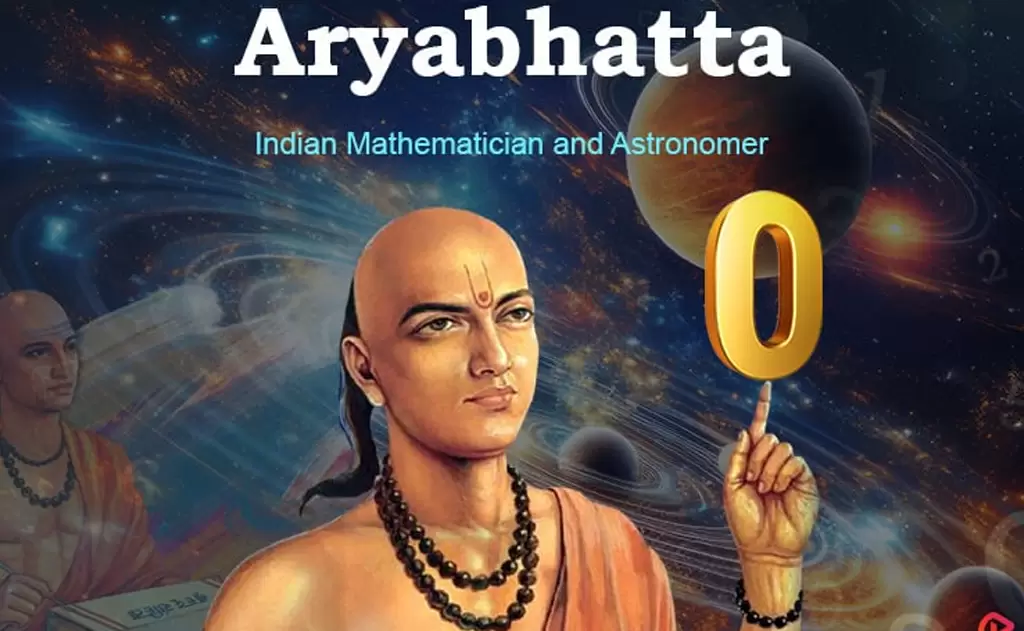
Aryabhata was an Indian mathematician and astronomer, born in 476 CE, who wrote the Aryabhatiya in 499 CE at Kusumapura, near present-day Patna. In 121 short Sanskrit verses it sets out methods of arithmetic, algebra and trigonometry, a value of pi correct to four decimal places, a rotating Earth, and an explanation of eclipses by the shadows of the Earth and Moon.
| Key facts | |
|---|---|
| Born | 476 CE (from his own statement in the Aryabhatiya) |
| Worked at | Kusumapura (Pataliputra, near Patna) |
| Main work | Aryabhatiya (499 CE), 121 verses in four sections |
| Known for | Pi ≈ 3.1416; sine table; Earth's rotation; eclipse theory; place-value calculation |
| Remembered in | India's first satellite, Aryabhata (1975) |
What we know of his life
Almost all we know comes from the Aryabhatiya itself. In one verse Aryabhata says that he was 23 years old when 3,600 years of the Kali Yuga had passed, which corresponds to 499 CE, so he was born in 476 CE. He says he wrote at Kusumapura. Later commentators connect him with Ashmaka, a region of central or southern India, but his birthplace is not certain.
The Aryabhatiya
The work has four sections:
- Gitikapada (13 verses): large units of time, the yuga system, and a compact way of writing numbers with syllables.
- Ganitapada (33 verses): mathematics, including square and cube roots, areas and volumes, arithmetic series, and the kuttaka method for solving equations in whole numbers.
- Kalakriyapada (25 verses): the reckoning of time and planetary positions.
- Golapada (50 verses): the celestial sphere, the motion of the Earth, and eclipses.
His main contributions
- Pi: he gives the circumference of a circle of diameter 20,000 as 62,832, which is 3.1416, and calls the value "approximate".
- Sines: he tabulates sine differences at intervals of 3¾ degrees, an early form of the trigonometric sine.
- The rotating Earth: he teaches that the Earth turns on its axis, so the stars appear to move westward, as the shore seems to move to a person in a moving boat.
- Eclipses: he explains solar and lunar eclipses by the Moon and the Earth's shadow, rather than by the demon Rahu.
These were later debated, adopted or rejected by astronomers such as Varahamihira and Brahmagupta.
His legacy
Commentaries on the Aryabhatiya were written for centuries, including one by Bhaskara I in the 7th century. India named its first satellite, launched in 1975, after him. Scientists today describe his work in historical terms: it was a high point of the mathematics of its time, not a prediction of later science.
Frequently asked questions
When was Aryabhata born?
In 476 CE. He states that he was 23 when he wrote the Aryabhatiya in 499 CE.
What value of pi did Aryabhata give?
62,832 divided by 20,000, which is 3.1416. He described it as an approximation.
Did Aryabhata invent zero?
The Aryabhatiya uses place-value calculation, but it does not use a symbol for zero as a number. Brahmagupta (628 CE) is the first known writer to give rules for calculating with zero.
Why is India's first satellite called Aryabhata?
It was named in his honour. It was launched on 19 April 1975.
Sources
- K. S. Shukla and K. V. Sarma (eds and trans.), Aryabhatiya of Aryabhata (Indian National Science Academy, 1976).
- Kim Plofker, Mathematics in India (Princeton University Press, 2009).
- Indian Space Research Organisation, "Aryabhata" (isro.gov.in).
Last reviewed: 12 November 2026.
Related: Brahmagupta · Pioneers of science from ancient India
Share this with family and friends
Send it on WhatsApp, post it, or copy the link.
More from Famous Hindus
- Krishnadevaraya: Vijayanagara Emperor, Poet and Patron
- Annamacharya: Life, Sankeertanas and Legacy of the Tallapaka Poet-Saint
- Hindu Spiritual Leaders and Temple Founders Abroad: The Swamis, Priests and Sabha Leaders Who Built the Diaspora
- Hindu Scientists, Astronauts and Business Leaders Abroad: 14 People Who Carried Their Faith Into Labs, Orbit and Boardrooms
- Sworn In on the Bhagavad Gita: 17 Leaders Outside India Who Took Their Oath on the Gita