The Great Inventions and Pioneers of Science from Ancient India
Ancient Indian Scientists Who Shaped the World India has long been a hub of knowledge, science, and discovery.
Ancient Indian Scientists Who Shaped the World India has long been a hub of knowledge, science, and discovery.
Ancient Indian Scientists Who Shaped the World
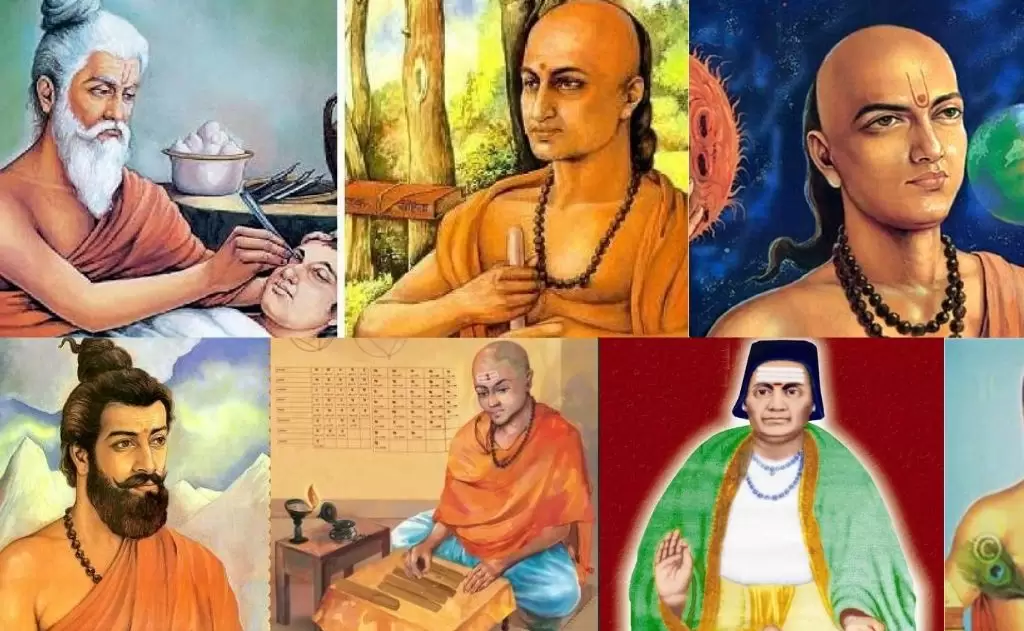
India has long been a hub of knowledge, science, and discovery. Ancient Indian scholars and scientists made groundbreaking contributions that shaped world history in mathematics, medicine, astronomy, metallurgy, and more. Below is a list of 10 of the greatest ancient Indian scientists whose remarkable work continues to inspire us today.
1. Maharishi Sushruta – The World’s First Surgeon
Maharishi Sushruta is often referred to as the “Father of Surgery” for his pioneering contributions to medical science. His treatise, Sushruta Samhita, is one of the earliest known texts on surgery, detailing surgical techniques, including:
✔️ The use of surgical instruments
✔️ Methods for plastic surgery and cataract surgery
His contributions to medical science were centuries ahead of his time.
2. Kanada – The Father of Atomic Theory
Kanada, an ancient Indian philosopher, is credited with formulating the concept of atoms long before John Dalton. Over 2,500 years ago, he proposed that:
🔹 Matter is made up of "paramanu" (atoms)
🔹 These atoms combine to form different substances
His theories laid the foundation for modern atomic theory.
3. Aryabhata – The Genius Mathematician and Astronomer
Aryabhata was one of the greatest mathematicians and astronomers of ancient India. His contributions include:
✔️ Accurate approximation of pi (3.1416)
✔️ Discovering the concept of zero, revolutionizing mathematics
✔️ Studying planetary motion and eclipses
His work transformed mathematics on a global scale.
4. Nagarjuna – Pioneer of Metallurgy
Nagarjuna was a key figure in metallurgy and alchemy, known for:
🔹 Developing methods for extracting metals from ores
🔹 Advancing techniques for high-quality steel production
His research contributed to India’s advanced ironworking technology.
5. Baudhayana – The True Discoverer of the Pythagorean Theorem
Though the Pythagorean Theorem is attributed to Pythagoras, it was actually known to Baudhayana centuries earlier. His Baudhayana Sulba Sutra explicitly states the theorem, demonstrating:
✔️ Advanced geometrical concepts
✔️ Practical applications for construction and architecture
6. Maharishi Charaka – The Father of Ayurveda
Maharishi Charaka played a key role in developing Ayurveda, India’s ancient system of medicine. His Charaka Samhita focused on:
🌿 Holistic health through balance of body, mind, and spirit
🌿 Detailed descriptions of diseases, treatments, and herbal remedies
His principles are still widely followed in Ayurvedic medicine today.
7. Vagbhatta – The Ayurvedic Master
Vagbhatta was another influential figure in Ayurveda. His work, Ashtanga Hridayam, refined Ayurvedic knowledge by:
🔹 Enhancing treatment techniques
🔹 Introducing herbal medicine and its benefits
His teachings form the basis of modern Ayurvedic practices.
8. Varahamihira – The Father of Astronomy and Meteorology
Varahamihira was a brilliant astronomer and mathematician. His discoveries include:
✔️ Theories on planetary motion
✔️ Early understanding of gravity, long before Newton
✔️ Advances in meteorology and climate science
His work influenced later scientific developments in astronomy.
9. Sridhara Acharya – The Pioneer of Algebra
Sridhara Acharya made significant contributions to algebra and mathematics. He was the first to:
🔹 Develop systematic methods for solving quadratic equations
🔹 Lay the foundation for modern algebraic techniques
10. Bhaskara I & Bhaskara II (Bhaskaracharya) – Innovators of the Decimal System
Bhaskara II, also known as Bhaskaracharya, was a renowned mathematician and astronomer. His contributions include:
✔️ Writing the first known text to fully use the decimal system
✔️ His famous treatise Lilavati, a classic in mathematics
His work remains highly influential in mathematics and astronomy.
India’s Ancient Scientific Legacy: A Treasure Trove of Knowledge
These remarkable individuals exemplify India’s rich scientific heritage. From medicine to mathematics, astronomy to metallurgy, their discoveries continue to shape the modern world in countless ways.
🌟 India’s legacy as a cradle of scientific innovation has influenced generations of scholars and continues to inspire curiosity and research in the modern age.
📢 Which ancient Indian scientific contributions fascinate you the most? Share your thoughts below!
Also read: Pingala's binary-like counting, Madhava's infinite series for pi and Panini's grammar and computer science.
Frequently Asked Questions
Who is called the father of surgery in ancient India?
Maharishi Sushruta, whose Sushruta Samhita is one of the earliest known texts on surgery. It describes surgical instruments and methods for plastic surgery and cataract surgery.
Who proposed the idea of atoms in ancient India?
Kanada, an ancient Indian philosopher, proposed over 2,500 years ago that matter is made of "paramanu" (atoms) that combine to form different substances. He is credited with this long before John Dalton.
What did Aryabhata contribute to mathematics and astronomy?
Aryabhata gave an approximation of pi as 3.1416, is credited with the concept of zero, and studied planetary motion and eclipses.
Did ancient India know the Pythagorean Theorem?
Yes. Baudhayana's Sulba Sutra explicitly states the theorem, centuries before Pythagoras. It was used for geometry in construction and architecture.
Which ancient Indian texts form the basis of Ayurveda?
Charaka's Charaka Samhita covers holistic health and the treatment of diseases with herbal remedies. Vagbhatta's Ashtanga Hridayam refined Ayurvedic knowledge.
Who wrote the Lilavati?
Bhaskara II, also known as Bhaskaracharya, wrote the treatise Lilavati, a classic in mathematics. He is also credited with the first known text to fully use the decimal system.
You might also like
Chhatrapati Shivaji Maharaj Jayanti 2026: Honouring the Great Protector of Hindu Dharma
The Untold Greatness of Chhatrapati Shivaji Maharaj: A Saga of Valor, Vision, and Hindu Revival
Ganapati Atharvashirsha: Full Sanskrit Text with IAST, Meaning and How to Recite