Famous Temples in Maharashtra: A Source-Checked Guide to Ashtavinayak, Jyotirlingas, Pandharpur, Kolhapur and More
A guide to 24 temples in Maharashtra built only from HinduTone's source-checked temple records: four Ashtavinayak shrines and Pune's and Nagpur's Ganesha temples, the Jyotirlingas of Trimbakeshwar, Bhimashankar and Grishneshwar, heritage Shiva temples from Ellora to Ambernath, Vithoba at Pandharpur, Khandoba at Jejuri, and Devi temples at Kolhapur, Mumbai, Pune and Aundh. Each section covers location, tradition as recorded, festivals and visitor notes, with a summary table, pilgrimage circuits, tips for visitors from abroad and FAQs.
A guide to 24 temples in Maharashtra built only from HinduTone's source-checked temple records: four Ashtavinayak shrines and Pune's and Nagpur's Ganesha temples, the Jyotirlingas of Trimbakeshwar, Bhimashankar and Grishneshwar, heritage Shiva temples from Ellora to Ambernath, Vithoba at Pandharpur, Khandoba at Jejuri, and Devi temples at Kolhapur, Mumbai, Pune and Aundh. Each section covers location, tradition as recorded, festivals and visitor notes, with a summary table, pilgrimage circuits, tips for visitors from abroad and FAQs.
Quick answer: This guide covers all 24 Maharashtra temples in HinduTone's source-checked records, in five groups: Ganesha temples (including four Ashtavinayak shrines: Morgaon, Siddhatek, Pali and Mahad), the Jyotirlingas of Trimbakeshwar, Bhimashankar and Grishneshwar, heritage Shiva temples such as the Kailasa temple at Ellora, the Varkari and Khandoba centres of Pandharpur and Jejuri, and Devi temples including Mahalakshmi (Ambabai) at Kolhapur and the Mahalakshmi temple in Mumbai. Each section links to the temple's own record page.
Last updated: 20 October 2026. Built from HinduTone's source-checked temple records (checked on 11 October 2026). The records do not publish fixed darshan timings, so confirm timings and arrangements with each temple before you travel.
Ganesha temples and the Ashtavinayak
Four of the eight Ashtavinayak shrines are in our verified set; our Ashtavinayak yatra guide covers the whole circuit. Wednesday is widely kept for Ganesha; see our Wednesday guide.
Shri Mayureshwar Temple, Morgaon (Pune district)
Ganesha is worshipped here as Mayureshwar, riding a peacock, in a swayambhu image flanked by Riddhi and Siddhi. Maharashtra Tourism calls Morgaon the spiritual headquarters of the Ganapatya tradition, and the Ashtavinayak yatra traditionally starts and ends here. Devotees may perform abhishekam directly on the image. Festivals include Ganesh Chaturthi, Maghi Ganesh Jayanti and a silver-palanquin procession on the Shashti of Bhadrapada and Magha. Morgaon temple page.
Siddhivinayak Temple, Siddhatek (Ahilyanagar district)
On a hillock above the Bhima river in Karjat taluka, this black stone, north-facing temple holds a seated Ganesha with the trunk turned to the right. It is usually visited second on the yatra, after Morgaon. According to tradition, Vishnu worshipped Ganesha on this hill, gained siddhi and defeated the demons Madhu and Kaitabha. Many devotees walk around the whole hill on a rough, unpaved path, so keep age, health and weather in mind. Siddhatek temple page.
Ballaleshwar Temple, Pali (Raigad district)
This Ashtavinayak shrine is named after a devotee, the boy Ballal: according to tradition, Ganesha freed him after his angry father tied him to a tree, and agreed to remain at Pali. Devotees first visit Dhundi Vinayak, the stone Ballal is believed to have worshipped. The stone temple of 1760 is laid out in the shape of the letter 'Shri'. Expect long queues on Sankashti Chaturthi, Ganesh Chaturthi and Magha festival days. Pali temple page.
Varadvinayak Temple, Mahad (Khalapur taluka, Raigad)
This Mahad, near Khopoli beside the old Mumbai-Pune highway, is not the better-known town of Mahad elsewhere in Raigad. Ganesha is worshipped as Varadvinayak, the giver of boons, and devotees may enter the sanctum and touch the swayambhu idol. According to tradition, the sage Gritsamada asked Ganesha to remain here. Maghi Chaturthi is the busiest festival; devotees believe its coconut prasad brings the blessing of children. Varadvinayak temple page.
Kasba Ganpati, Pune
Near the Lal Mahal in Kasba Peth, Pune's original settlement, Kasba Ganpati is described by the district administration as the city's gramdaivat. Jijabai, mother of Chhatrapati Shivaji Maharaj, is credited with installing the deity. Kasba Ganpati is honoured ahead of Pune's other 'manache' Ganpatis, and the city's immersion procession begins here, so expect heavy crowds during Ganeshotsav. Kasba Ganpati temple page.
Shri Ganesh Mandir Tekdi, Nagpur
Tekdi Ganapati sits on the Sitabuldi hillock behind Sitabuldi fort in central Nagpur; tekdi is Marathi for hill. Devotees regard the idol as swayambhu. Long queues form at Ganesh Chaturthi. Tekdi Ganesh temple page.
The Jyotirlingas of Maharashtra
Three Jyotirlingas are in our verified records. Our 12 Jyotirlingas guide explains the full list, and our Monday guide covers the Somvar traditions of Shiva worship.
Trimbakeshwar, Nashik district
At the foot of Brahmagiri hill, the source of the Godavari, the linga at Trimbak has three faces standing for Brahma, Vishnu and Shiva, according to the temple trust. Pilgrims bathe in the Kushavarta Kund. The present temple was built by Peshwa Balaji Bajirao between 1740 and 1760. Saint Nivruttinath took samadhi here. Festivals include Mahashivaratri, the Kartik festival with a golden mask on the linga, and a Monday palanquin procession. Trimbakeshwar temple page.
Bhimashankar, Pune district
In the Sahyadri forests of the Bhimashankar Wildlife Sanctuary, near the source of the Bhima, the sanctum holds a swayambhu linga. The Jyotirlinga stotra's line 'Dakinyam Bhimashankaram' names it. Construction work has cut darshan to a short morning window, so check first. Festivals include the Maha Shivaratri Yatra, Tripurari Purnima and Shravan. Footwear, meat and alcohol are not allowed. Bhimashankar temple page.
Grishneshwar, Verul (Chhatrapati Sambhajinagar district)
About 1 km from the Ellora Caves, this 18th-century temple, whose roots Incredible India traces to the Rashtrakuta period, is revered as a Jyotirlinga. Devotees may touch the linga directly, and men must remove their shirts to enter the sanctum. Grishneshwar temple page.
Heritage Shiva temples
Kailasa Temple (Cave 16), Ellora
Part of the Ellora Caves World Heritage Site, this rock-cut Shiva temple represents Mount Kailasa. Scholarly consensus attributes it to the Rashtrakuta kings Dantidurga and Krishna I in the late 8th century CE. It is a protected monument, so check opening days and entry rules with the Archaeological Survey of India. Kailasa temple page.
Ambreshwar Shiv Mandir, Ambernath (Thane district)
On the Waldhuni river, this black basalt temple is dated to 1060 CE, in the Shilahara period. Devotees regard the linga as swayambhu. Mahashivratri brings lakhs of devotees, and police advise leaving gold and valuables at home. Ambernath temple page.
Walkeshwar Temple and Banganga, Mumbai
On Malabar Hill, the name recalls the tradition that Rama made a linga of sand (Walukeshwar) on his way to Lanka. The district administration dates the original temple and the Banganga Tank to 1127 CE. At Tripurari Purnima thousands of lamps are lit on the tank steps. Walkeshwar temple page.
Bhuleshwar Mahadeo Temple, Malshiras (Pune district)
Inside the hilltop Daulatmangal fort near Yavat, this ASI-protected temple is known for carved stonework and Ganeshwari, a figure of Ganesha in female form. According to tradition, Parvati danced here in disguise to please Shiva. Crowds peak on Shravan Mondays. Bhuleshwar temple page.
Anandeshwar Temple, Lasur (Amravati district)
On the Purna river, this black stone Hemadpanti temple is dated to around the 13th century, in the Yadava period, and is ASI-protected. Three sanctums surround an open central hall, the swarga mandap, with 18 carved pillars. Devotees from Amravati and Akola come in Shravan and at Mahashivratri. Anandeshwar temple page.
Kankaleshwar Temple, Beed
This Shiva temple stands in the middle of a large stone tank, reached by a causeway, with a star-shaped exterior and a domed hall on 24 pillars. All India Radio calls it the guardian deity of Beed city, and devotees queue from early morning on Maha Shivaratri. Kankaleshwar temple page.
Markandadeo Temple Complex, Gadchiroli
On the Wainganga river in Chamorshi tahsil, this ASI-protected group of about 16 temples dates to the 9th to 12th centuries; its main shrine is to Shiva as Markandeshwar. Restoration is ongoing, so follow site rules. Markanda temple page.
Vithoba, Khandoba and the saints' places
Shri Vitthal Rukmini Mandir, Pandharpur (Solapur district)
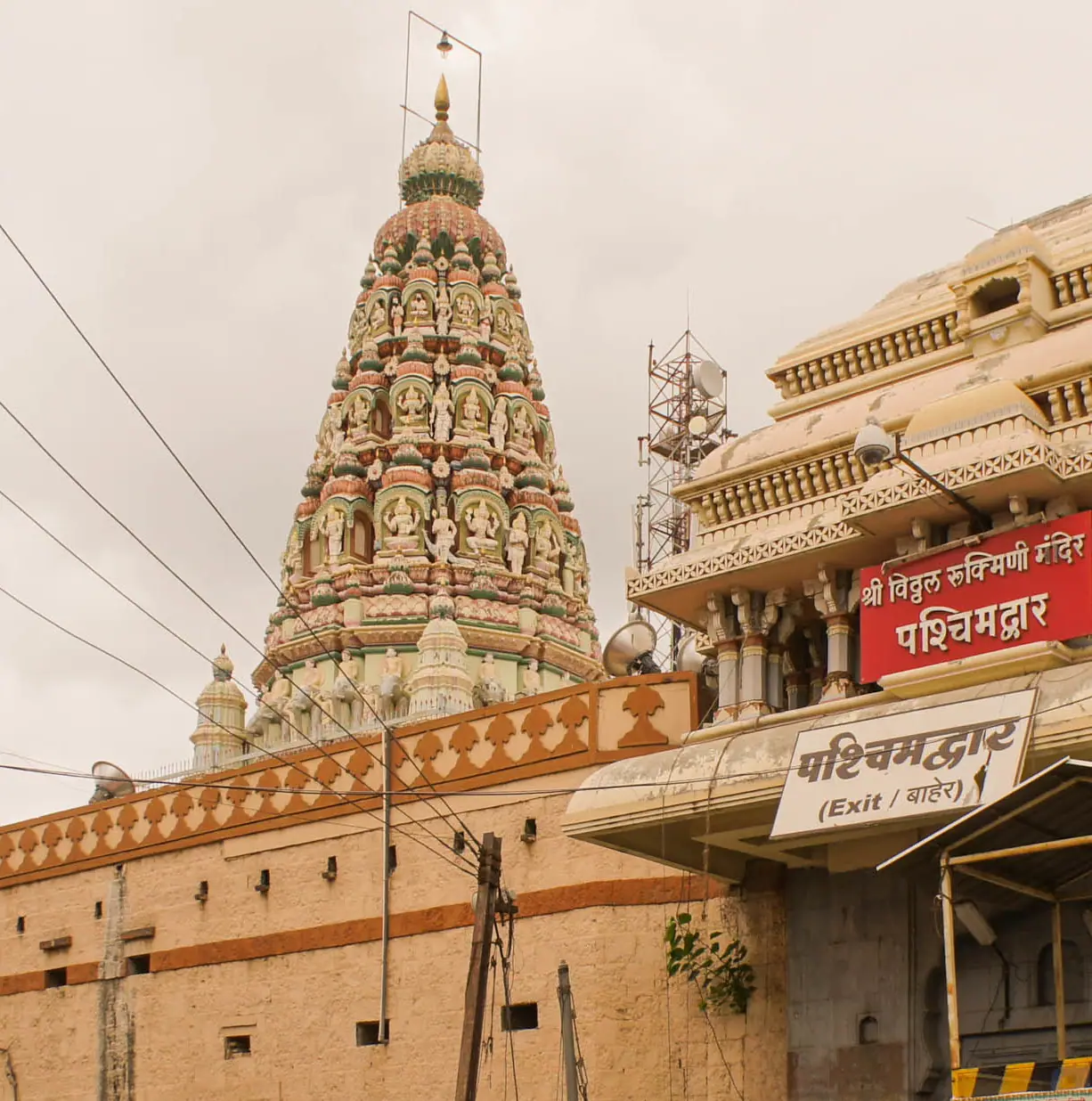
Vitthal, worshipped as a form of Vishnu identified with Krishna, stands on a brick with hands on his waist; legend says the devotee Pundalik asked him to stand there. Rukmini has her own shrine. The district administration calls Vitthal the kuldaivat of Maharashtra. Devotees traditionally bathe in the Chandrabhaga before darshan, and Varkari devotees regard Wednesday as Vitthal's day. Four Ekadashi yatras, Ashadhi, Kartiki, Maghi and Chaitri, draw lakhs; the temple committee offers advance darshan passes on its website. See our Kartiki Ekadashi 2026 guide, our Sant Tukaram profile and the Pandharpur temple page.
Shri Khandoba Martanda Bhairav Mandir, Jejuri (Pune district)
Khandoba, worshipped as Martanda Bhairava, a form of Shiva, with his consort Mhalsa, is a family deity for very many households across Maharashtra and the Deccan. The fort-like temple on Jejuri hill is reached by a long, steep flight of steps lined with lamp pillars, and the turmeric (bhandara) thrown at festivals gives the town its name, Sonyachi Jejuri. Somvati Amavasya (Incredible India listed 15 June and 9 November 2026), Champa Shashti, Magh Purnima and Dasara are the big days. Jejuri temple page.
Shivthar Ghal (Sundarmath), Raigad district
A cave in the Sahyadri hills near Biravadi, revered as the place where Samarth Ramdas composed the Dasbodh, dictated, by tradition, to his disciple Kalyan Swami. Dasbodh Jayanti is marked here every year on Magh Shuddha Navami. Steps climb from the road to the cave, and staying requires prior permission. See our Samarth Ramdas profile and the Shivthar Ghal page.
Devi temples
Friday is widely kept for the Goddess; see our Friday guide. Tulja Bhavani at Tuljapur, Saptashrungi at Vani and Renuka Mata at Mahur are not yet in our source-checked record set, but have their own HinduTone guides: Tulja Bhavani, Saptashrungi and Mahur.
Mahalakshmi (Ambabai) Temple, Kolhapur
The goddess, worshipped as Mahalakshmi and as Ambabai, is a black stone image crowned by a five-headed serpent, with Mahakali and Mahasaraswati in side shrines. The temple trust counts Kolhapur among the 'three and a half' Shakti Peethas. Navratri is the main festival, the Kiranotsav falls on 31 January to 2 February and 9 to 11 November. The trust asks for modest, traditional clothing. Kolhapur temple page.
Shri Mahalakshmi Temple, Mumbai
On Bhulabhai Desai Road, Mahalakshmi is worshipped with Mahakali and Mahasaraswati. Tradition says the three images were recovered from the sea during work on the Hornby Vellard causeway. Devotees press a coin to the rear wall while praying for a wish. Fridays and Navratri bring heavy crowds; Diwali with Annakut and Akshaya Tritiya are also observed. Mumbai Mahalakshmi temple page.
Chaturshringi Devi Temple, Pune
On a hill slope along Senapati Bapat Road, the goddess Chaturshringi is described by the trust as also known as Mahakali, Mahalakshmi, Mahasaraswati and Ambareshwari. Navratri brings heavy crowds and traffic diversions. Chaturshringi temple page.
Shri Yamai Devi Temple, Aundh (Satara district)
On Mulpeeth hill beside Aundh, Yamai is described by the Ministry of Tourism as a combined form of Parvati and Renuka; tradition links the name to Rama calling out 'Ye Mai' to Parvati. The Paush yatra peaks around Shakambhari Pournima, and Navratri has an Ashtami palanquin procession. Aundh temple page.
Shree Yamai Devi Temple, Kanhersar (Pune district)
Yamai Devi is the village deity of Kanhersar in Khed taluka. According to the trust's tradition, she manifested here in answer to the penance of Sant Kanhuraj Maharaj of Kendur. Navratri, Dasara and the Paush, Magh and Chaitra full moons are its festivals; the trust fixes dates each year. Kanhersar temple page.
Maharashtra temples at a glance
| Temple | District/City | Deity | Known for |
|---|---|---|---|
| Mayureshwar | Pune (Morgaon) | Ganesha | Ashtavinayak start and end |
| Siddhivinayak | Ahilyanagar (Siddhatek) | Ganesha | Right-turned trunk |
| Ballaleshwar | Raigad (Pali) | Ganesha | Named after devotee Ballal |
| Varadvinayak | Raigad (Mahad, Khalapur) | Ganesha | Devotees touch the idol |
| Kasba Ganpati | Pune | Ganesha | Pune's gramdaivat |
| Tekdi Ganesh | Nagpur | Ganesha | Sitabuldi hillock |
| Trimbakeshwar | Nashik (Trimbak) | Shiva | Jyotirlinga; three-faced linga |
| Bhimashankar | Pune | Shiva | Jyotirlinga; forest setting |
| Grishneshwar | Chhatrapati Sambhajinagar (Verul) | Shiva | Jyotirlinga near Ellora |
| Kailasa (Cave 16) | Chhatrapati Sambhajinagar (Ellora) | Shiva | Rock-cut temple |
| Ambreshwar | Thane (Ambernath) | Shiva | Shilahara temple, 1060 CE |
| Walkeshwar | Mumbai City | Shiva | Banganga Tank |
| Bhuleshwar | Pune (Malshiras) | Shiva | Ganeshwari carving |
| Anandeshwar | Amravati (Lasur) | Shiva | Open-sky hall |
| Kankaleshwar | Beed | Shiva | Temple in a tank |
| Markandadeo | Gadchiroli | Shiva | Temple group on the Wainganga |
| Vitthal Rukmini | Solapur (Pandharpur) | Vitthal | Varkari wari |
| Khandoba | Pune (Jejuri) | Khandoba | Turmeric festivals |
| Shivthar Ghal | Raigad | Samarth tradition | Dasbodh cave |
| Mahalakshmi (Ambabai) | Kolhapur | Devi | Kiranotsav |
| Mahalakshmi | Mumbai City | Devi | Tridevi; Fridays |
| Chaturshringi | Pune | Devi | Navratri crowds |
| Yamai Devi | Satara (Aundh) | Devi | Hilltop yatra |
| Yamai Devi | Pune (Kanhersar) | Devi | Village deity |
Pilgrimage circuits in Maharashtra
- Pune district: Morgaon and Jejuri (Jejuri is Morgaon's nearest railway station), then Siddhatek across the Bhima, Bhuleshwar near Yavat, and in the city Kasba Ganpati and Chaturshringi; Bhimashankar is a separate hill trip.
- Mumbai, Thane and Raigad: Mahalakshmi and Walkeshwar in South Mumbai, Ambreshwar at Ambernath, then Varadvinayak near Khopoli and Ballaleshwar at Pali, with Shivthar Ghal reachable via Mahad.
- Nashik and Chhatrapati Sambhajinagar: Trimbakeshwar near Nashik, then Grishneshwar and the Kailasa temple, about 1 km apart at Verul and Ellora; Beed's Kankaleshwar uses the same airport.
- South Maharashtra: Ambabai at Kolhapur, Yamai at Aundh in Satara district (whose nearest airport is Kolhapur), and Vitthal at Pandharpur.
- Vidarbha: Tekdi Ganapati in Nagpur, the Markanda temples in Gadchiroli and Anandeshwar at Lasur in Amravati district.
The records do not name a single best season. Festival days are crowded: Shravan and Mahashivratri at Shiva temples, Ganeshotsav and Maghi Chaturthi at Ganesha temples, Navratri at Devi temples and the Ekadashi yatras at Pandharpur. In the monsoon, ghat roads and trails such as those to Bhimashankar can be slippery.
Visiting from abroad
The airports named in the records include Mumbai's Chhatrapati Shivaji Maharaj International Airport, Pune, Nashik (Ojhar), Kolhapur, Chhatrapati Sambhajinagar and Nagpur's Babasaheb Ambedkar International Airport. Rest a day after a long flight before hill climbs. Book darshan passes, pujas and lodging only through official temple websites, carry a copy of your passport, and keep some cash for offerings and footwear counters. Our temple visit guide covers dress and etiquette, and our temple safety tips help on crowded festival days.
Frequently asked questions
Which Ashtavinayak temples are covered in this guide?
Four of the eight are in our source-checked records: Mayureshwar at Morgaon, Siddhivinayak at Siddhatek, Ballaleshwar at Pali and Varadvinayak at Mahad in Khalapur taluka. Our Ashtavinayak yatra guide covers the full circuit.
Which Jyotirlingas are in Maharashtra?
Our records cover three: Trimbakeshwar in Nashik district, Bhimashankar in Pune district and Grishneshwar at Verul near Ellora. The Bhimashankar record notes that lists vary on whether Parli Vaijnath and Aundha Nagnath are counted among the twelve, so sources give the state's count differently.
Is Siddhatek the same as the Siddhivinayak temple in Mumbai?
No. The record states that the Siddhivinayak at Siddhatek, on the Bhima river in Ahilyanagar district, is a different shrine from the well-known Siddhivinayak temple in Mumbai. The Siddhatek idol is known for its trunk turned to the right.
When is the Kiranotsav at Kolhapur?
The temple trust and Maharashtra Tourism give the dates as 31 January to 2 February and 9 to 11 November.
When are the big Pandharpur gatherings?
The Solapur district administration lists four main Ekadashi yatras: Ashadhi (June to July), Kartiki (October to November), Maghi (January to February) and Chaitri (March to April). Ashadhi Ekadashi, the climax of the Varkari wari, is the busiest.
Is a temple visit a guaranteed remedy?
No. Devotees pray for wishes, children and other blessings, as at Varadvinayak where many believe the coconut prasad brings the blessing of children. The records report these as beliefs of faith; no outcome is guaranteed.
Editor's note (20 October 2026)
Every temple fact in this guide comes from HinduTone's source-checked temple records, which were researched against district administrations, state tourism and endowment departments, newspapers and temple directories and checked on 11 October 2026. Claims resting on a single source and temples not yet verified are left out. Timings and seva rules change; please confirm with the temple before travelling.
Related guides
- Ashtavinayak yatra: the eight Ganesha temples of Maharashtra
- 12 Jyotirlingas: complete darshan guide
- Kartiki Ekadashi 2026 at Pandharpur
- Dussehra 2026 in Maharashtra
- Tulja Bhavani Temple, Tuljapur
- Famous Ganesh temples in India
- Famous Krishna temples in India
- Lord Ganesha
- Lord Shiva
- Goddess Lakshmi
- Goddess Durga
- Importance of Thursday in Hinduism
- Hindu days of the week
You might also like
Famous Krishna Temples in India: 13 Source-Checked Temples from Guruvayur to Mathura, Vrindavan, Dakor and Pandharpur
Famous Temples in Kerala: A Source-Checked Guide to Guruvayur, Padmanabhaswamy, Vadakkunnathan, Attukal, Sabarimala and 70 More
Famous Temples in Karnataka: A Source-Checked Guide to Kukke, Kollur, Mysuru, Melukote, Hampi and More