
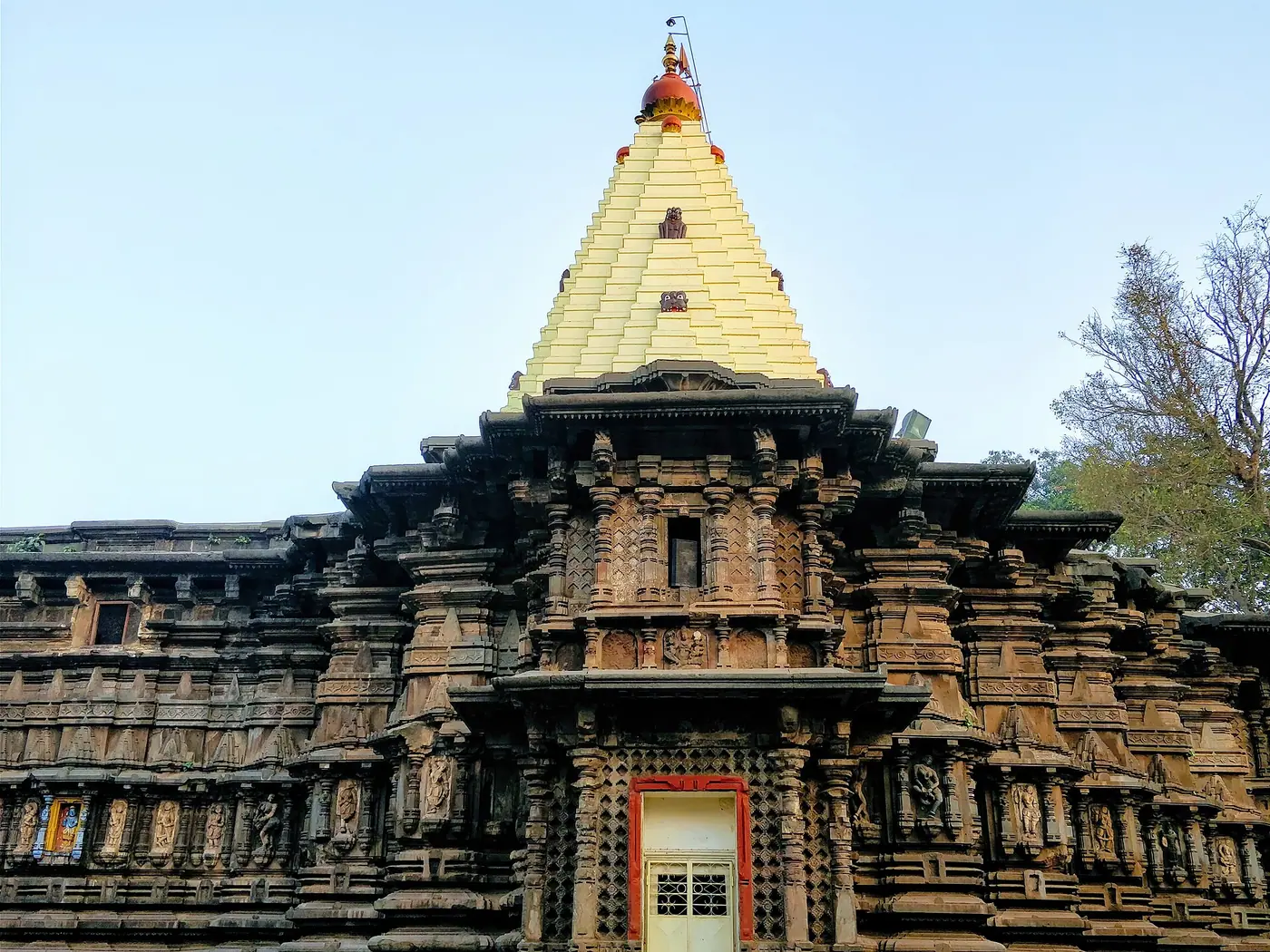
Mahalakshmi (Ambabai) Temple, Kolhapur
महालक्ष्मी मंदिर
Devi (Mahalakshmi / Ambabai, Karveer Nivasini) temple · Kolhapur, Maharashtra, India
Photo: Lovelitjadhav · CC BY-SA 4.0 · via Wikimedia Commons
The Shree Karveer Nivasini Ambabai (Mahalakshmi) Temple stands in the old centre of Kolhapur, Maharashtra. The temple trust's office is in Mangalwar Peth. The goddess is worshipped as Mahalakshmi and as Ambabai, and the temple is counted among the 'three and a half' Shakti Peethas.
The Kolhapur District Gazetteer calls it the most important of the city's monuments. It notes that the old town grew up around the temple and that Kolhapur owes its title 'Dakshin Kashi' (the Kashi of the South) mainly to this shrine.
Faith & Tradition
Religious Significance of Mahalakshmi (Ambabai) Temple, Kolhapur
The temple trust describes Kolhapur as one of the three and a half Shakti Peethas named in the Puranas. It also calls Kolhapur one of six places where devotees believe they can either be freed from desires or have them fulfilled. The trust says the temple takes its name from Ambabai, consort of Shiva, while Maharashtra Tourism describes the goddess as Mahalakshmi, consort of Vishnu. Both identities are part of living tradition here.
Twice a year, at sunset, the sun's rays enter the temple and fall on the image, moving from the feet to the face over three days. This is the Kiranotsav. Both the temple trust and Maharashtra Tourism give its dates as 31 January to 2 February and 9 to 11 November.
Heritage
History of Mahalakshmi (Ambabai) Temple, Kolhapur
The temple's age is debated. The District Gazetteer says construction is thought to have begun in the Rashtrakuta period (9th century), notes a view that the oldest parts may be early Chalukya work, and elsewhere says the temple was built in the 7th or 8th century. Maharashtra Tourism credits a Chalukya ruler, Karandev, in the 7th century. The Gazetteer also records a long-standing claim that the building was originally a Jain temple.
The temple trust cites inscriptions as evidence of royal patronage. It names the Sanjan copper plate of the Rashtrakuta king Amoghavarsha (871 CE) as the oldest known documentary reference to the goddess. It also notes that the Shilahara rulers of Kolhapur (11th-12th centuries) styled themselves as having received boons from Mahalakshmi, and that Yadava-period inscriptions include one of Singhana (1218-19 CE). The Gazetteer lists four Devanagari inscriptions in the temple, including ones dated 1218 and 1236 CE.
According to the Gazetteer, during the disturbances of the 14th and 15th centuries the image was hidden in a private house. It was reinstalled in the temple around 1722 on the orders of Sambhaji of Kolhapur. The Garud Mandap in front of the temple was added between 1838 and 1843.
Architecture and sacred features
The Gazetteer describes a cross-shaped temple of local black stone in the mortarless Hemadpanti style. It faces west, with a drum chamber (nagarkhana) over the main entrance and smaller gates on the north, east and south. Ambabai is enshrined under the main dome, with Mahakali and Mahasaraswati in smaller side shrines and a linga in the upper storey directly above the goddess. The outer walls carry niches with carved figures of musicians and dancers.
Maharashtra Tourism describes the image as a black stone figure about three feet tall, crowned by a five-headed serpent, holding a matulinga fruit, a mace, a shield and a drinking bowl, with a stone lion behind it.
Plan Your Visit
Darshan and Visitor Information
The temple trust asks devotees to wear modest, traditional clothing and not to enter in revealing or inappropriate dress. It lists five daily worship services, from the early-morning Kakad Aarti to the night Shejarti (checked October 2026); confirm before travelling. Confirm current arrangements, including any changes during Navratri, with the Devasthan Management Committee, Western Maharashtra, Kolhapur.
Timings and arrangements change with seasons and festivals. Confirm current details with Devasthan Management Committee, Western Maharashtra, Kolhapur (Paschim Maharashtra Devasthan Samiti) (official website) before travelling. Last reviewed 5 October 2026.
Sacred Calendar
Festivals at Mahalakshmi (Ambabai) Temple, Kolhapur
Navratri
The temple's biggest festival lasts ten days. The temple trust describes nightly processions of the goddess's palanquin within the complex, a visit to the Tryambuli (Temblai) temple on the fifth day where the Chhatrapati performs the Kushmanda offering, and a city procession of the silver image.
Kiranotsav
Over three evenings the setting sun's rays fall on the goddess from her feet to her face, according to the temple trust and Maharashtra Tourism.
Rathotsav
The Gazetteer records a procession of the goddess's image through the town in a chariot on the full moon of Chaitra; the temple trust also publishes its yearly Rathotsav.
Location
How to Reach Mahalakshmi (Ambabai) Temple, Kolhapur
Maharashtra Tourism names Kolhapur Airport, about 10 km from the city centre, as the nearest airport. Kolhapur railway station (Chhatrapati Shahu Maharaj Terminus) is about 5 km from the temple. State transport and private buses link Kolhapur with Pune (240 km) and Mumbai (380 km).
The temple is in the old city near Mahadwar Road, and Bhavani Mandap is a short walk away.
Location: Kolhapur, Maharashtra, India
Nearest airport: Kolhapur Airport
Nearest railway station: Kolhapur (Chhatrapati Shahu Maharaj Terminus)
More in Hindu temples in Maharashtra · Devi (Mahalakshmi / Ambabai, Karveer Nivasini) temples · Temples in Karvir Taluka · Temples in Kolhapur District
Questions
Mahalakshmi (Ambabai) Temple, Kolhapur: Frequently Asked Questions
Is the Kolhapur Mahalakshmi temple a Shakti Peetha?
Yes, by tradition. The temple trust and Maharashtra Tourism count it among the 'three and a half' Shakti Peethas mentioned in the Puranas.
Is the goddess Mahalakshmi or Ambabai?
She is worshipped under both names. The temple trust links the name Ambabai with the consort of Shiva, while Maharashtra Tourism describes her as Mahalakshmi, consort of Vishnu.
When is the Kiranotsav?
Both the temple trust and Maharashtra Tourism list 31 January to 2 February and 9 to 11 November, when the setting sun lights up the image.
How old is the temple?
Its date is debated. Estimates range from the 7th to the 9th century CE, and the temple trust cites a Rashtrakuta copper plate of 871 CE as the oldest documentary reference to the goddess.
Who manages the temple?
The Devasthan Management Committee, Western Maharashtra, Kolhapur, with the Kolhapur Collector as administrator.
Is there a dress code?
Yes. The temple trust asks devotees to dress in a culturally appropriate way and not to wear revealing clothing inside the temple.
How do I reach the temple from Kolhapur railway station?
Maharashtra Tourism puts the temple about 5 km from Chhatrapati Shahu Maharaj Terminus, reachable by taxi, autorickshaw or local bus.
Sources and attribution
- © OpenStreetMap contributors — location data © OpenStreetMap contributors (ODbL)
- Wikidata Q3595240 — structured data (CC0)
- Wikipedia — Mahalakshmi Temple, Kolhapur — text facts from Wikipedia, licensed CC BY-SA 4.0
- Devasthan Management Committee, Western Maharashtra, Kolhapur — Shree Karveer Niwasini Ambabai Mahalaxmi, Kolhapur (official website)
- Department of Tourism, Government of Maharashtra — Shree Mahalaxmi Ambabai Mata (Karveer, Kolhapur)
- Gazetteers Department, Government of Maharashtra — Kolhapur District Gazetteer: Places - Kolhapur (archived copy)
- District Administration Kolhapur — Kolhapur Tourism
- OpenStreetMap — Mahalaxmi Temple (OSM way 153401923; confirms coordinates)
Further reading: Mahalakshmi (Ambabai) Temple, Kolhapur on Wikipedia (CC BY-SA 4.0).
Spotted an error? Write to info@hindutone.com — see our editorial policy.
Pilgrim Circuit