Gajendra Moksha Stotram (Srimad Bhagavatam 8.3): Full Text with Meaning
The Gajendra Moksha is the prayer of Gajendra, the king of elephants, seized by a crocodile, in Srimad Bhagavatam 8.3, and the story of how Vishnu came to free him. Here are all 33 verses of the chapter in Devanagari and IAST from sanskritdocuments.org, with our own meaning, the story and how to recite it.
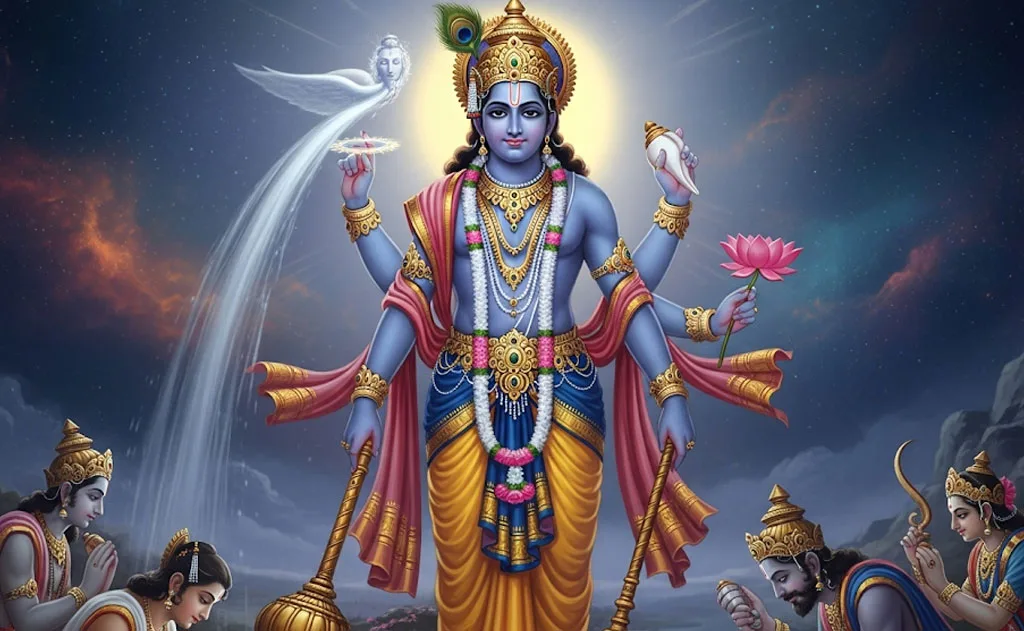
The Gajendra Moksha is the prayer of Gajendra, the king of elephants, seized by a crocodile, in Srimad Bhagavatam 8.
Quick answer: The Gajendra Moksha Stotram (Gajendra Stuti) is the prayer of Gajendra, the king of elephants, in the Srimad Bhagavatam, Book 8, Chapter 3. Seized by a crocodile in a lake and unable to free himself after a long struggle, Gajendra turns to the Supreme Lord in a prayer of 28 verses (verses 2 to 29); Vishnu comes on Garuda and frees him. The chapter has 33 verses, all given below. It is traditionally recited in the early morning, on Thursdays and in times of crisis.
Last updated: 20 October 2026. The Sanskrit below is the complete Chapter 3 as published by sanskritdocuments.org (file gajendramokShaNaH_bhAgavatam.itx), converted to Devanagari and IAST by software from the source, with no word typed by hand. Our own plain-English meaning follows every verse.
The story in brief
Chapter 2 of Book 8 describes Mount Trikuta in the ocean of milk and a lake in Varuna's garden on its slopes. Gajendra, lord of a herd of elephants, comes to the lake to drink and play with his family. A powerful crocodile seizes his foot. The two struggle for a very long time; his herd cannot help him, and his strength begins to fail. Remembering a prayer learned in a former birth, he turns to the Lord, and Chapter 3 begins.
Chapter 4 tells that Gajendra had been King Indradyumna, a devotee of Vishnu, born as an elephant through a sage's curse, and that the crocodile had been a gandharva, Huhu, freed from the curse of the sage Devala by the Lord's touch. Both chapters are summarised here; only Chapter 3, the chapter of the prayer, is printed.
Gajendra Moksha: full text with meaning
Verse 1 and verses 30 to 33 are spoken by Shuka; verses 2 to 29 are Gajendra's prayer. Each verse appears in Devanagari and then in IAST transliteration, followed by its meaning.
Invocation
॥ ॐ नमो भगवते वासुदेवाय ॥
|| oṃ namo bhagavate vāsudevāya ||
Meaning: Om, salutations to the Lord Vasudeva.
Gajendra turns to the Lord (verse 1)
Verse 1
श्रीशुक उवाच ।
एवं व्यवसितो बुद्ध्या समाधाय मनो हृदि ।
जजाप परमं जाप्यं प्राग्जन्मन्यनुशिक्षितम् ॥ १॥
śrīśuka uvāca |
evaṃ vyavasito buddhyā samādhāya mano hṛdi |
jajāpa paramaṃ jāpyaṃ prāgjanmanyanuśikṣitam || 1||
Meaning: Shuka said: Having thus made up his mind and fixed his mind in his heart, the elephant chanted the supreme prayer, which he had learned in a former birth.
The Lord beyond the world (verses 2 to 8)
Verse 2
गजेन्द्र उवाच ।
ॐ नमो भगवते तस्मै यत एतच्चिदात्मकम् ।
पुरुषायादिबीजाय परेशायाभिधीमहि ॥ २॥
gajendra uvāca |
oṃ namo bhagavate tasmai yata etaccidātmakam |
puruṣāyādibījāya pareśāyābhidhīmahi || 2||
Meaning: Gajendra said: Om, salutations to that Lord from whom this conscious world comes; we meditate on the Supreme Lord, the Purusha, the original seed.
Verse 3
यस्मिन्निदं यतश्चेदं येनेदं य इदं स्वयम् ।
योऽस्मात्परस्माच्च परस्तं प्रपद्ये स्वयम्भुवम् ॥ ३॥
yasminnidaṃ yataścedaṃ yenedaṃ ya idaṃ svayam |
yo'smātparasmācca parastaṃ prapadye svayambhuvam || 3||
Meaning: In whom this world rests, from whom it comes and by whom it is made, who is himself all this, and who is beyond both cause and effect: in him, the self-existent, I take refuge.
Verse 4
यः स्वात्मनीदं निजमाययार्पितं
क्वचिद्विभातं क्व च तत्तिरोहितम् ।
अविद्धदृक्साक्ष्युभयं तदीक्षते
स आत्ममूलोऽवतु मां परात्परः ॥ ४॥
yaḥ svātmanīdaṃ nijamāyayārpitaṃ
kvacidvibhātaṃ kva ca tattirohitam |
aviddhadṛksākṣyubhayaṃ tadīkṣate
sa ātmamūlo'vatu māṃ parātparaḥ || 4||
Meaning: He who by his own maya places this world within himself, at times revealed and at times hidden, and who, with unclouded sight, watches both as the witness: may he, the root of himself, higher than the highest, protect me.
Verse 5
कालेन पञ्चत्वमितेषु कृत्स्नशो
लोकेषु पालेषु च सर्वहेतुषु ।
तमस्तदासीद्गहनं गभीरं
यस्तस्य पारेऽभिविराजते विभुः ॥ ५॥
kālena pañcatvamiteṣu kṛtsnaśo
lokeṣu pāleṣu ca sarvahetuṣu |
tamastadāsīdgahanaṃ gabhīraṃ
yastasya pāre'bhivirājate vibhuḥ || 5||
Meaning: When in time all the worlds, their guardians and all their causes have dissolved, there remains a dense and deep darkness; beyond it shines the all-pervading Lord.
Verse 6
न यस्य देवा ऋषयः पदं विदु
र्जन्तुः पुनः कोऽर्हति गन्तुमीरितुम् ।
यथा नटस्याकृतिभिर्विचेष्टतो
दुरत्ययानुक्रमणः स मावतु ॥ ६॥
na yasya devā ṛṣayaḥ padaṃ vidu
rjantuḥ punaḥ ko'rhati gantumīritum |
yathā naṭasyākṛtibhirviceṣṭato
duratyayānukramaṇaḥ sa māvatu || 6||
Meaning: Whose state even the gods and sages do not know, so how could any creature know or describe it; whose ways, like the movements of an actor in many roles, are hard to follow: may he protect me.
Verse 7
दिदृक्षवो यस्य पदं सुमङ्गलं
विमुक्तसङ्गा मुनयः सुसाधवः ।
चरन्त्यलोकव्रतमव्रणं वने
भूतात्मभूताः सुहृदः स मे गतिः ॥ ७॥
didṛkṣavo yasya padaṃ sumaṅgalaṃ
vimuktasaṅgā munayaḥ susādhavaḥ |
carantyalokavratamavraṇaṃ vane
bhūtātmabhūtāḥ suhṛdaḥ sa me gatiḥ || 7||
Meaning: Longing to see his auspicious feet, sages free of every attachment, wholly good, friends to all, seeing all beings as their own self, keep in the forest a flawless vow beyond the world: he is my refuge.
Verse 8
न विद्यते यस्य च जन्म कर्म वा
न नामरूपे गुणदोष एव वा ।
तथापि लोकाप्ययसम्भवाय यः
स्वमायया तान्यनुकालमृच्छति ॥ ८॥
na vidyate yasya ca janma karma vā
na nāmarūpe guṇadoṣa eva vā |
tathāpi lokāpyayasambhavāya yaḥ
svamāyayā tānyanukālamṛcchati || 8||
Meaning: He has no birth and no action, no name or form, no quality or fault; yet for the creation and dissolution of the world he takes them on, in time, by his own maya.
Salutations to the Supreme (verses 9 to 18)
Verse 9
तस्मै नमः परेशाय ब्रह्मणेऽनन्तशक्तये ।
अरूपायोरुरूपाय नम आश्चर्यकर्मणे ॥ ९॥
tasmai namaḥ pareśāya brahmaṇe'nantaśaktaye |
arūpāyorurūpāya nama āścaryakarmaṇe || 9||
Meaning: Salutations to him, the Supreme Lord, Brahman of endless power, formless and yet of many forms, of wondrous deeds.
Verse 10
नम आत्मप्रदीपाय साक्षिणे परमात्मने ।
नमो गिरां विदूराय मनसश्चेतसामपि ॥ १०॥
nama ātmapradīpāya sākṣiṇe paramātmane |
namo girāṃ vidūrāya manasaścetasāmapi || 10||
Meaning: Salutations to the self-luminous one, the witness, the Supreme Self; salutations to him who is far beyond speech, mind and thought.
Verse 11
सत्त्वेन प्रतिलभ्याय नैष्कर्म्येण विपश्चिता ।
नमः कैवल्यनाथाय निर्वाणसुखसंविदे ॥ ११॥
sattvena pratilabhyāya naiṣkarmyeṇa vipaścitā |
namaḥ kaivalyanāthāya nirvāṇasukhasaṃvide || 11||
Meaning: Salutations to the lord of liberation, who is reached through purity by the wise who have given up action, who is the very experience of the bliss of freedom.
Verse 12
नमः शान्ताय घोराय मूढाय गुणधर्मिणे ।
निर्विशेषाय साम्याय नमो ज्ञानघनाय च ॥ १२॥
namaḥ śāntāya ghorāya mūḍhāya guṇadharmiṇe |
nirviśeṣāya sāmyāya namo jñānaghanāya ca || 12||
Meaning: Salutations to him who appears as peaceful, fierce and dull through the qualities he bears; to him who is without distinctions, the same to all, a mass of pure knowledge.
Verse 13
क्षेत्रज्ञाय नमस्तुभ्यं सर्वाध्यक्षाय साक्षिणे ।
पुरुषायात्ममूलाय मूलप्रकृतये नमः ॥ १३॥
kṣetrajñāya namastubhyaṃ sarvādhyakṣāya sākṣiṇe |
puruṣāyātmamūlāya mūlaprakṛtaye namaḥ || 13||
Meaning: Salutations to you, the knower of the field, the overseer of all, the witness; to the Purusha, the source of the self, and to the root of nature.
Verse 14
सर्वेन्द्रियगुणद्रष्ट्रे सर्वप्रत्ययहेतवे ।
असताच्छाययोक्ताय सदाभासाय ते नमः ॥ १४॥
sarvendriyaguṇadraṣṭre sarvapratyayahetave |
asatācchāyayoktāya sadābhāsāya te namaḥ || 14||
Meaning: Salutations to you, the seer of all the senses and their objects, the cause of every perception, who is pointed to by the unreal as by a shadow, and who shines through all that is.
Verse 15
नमो नमस्तेऽखिलकारणाय
निष्कारणायाद्भुतकारणाय ।
सर्वागमाम्नायमहार्णवाय
नमोऽपवर्गाय परायणाय ॥ १५॥
namo namaste'khilakāraṇāya
niṣkāraṇāyādbhutakāraṇāya |
sarvāgamāmnāyamahārṇavāya
namo'pavargāya parāyaṇāya || 15||
Meaning: Salutations, salutations to you, the cause of all, yourself without cause, the wondrous cause; the great ocean into which all scriptures and traditions flow; liberation itself, the final refuge.
Verse 16
गुणारणिच्छन्नचिदूष्मपाय
तत्क्षोभविस्फूर्जितमानसाय ।
नैष्कर्म्यभावेन विवर्जितागम
स्वयम्प्रकाशाय नमस्करोमि ॥ १६॥
guṇāraṇicchannacidūṣmapāya
tatkṣobhavisphūrjitamānasāya |
naiṣkarmyabhāvena vivarjitāgama
svayamprakāśāya namaskaromi || 16||
Meaning: I bow to him whose consciousness, like fire hidden in the fire-sticks, lies covered by the qualities, whose mind springs forth when they are stirred, and who shines by himself for those who, through non-action, have gone beyond ritual rules.
Verse 17
मादृक् प्रपन्नपशुपाशविमोक्षणाय
मुक्ताय भूरिकरुणाय नमोऽलयाय ।
स्वांशेन सर्वतनुभृन्मनसि प्रतीत
प्रत्यग्दृशे भगवते बृहते नमस्ते ॥ १७॥
mādṛk prapannapaśupāśavimokṣaṇāya
muktāya bhūrikaruṇāya namo'layāya |
svāṃśena sarvatanubhṛnmanasi pratīta
pratyagdṛśe bhagavate bṛhate namaste || 17||
Meaning: Salutations to him who frees surrendered beasts like me from the noose; to the ever-free, boundlessly compassionate, never-tiring one; salutations to you, the great Lord, who by a part of yourself is known within the mind of every embodied being as the inner witness.
Verse 18
आत्माऽऽत्मजाप्तगृहवित्तजनेषु सक्तै
र्दुष्प्रापणाय गुणसङ्गविवर्जिताय ।
मुक्तात्मभिः स्वहृदये परिभाविताय
ज्ञानात्मने भगवते नम ईश्वराय ॥ १८॥
ātmā''tmajāptagṛhavittajaneṣu saktai
rduṣprāpaṇāya guṇasaṅgavivarjitāya |
muktātmabhiḥ svahṛdaye paribhāvitāya
jñānātmane bhagavate nama īśvarāya || 18||
Meaning: Salutations to the Lord, the master, whose self is knowledge, hard to reach for those attached to body, children, friends, home, wealth and people, free from contact with the qualities, and meditated upon in their hearts by the liberated.
The goal of the devotee (verses 19 to 25)
Verse 19
यं धर्मकामार्थविमुक्तिकामा
भजन्त इष्टां गतिमाप्नुवन्ति ।
किं त्वाशिषो रात्यपि देहमव्ययं
करोतु मेऽदभ्रदयो विमोक्षणम् ॥ १९॥
yaṃ dharmakāmārthavimuktikāmā
bhajanta iṣṭāṃ gatimāpnuvanti |
kiṃ tvāśiṣo rātyapi dehamavyayaṃ
karotu me'dabhradayo vimokṣaṇam || 19||
Meaning: Those who seek dharma, pleasure, wealth or liberation worship him and gain the goal they desire; he gives other blessings too, and even an imperishable body: may he, of great compassion, set me free.
Verse 20
एकान्तिनो यस्य न कञ्चनार्थं
वाञ्छन्ति ये वै भगवत्प्रपन्नाः ।
अत्यद्भुतं तच्चरितं सुमङ्गलं
गायन्त आनन्दसमुद्रमग्नाः ॥ २०॥
ekāntino yasya na kañcanārthaṃ
vāñchanti ye vai bhagavatprapannāḥ |
atyadbhutaṃ taccaritaṃ sumaṅgalaṃ
gāyanta ānandasamudramagnāḥ || 20||
Meaning: His one-pointed devotees, wholly given to the Lord, want nothing at all; immersed in an ocean of bliss, they sing of his most wonderful and auspicious deeds.
Verse 21
तमक्षरं ब्रह्म परं परेश
मव्यक्तमाध्यात्मिकयोगगम्यम् ।
अतीन्द्रियं सूक्ष्ममिवातिदूर
मनन्तमाद्यं परिपूर्णमीडे ॥ २१॥
tamakṣaraṃ brahma paraṃ pareśa
mavyaktamādhyātmikayogagamyam |
atīndriyaṃ sūkṣmamivātidūra
manantamādyaṃ paripūrṇamīḍe || 21||
Meaning: Him I praise: the imperishable Brahman, the supreme, the lord of lords, the unmanifest, reached by inner yoga, beyond the senses, subtle, as if very far, endless, the first, perfectly full.
Verse 22
यस्य ब्रह्मादयो देवा वेदा लोकाश्चराचराः ।
नामरूपविभेदेन फल्ग्व्या च कलया कृताः ॥ २२॥
yasya brahmādayo devā vedā lokāścarācarāḥ |
nāmarūpavibhedena phalgvyā ca kalayā kṛtāḥ || 22||
Meaning: By a tiny part of whom Brahma and the gods, the Vedas and all moving and unmoving worlds are made, with their differences of name and form.
Verse 23
यथार्चिषोऽग्नेः सवितुर्गभस्तयो
निर्यान्ति संयान्त्यसकृत्स्वरोचिषः ।
तथा यतोऽयं गुणसम्प्रवाहो
बुद्धिर्मनः खानि शरीरसर्गाः ॥ २३॥
yathārciṣo'gneḥ saviturgabhastayo
niryānti saṃyāntyasakṛtsvarociṣaḥ |
tathā yato'yaṃ guṇasampravāho
buddhirmanaḥ khāni śarīrasargāḥ || 23||
Meaning: As flames go forth from a fire and rays from the sun, and return again and again, so from him come forth and return this stream of the qualities: intellect, mind, the senses and all bodies.
Verse 24
स वै न देवासुरमर्त्यतिर्यङ्
न स्त्री न षण्ढो न पुमान्न जन्तुः ।
नायं गुणः कर्म न सन्न चास
न्निषेधशेषो जयतादशेषः ॥ २४॥
sa vai na devāsuramartyatiryaṅ
na strī na ṣaṇḍho na pumānna jantuḥ |
nāyaṃ guṇaḥ karma na sanna cāsa
nniṣedhaśeṣo jayatādaśeṣaḥ || 24||
Meaning: He is not god or demon, human or animal; not woman, man or neither, nor any creature; not a quality, not action, not being, not non-being. He is what remains when all is denied, and yet he is all: may he be victorious.
Verse 25
जिजीविषे नाहमिहामुया कि
मन्तर्बहिश्चावृतयेभयोन्या ।
इच्छामि कालेन न यस्य विप्लव
स्तस्यात्मलोकावरणस्य मोक्षम् ॥ २५॥
jijīviṣe nāhamihāmuyā ki
mantarbahiścāvṛtayebhayonyā |
icchāmi kālena na yasya viplava
stasyātmalokāvaraṇasya mokṣam || 25||
Meaning: I do not wish to go on living here as an elephant: what is the use of a body covered inside and out by ignorance? I long for freedom from that covering over the light of the self, which time does not destroy.
Surrender (verses 26 to 29)
Verse 26
सोऽहं विश्वसृजं विश्वमविश्वं विश्ववेदसम् ।
विश्वात्मानमजं ब्रह्म प्रणतोऽस्मि परं पदम् ॥ २६॥
so'haṃ viśvasṛjaṃ viśvamaviśvaṃ viśvavedasam |
viśvātmānamajaṃ brahma praṇato'smi paraṃ padam || 26||
Meaning: So I, longing for freedom, bow down to the creator of the universe, who is the universe and beyond it, the knower of all, the Self of the universe, the unborn Brahman, the supreme goal.
Verse 27
योगरन्धितकर्माणो हृदि योगविभाविते ।
योगिनो यं प्रपश्यन्ति योगेशं तं नतोऽस्म्यहम् ॥ २७॥
yogarandhitakarmāṇo hṛdi yogavibhāvite |
yogino yaṃ prapaśyanti yogeśaṃ taṃ nato'smyaham || 27||
Meaning: I bow to the lord of yoga, whom yogis, their karma burnt away by yoga, behold in hearts made pure by yoga.
Verse 28
नमो नमस्तुभ्यमसह्यवेग
शक्तित्रयायाखिलधीगुणाय ।
प्रपन्नपालाय दुरन्तशक्तये
कदिन्द्रियाणामनवाप्यवर्त्मने ॥ २८॥
namo namastubhyamasahyavega
śaktitrayāyākhiladhīguṇāya |
prapannapālāya durantaśaktaye
kadindriyāṇāmanavāpyavartmane || 28||
Meaning: Salutations, salutations to you, whose three powers move with irresistible force, who appear as the objects of every sense, protector of those who take refuge, of endless power, whose path cannot be found by those whose senses are unrestrained.
Verse 29
नायं वेद स्वमात्मानं यच्छक्त्याहन्धिया हतम् ।
तं दुरत्ययमाहात्म्यं भगवन्तमितोऽस्म्यहम् ॥ २९॥
nāyaṃ veda svamātmānaṃ yacchaktyāhandhiyā hatam |
taṃ duratyayamāhātmyaṃ bhagavantamito'smyaham || 29||
Meaning: I take refuge in that Lord of boundless greatness, by whose power the individual, struck by the thought 'I', does not know his own self.
Hari comes (verses 30 to 33)
Verse 30
श्रीशुक उवाच ।
एवं गजेन्द्रमुपवर्णितनिर्विशेषं
ब्रह्मादयो विविधलिङ्गभिदाभिमानाः ।
नैते यदोपससृपुर्निखिलात्मकत्वा
त्तत्राखिलामरमयो हरिराविरासीत् ॥ ३०॥
śrīśuka uvāca |
evaṃ gajendramupavarṇitanirviśeṣaṃ
brahmādayo vividhaliṅgabhidābhimānāḥ |
naite yadopasasṛpurnikhilātmakatvā
ttatrākhilāmaramayo harirāvirāsīt || 30||
Meaning: Shuka said: When Brahma and the other gods, each attached to his own distinct form, did not come forward to Gajendra, who had praised the Lord beyond all attributes, then Hari, who contains all the gods, appeared there, for he is the Self of all.
Verse 31
तं तद्वदार्तमुपलभ्य जगन्निवासः
स्तोत्रं निशम्य दिविजैः सह संस्तुवद्भिः ।
छन्दोमयेन गरुडेन समुह्यमान
श्चक्रायुधोऽभ्यगमदाशु यतो गजेन्द्रः ॥ ३१॥
taṃ tadvadārtamupalabhya jagannivāsaḥ
stotraṃ niśamya divijaiḥ saha saṃstuvadbhiḥ |
chandomayena garuḍena samuhyamāna
ścakrāyudho'bhyagamadāśu yato gajendraḥ || 31||
Meaning: Seeing him in such distress and hearing his hymn, the Lord who dwells in the universe, borne by Garuda whose form is the Vedic metres and holding his discus, came swiftly to where Gajendra was, while the gods praised him.
Verse 32
सोऽन्तःसरस्युरुबलेन गृहीत आर्तो
दृष्ट्वा गरुत्मति हरिं ख उपात्तचक्रम् ।
उत्क्षिप्य साम्बुजकरं गिरमाह कृच्छ्रा
न्नारायणाखिलगुरो भगवन्नमस्ते ॥ ३२॥
so'ntaḥsarasyurubalena gṛhīta ārto
dṛṣṭvā garutmati hariṃ kha upāttacakram |
utkṣipya sāmbujakaraṃ giramāha kṛcchrā
nnārāyaṇākhilaguro bhagavannamaste || 32||
Meaning: Gajendra, held with great force within the lake and in pain, saw Hari on Garuda in the sky with his discus raised; lifting his trunk with a lotus in it, he spoke with difficulty: 'Narayana, teacher of all, O Lord, salutations to you.'
Verse 33
तं वीक्ष्य पीडितमजः सहसावतीर्य
सग्राहमाशु सरसः कृपयोज्जहार ।
ग्राहाद्विपाटितमुखादरिणा गजेन्द्रं
सम्पश्यतां हरिरमूमुचदुच्छ्रियाणाम् ॥ ३३॥
taṃ vīkṣya pīḍitamajaḥ sahasāvatīrya
sagrāhamāśu sarasaḥ kṛpayojjahāra |
grāhādvipāṭitamukhādariṇā gajendraṃ
sampaśyatāṃ hariramūmucaducchriyāṇām || 33||
Meaning: Seeing him in pain, the unborn Lord quickly came down and, in compassion, drew him out of the lake together with the crocodile; and as the gods looked on, Hari freed Gajendra, splitting open the crocodile's mouth with his discus.
Colophon
इति श्रीमद्भागवते महापुराणे पारमहंस्यां संहितायां अष्टमस्कन्धे
मन्वन्तरानुवर्णने गजेन्द्रोपाख्याने तृतीयोऽध्यायः ॥ ३॥
iti śrīmadbhāgavate mahāpurāṇe pāramahaṃsyāṃ saṃhitāyāṃ aṣṭamaskandhe
manvantarānuvarṇane gajendropākhyāne tṛtīyo'dhyāyaḥ || 3||
Meaning: Thus ends the third chapter, in the story of Gajendra within the account of the Manvantaras, of the eighth book of the great Purana, the Srimad Bhagavatam, the collection of the highest seekers.
What the prayer teaches
| Verses | Theme |
|---|---|
| 2 to 8 | The Lord is the source, support and end of the world, beyond it and its witness |
| 9 to 18 | Salutations to him as the Self, the witness, the cause beyond causes, the compassionate freer of 'beasts like me' |
| 19 to 21 | True devotees ask for nothing; they sing his deeds |
| 22 to 24 | All gods and worlds come from a fraction of him; he is beyond every category |
| 25 | Gajendra no longer asks to live: he asks for freedom from ignorance |
| 26 to 29 | Complete surrender to the lord of yoga |
| 30 to 33 | Hari appears, Gajendra offers a lotus, and is freed |
Notice what Gajendra does not do: he does not name any particular god or ask for the crocodile to die. He prays to the Supreme beyond all forms (verse 24), and so, verse 30 says, the gods who identified with particular forms held back, and Hari, who contains all the gods, came himself.
When is the Gajendra Moksha traditionally recited?
- Early morning: many recite it daily after waking, before other prayers.
- Thursdays and Ekadashi: see our Thursday guide to Vishnu worship; the coming Ekadashis include Papankusha Ekadashi on Thursday 22 October 2026, Rama Ekadashi on Thursday 5 November and Vaikuntha Ekadashi on Sunday 20 December (dates for New Delhi).
- In times of crisis: illness, legal or money trouble, danger to the family: the prayer of one who has run out of other help.
How to recite it at home
- Sit before a picture of Vishnu, ideally one showing him on Garuda, with a lamp and a flower; a lotus or any flower recalls the lotus Gajendra offered.
- Read the story above once, so the prayer is heard in its setting.
- Recite verses 1 to 33 slowly. If time is short, recite verses 2 to 10 and 26 to 33.
- At verse 32, many lift a flower in their hands, as Gajendra lifted the lotus, and offer it.
- Close with 'om namo narayanaya', or continue with the Narayana Kavacham or the Vishnu Sahasranama.
Pronunciation help
- In the IAST, a line over a vowel (ā, ī, ū) means it is held twice as long; ṇ, ṭ and ḍ are made with the tongue curled back; ś and ṣ are both 'sh' sounds; c is always 'ch'.
- Verses 1 to 3, 9 to 14, 22, 26, 27 and 29 have two lines; the others have four longer lines. A line that ends mid-word (as in verses 6 and 21) runs straight into the next without a pause.
- Verse 32: nā-rā-ya-ṇā-khi-la-gu-ro bha-ga-van na-mas-te.
Traditional beliefs about the Gajendra Moksha
This chapter has no separate phalashruti; the Bhagavatam's praise of those who remember the story comes in the next chapter. Devotees traditionally believe that reciting it with faith:
- brings courage and hope when every other help has failed;
- teaches surrender, as Gajendra moved from struggle to prayer;
- reminds the reciter of the Lord's compassion, who 'frees surrendered beasts like me from the noose' (verse 17);
- turns the mind from fear of death towards the freedom of the self (verse 25).
These are matters of faith, not guarantees. The Gajendra Moksha is a prayer for grace and inner freedom; it is not a substitute for medical treatment, legal or financial advice, or other practical help.
Tips for NRI families
- Tell the story first. Children love the story of the elephant, the crocodile and Garuda; read it to them before teaching any verse.
- Learn verse 32. 'Narayana, teacher of all, O Lord, salutations to you': a one-line prayer for any moment of fear.
- Use local dates. Ekadashi abroad can fall a day earlier or later than in India; use a panchang for your city, and see our Thursday guide for NRI families.
- Go deeper. The Vishnu hub gathers our Vishnu guides; the Narayana Suktam and Achyutashtakam are good companions.
Frequently asked questions
Where does the Gajendra Moksha come from?
From the Srimad Bhagavatam, Book 8. Chapter 2 tells how the crocodile seized the elephant king; Chapter 3, printed here in full, contains Gajendra's prayer (verses 2 to 29) and his rescue by Vishnu; Chapter 4 tells their former lives.
Why is it so loved?
Because it is the prayer of one who has tried everything and failed. Gajendra's strength, his herd and his family cannot save him; only when he turns wholly to the Supreme does help come. Verse 32, 'Narayana, teacher of all, O Lord, salutations to you', is the cry of every devotee in trouble.
Does reciting it remove troubles or debts?
Many devotees recite it in times of hardship, trusting in the Lord's compassion, and the Bhagavatam praises those who remember this story. But no prayer can guarantee a particular result; it is not a substitute for medical, legal or financial help.
When is it traditionally recited?
Early in the morning, on Thursdays and Ekadashi, and at any time of fear, illness or crisis. Some families recite it daily for a fixed number of days.
Which verses form the stuti?
Verses 2 to 29, spoken by Gajendra. Verse 1 and verses 30 to 33, spoken by Shuka, frame the prayer and tell of the rescue.
How long does it take?
About 12 to 15 minutes for all 33 verses.
Is the stuti hard to understand?
It is one of the most philosophical prayers in the Bhagavatam: Gajendra praises the Lord beyond all names and forms. Read our meaning with each verse; verses 2, 3, 9, 10 and 26 to 29 are a good place to begin.
Editor's note (20 October 2026)
This page was published on 20 October 2026 at the address readers and search engines were already requesting. The Sanskrit is Chapter 3 of the Gajendra Mokshana from the Srimad Bhagavatam on sanskritdocuments.org (file gajendramokShaNaH_bhAgavatam.itx, which gives Book 8, Chapters 2 to 4 and notes that 'the stuti is in Chapter 3'). Its chapter colophon places the text in Srimad Bhagavatam, Book 8, Chapter 3, in the story of Gajendra. It was converted from ITRANS to Devanagari and IAST by software; no letter has been changed. We compared it letter by letter with the second sanskritdocuments.org text of the same chapter (gajendramokShaH); that file has a few typing slips (for example in verses 14, 31 and 33) which the text printed here does not, and the two otherwise agree. Chapters 2 and 4 are summarised in our own words. Ekadashi dates are from HinduTone's panchang pages for New Delhi.
Related guides
You might also like
Argala Stotram (Durga Saptashati): Full Text with Meaning
Siddha Kunjika Stotram: Full Text with Meaning, as in the Source
Dwadasa Jyotirlinga Stotram (Adi Shankaracharya): Full Text with Meaning