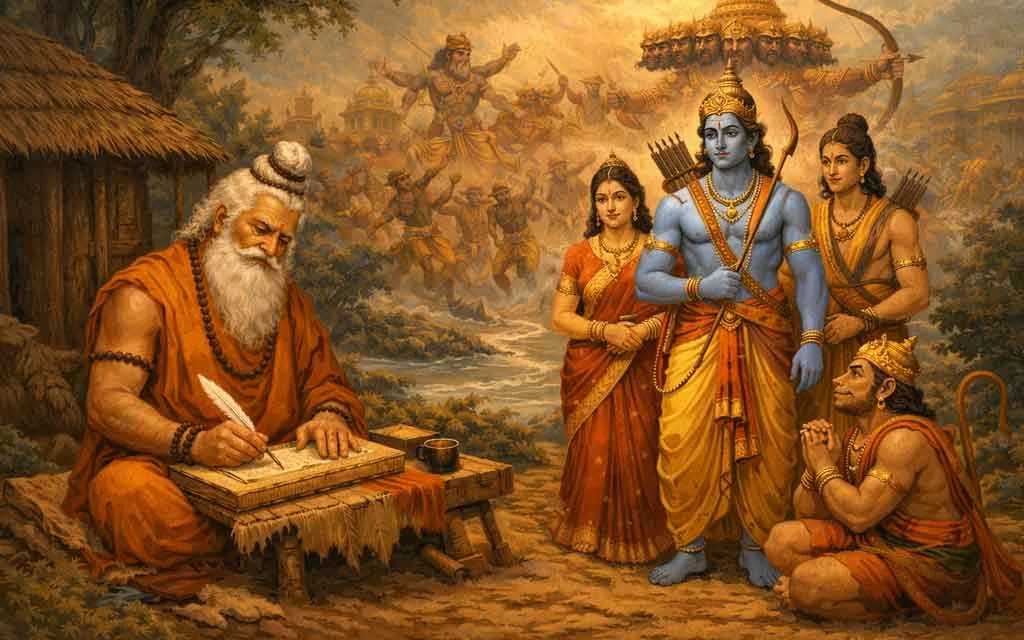
Mahabharata: The Complete Guide
Quick answer: The Mahabharata is the great Sanskrit epic of the Kuru family, traditionally ascribed to the sage Vyasa. Its central story is the quarrel between the five Pandava brothers and their Kaurava cousins, which ends in the eighteen-day war at Kurukshetra. Around that story it gathers teachin
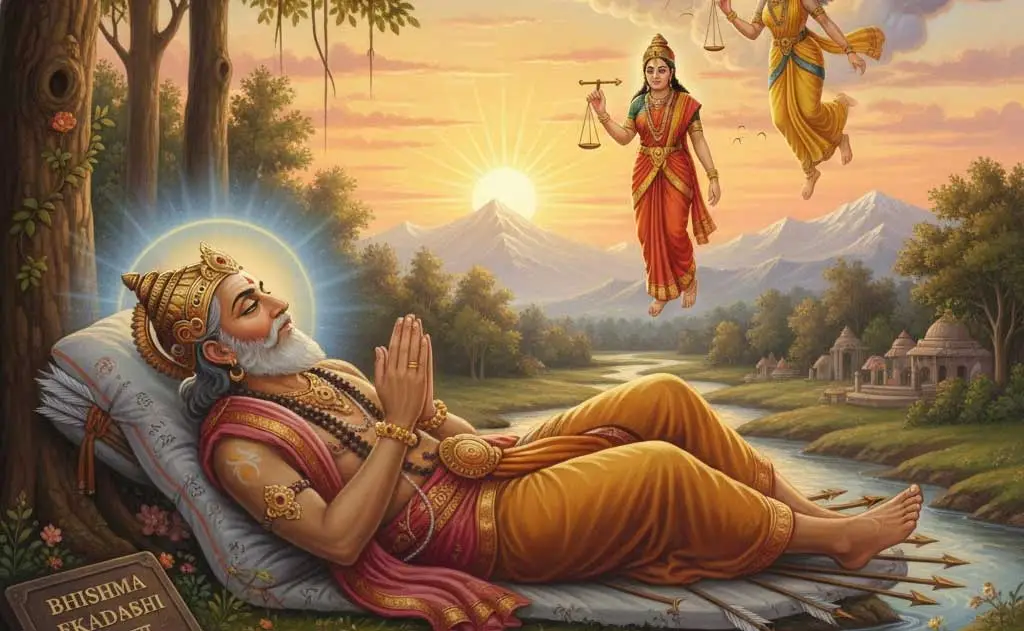
Quick answer: The Mahabharata is the great Sanskrit epic of the Kuru family, traditionally ascribed to the sage Vyasa. Its central story is the quarrel between the five Pandava brothers and their Kaurava cousins, which ends in the eighteen-day war at Kurukshetra. Around that story it gathers teachings on dharma, many shorter tales and the Bhagavad Gita. It has 18 books called parvas.
The Mahabharata calls itself an itihasa, "what happened", and also a teaching on the four aims of life. It is one of the longest poems ever composed. This guide explains what is in it, how it is organised and how its editions differ, and it links to every Mahabharata page on HinduTone.
| The Mahabharata at a glance | |
|---|---|
| Traditional author | Vyasa (Krishna Dvaipayana), who dictated it to Ganesha |
| Language | Sanskrit |
| Books | 18 parvas; the Harivamsha (the life of Krishna) is a supplement |
| Length | Traditionally a hundred thousand verses, counting the Harivamsha. The critical edition is about 73,000 numbered verse units in 1,995 chapters (our count from its electronic text) |
| Main families | The Kurus of Hastinapura: the Pandavas and the Kauravas |
| Contains | The Bhagavad Gita (Bhishma Parva), the Vishnu Sahasranama (Anushasana Parva), Vidura Niti (Udyoga Parva), the Yaksha Prashna (Aranyaka Parva) |
| Dating | Tradition places the war at the end of the Dvapara Yuga. Scholars usually date the text's composition across several centuries, roughly 400 BCE to 400 CE |
New to the Mahabharata? Start here
- Read the Mahabharata story summary, which tells the whole epic in order.
- Meet one of its great figures: Karna.
- Read the Bhagavad Gita for beginners: all 18 chapters.
- When you want the full text, choose a complete translation (see "Editions" below) and read one parva at a time.
The 18 parvas
Chapter and verse counts below are from the electronic text of the Pune critical edition. The vulgate, the text most commonly printed in India, has more chapters and verses.
| No. | Parva | What it contains | Chapters (critical edition) |
|---|---|---|---|
| 1 | Adi (Beginning) | Origins of the Kurus, Bhishma's vow, birth of the Pandavas and Kauravas, the house of lac, Draupadi's svayamvara, Indraprastha | 225 |
| 2 | Sabha (Assembly hall) | The Rajasuya, the game of dice, Draupadi in the assembly, the exile | 72 |
| 3 | Aranyaka or Vana (Forest) | The twelve forest years; Nala and Damayanti, Savitri, a short Ramayana; the Yaksha Prashna | 299 |
| 4 | Virata | The thirteenth year in disguise at King Virata's court | 67 |
| 5 | Udyoga (Effort) | Peace embassies, Krishna's mission, Vidura Niti, Karna's choice, the armies gather | 197 |
| 6 | Bhishma | War days 1 to 10; the Bhagavad Gita (chapters 23 to 40); Bhishma falls | 117 |
| 7 | Drona | Days 11 to 15; Abhimanyu and the chakravyuha; Jayadratha; Ghatotkacha; Drona's death | 173 |
| 8 | Karna | Days 16 and 17; Duhshasana's death; Karna's death | 69 |
| 9 | Shalya | Day 18; Shalya and Shakuni killed; Duryodhana falls | 64 |
| 10 | Sauptika (Sleeping warriors) | Ashvatthama's night raid | 18 |
| 11 | Stri (Women) | The lament of the women; Gandhari's curse; Kunti reveals Karna's birth | 27 |
| 12 | Shanti (Peace) | Bhishma's teaching on kingship, crisis and liberation | 353 |
| 13 | Anushasana (Instruction) | Bhishma's teaching on giving and dharma; the Vishnu Sahasranama; Bhishma's death | 154 |
| 14 | Ashvamedhika | Yudhishthira's horse sacrifice; the Anugita | 96 |
| 15 | Ashramavasika (Hermitage) | Dhritarashtra, Gandhari and Kunti in the forest, and their deaths | 47 |
| 16 | Mausala (Clubs) | The destruction of the Yadavas; Krishna's departure | 9 |
| 17 | Mahaprasthanika (Great journey) | The Pandavas' last journey | 3 |
| 18 | Svargarohana (Ascent to heaven) | Yudhishthira in heaven and hell; the ending | 5 |
The main characters
The elders. Shantanu and Ganga; Bhishma, their son; Satyavati; Vyasa; Dhritarashtra and Gandhari; Pandu, Kunti and Madri; Vidura; Drona and Kripa, the teachers.
The Pandavas. Yudhishthira, Bhima, Arjuna, Nakula and Sahadeva; Draupadi, their common wife; their sons, among them Abhimanyu (Arjuna's son by Subhadra) and Ghatotkacha (Bhima's son by Hidimbi; see Ghatotkacha).
The Kauravas and their allies. Duryodhana and Duhshasana; Shakuni, their uncle; Karna; Ashvatthama, Drona's son; Jayadratha; Shalya.
Krishna. Prince of the Yadavas at Dvaraka, cousin and friend of the Pandavas, envoy for peace and Arjuna's charioteer. See Krishna avatar: the Gita and the Mahabharata.
Character stories already on HinduTone: Dhritarashtra and his karma, Did Ekalavya fight at Kurukshetra?, Bhishma Ekadashi and Savitri and Satyavan.
The teachings inside the epic
- The Bhagavad Gita: Krishna's teaching to Arjuna before the battle, 700 verses in 18 chapters. Start with all 18 chapters explained and the commentaries on chapter 2 and chapter 12. For home reading plans, see Gita parayanam at home.
- The Vishnu Sahasranama: the thousand names of Vishnu, taught by Bhishma in the Anushasana Parva (chapter 135 in the critical edition; chapter 149 in the commonly printed vulgate). See the Vishnu Sahasranama guide.
- Vidura Niti: Vidura's counsel to the sleepless Dhritarashtra (Udyoga Parva).
- The Yaksha Prashna: the questions at the lake, answered by Yudhishthira (Aranyaka Parva, 3.296 to 3.298 in the critical edition).
- Bhishma's teaching on the bed of arrows, which fills the Shanti and Anushasana Parvas.
Editions: critical edition and vulgate
Two texts are in common use, and they number chapters differently:
- The critical edition, prepared at the Bhandarkar Oriental Research Institute, Pune, from hundreds of manuscripts (published 1933 to 1966). It leaves out passages that are found only in some manuscripts and prints them in notes and appendices. Most modern scholarly translations follow it.
- The vulgate, the text known with the commentary of Nilakantha (17th century), printed in many Indian editions, including those used in temples and homes. It includes passages and episodes that the critical edition omits, such as Draupadi's refusal of Karna at her svayamvara.
When you quote the Mahabharata, name the edition with the parva and chapter. For example, the Bhagavad Gita is chapters 23 to 40 of the Bhishma Parva in the critical edition and 25 to 42 in the vulgate.
Regional Mahabharatas are works in their own right: in Telugu, the Andhra Mahabharatam of Nannaya, Tikkana and Errana; in Tamil, Villiputturar's Bharatam; in Kannada, Pampa's Vikramarjuna Vijaya and Kumaravyasa's Bharata; and many folk and performance traditions.
Not in Vyasa's text, though widely told
- Barbarika (Khatu Shyam), who watches the war as a severed head, comes from later Puranic and regional tradition.
- Draupadi mocking Duryodhana in the palace of illusions: in the critical edition it is Bhima, Arjuna, the twins and the servants who laugh at him (2.43).
- Draupadi refusing Karna at her svayamvara is in the vulgate, not the critical edition.
Frequently asked questions
Who wrote the Mahabharata?
Tradition ascribes it to Vyasa, with Ganesha as his scribe. Scholars see a text that grew over several centuries.
How many parvas does the Mahabharata have?
Eighteen, plus the Harivamsha as a supplement.
Is the Mahabharata longer than the Ramayana?
Yes, roughly four times longer in its traditional count (a hundred thousand verses against the Ramayana's twenty-four thousand). See the Ramayana guide.
Where is the Bhagavad Gita in the Mahabharata?
In the Bhishma Parva, just before the fighting begins.
How long did the war last?
Eighteen days.
Is it unlucky to keep the Mahabharata at home?
Some families hold this belief; it is a popular custom, not a teaching of the text. Many Hindu homes keep and read the Mahabharata, and the epic itself praises hearing and reading it.
Which translation should I read?
For the critical edition in English, the University of Chicago translation (begun by J. A. B. van Buitenen) and Bibek Debroy's complete translation (Penguin) are widely used. For the vulgate, the Gita Press edition with Hindi translation and the older English translation by Kisari Mohan Ganguli are common.
Sources
- The Mahabharata, critical edition, ed. V. S. Sukthankar and others (Bhandarkar Oriental Research Institute, Pune, 1933 to 1966); electronic text BORI 1999, via Indology: indology.info/bombay/mahabharata. Chapter and verse-unit counts made from this text on 12 November 2026.
- Mahabharata with Nilakantha's commentary (vulgate), for the vulgate chapter numbers.
- Vishnu Sahasranama with Shankara's commentary, on Ambuda, which places the hymn in chapter 149 of the Anushasana Parva in the vulgate: ambuda.org.
- John Brockington, The Sanskrit Epics (Brill, 1998).
Last reviewed: 12 November 2026.
Share this with family and friends
Send it on WhatsApp, post it, or copy the link.
More from Stories
- Kishkindha Kanda Summary: Hanuman, Sugriva and the Death of Vali
- Aranya Kanda Summary: The Forest Years and Sita's Abduction
- Ayodhya Kanda Summary: Kaikeyi's Boons and Rama's Exile
- Sita: Her Life in the Ramayana
- Sundara Kanda Summary: Hanuman's Journey to Lanka, Sarga by Sarga