
Sundara Kanda Summary: Hanuman's Journey to Lanka, Sarga by Sarga
Quick answer: The Sundara Kanda is the fifth of the seven books of Valmiki's Ramayana. It follows Hanuman as he crosses the ocean to Lanka, searches the city, finds Sita in the Ashoka grove, gives her Rama's ring, meets Ravana, sets Lanka on fire and returns with Sita's jewel (chudamani) as proof. I
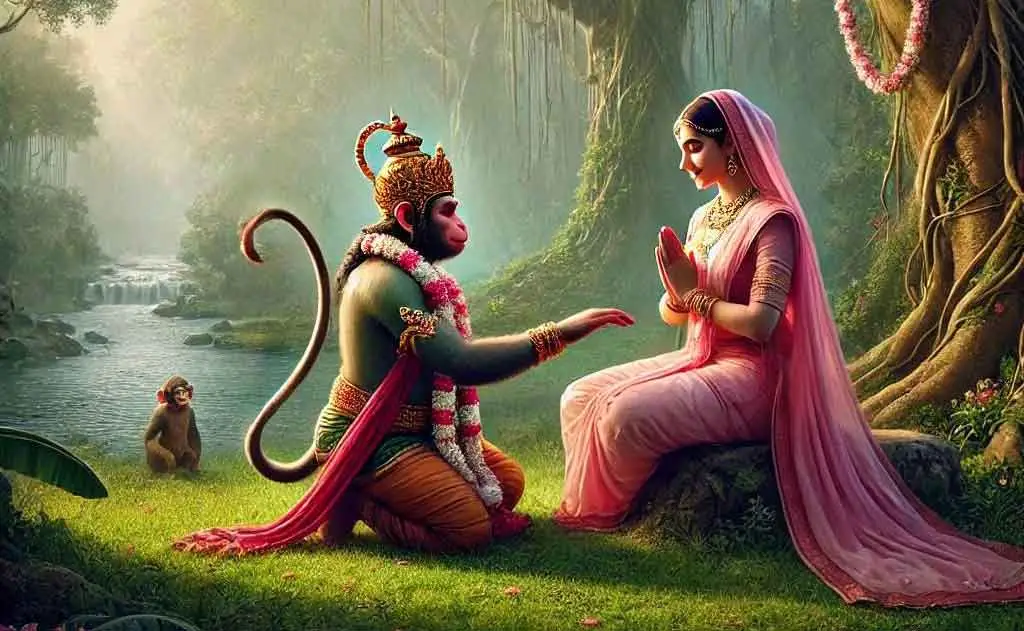
Quick answer: The Sundara Kanda is the fifth of the seven books of Valmiki's Ramayana. It follows Hanuman as he crosses the ocean to Lanka, searches the city, finds Sita in the Ashoka grove, gives her Rama's ring, meets Ravana, sets Lanka on fire and returns with Sita's jewel (chudamani) as proof. It has 68 sargas (chapters).
The Sundara Kanda is the best-loved book of the Ramayana for reading aloud. It is the one book in which Rama is absent for almost the whole story, and the hero is his messenger. This page tells the story in order, with the sarga numbers so that you can find each scene in the text.
| Sundara Kanda at a glance | |
|---|---|
| Position | Fifth of seven kandas, after the Kishkindha Kanda and before the Yuddha Kanda |
| Chapters | 68 sargas in the edition on IIT Kanpur's Valmiki Ramayana site (other editions number them differently) |
| Main characters | Hanuman, Sita, Ravana, Trijata, Indrajit, Vibhishana, Angada, Jambavan, Rama |
| Main places | The ocean crossing, Lanka, Ravana's palace, the Ashoka grove (Ashoka vatika), Mount Arishta, Madhuvana |
| Opens with | Hanuman setting out to find Sita (5.1.1) |
| Ends with | Hanuman's full report to Rama and Rama's grief at the sight of the chudamani |
Where the Sundara Kanda fits in the Ramayana
At the end of the Kishkindha Kanda, the vanara search party led by Angada has reached the southern shore. The vulture Sampati has told them that Ravana carried Sita to Lanka, a hundred yojanas across the sea, and Jambavan has reminded Hanuman of his own strength. The Sundara Kanda opens at that point.
Its first verse sets the task for the whole book. In the words of Valmiki (5.1.1), Hanuman, "crusher of enemies", resolved to find the trail of Sita, whom Ravana had carried away, and set out by the path of the Charanas, the celestial bards.
Why is it called "Sundara" Kanda?
Sundara means "beautiful". The text does not explain the name, so the reasons given for it are traditional explanations, not statements of Valmiki. Commonly given reasons are that the book is beautiful in its poetry and in its descriptions of Lanka, that Hanuman was known as Sundara, and that it is the book in which the story turns from grief to hope. Read these as devotional readings rather than settled fact.
The story in order
Crossing the ocean (sarga 1)
Hanuman climbs Mount Mahendra and leaps. The first sarga is long and covers the whole crossing. On the way, the mountain Mainaka rises from the sea and offers him rest, which he courteously declines; Surasa, mother of the nagas, tests him by blocking his path; and Simhika, a demoness who seizes flying creatures by their shadow, tries to drag him down, and he kills her. He lands on Mount Lamba in Lanka.
Entering Lanka and searching (sargas 2 to 13)
Hanuman shrinks to a small form and enters the city by night (sarga 2). He overcomes Lankini, the guardian spirit of the city (sarga 3). He searches the mansions of Lanka, Ravana's palace and the great aerial car Pushpaka (sargas 4 to 8), and walks through Ravana's inner apartments (sarga 9). In sarga 10 he sees Mandodari asleep and for a moment takes her for Sita; in sarga 11 he corrects himself, reasoning that Sita, separated from Rama, would never sleep in luxury.
When the search fails (sargas 12 and 13), Hanuman falls into despair and even thinks of giving up his life rather than return without news. He steadies himself, prays, and decides to search the one place he has not yet seen: the Ashoka grove.
Finding Sita in the Ashoka grove (sargas 14 to 29)
From a simsupa tree in the grove, Hanuman sees a woman in a soiled garment, thin from fasting, guarded by rakshasis. He recognises Sita by the description Rama gave and by the ornaments the vanaras had found (sargas 14 to 17).
Before he can approach her, Ravana arrives (sarga 18). He tries to win Sita with promises (sarga 20). She refuses him, placing a blade of grass between them as she speaks (sarga 21). Ravana gives her two months to change her mind and orders the guards to break her will (sarga 22). The rakshasis threaten her (sargas 23 and 24), and in her grief Sita thinks of ending her life (sargas 25 and 26).
Trijata, one of the rakshasis, then wakes from a dream in which she saw Rama victorious and Ravana ruined, and she warns the others to leave Sita alone (sarga 27). Sita notices auspicious signs in her own body and takes heart (sargas 28 and 29).
Hanuman speaks to Sita (sargas 30 to 40)
Hanuman worries that a vanara suddenly speaking to her would frighten Sita, so he first sings Rama's story softly within her hearing (sargas 30 and 31). Sita sees him and fears he is a dream or one of Ravana's tricks (sargas 32 and 33). Hanuman describes Rama and Lakshmana in detail to win her trust (sargas 34 and 35), and then gives her Rama's signet ring (sarga 36).
Hanuman offers to carry her back on his back. Sita declines (sarga 37). She gives reasons: she would not willingly touch another man, the journey would be dangerous, and it is for Rama himself to rescue her and win back his honour. As a token for Rama she gives Hanuman her chudamani, a jewel for the hair, and tells him an incident only Rama would know: the story of the crow (Kakasura) at Chitrakuta (sarga 38). She asks that Rama come soon (sargas 39 and 40).
Hanuman in Ravana's court (sargas 41 to 53)
Hanuman decides to test the strength of Lanka before he leaves (sarga 41). He wrecks the Ashoka grove and defeats the guards sent against him (sargas 42 to 46), including Jambumali, the sons of Ravana's minister and five generals. He kills Prince Aksha, Ravana's son (sarga 47).
Indrajit, Ravana's eldest son, binds Hanuman with the Brahmastra. Hanuman lets himself be taken before Ravana (sarga 48). Asked who he is, he declares that he is Rama's messenger (sarga 50) and warns Ravana to return Sita (sarga 51). Ravana orders his death; Vibhishana reminds him that an envoy may not be killed (sarga 52). Ravana orders instead that Hanuman's tail be set on fire (sarga 53).
Lanka on fire and the return (sargas 54 to 68)
With his tail burning, Hanuman breaks free and sets Lanka on fire (sarga 54). He then fears that Sita has died in the fire, until he hears that she is safe (sarga 55). He takes leave of her and leaps back from Mount Arishta (sarga 56).
On the northern shore he tells the vanaras, "I have seen Sita", and gives a full account (sargas 57 to 59). The vanaras celebrate by raiding Madhuvana, Sugriva's honey grove (sargas 61 to 63), which Sugriva reads correctly as a sign of success. Hanuman reports to Rama and gives him the chudamani (sargas 64 and 65). Rama weeps at the sight of it (sarga 66). The book closes as Hanuman repeats Sita's message and assures Rama that the army can cross (sargas 67 and 68).
Key verses with references
These are references to the text on IIT Kanpur's Valmiki Ramayana site, with the meaning in our own words:
- 5.1.1: Hanuman resolves to find Sita and sets out by the sky-path. The opening of the book.
- 5.36: Hanuman gives Rama's ring to Sita.
- 5.38: Sita gives the chudamani and tells the story of the crow as proof for Rama.
- 5.48: Indrajit binds Hanuman with the Brahmastra.
- 5.65: Hanuman gives the chudamani to Rama.
Read each verse with its translation and the classical commentaries at the link in the sources below.
What later tellings add or change
The Sundara Kanda is told in many Ramayanas, and they do not all agree. Keep them apart from Valmiki's text:
- Tulsidas's Ramcharitmanas (16th century, in Awadhi) has its own Sundar Kand, the fifth of its seven kands. It is much shorter, is sung in many North Indian homes, often on Tuesdays and Saturdays, and differs in detail. Read about it in our Sundar Kand (Ramcharitmanas) guide.
- Regional Ramayanas in Tamil, Telugu, Malayalam and other languages retell the same events in their own way. See Ramayana variations across India.
- Popular stories sometimes add episodes that are not in Valmiki's Sundara Kanda. When a story is not in the sargas listed above, treat it as a later or regional tradition.
How the Sundara Kanda is read
Many families read the Sundara Kanda as a parayanam, a devotional reading of the whole book, sometimes over a fixed number of days. Practices differ by region and family, and devotees often read it at times of difficulty because it is the book in which hope returns. If you plan to read it, choose one complete edition, read it in order, and follow your family's or your teacher's practice for the number of days and any accompanying puja.
Frequently asked questions
How many sargas are in the Sundara Kanda?
68 in the edition on IIT Kanpur's Valmiki Ramayana site. Chapter numbering differs between editions and recensions, so give the edition when you quote a sarga number.
Is the Sundara Kanda about Hanuman only?
Hanuman is its hero, but Sita is at its centre. Much of the book is her ordeal in the Ashoka grove, her refusal of Ravana and her conversation with Hanuman.
Why did Sita not go back with Hanuman?
In sarga 37, Sita says she would not willingly touch a man other than Rama, that the crossing would put her in danger in a fight, and that it was for Rama to defeat Ravana and take her back himself.
What is the chudamani?
A jewel worn in the hair. Sita gives it to Hanuman in sarga 38 as a sign for Rama, and Hanuman gives it to Rama in sarga 65.
Who set Lanka on fire?
Hanuman, after Ravana ordered his tail to be set alight as a punishment (sargas 53 and 54).
Is the Sundar Kand of the Ramcharitmanas the same as the Sundara Kanda?
No. They tell the same part of the story, but the Sundar Kand is Tulsidas's Awadhi poem from the 16th century, and the Sundara Kanda is part of Valmiki's Sanskrit Ramayana. The order of some events and many details differ.
Related reading
- Ramayana: The Complete Guide
- Sita: Her Life in the Ramayana
- Ramayana story in simple English, kanda by kanda
- The complete story of Lord Hanuman
- Ten heads of Ravana: meaning and interpretations
Sources
- Valmiki Ramayana, Sundara Kanda, Sanskrit text with English translation (Rashtriya Sanskrit Vidyapeetha, Tirupati) and commentaries, IIT Kanpur: heritage.iitk.ac.in/VRAM/5.1.1. Sarga headings from the same site's chapter list: heritage.iitk.ac.in/VRAM.
- Tulsidas, Sri Ramacharitamanasa, Sundar Kand (Gita Press, Gorakhpur), for the comparison with the Ramcharitmanas.
Last reviewed: 12 November 2026.
Share this with family and friends
Send it on WhatsApp, post it, or copy the link.
More from Stories
- Jatayu and Sampati: The Vulture Brothers of the Ramayana
- Kumbhakarna in the Ramayana: Sleep, Loyalty and Death
- Vibhishana in the Ramayana: Ravana's Brother and Rama's Ally
- Bharata in the Ramayana: The Brother Who Refused a Crown
- Ravana in the Ramayana: Scholar, King and Antagonist