
Bala Kanda Summary: Rama's Birth, Youth and Wedding
Quick answer: The Bala Kanda ("Book of Youth") is the first of the seven books of Valmiki's Ramayana. It tells how Valmiki came to compose the epic, how Rama and his three brothers were born to King Dasharatha, how Rama protected the sage Vishvamitra's sacrifice, and how he broke Shiva's bow and mar
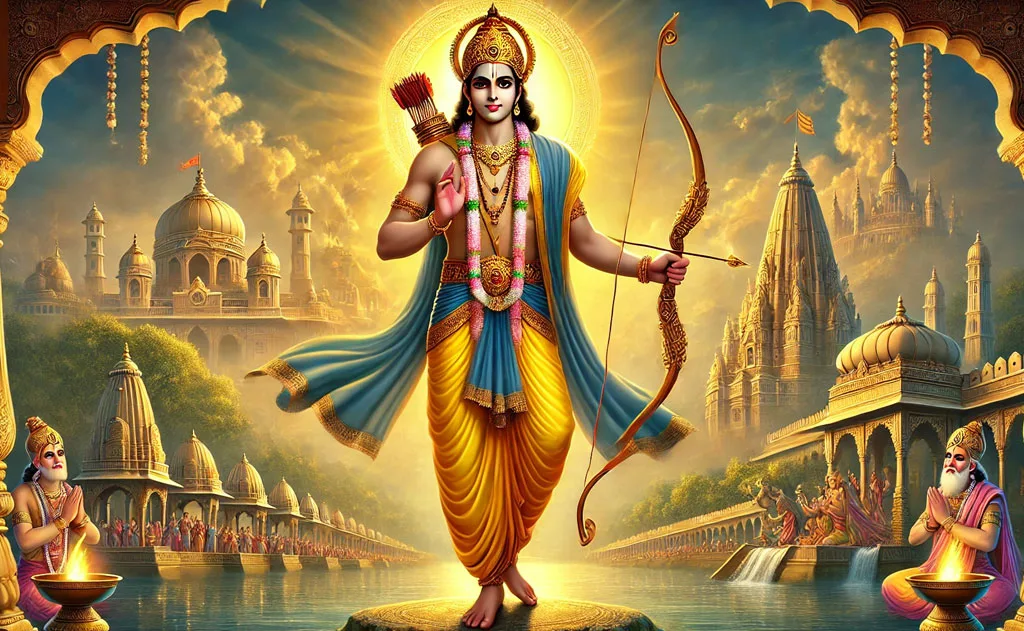
Quick answer: The Bala Kanda ("Book of Youth") is the first of the seven books of Valmiki's Ramayana. It tells how Valmiki came to compose the epic, how Rama and his three brothers were born to King Dasharatha, how Rama protected the sage Vishvamitra's sacrifice, and how he broke Shiva's bow and married Sita. It has 77 sargas.
Much of the Bala Kanda is made up of stories within the story: on the road, Vishvamitra tells the young princes the legends of the places they pass. This summary follows the book in order, with sarga numbers so that you can find each episode in the text.
| Bala Kanda at a glance | |
|---|---|
| Position | First of seven kandas, before the Ayodhya Kanda |
| Chapters | 77 sargas in the edition on IIT Kanpur's Valmiki Ramayana site |
| Main characters | Valmiki, Narada, Dasharatha and his queens, Rama, Lakshmana, Bharata, Shatrughna, Vishvamitra, Vasishtha, Janaka, Sita, Parashurama |
| Main places | The Tamasa river, Ayodhya, Siddhashrama, the Ganga, Mithila |
| Stories within the story | Rishyashringa, Tataka, the descent of the Ganga, the churning of the ocean, Ahalya, the life of Vishvamitra |
How the Ramayana came to be written (sargas 1 to 4)
The book opens with the sage Valmiki asking Narada whether there is anyone in the world who is truly virtuous, and Narada answers by telling him the life of Rama in brief (sarga 1). Soon after, by the Tamasa river, Valmiki sees a hunter kill one of a pair of mating birds. His grief comes out as a curse in a new metre, the shloka, and Brahma tells him to use this metre to compose Rama's story (sarga 2). Valmiki sees the whole story in meditation and composes the Ramayana (sarga 3), and he teaches it to two young disciples, Kusha and Lava, who sing it before Rama himself (sarga 4).
This is why the Ramayana is called the adi kavya, the first poem, and Valmiki the adi kavi, the first poet.
Ayodhya and the sacrifice for sons (sargas 5 to 17)
Valmiki describes Ayodhya on the Sarayu, its prosperity and its righteous king Dasharatha (sargas 5 to 7). Dasharatha has no son, and he resolves to perform the ashvamedha (horse sacrifice) (sarga 8). On the advice of his minister Sumantra, he brings the sage Rishyashringa to conduct it (sargas 9 to 13). The ashvamedha is performed on the bank of the Sarayu (sarga 14), followed by the putrakameshti, the rite for sons.
Meanwhile the gods, troubled by Ravana, ask Vishnu to be born as a man, since Ravana's boon protected him from gods and other beings but not from humans (sarga 15). A radiant being rises from the sacrificial fire and gives Dasharatha a vessel of payasam, which he shares among his queens (sarga 16). At Brahma's request, the gods father the vanara and bear heroes who will later help Rama (sarga 17).
The birth of the four princes (sarga 18)
Kausalya gives birth to Rama, Kaikeyi to Bharata, and Sumitra to the twins Lakshmana and Shatrughna (sarga 18). Rama's birth is celebrated on Sri Rama Navami. The boys grow up learned and skilled in arms; Lakshmana is devoted to Rama and Shatrughna to Bharata.
Vishvamitra takes Rama to the forest (sargas 18 to 30)
When Rama is still young, the sage Vishvamitra comes to Ayodhya and asks the king to send Rama to protect his sacrifice from rakshasas (sargas 18 and 19). Dasharatha refuses, unwilling to send a boy against demons (sarga 20); Vishvamitra's anger and Vasishtha's counsel change his mind (sarga 21).
On the road, Vishvamitra teaches the brothers the mantras bala and atibala (sarga 22). He tells them the story of the yakshi Tataka who has laid waste the land, and Rama kills her (sargas 24 to 26). Pleased, Vishvamitra gives Rama divine weapons and teaches him how to use and withdraw them (sargas 27 and 28). At Siddhashrama, Rama and Lakshmana guard the six-day sacrifice and drive off the rakshasas Maricha and Subahu (sargas 29 and 30). Maricha survives, and will return in the Aranya Kanda.
Stories on the road to Mithila (sargas 31 to 49)
Vishvamitra now leads the princes towards Mithila, where King Janaka is holding a sacrifice. On the way he tells them the legends of the land:
- The founding of cities by the sons of Kusha, and the origin of the Kaushiki river, Vishvamitra's own family story (sargas 32 to 34).
- The birth of Kartikeya (sargas 35 to 37).
- The descent of the Ganga. King Sagara's sixty thousand sons are burnt to ashes by the sage Kapila while searching for the sacrificial horse. Generations later, King Bhagiratha performs austerities to bring the Ganga down from heaven to purify their ashes; Shiva catches the river in his hair to break her fall (sargas 38 to 44).
- The churning of the ocean of milk and the battle for the nectar (sarga 45), and the birth of the Maruts (sargas 46 and 47).
- Ahalya. At Gautama's empty hermitage, Vishvamitra tells how Indra seduced Ahalya and how Gautama cursed her to live there for thousands of years, unseen, fasting and living on air (sarga 48). When Rama enters the hermitage, Ahalya is freed and honoured, and Gautama returns to her (sarga 49).
Ahalya and the stone. In many later tellings, including the Ramcharitmanas, Ahalya is turned to stone and comes back to life at the touch of Rama's foot. In Valmiki she is not a stone: she is doing penance unseen by any living being (1.48.29 to 30). The stone is a later tradition.
The life of Vishvamitra (sargas 50 to 65)
At Mithila, Janaka's priest Shatananda tells Rama the story of Vishvamitra (sargas 51 to 65): how King Vishvamitra tried to take the wish-giving cow Kamadhenu from the sage Vasishtha and was defeated by Vasishtha's spiritual power; how he gave up his kingdom to win the status of a brahmarshi; how he raised King Trishanku to a heaven of his own; how he saved the boy Shunahshepa; how the apsara Menaka interrupted his austerities; and how Brahma at last acknowledged him as a brahmarshi.
Shiva's bow and the four weddings (sargas 66 to 73)
Janaka shows the princes the great bow of Shiva, kept in his family for generations, and tells how he found Sita in a furrow while ploughing. He has promised her to the man who can string the bow (sarga 66). Rama lifts and strings it, and it breaks with a sound like thunder (sarga 67). Janaka sends for Dasharatha (sargas 68 and 69). Vasishtha recites the line of the Ikshvaku kings and Janaka recites his own (sargas 70 and 71). The four brothers are married: Rama to Sita and Lakshmana to Urmila, the daughters of Janaka, and Bharata and Shatrughna to Mandavi and Shrutakirti, the daughters of Janaka's brother Kushadhvaja (sargas 72 and 73).
Parashurama and the return home (sargas 74 to 77)
On the way back to Ayodhya, Parashurama, the warrior-sage who had destroyed the kshatriyas, confronts Rama and challenges him to string the bow of Vishnu (sargas 74 and 75). Rama strings it with ease, and Parashurama recognises him and withdraws to Mount Mahendra (sarga 76). The wedding party returns to Ayodhya, and Bharata leaves with his maternal uncle for his grandfather's kingdom (sarga 77). The Ayodhya Kanda opens from here.
Is the Bala Kanda part of the original Ramayana?
Tradition counts it as Valmiki's. Many scholars regard much of the Bala Kanda, together with the Uttara Kanda, as later than the central five books, pointing among other things to the long legends inserted into the journey and to the summaries in sargas 1 to 4. Both views are held by serious readers.
Frequently asked questions
How many sargas are in the Bala Kanda?
77 in the edition on IIT Kanpur's Valmiki Ramayana site. Other editions number them differently.
What does "Bala Kanda" mean?
"The Book of Youth" or "Book of Childhood". It covers Rama's life from birth to his wedding.
Who was Tataka?
A yakshi who, under a curse, had become a man-eating demoness and laid waste the region near the Ganga. Rama kills her at Vishvamitra's bidding (sargas 24 to 26).
Was Ahalya turned to stone in the Ramayana?
Not in Valmiki's text. She does penance unseen and is freed when Rama arrives (sargas 48 and 49). The stone comes from later retellings.
Whose bow did Rama break?
Shiva's, at Janaka's court in Mithila (sarga 67). He later strings the bow of Vishnu that Parashurama brings (sarga 76).
Related reading
- Ramayana: The Complete Guide
- Sita: Her Life in the Ramayana
- Ram Sita Vivah Katha: the wedding in Valmiki and Tulsidas
- Ramayana story in simple English, kanda by kanda
- Sundara Kanda summary
Sources
- Valmiki Ramayana, Bala Kanda, Sanskrit text with English translation (Rashtriya Sanskrit Vidyapeetha, Tirupati), IIT Kanpur: heritage.iitk.ac.in/VRAM/1.1.1; sarga headings from the chapter list at heritage.iitk.ac.in/VRAM.
- John Brockington, The Sanskrit Epics (Brill, 1998), for the scholarly view of the Bala Kanda.
Last reviewed: 12 November 2026.
Share this with family and friends
Send it on WhatsApp, post it, or copy the link.
More from Stories
- Vidura Niti: Selected Teachings with Sources
- Jatayu and Sampati: The Vulture Brothers of the Ramayana
- Kumbhakarna in the Ramayana: Sleep, Loyalty and Death
- Bharata in the Ramayana: The Brother Who Refused a Crown
- Ravana in the Ramayana: Scholar, King and Antagonist