
Vishishtadvaita Explained: Ramanuja's Philosophy of Qualified Non-Dualism
Quick answer: Vishishtadvaita ("non-duality of the qualified") is the school of Vedanta taught by Ramanujacharya. It holds that there is one ultimate reality, Brahman, identified with Narayana (Vishnu). Souls and matter are real, but they exist only as the "body" of God, inseparable from Him, while
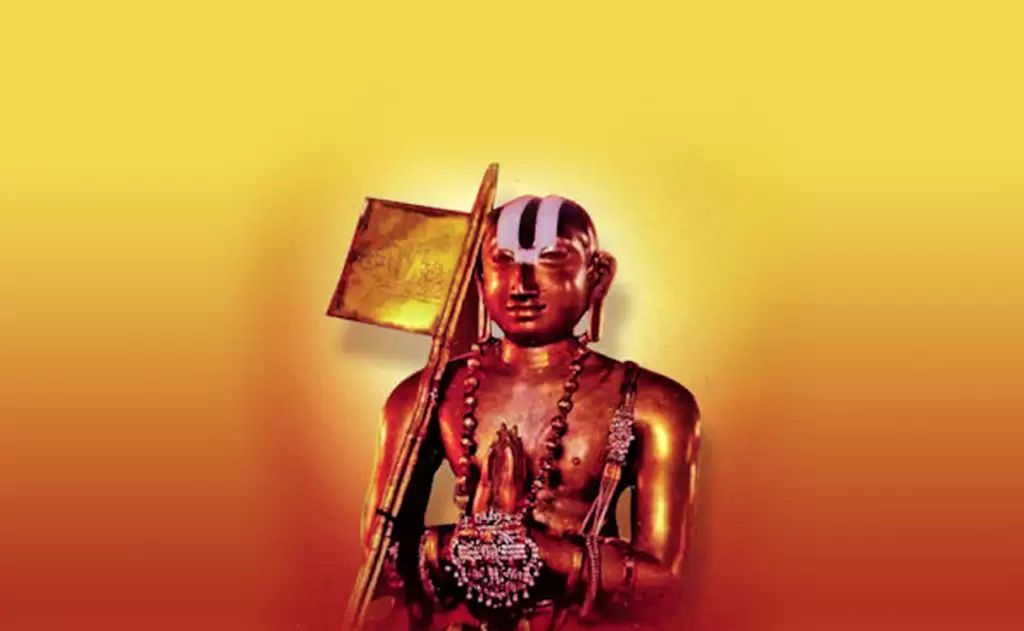
Quick answer: Vishishtadvaita ("non-duality of the qualified") is the school of Vedanta taught by Ramanujacharya. It holds that there is one ultimate reality, Brahman, identified with Narayana (Vishnu). Souls and matter are real, but they exist only as the "body" of God, inseparable from Him, while God is their inner Self. Liberation comes through devotion (bhakti) and surrender (prapatti), by God's grace. The liberated soul serves God eternally in Vaikuntha and shares His bliss, but never becomes God.
Vishishtadvaita is the philosophy behind Sri Vaishnavism, the tradition of Srirangam, Melkote and Tirumala, of the Alvars' Tamil hymns and of the many Sri Venkateswara temples abroad. This guide explains its main ideas simply. For a side-by-side comparison with Advaita and Dvaita, see Advaita vs Vishishtadvaita vs Dvaita. For the life of the acharya, see Ramanujacharya: Life, Teachings and Relevance.
Vishishtadvaita at a Glance
| Feature | Details |
|---|---|
| Name | Vishishta (qualified) + advaita (non-dual): one Brahman, qualified by souls and matter |
| Main acharya | Ramanujacharya (traditional dates 1017–1137 CE; some scholars suggest c. 1077–1157) |
| Earlier teachers | Nathamuni and Yamunacharya (Alavandar), building on the Tamil hymns of the Alvars |
| Ultimate reality | Brahman as Narayana with Sri (Lakshmi), full of auspicious qualities |
| Three realities | Chit (souls), achit (matter), Ishvara (God) |
| Key relation | Body and soul (sharira–shariri): the world and souls are God's body |
| The world | Real, not an illusion |
| Path | Bhakti, and above all prapatti (surrender) |
| Liberation | After this life, eternal service of God in Vaikuntha |
| Core texts | Sri Bhashya, Vedartha Sangraha, Gita Bhashya, Gadya Traya |
| Living tradition | Sri Vaishnavism; Vadakalai and Tenkalai lineages |
Where the Name Comes From
Vedanta schools are named after how they understand the oneness taught in the Upanishads. Advaita says the oneness is absolute: only Brahman is real. Vishishtadvaita agrees that there is one Brahman with nothing outside it, but says this one Brahman is qualified (vishishta) by souls and matter. It is like saying "one person", where that person includes a body and a mind. The unity is real, and so are the parts.
The Three Realities (Tattva-Traya)
Vishishtadvaita teaches three real and eternal categories:
- Chit, the conscious souls. Each soul (jiva) is eternal, atomic in size and conscious by nature. Its knowledge can expand or contract: it is clouded in bondage and fully open in liberation. Souls are of three kinds: baddha (bound in samsara), mukta (liberated) and nitya (eternally free, such as Garuda and Ananta in Vaikuntha).
- Achit, non-conscious matter. Primordial matter (prakriti), time and the pure substance of Vaikuntha. Matter changes its state, from subtle to gross, but it is never unreal.
- Ishvara, God. Narayana, the one Lord, who is the creator, sustainer and inner controller of all. He is free from every defect and full of countless auspicious qualities such as knowledge, power, compassion and accessibility.
God and the World: Soul and Body
The central idea of the school is the body–soul relation (sharira–shariri bhava). Just as your body exists for you, is controlled by you and cannot exist apart from you, so souls and matter exist for God, are controlled by God and cannot exist apart from Him. God is the soul of the universe; the universe is God's body.
Ramanuja found this idea in the Upanishads themselves. The Antaryami Brahmana of the Brihadaranyaka Upanishad (3.7) repeatedly describes the Self who dwells within the earth, the waters and every being, "whose body" they are, and who controls them from within. Ramanuja read such passages as the key to the whole of Vedanta.
Three technical terms follow from this:
- *Aprithak-siddhi* (inseparability): souls and matter can never exist apart from God, yet they remain distinct from Him, as a quality is inseparable from what it qualifies.
- *Antaryami* (inner controller): God lives within every soul as its Self.
- *Samanadhikaranya* (co-ordinate reference): when two words such as "That" and "you" refer to one thing in different modes, they show unity with difference, not bare identity.
How Ramanuja Read "Tat Tvam Asi"
The Chandogya Upanishad's saying Tat Tvam Asi, "You are That", is read by Advaita as the identity of the self and Brahman. Ramanuja read it differently. "That" refers to Brahman as the cause of the world; "you" refers to the same Brahman as the inner Self of the individual. The sentence teaches that one Brahman is both, not that the individual soul is God. See The Four Mahavakyas for how the schools read these sayings.
The World Is Real
Ramanuja rejected the Advaita doctrine of maya as an inexplicable ignorance that projects an unreal world. He argued that ignorance cannot belong to Brahman, which is pure knowledge, nor to the soul before the soul exists apart from it. His criticism is traditionally summarised as seven objections (sapta-vidha anupapatti) in the Sri Bhashya.
For Vishishtadvaita, creation is a real change of state. Before creation, souls and matter exist in God in a subtle, undifferentiated condition (karana avastha). In creation, God unfolds them into names and forms (karya avastha). Brahman is therefore both the material and the efficient cause of the world, without being touched by its defects. See Brahman, Atman and Maya Explained for the wider debate.
Five Forms of God
Following the Pancharatra Agamas, Sri Vaishnavism describes five forms in which Narayana is available to souls:
| Form | Meaning |
|---|---|
| Para | The supreme form in Vaikuntha |
| Vyuha | The four emanations (Vasudeva, Sankarshana, Pradyumna, Aniruddha) for creation and the protection of the world |
| Vibhava | The avataras, such as Rama and Krishna |
| Antaryami | God dwelling within every heart |
| Archa | The consecrated temple image, in which God makes Himself accessible to all |
The archa form is why temple worship is so central to Sri Vaishnavism. The murti in the temple is not a symbol only; tradition holds that God is truly present in it out of compassion.
The Path: Bhakti and Prapatti
Bhakti in Ramanuja's sense is continuous loving meditation on God, steady "like a flow of oil", supported by duties performed without attachment. Ramanuja's Gita Bhashya reads the Gita as teaching that knowledge and action both culminate in such devotion.
Prapatti or sharanagati is complete surrender to God, trusting His grace as the means. The tradition holds that prapatti is open to everyone, whatever their learning or birth. Ramanuja's Sharanagati Gadya is a prose prayer of surrender. Sri Vaishnavas regard the Bhagavad Gita's verse 18.66, where Krishna asks Arjuna to abandon all other supports and take refuge in Him alone, as the charama shloka, the final teaching. It is one of the "three secrets" (rahasya traya) of the tradition, with the Tirumantra and the Dvaya mantra.
Liberation
In Vishishtadvaita, liberation comes after the present body falls. The liberated soul travels to Vaikuntha, where its knowledge becomes fully open. It enjoys a bliss equal to God's and serves Him eternally (kainkarya). It shares God's bliss but not His unique functions, such as creating and governing the universe. The soul never merges into God; its joy lies in the relationship.
Ramanuja's Main Works
Tradition credits Ramanuja with nine works:
| Work | What it is |
|---|---|
| Sri Bhashya | His commentary on the Brahma Sutras, the central text of the school |
| Vedartha Sangraha | A summary of how he reads the Upanishads |
| Vedanta Sara and Vedanta Dipa | Shorter commentaries on the Brahma Sutras |
| Gita Bhashya | Commentary on the Bhagavad Gita |
| Gadya Traya | Three prose prayers: Sharanagati, Sriranga and Vaikuntha Gadya |
| Nitya Grantha | A manual of daily worship |
Ubhaya Vedanta: Sanskrit and Tamil
Sri Vaishnavism honours two bodies of scripture, which is why it is called Ubhaya Vedanta, "the double Vedanta". One is the Sanskrit Vedas and Upanishads. The other is the Nalayira Divya Prabandham, about four thousand Tamil verses by the twelve Alvars, which Nathamuni compiled. Both are recited in temples and homes, and the Alvars' hymns are often called the "Tamil Veda".
After Ramanuja: The Two Lineages
In the centuries after Ramanuja, Sri Vaishnavism developed two main lineages:
- Vadakalai (northern), associated with Vedanta Desika, who stressed Sanskrit learning and the soul's own effort in surrendering.
- Tenkalai (southern), associated with Pillai Lokacharya and Manavala Mamunigal, who stressed the Tamil Prabandham and the sufficiency of God's grace.
Teachers often explain the difference with two images. The Vadakalai view is like a baby monkey that clings to its mother (markata nyaya); the Tenkalai view is like a kitten that the mother cat carries (marjara nyaya). Both lineages follow Ramanuja and share the same core philosophy. You can often tell them apart by the shape of the thiruman (forehead mark).
Vishishtadvaita in Daily Life
- Temple worship: Srirangam, Tirumala, Kanchipuram, Melkote and the 108 Divya Desams are central to the tradition. Many diaspora Sri Venkateswara and Ranganatha temples follow Pancharatra or Vaikhanasa worship; see Vaikhanasa Agamas.
- Recitation: the Divya Prabandham, the Vishnu Sahasranama and the Tiruppavai, especially in the month of Margazhi.
- Marks: the thiruman (urdhva pundra) with the red or yellow Sri Churnam.
- Festivals: Ramanuja Jayanti, Vaikuntha Ekadashi and temple brahmotsavams.
- Service: kainkarya, service to God and His devotees, is valued as the soul's true nature.
Frequently Asked Questions
What does Vishishtadvaita mean?
"Non-duality of the qualified." There is one Brahman, but that Brahman is qualified by real souls and real matter, which form His body.
Who founded Vishishtadvaita?
Ramanujacharya is its greatest teacher and systematiser. He built on earlier teachers, Nathamuni and Yamunacharya, and on the Tamil hymns of the Alvars. Tradition also names earlier Vedanta teachers in this line.
Is the world an illusion in Vishishtadvaita?
No. The world is real. It is the body of God, and creation is a real transformation of God's subtle body into a gross one.
How is Vishishtadvaita different from Advaita?
Advaita holds that the soul is identical with attributeless Brahman and that the world is not ultimately real. Vishishtadvaita holds that souls and the world are real and remain distinct from God even though they are inseparable from Him, and that Brahman has infinite auspicious qualities.
How is it different from Dvaita?
Both accept a real world and real souls. Dvaita stresses the eternal difference between God and souls. Vishishtadvaita stresses their inseparable unity, like soul and body. See Dvaita Philosophy Explained.
What is prapatti?
Complete surrender to God, trusting His grace as the means to liberation. It is central to Sri Vaishnava practice and is described as open to all.
Which famous temples follow this tradition?
The Sri Ranganathaswamy Temple at Srirangam and the Venkateswara temple at Tirumala are among the best known, along with the other Divya Desams praised by the Alvars.
Related Reading on HinduTone
- Advaita vs Vishishtadvaita vs Dvaita: Differences Explained
- Ramanujacharya: Life, Teachings and Relevance
- Swami Ramanuja: The Father of the Bhakti Movement
- The Statue of Equality and Ramanujacharya's Wisdom
- Bhakti Yoga and the Nine Forms of Devotion
- Six Schools of Hindu Philosophy
- Shaiva, Vaishnava, Shakta and Smarta Traditions
Sources
- Internet Encyclopedia of Philosophy, Rāmānuja (dates, body–soul relation, three realities, criticism of maya, bhakti and prapatti, works): iep.utm.edu/ramanuja/
- John B. Carman, The Theology of Rāmānuja: An Essay in Interreligious Understanding, Yale University Press, 1974.
- Julius Lipner, The Face of Truth: A Study of Meaning and Metaphysics in the Vedāntic Theology of Rāmānuja, Macmillan, 1986.
- Patrick Olivelle (tr.), Upaniṣads, Oxford World's Classics, 1996 (Brihadaranyaka 3.7; Chandogya 6).
- Swami Adidevananda (tr.), Sri Ramanuja Gita Bhashya, Sri Ramakrishna Math, Chennai.
Last reviewed: 12 November 2026.
Share this with family and friends
Send it on WhatsApp, post it, or copy the link.
More from Hinduism
- How to Begin Studying Sanatana Dharma: A Complete Learning Path
- Hinduism and the Meaning of Family Dharma
- Hinduism for Kids: A Simple Guide to What Hindus Believe
- A Hindu Day: Daily Practices from Waking to Sleep
- Hindu Symbols and Their Meanings
You might also like
Samkhya Philosophy Explained: Purusha, Prakriti and the 25 Tattvas

Dvaita Philosophy Explained: Madhvacharya's Vedanta of Difference
Advaita, Vishishtadvaita and Dvaita Explained: The Three Great Schools of Vedanta Compared
