Love vs Attachment: What the Ramayana, the Bhagavata and Vedanta Teach About Selfless Love
A Telugu reflection by Sri Sadguru Peetham: attachment possesses and fears loss, selfless love offers and frees. Drawing on Dasharatha and Rama, Yashoda and the gopis, Yajnavalkya's teaching to Maitreyi (Brihadaranyaka 2.4.5), Gita 6.32 and Chandogya 3.14.1, with Sanskrit lines and a FAQ.
In short: this reflection by Sri Sadguru Peetham says that love and attachment are not the same. Attachment demands possession, expects something back and fears loss; selfless love offers and leaves the other free. It draws on Dasharatha and Rama, on Yashoda and the gopis, and on three scripture quotations: Brihadaranyaka Upanishad 2.4.5, Bhagavad Gita 6.32 and Chandogya Upanishad 3.14.1. We add the Sanskrit for those three with their meanings, a short comparison, and FAQs.
Understanding the difference between love and attachment is the first step of spiritual maturity.
The word love is heard often in human life. But in many situations, what we really have is more possessiveness (mamakara), infatuation (moha) and selfish attachment than love.
Toward children it is vatsalya (parental affection), toward things it is mamakara (the sense of "mine"), between husband and wife it is anuraga (tender affection), and toward friends it is maitri (friendship). All of these are natural emotions. But when the possessive feeling "this is mine", "they must belong only to me" enters them, love turns into infatuation.
Attachment demands possession.
Love wants freedom. Attachment expects.
Love offers.
Attachment brings the fear of losing.
Selfless love has no such fear....
Teachings on love in the Ramayana and the Bhagavata
King Dasharatha had immense fatherly affection for Rama.
But he could not bear the separation from Rama and gave up his life. This shows the intensity of human attachment.
On the other hand, Sri Rama, with no sense of "mine" toward the kingdom, went to the forest to protect truth and dharma.
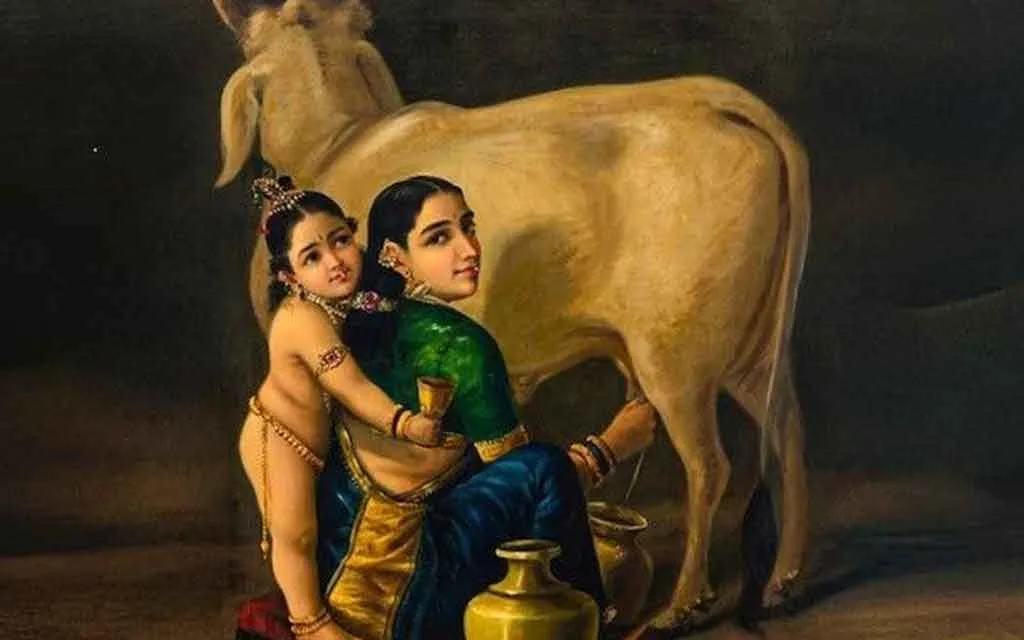
Yashoda had immense motherly affection for Krishna. Even after Krishna left Gokula, the love for Krishna in the hearts of the gopis did not diminish in the least.
Their love did not stay limited to physical nearness; it grew into constant remembrance of God...
The nature of love according to Vedanta
The Upanishads explain wonderfully the truth of the Self that lies behind love.
In the Brihadaranyaka Upanishad, the sage Yajnavalkya instructs Maitreyi thus:
na vā are patyuḥ kāmāya patiḥ priyo bhavati, ātmanas tu kāmāya patiḥ priyo bhavati...
That is, the husband is dear not merely for his own sake; the husband becomes dear because he is dear to the Self (atma). The same principle applies to the wife, children, wealth and all other dear things.
The inner meaning of this is that the foundation of every dear experience is the nature of the Self itself.
A person looks for the joy within him in external objects and in people. When he gets them he rejoices; when they go far away he grieves. But the joy of one who knows the Self does not depend on external circumstances. He sees the same Self-principle in every being.
In the Bhagavad Gita, Sri Krishna says:
“ātmaupamyena sarvatra samaṃ paśyati yo'rjuna” (6.32)
The one who, by comparison with himself, sees the joys and sorrows of all beings as equal is the highest yogi.
This is the foundation of the universal love that Vedanta teaches.
How can we cultivate love?
First, one should cultivate love for family members selflessly. Then one should love the neighbours, society and the nation. Finally, one should develop a wide heart that sees divinity in all living beings.
On this journey the narrow notions of "I" and "mine" must decrease. Ego, hatred, jealousy and selfishness must go. Then love, no longer limited to individuals, blossoms as universal love.
The journey from attachment to selfless love, from selfless love to universal love, and from universal love to self-knowledge (atma jnana) is the ultimate purpose of spiritual life.
Sarvaṃ khalv idaṃ brahma —
All this is Brahman.
(Chandogya Upanishad 3.14.1)
A heart that sees no one as a stranger, a mind with no hatred toward anyone, a love that expects nothing in return: these are the true ornaments of spiritual life.
Do not search for love... try to become full of love. For the Self-principle within you is the Supreme Truth shining in all beings!
A Telugu reflection by: Sri Sadguru Peetham
Notes added by HinduTone: love and attachment at a glance, and the scripture lines
The reflection above is the author's own. The notes below are added by HinduTone and checked against the texts (Sanskrit as given on sanskritdocuments.org).
Attachment and selfless love, as the reflection puts it
| Point | Attachment (anubandham) | Selfless love (prema) |
|---|---|---|
| What it wants | Possession | Freedom |
| Its attitude | Expects | Offers |
| Fear of loss | Brings the fear of losing | Has no such fear |
Dasharatha, Rama, Yashoda and the gopis
Dasharatha's death after Rama's departure to the forest is told in the Ayodhya Kanda of the Ramayana. The gopis' remembrance of Krishna after he left Vraja is told in the Bhagavata Purana, Canto 10, where Krishna sends Uddhava to Vraja (chapters 46 and 47). The reflection uses these as examples of the intensity of human attachment on one side and of love that grows into constant remembrance of God on the other.
Brihadaranyaka Upanishad 2.4.5 (also 4.5.6)
न वा अरे पत्युः कामाय पतिः प्रियो भवत्यात्मनस्तु कामाय पतिः प्रियो भवति ।
न वा अरे जायायै कामाय जाया प्रिया भवत्यात्मनस्तु कामाय जाया प्रिया भवति ।
न वा अरे पुत्राणां कामाय पुत्राः प्रिया भवन्त्यात्मनस्तु कामाय पुत्राः प्रिया भवन्ति ।
न वा अरे वित्तस्य कामाय वित्तं प्रियं भवत्यात्मनस्तु कामाय वित्तं प्रियं भवति ।
na vā are patyuḥ kāmāya patiḥ priyo bhavaty ātmanas tu kāmāya patiḥ priyo bhavati |
na vā are jāyāyai kāmāya jāyā priyā bhavaty ātmanas tu kāmāya jāyā priyā bhavati |
na vā are putrāṇāṃ kāmāya putrāḥ priyā bhavanty ātmanas tu kāmāya putrāḥ priyā bhavanti |
na vā are vittasya kāmāya vittaṃ priyaṃ bhavaty ātmanas tu kāmāya vittaṃ priyaṃ bhavati |
Meaning: "Not for the husband's sake is the husband dear, but for the sake of the Self (atman) the husband is dear. Not for the wife's sake is the wife dear, but for the sake of the Self the wife is dear." The same is then said of sons and of wealth.
In 2.4.1 Yajnavalkya tells Maitreyi that he is about to leave household life, and in 2.4.3 Maitreyi asks for the knowledge by which she can become immortal. The passage above is part of his answer. The same passage returns in 4.5.6 with a longer list that also names animals and the Vedas. It goes on with the line below, which is also the line that links this teaching to the practice of self-inquiry:
आत्मा वा अरे द्रष्टव्यः श्रोतव्यो मन्तव्यो निदिध्यासितव्यः
ātmā vā are draṣṭavyaḥ śrotavyo mantavyo nididhyāsitavyaḥ
"The Self, Maitreyi, is to be seen, heard, reflected on and meditated on." Like the reflection, we read the passage as pointing to the Self as the source of what we find dear. It explains why things are dear; it does not tell anyone to stop caring for their family.
Bhagavad Gita 6.32
आत्मौपम्येन सर्वत्र समं पश्यति योऽर्जुन ।
सुखं वा यदि वा दुःखं स योगी परमो मतः ॥
ātmaupamyena sarvatra samaṃ paśyati yo'rjuna |
sukhaṃ vā yadi vā duḥkhaṃ sa yogī paramo mataḥ ||
Meaning: One who, by comparison with his own self, sees the same everywhere, whether in pleasure or in pain, is considered the highest yogi.
The verse comes in Chapter 6, soon after verses 6.29 to 6.31, which speak of seeing the Self in all beings and all beings in the Self.
Chandogya Upanishad 3.14.1
सर्वं खल्विदं ब्रह्म तज्जलानिति शान्त उपासीत ।
sarvaṃ khalv idaṃ brahma tajjalān iti śānta upāsīta |
Meaning: "All this is indeed Brahman. Calm, one should meditate on it as tajjalan." The word tajjalan is traditionally explained as that from which all things are born, into which they dissolve, and by which they live. The reflection quotes only the opening words, "sarvaṃ khalv idaṃ brahma".
Frequently asked questions
What is the difference between love and attachment?
According to the reflection, attachment demands possession, expects something in return and brings the fear of losing; selfless love wants the other person's freedom, offers without expecting, and has no such fear. Natural affection becomes attachment when the feeling "they must belong only to me" enters it.
Is affection for family and friends wrong?
No. The reflection calls vatsalya (parental affection), anuraga (a couple's tender affection) and maitri (friendship) natural emotions. The problem starts only when possessiveness enters. It advises cultivating love for family members selflessly first, and then widening it to neighbours, society, the nation and all beings.
What does the Brihadaranyaka Upanishad say about love?
In the passage where Yajnavalkya teaches his wife Maitreyi (2.4.5, repeated in 4.5.6), he says that the husband is dear not for the husband's sake but for the sake of the Self (atman); the same is said of the wife, sons, wealth and other things. Vedanta reads this as pointing to the Self as the ground of everything we find dear.
What does Bhagavad Gita 6.32 mean?
"Ātmaupamyena sarvatra samaṃ paśyati yo'rjuna, sukhaṃ vā yadi vā duḥkhaṃ sa yogī paramo mataḥ": one who, by comparison with his own self, sees the same everywhere, in pleasure or in pain, is considered the highest yogi. The reflection takes this as the basis of universal love.
How can selfless love grow into universal love?
The reflection describes a path: start with selfless love for family, then love neighbours, society and the nation, and finally develop a heart that sees divinity in all living beings. On the way the narrow sense of "I" and "mine" has to decrease, and ego, hatred, jealousy and selfishness have to go.
What does "sarvaṃ khalv idaṃ brahma" mean?
It is from the Chandogya Upanishad 3.14.1 and means "all this is indeed Brahman". The reflection ends with it to say that when everything is seen as Brahman, no one is a stranger and love need not expect anything in return.
Editor's note
This reflection was shared with HinduTone in Telugu by Sri Sadguru Peetham. The Telugu version is the original; the English page is a faithful translation of it. The reflection itself, from the opening line to the closing words, is the author's. Two paste artefacts were removed from the Telugu (a stray full stop on its own line and an unmatched closing quotation mark on the Gita line). HinduTone added the short summary, the comparison table, the notes on the Ramayana and Bhagavata examples, the Sanskrit lines with their meanings and verse references, the FAQs and the related links. We do not promise any particular result from study or practice.
Last updated: 1 November 2026
Also read
- Atma Paramatma Tattvam: Are They One? The Lion Story, Tat Tvam Asi and Advaita Vedanta
- Ahankara, the wall before self-knowledge
- Gargi and Maitreyi: women seers of the Upanishads
- What Is Atma? The Self in the Upanishads
- Tat Tvam Asi meaning: Chandogya Upanishad 6.8.7
- Bhagavad Gita for Beginners: all 18 chapters explained
- Holi: significance and the divine love of Radha and Krishna
Share this with family and friends
Send it on WhatsApp, post it, or copy the link.
More from Spirituality
- Aham Brahmasmi Meaning: Why It Is Not Ego
- Tat Tvam Asi Meaning: Chandogya Upanishad 6.8.7 Explained
- What Is Atma? The Self in the Upanishads, Explained
- Ahankara, the Wall Before Self-Knowledge | True Knowledge Dawns When the Ego Goes
- Daiva Sankalpam (Divine Will): The Story of the Sadhu on the Sinking Boat
You might also like

Atma Paramatma Tattvam: Are They One? The Lion Story, Tat Tvam Asi and Advaita Vedanta
Not Wealth, Just Good Character: A Reflection on Daanam (Charity) | Selfless Giving in the Hindu Tradition

Gargi and Maitreyi: Women Seers of the Upanishads