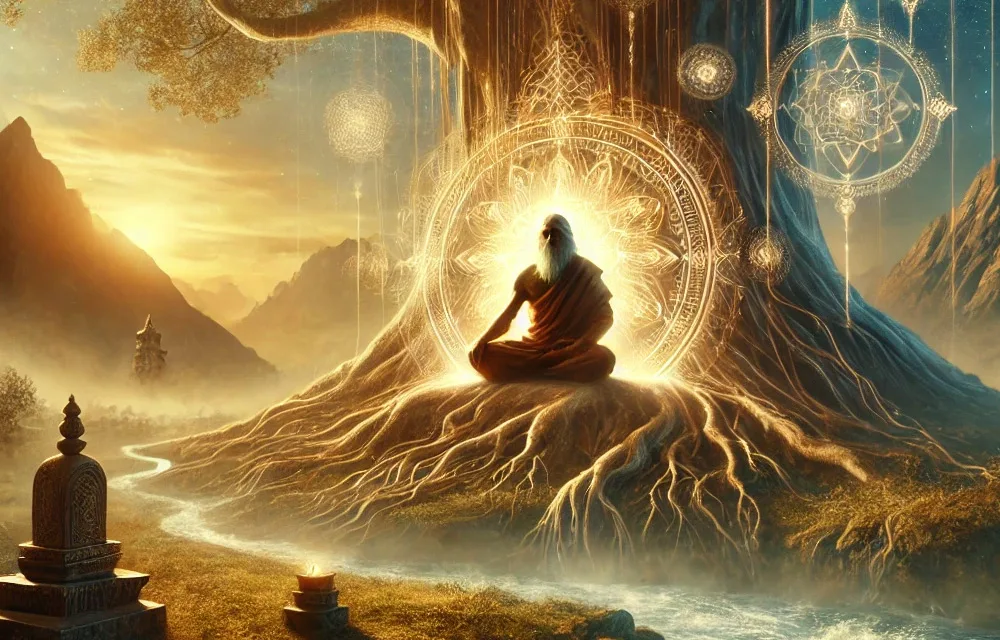
Gargi and Maitreyi: Women Seers of the Upanishads
Meet Gargi Vachaknavi and Maitreyi, two women who appear in the Brihadaranyaka Upanishad asking about the Self. What they asked, what Yajnavalkya answered, and how women study Vedanta today.

Quick answer: Gargi Vachaknavi and Maitreyi are two women of the Brihadaranyaka Upanishad. Maitreyi asks her husband, the sage Yajnavalkya, for the knowledge that makes one immortal (2.4 and 4.5). Gargi challenges Yajnavalkya in a public debate in King Janaka's court (3.6 and 3.8). Both are shown asking about the Self (Atma), the central subject of our Atma Paramatma Tattvam guide.
These passages are among the oldest records of women in Indian philosophical conversation. They also show, in action, the method we describe in What is Atma?: a question is asked, the teacher answers, and the student does not let go until the answer is clear. This guide goes through what the text says (with verse numbers) and what it does not say.
Where the passages are found
| Person | Passage | What happens |
|---|---|---|
| Maitreyi | Brihadaranyaka 2.4 and 4.5 | Yajnavalkya is about to leave household life; Maitreyi asks for what would make her immortal; he teaches her about the Self |
| Gargi Vachaknavi | Brihadaranyaka 3.6 | She questions Yajnavalkya about what everything is 'woven on'; he cautions her not to ask too far |
| Gargi Vachaknavi | Brihadaranyaka 3.8 | She returns with two questions and receives the teaching on the Imperishable |
The Brihadaranyaka is one of the oldest and longest Upanishads and is traditionally associated with the White Yajurveda. Yajnavalkya is its central teacher; Janaka is the king of Videha whose court is the setting of the great debates in chapters 3 and 4. We describe these two people by their roles in the text and without labels of birth, as the Upanishad's own teaching on the Self does.
Maitreyi and Yajnavalkya: the question of immortality
The text introduces Maitreyi in 4.5.1:
मैत्रेयी ब्रह्मवादिनी बभूव
maitreyī brahmavādinī babhūva
Paraphrase: Yajnavalkya had two wives, Maitreyi and Katyayani. Of them, Maitreyi was a speaker of Brahman (brahmavadini), while Katyayani, the text says, had the understanding that concerns ordinary matters (stri-prajna). The text sets the two side by side to show the kind of knowledge each was concerned with, and it is Maitreyi who asks the question that carries the teaching. When Yajnavalkya says he is about to leave this way of life and proposes to settle matters between her and Katyayani (2.4.1 and 4.5.2), Maitreyi asks whether, if the whole earth full of wealth were hers, she would become immortal by it.
Yajnavalkya answers: no, her life would be like the life of those who have plenty; there is no hope of immortality through wealth (2.4.2). Maitreyi replies in a line often quoted: what use is it to me if it does not make me immortal? Tell me what you know (2.4.3). This is the first great question of the Upanishads in a woman's voice.
What Yajnavalkya teaches Maitreyi (2.4.5 to 2.4.14)
- Dearness is for the sake of the Self. A husband is dear not for the husband's sake but for the Self's sake; so too a wife, children, wealth and the worlds (2.4.5). Teachers read this as pointing out that what we love most is a reflection of our own nature, not as a teaching that others do not matter.
- The Self is to be seen, heard, reflected on, meditated on. Through this, the text says, everything is known (2.4.5). This is the sentence that gave Vedanta its three steps of shravana, manana and nididhyasana. See Atma Vichara for Hindus abroad for a practical adaptation.
- Sound and instrument. As the sound of a drum, a conch or a vina cannot be grasped by itself but is grasped through the instrument, so all these things are grasped in the Self (2.4.7 to 2.4.9).
- The ocean and the salt. The verse lists the ocean as the one meeting-place of all waters, the skin of all touches, the tongue of all tastes, the eye of all forms, the ear of all sounds, the mind of all intentions and the heart of all kinds of knowledge (2.4.11); teachers read this as pointing to one common ground of all experience, the Self. As a lump of salt thrown in water dissolves and cannot be picked up again, although every sip tastes of it, so this great being, endless and boundless, a mass of consciousness, arises from these elements and disappears with them (2.4.12). Compare the salt illustration that Uddalaka uses with his son in Tat Tvam Asi meaning.
At this point (2.4.13), Maitreyi says that the teacher has bewildered her. Yajnavalkya answers that he has said nothing confusing; what he has said is enough for understanding. He then closes with a question that is one of the most quoted lines of the Upanishad (2.4.14): by what should one know the knower?
विज्ञातारमरे केन विजानीयात्
vijñātāram are kena vijānīyāt
A key point of the dialogue is that Maitreyi does not accept the first answer, and that the teacher does not treat her question as unusual. The conversation is repeated in 4.5 in a similar form, and in 4.5.15 the Self is described as 'neti neti', 'not this, not this', not to be grasped. The passage ends with Yajnavalkya saying that this much is the teaching on immortality, and he then goes forth.
Gargi Vachaknavi: the debater at Janaka's court
Chapter 3 opens with Janaka's sacrifice, at which he offers a large herd of cows to the one who is most learned in Brahman. Yajnavalkya claims them and, one after another, learned participants test him with questions. Gargi, called Vachaknavi in the text, is the only woman named among the questioners.
First challenge (3.6)
Gargi asks: all this is woven, warp and weft, in water; what is water woven on? Yajnavalkya answers, 'air'. She then moves step by step through the worlds, from air to the sky-world, the world of the gandharvas, the sun, the moon, the stars, the gods, Indra, Prajapati and the world of Brahma, asking each time what that is woven on. At the last question, he tells her not to ask beyond this, because that is a divinity beyond further questioning, and that otherwise her head would fall off. She falls silent.
गार्गि मातिप्राक्षीः
gārgi mātiprākṣīḥ
It is worth noting how the text frames this. The warning is part of the literary form of the brahmodya, the contest of learning, and in the Upanishad's own words it marks where discussion by questions of 'what is it woven on?' reaches its limit. Such warnings are a feature of these debates: in 3.9.26 another questioner, Vidagdha Shakalya, is told that his head will fall if he cannot answer, and the text says that it did. The Upanishad does not present the warning to Gargi as a rebuke of her as a woman. Readers have taken the passage differently, and it is more careful to read the verse than to read a view into it.
Second challenge (3.8)
Gargi rises again and addresses the assembly, saying that she will ask Yajnavalkya two questions; if he answers them, none of them will defeat him in a debate on Brahman. She compares herself to a warrior from Kashi or Videha who strings a bow and rises with two arrows. He tells her to ask.
- Her question: that which is above the sky, below the earth, between the two, and which they call past, present and future, what is it woven on? His answer: on space (akasha).
- Her second question: and on what is space woven? His answer is the teaching on the Imperishable (akshara).
Yajnavalkya says that the knowers of Brahman call it the Imperishable: not coarse, not fine, not short, not long (3.8.8):
अस्थूलमनण्वह्रस्वमदीर्घम्
asthūlam anaṇv ahrasvam adīrgham
The text continues that it has no eyes, ears, speech or mind, no breath or mouth, nothing within or without; it eats nothing and nothing eats it. Under its command, Gargi, the sun and moon are held apart, heaven and earth stand held in place, and moments, days, months and years are held, and the rivers flow (3.8.9). It is the unseen seer, the unheard hearer, the unthought thinker and the unknown knower; there is no other seer, hearer, thinker or knower apart from it (3.8.11). Gargi then says to the assembly that they should consider it a great thing if they are released by bowing to him; none of them will defeat him in this debate on Brahman (3.8.12). With that she falls silent.
What Gargi and Maitreyi teach about atma jnana
- The question comes first. Both women begin with a precise question, Maitreyi about immortality and Gargi about what supports everything, and neither accepts a vague answer.
- Wealth and world are not the final answer. Maitreyi asks for knowledge instead of property; Gargi follows the chain of supports until she reaches the limit of explanation.
- The Self is the knower, not a thing known. Both passages arrive at the same thought from different sides: the knower cannot itself be made an object of knowledge.
- Learning is public and respected. In the text, Gargi speaks first, in public, before the assembled scholars, and Maitreyi is called a speaker of Brahman.
Other women in the Vedic and Upanishadic tradition
Brahmavadini is also used in later tradition for women who studied and taught the Vedas. Several women are credited in the tradition with Vedic hymns. Vak Ambhrini is named as the seer of the hymn that is also called the Devi Sukta (Rigveda 10.125); Ghosha is credited with the hymns 10.39 and 10.40; and a Rigveda hymn is attributed to Lopamudra. Lists vary between texts and scholars, and we mention only these three as examples. We do not make claims about how many women studied or taught, because the surviving records are sparse.
Our related guides cover the importance of women in Hinduism and powerful women of the Ramayana and Mahabharata. For the names themselves, see Gargi and Maitreyi.
How women engage with Vedanta today
Women study and teach Vedanta in India and abroad: in temple classes, university courses, study groups, online sessions and monastic orders, including orders of women monastics in several traditions. We do not give statistics, since we do not have reliable figures for these. What we can say is that the two passages above have served as a reference point for women who seek the same kind of study.
- Choose one passage (for example, the Maitreyi dialogue) and read it slowly with a translation by a recognised teacher.
- Find a group: well-known organisations such as Chinmaya Mission, Arsha Vidya groups and the Vedanta Societies of the Ramakrishna Order run classes in many countries. Check each one's website for what is on offer.
- Ask questions the way Maitreyi and Gargi did: precisely, and with the aim of understanding.
- Share the stories with daughters and sons alike; they are short and memorable.
For a family routine, see Atma Vichara for Hindus abroad. For the school of thought that studies these texts most, see What is Advaita Vedanta?; for the four great statements see Aham Brahmasmi.
Frequently asked questions
Who was Maitreyi in the Upanishads?
Maitreyi is a woman in the Brihadaranyaka Upanishad who is described as a brahmavadini (one who speaks of Brahman). She is one of the two wives of the sage Yajnavalkya. When he prepares to leave household life, she asks for the knowledge that makes one immortal, and he teaches her about the Self (2.4 and 4.5).
Who was Gargi Vachaknavi?
Gargi Vachaknavi is a woman who questions Yajnavalkya in the assembly at King Janaka's sacrifice in the Brihadaranyaka Upanishad. She asks him a series of questions (3.6) and later returns with two more (3.8), after which she tells the assembly they should be glad to escape from him with a bow.
What did Yajnavalkya teach Maitreyi?
He taught that wealth cannot give immortality, and that everything we love is dear for the sake of the Self. He said the Self is to be seen, heard, reflected on and meditated on (2.4.5), and compared the Self to the salt that dissolves in water and to the sound of a drum. This is the passage often cited for shravana, manana and nididhyasana.
What is a brahmavadini?
The word is used for a woman who speaks of or studies Brahman. In the Brihadaranyaka (4.5.1) Maitreyi is called one. Later tradition also uses the word for other women who studied the Vedas.
Were there other women seers in the Vedic tradition?
Yes. Tradition credits several women with Rigveda hymns: for example, Vak Ambhrini is named as the seer of the hymn to Devi (Rigveda 10.125) and Ghosha is credited with hymns 10.39 and 10.40. Scholars and traditional lists name others, such as Lopamudra.
What does the Gargi episode teach?
It shows a woman challenging the most respected teacher in an assembly of scholars, and being answered at length. The teaching she receives is that the Imperishable (akshara) supports even space itself, and that the knower of it is not limited by the world's order.
How do women engage with Vedanta today?
Women study and teach Vedanta in many traditions, at temples, in study groups, in online classes and in monastic orders. The details vary by tradition and place; we do not give figures. A good first step is the same as for anyone: find a qualified teacher or recognised group and a text.
Editor's note (31 October 2026)
This guide is part of HinduTone's series on atma jnana, built around our pillar article from Sri Sadguru Peetham. Upanishad references are given by chapter and verse so that you can check them in a translation by a recognised teacher; translations of verses on this page are our own faithful paraphrases, not quotations from any published translation. The Sanskrit lines were checked against the Upanishad texts on sanskritdocuments.org. HinduTone offers education and devotion, not medical, psychological or financial advice, and no spiritual practice here comes with a guaranteed result. Section numbers for Maitreyi (2.4, 4.5) and Gargi (3.6, 3.8) were checked against the Sanskrit text. All dialogue is our paraphrase. Mentions of other women are from tradition and secondary sources, and are stated cautiously.
Last updated: 31 October 2026
Also read in this series
- Atma Paramatma Tattvam: the pillar guide (lion story, Tat Tvam Asi, Advaita Vedanta)
- What is Atma? The Self in the Upanishads
- Tat Tvam Asi meaning: Chandogya Upanishad 6.8.7
- Aham Brahmasmi meaning: why it is not ego
- What is Advaita Vedanta? A beginner's guide
- Atma Vichara for Hindus abroad: a self-inquiry routine for busy families
- The importance of women in Hinduism
- Love vs Attachment: What the Ramayana, the Bhagavata and Vedanta Teach About Selfless Love
Share this with family and friends
Send it on WhatsApp, post it, or copy the link.
More from Spirituality
- Tat Tvam Asi Meaning: Chandogya Upanishad 6.8.7 Explained
- Atma Paramatma Tattvam: Are They One? The Lion Story, Tat Tvam Asi and Advaita Vedanta
- Not Wealth, Just Good Character: A Reflection on Daanam (Charity) | Selfless Giving in the Hindu Tradition
- Ahankara, the Wall Before Self-Knowledge | True Knowledge Dawns When the Ego Goes
- Daiva Sankalpam (Divine Will): The Story of the Sadhu on the Sinking Boat