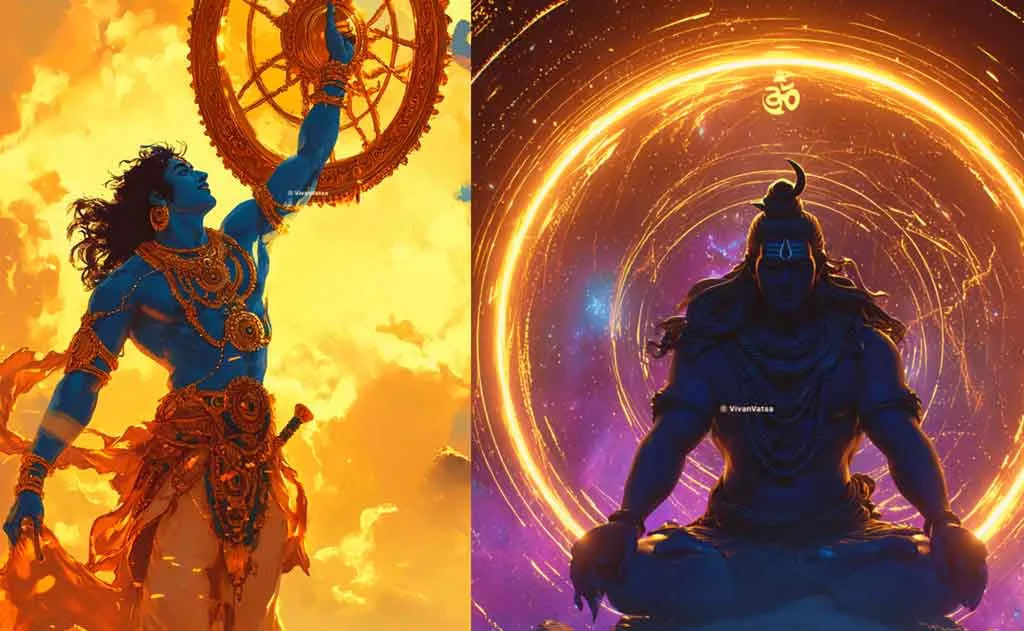
Hinduism and Science: Vedanta and Quantum Physics, Analogies Not Predictions
Vedanta and quantum physics are often compared. This guide sets out the best-known parallels as analogies, with the Upanishad passages, the science, the scholars who drew them and their critics.

Quick answer: The Upanishads and Vedanta ask what is ultimately real, how the self relates to the whole, and how perception shapes experience. Quantum physics asks how matter and light behave at the smallest scales. Several well-known physicists and writers have found the two thought-provoking side by side, and this article sets out those comparisons. They are analogies, not predictions: the texts speak about consciousness, dharma and liberation, not about electrons or experiments, and no scripture describes quantum mechanics.
Editor's note (12 November 2026): We rewrote this article. The earlier version said the rishis "knew quantum physics" and presented Vedantic ideas as scientific findings. It also attributed a Brihadaranyaka Upanishad passage to the Chandogya Upanishad, called the waking world a "dream" in the Mandukya Upanishad itself (the argument is Gaudapada's), and gave a quotation as "Vedanta & Quantum Physics" with no source. Those claims have been corrected or removed, in line with our editorial policy.
| Key fact | |
|---|---|
| What the texts are | Philosophical and spiritual works on Brahman, Atman and liberation (Upanishads, Gaudapada, Shankara) |
| What quantum physics is | A physical theory, developed from 1900 to the 1930s, tested by experiment |
| Best-known people who drew parallels | Erwin Schrödinger, Fritjof Capra, David Bohm |
| Best-known critics | Physicist Victor Stenger, philosopher of science Meera Nanda |
| Our framing | Analogies that can help reflection, not evidence for either side |
How to read these comparisons
The Rigveda says ekam sad viprā bahudhā vadanti, "truth is one; the wise call it by many names" (Rigveda 1.164.46). Many Hindus read that line as an invitation to look for common ground between traditions of inquiry, and comparing Vedanta with physics is one such exercise.
Three cautions apply throughout. First, words such as "observation", "field" or "wave" have exact technical meanings in physics that differ from their everyday or spiritual senses. Second, a resemblance in wording is not the same as a shared claim. Third, Hinduism's value does not depend on matching modern science; the Upanishads are read for their teaching on the self, not as physics textbooks.
1. Maya and the nature of the physical world
The tradition: In Advaita Vedanta, as taught by Shankara (traditionally dated to the 8th century CE), the world of many separate things is maya: not a simple illusion, but an appearance that is real in everyday experience (vyavaharika) while Brahman alone is real in the ultimate sense (paramarthika). The argument that the waking world is unreal in the same way as a dream is made by Gaudapada in the second chapter of his Mandukya Karika (the Vaitathya Prakarana), a commentary-poem on the Mandukya Upanishad; see Swami Nikhilananda's translation, The Mandukyopanishad with Gaudapada's Karika and Sankara's Commentary (Sri Ramakrishna Ashrama, Mysore).
The science: Einstein's 1905 relation E = mc² states that mass and energy are equivalent. In the double-slit experiment, electrons sent one at a time build up an interference pattern, a wave-like behaviour; this was shown with single electrons by Akira Tonomura's team at Hitachi in 1989.
The comparison and its limits: Some writers compare maya with the discovery that solid matter is, at bottom, energy and fields. The parallel is loose. Mass-energy equivalence says nothing about whether the world is an appearance of consciousness, and maya is a claim about knowledge and the self, not about particles.
2. Oneness and entanglement
The tradition: Aham brahmāsmi, "I am Brahman" (Brihadaranyaka Upanishad 1.4.10), and tat tvam asi, "you are that" (Chandogya Upanishad 6.8.7), are two of the "great sayings" (mahavakyas) that Advaita reads as teaching the identity of the self and Brahman. The peace invocation pūrṇam adaḥ pūrṇam idam (Brihadaranyaka Upanishad 5.1.1, also recited with the Isha Upanishad) says, in our plain paraphrase, that "that" is whole and "this" is whole, and that the whole remains whole. Standard English translations include F. Max Müller's in Sacred Books of the East, vols. 1 and 15 (1879, 1884), and Patrick Olivelle's Upaniṣads (Oxford World's Classics, 1996).
The science: In quantum entanglement, measurements on two particles that have interacted remain correlated however far apart they are. Einstein doubted this ("spooky action at a distance"). John Bell showed in 1964 how to test it, and experiments by John Clauser, Alain Aspect and Anton Zeilinger, recognised by the 2022 Nobel Prize in Physics, confirmed the quantum predictions. Entanglement does not let anyone send a message faster than light.
The comparison and its limits: Writers sometimes use entanglement to illustrate non-duality. But entanglement is a correlation between particle measurements, described by mathematics; it does not show that separate beings are one Self, and Advaita does not need it.
3. The "observer effect" and consciousness
The tradition: The Brihadaranyaka Upanishad (4.4.5) links desire, will, action and destiny. In Eknath Easwaran's widely read translation (The Upanishads, Nilgiri Press, 1987): "You are what your deep, driving desire is. As your desire is, so is your will. As your will is, so is your deed. As your deed is, so is your destiny." This is a teaching about karma and character. (Our earlier version wrongly gave it as the Chandogya Upanishad.)
The science: In quantum mechanics, a "measurement" is a physical interaction that leaves a definite record, for example in a detector. Whether a conscious observer plays any special role is a question of interpretation, and most working physicists do not think it does; see the Stanford Encyclopedia of Philosophy entry "Philosophical Issues in Quantum Theory" (Wayne Myrvold).
The comparison and its limits: Popular books often say "consciousness creates reality" and link this to Vedanta. That is one minority interpretation of quantum theory, not an established result, and the Upanishad passage above is about moral life, not about measurement.
4. Time, cycles and the dance of Shiva
The tradition: The Atharva Veda (19.53) has a hymn to Kala, Time, pictured as a horse with seven reins that carries all beings; see Ralph T. H. Griffith's translation, The Hymns of the Atharva Veda (1895–96). The Puranas describe time in vast repeating cycles of yugas and kalpas. Shiva as Nataraja dances the cosmos into being and dissolution.
The science: Modern cosmology describes a universe about 13.8 billion years old whose expansion is speeding up (age from the Planck Collaboration's 2018 results), a discovery recognised by the 2011 Nobel Prize in Physics. Cyclic or "bouncing" universe models exist but are speculative and not part of the standard model.
People who drew parallels: Carl Sagan, in Cosmos (1980), wrote that Hinduism "is the only religion in which the time scales correspond ... to those of modern scientific cosmology." Fritjof Capra, in The Tao of Physics (1975), wrote that "for the modern physicists, then, Shiva's dance is the dance of subatomic matter." A Nataraja statue given by the Government of India stands at CERN, the European physics laboratory near Geneva, with a plaque quoting Capra.
The limits: A match in the size of numbers is not a match in theory: the Puranic cycles are religious cosmology, and current science does not describe a universe that repeats in fixed cycles. Capra's image is a metaphor, and the CERN statue is a cultural gift, not a scientific endorsement.
5. "All this is pervaded": wholeness and fields
The tradition: The Isha Upanishad opens īśā vāsyam idaṃ sarvam, which Max Müller translates as "All this, whatsoever moves on earth, is to be hidden in the Lord (the Self)" (Sacred Books of the East, vol. 1, 1879). The verse goes on to teach enjoyment through renunciation and freedom from greed.
The science: In quantum field theory, particles are understood as excitations of underlying fields that fill space.
People who drew parallels: Physicist David Bohm, in Wholeness and the Implicate Order (1980), proposed that reality is an undivided whole and used the hologram as an illustration of how each region can carry information about the whole. Bohm held long dialogues with the Indian teacher J. Krishnamurti, published as The Ending of Time (1985).
The limits: Bohm's implicate order is his own interpretation, not mainstream physics, and the Isha verse is about seeing the divine in all things and living without greed.
What Schrödinger actually said
Erwin Schrödinger, one of the founders of quantum mechanics, read the Upanishads and wrote about them. In Mind and Matter (Cambridge University Press, 1958) he argued for the unity of consciousness: "There is obviously only one alternative, namely the unification of minds or consciousnesses. Their multiplicity is only apparent, in truth there is only one mind." He identified this view with the teaching of the Upanishads. His biographer Walter Moore (Schrödinger: Life and Thought, Cambridge University Press, 1989) describes his lifelong interest in Vedanta.
Schrödinger presented this as his personal philosophy of mind, not as something that follows from his physics. He did not claim that the Upanishads contain quantum mechanics.
What critics say
- Victor J. Stenger, a particle physicist, argued in The Unconscious Quantum (Prometheus Books, 1995) that "quantum mysticism", including Capra's parallels, misreads the physics: nothing in quantum mechanics requires consciousness or supports a cosmic mind.
- Meera Nanda, a philosopher and historian of science, argues in Prophets Facing Backward (Rutgers University Press, 2003) and Science in Saffron (Three Essays Collective, 2016) that claims that the Vedas anticipated modern science distort both the science and the tradition.
- Physicists also note a general point: the equations of quantum mechanics make the same predictions under many different philosophical interpretations, so no single spiritual reading can be "proved" by them.
Why the comparisons still interest people
For many readers, the parallels are a doorway rather than a proof. They show that questions the Upanishads raised, about what is real, what the self is and how knowing works, are still alive. Thinkers such as Schrödinger found Vedanta helpful in thinking about consciousness, while critics remind us to keep science and scripture each in its own domain. Both views can be held with respect.
Sources
- Rigveda 1.164.46; Brihadaranyaka Upanishad 1.4.10, 4.4.5, 5.1.1; Chandogya Upanishad 6.8.7; Isha Upanishad 1. Translations: F. Max Müller, Sacred Books of the East, vols. 1 and 15 (Oxford, 1879, 1884); Patrick Olivelle, Upaniṣads (Oxford World's Classics, 1996); Eknath Easwaran, The Upanishads (Nilgiri Press, 1987).
- Gaudapada, Mandukya Karika, ch. 2, tr. Swami Nikhilananda (Sri Ramakrishna Ashrama, Mysore).
- Atharva Veda 19.53, tr. Ralph T. H. Griffith, The Hymns of the Atharva Veda (1895–96).
- A. Tonomura et al., "Demonstration of single-electron buildup of an interference pattern", American Journal of Physics 57 (1989).
- The Nobel Prize in Physics 2022 (Aspect, Clauser, Zeilinger) and 2011 (Perlmutter, Schmidt, Riess), nobelprize.org.
- Wayne Myrvold, "Philosophical Issues in Quantum Theory", Stanford Encyclopedia of Philosophy.
- Erwin Schrödinger, Mind and Matter (Cambridge University Press, 1958); Walter Moore, Schrödinger: Life and Thought (Cambridge University Press, 1989).
- Fritjof Capra, The Tao of Physics (1975); Carl Sagan, Cosmos (1980); David Bohm, Wholeness and the Implicate Order (1980); J. Krishnamurti and David Bohm, The Ending of Time (1985); CERN, Nataraja statue.
- Victor J. Stenger, The Unconscious Quantum (Prometheus Books, 1995); Meera Nanda, Prophets Facing Backward (Rutgers University Press, 2003) and Science in Saffron (Three Essays Collective, 2016).
Updated 12 November 2026: rewritten as a set of analogies with named translations, scientific sources, and the views of both the scholars who draw these parallels and their critics; the claim that the rishis "knew quantum physics" was withdrawn, and a misattributed Upanishad passage and an unsourced quotation were corrected or removed.
Related guides
- AI, quantum physics and the Vedas: analogies, not predictions
- Quantum computing explained for Hindus: Vedanta analogies
- The "NASA Sanskrit computers" myth
- What is Advaita Vedanta? A beginner's guide
- Mandukya Upanishad
- Advaita, Vishishtadvaita and Dvaita compared
Frequently Asked Questions
Did ancient Hindu texts predict quantum physics?
No. The Upanishads and Vedanta discuss consciousness, the self and ultimate reality. Quantum physics is a 20th-century physical theory built on experiments. Some physicists and writers have found the two interesting to compare, but the texts do not describe quantum mechanics.
Which scientists were interested in Vedanta?
Erwin Schrödinger wrote about the Upanishads in Mind and Matter (1958), and David Bohm held dialogues with J. Krishnamurti. Fritjof Capra's The Tao of Physics (1975) popularised parallels between Eastern thought, including Hinduism, and physics.
Is maya the same as the quantum view of matter?
No. Maya in Advaita Vedanta concerns the relation between the everyday world and Brahman. Physics says mass and energy are equivalent and that particles show wave-like behaviour. The comparison is an analogy only.
Does the observer effect prove that consciousness creates reality?
No. In physics a "measurement" is a physical interaction recorded by an instrument. The view that consciousness plays a special role is one minority interpretation, not an established result.
Why is there a Nataraja statue at CERN?
The Government of India gave it to CERN, the European physics laboratory near Geneva. Its plaque quotes Fritjof Capra's comparison of Shiva's dance with the dance of subatomic matter. It is a cultural gift and a metaphor, not a scientific finding.
What do critics say about these parallels?
Physicist Victor Stenger argued that "quantum mysticism" misreads the physics, and Meera Nanda argues that claims of Vedic science distort both science and tradition. Others value the comparisons as a way into reflection while keeping science and scripture distinct.
Share this with family and friends
Send it on WhatsApp, post it, or copy the link.
More on Vedanta and Advaita
- Dvaita Philosophy Explained: Madhvacharya's Vedanta of Difference
- Vishishtadvaita Explained: Ramanuja's Philosophy of Qualified Non-Dualism
- Brahman, Atman and Maya in Plain Words
- Madhvacharya: Life, Dvaita Philosophy and the Udupi Tradition
- Advaita, Vishishtadvaita and Dvaita Explained: The Three Great Schools of Vedanta Compared
- Love vs Attachment: What the Ramayana, the Bhagavata and Vedanta Teach About Selfless Love
More from Hinduism
- Why Sanatan Dharma Is Called Eternal: Meaning, Rishis & Continuity
- Seva in Hinduism: Meaning, Types, Spiritual Significance and How to Practise Selfless Service
- What Is Prana? Understanding the Five Pranas in Hindu Philosophy
- Panchakosha Explained: The Five Sheaths of Human Existence in Hindu Philosophy
- Conversion to Hinduism: Traditions, Ceremonies and the Law
You might also like

Adi Shankaracharya's Teachings: Key Lessons of Advaita Vedanta
What Makes Sanatana Dharma Unique Among World Religions
Quantum Computing Explained for Hindus: Qubits, Superposition and Entanglement, with Vedanta Analogies (Not Equivalences)