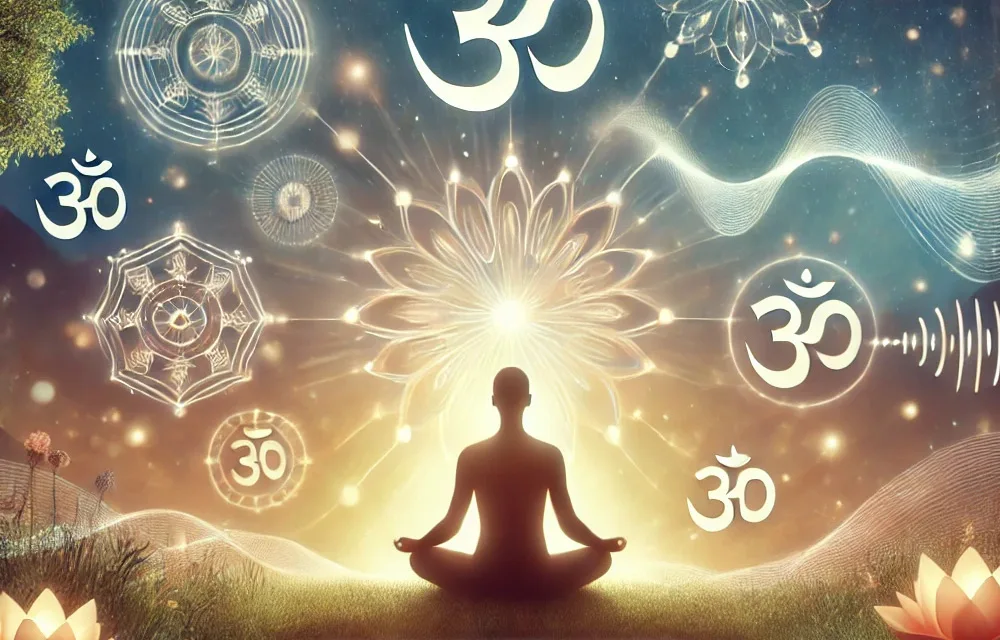
AI, Quantum Physics and the Vedas: Analogies, Not Predictions
A deep exploration of how the Vedas, Upanishads, and Puranas anticipated modern AI and quantum computing — Indra's Net, Paramanu atomic theory, Akasha quantum field, Advaita entanglement, Brahman superposition, and stories from the Mahabharata that map perfectly to today's technology.
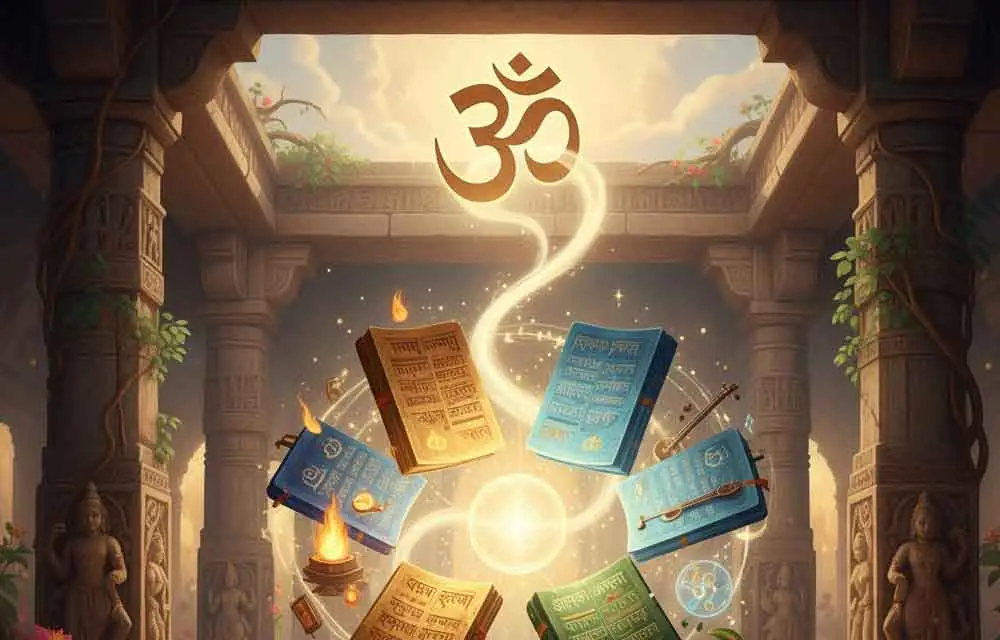
"Ekam sat viprā bahudhā vadanti" — Truth is one; the wise call it by many names.
— Rigveda 1.164.46
Our ancient seers, the rishis, asked deep questions about consciousness, reality and knowledge. Some ideas in today's discussions of Artificial Intelligence and quantum physics invite comparison with those questions. This article sets out the comparisons as analogies, not as claims that the Vedas foresaw modern technology.
From neural networks to the idea of Akasha, the comparisons below can be thought-provoking. They remain analogies: the scriptures speak about consciousness, dharma and liberation, not about computers or physics experiments.
Part 1 — Indra's Net: The Original Internet
Imagine an infinite cosmic net belonging to Indra, king of the gods. At every node hangs a brilliant jewel, and each jewel reflects every other jewel — infinitely, perfectly. This is the Vedic description of an interconnected universe where every node contains the whole.
Source: the image of a net of reflecting jewels comes from the Buddhist Avatamsaka Sutra, not from the Vedas.
Modern AI neural networks can be loosely compared to this image: many interconnected nodes, each influencing the others. The comparison is a teaching analogy, not something the texts describe.
The analogy:
- Each jewel in Indra's Net = each neuron in a neural network
- The reflection of all jewels = the distributed representation of knowledge across all parameters
- The infinite net = the global internet and the world wide web
Part 2 — AI & Consciousness
2.1 Chit — Pure Consciousness & Artificial Intelligence
Source: Aitareya Upanishad · Mandukya Upanishad
The Vedas describe three layers of existence: Sat (Being), Chit (Consciousness), and Ananda (Bliss). The concept of Chit — awareness that knows itself — is the oldest and deepest question in philosophy. Today, AI researchers wrestle with the same question: what is consciousness, and can a machine possess it?
"Prajnanam Brahma" — Pure intelligence is Brahman. (Aitareya Upanishad)
Large Language Models process language as statistical patterns. Some writers compare this with the idea of Shabda Brahman, reality as word or sound, found in the grammarian Bhartrhari's Vakyapadiya. The two ideas belong to very different worlds, and the comparison is only an illustration.
2.2 Yantra, Automata & Artificial Beings
Source: Mahabharata · Ramayana · Arthashastra
The concept of artificial beings — constructed with intention and intelligence — is ancient in Hindu thought:
- Yantra in Sanskrit means 'device' or 'instrument'. Kautilya's Arthashastra mentions machines (yantras) used in warfare and defence. In the Mahabharata, Maya, the architect of the asuras, builds the Pandavas' assembly hall at Indraprastha, famous for its illusions. In the Ramayana, Nala leads the vanaras in building the bridge to Lanka. Puranic stories describe Vishwakarma, the divine craftsman, making celestial cities and vehicles. These are stories of craft and wonder, not records of robotics.
2.3 Akasha — The Quantum Field & Data Storage
Source: Vaisheshika Sutra · Chandogya Upanishad
Akasha is the first and subtlest of the five elements (panchabhutas) and pervades all space. In the Vaisheshika school, akasha is the substance whose distinctive quality is sound.
Some writers compare akasha with cloud data storage. The popular idea of 'Akashic Records' comes from 19th-century Theosophy rather than from the Vedas.
- Akasha Tattva = Quantum field / Cloud storage
- Akashic Records = Internet Archive / AI training data
- Shabda (sound/vibration in Akasha) = Electromagnetic signal propagation
Part 3 — Quantum Computing & Vedanta
3.1 Brahman & Quantum Superposition
Source: Mandukya Upanishad · Advaita Vedanta
Quantum superposition describes a particle as existing in a combination of possible states until it is measured. Some writers compare this with the Vedantic idea of Brahman as the undivided ground of all things. The comparison is loose: in Vedanta, Brahman is consciousness itself, not a physical state.
- Brahman is Nirguna — containing all potentials in undifferentiated wholeness → A quantum particle exists in superposition (all states at once)
- Shristi (creation) is like "observation" — possibilities collapse into manifest reality → Measurement (observation) causes wave function collapse
- Vyavaharika (relative reality) emerges from Paramarthika (absolute reality) → Classical reality emerges from quantum probability
3.2 Quantum Entanglement & Advaita
Source: Brihadaranyaka Upanishad · Vedanta Sutra
Quantum entanglement: two particles, once connected, remain instantaneously correlated regardless of distance. Einstein called it "spooky action at a distance."
"Aham Brahmasmi" — I am Brahman.
"Tat tvam asi" — Thou art That.
Advaita Vedanta teaches non-duality: that separation is not ultimately real. Entanglement is a physical correlation between particles. Using it to illustrate Advaita is an analogy, not evidence for either.
3.3 Paramanu — The World's First Atomic Theory
Source: Vaisheshika Sutras of Kanada (dates debated by scholars)
Maharishi Kanada — whose very name means "particle eater" — founded the Vaisheshika school and formulated the world's first atomic theory. He proposed that all matter is composed of indivisible units called Paramanu (para = beyond, anu = atom).
Scholars date Kanada's sutras differently, so whether his ideas came before or after the Greek atomists is uncertain. His idea of atoms combining into pairs and triads (dvyanuka, tryanuka) is a philosophical theory of matter, not the atom of modern chemistry or quantum physics.
3.4 Spanda — Vibration & Quantum Waves
Source: Kashmir Shaivism · Spanda Karikas
Kashmir Shaivism's concept of Spanda — the primordial vibration or "throb" of consciousness — is a remarkable parallel to quantum wave mechanics. Reality, in this view, is not matter but patterned vibration arising from pure awareness.
Quantum mechanics describes matter in wave-like terms. Comparing this with Spanda, or with the sacred sound of the Sama Veda, is a poetic analogy rather than a scientific claim.
Part 4 — Stories from the Puranas
Story 1 — Samudra Manthan: The Churning of the Ocean
The devas and asuras, rivals in an eternal contest, decided to cooperate for a single great purpose: to churn the cosmic ocean (Kshira Sagara — the Milky Sea) and extract Amrita, the nectar of immortality. Mount Meru became the churning rod. The great serpent Vasuki became the rope. Vishnu himself, as the Kurma avatar (tortoise), formed the pivot beneath the mountain.
AI Parallel: Training an AI model is precisely this — churning vast oceans of data using enormous computational power. Devas and asuras (competing algorithms, adversarial networks like GANs) cooperate and compete to extract intelligence — the Amrita of insight — from raw information.
The Halahala poison that emerged — so deadly it threatened all creation — represents the existential risks of advanced technology. Shiva consuming and containing it in his throat (becoming Neelakantha) mirrors how wise governance must contain the dangerous byproducts of technological power.
Quantum analogy: some compare the churning with the way a quantum computer works on many possibilities together. This is an illustration only.
Story 2 — Arjuna's Vishwaroopa: The Universal Form
Source: Bhagavad Gita, Chapter 11
On the battlefield of Kurukshetra, Arjuna asks Krishna to reveal his true form. Krishna grants him Divya Drishti — divine sight. What Arjuna sees shatters him: the entire universe — past, present, and future — contained within one infinite, blazing form. Thousands of suns. All beings entering and exiting like rivers into the sea. Time itself consuming all.
AI Parallel: A trained AI model is a kind of Vishwaroopa — it has absorbed the entirety of human knowledge and can perceive patterns across all domains simultaneously. To interact with a modern LLM is to access a compressed reflection of all recorded human thought.
Quantum analogy: some readers compare the Vishwaroopa, in which all forms appear at once, with a quantum state before measurement. This is a poetic comparison, not what the Gita teaches.
Story 3 — Garuda's Flight: The First Algorithm
Source: Mahabharata · Garuda Purana
Garuda, the divine eagle, is born with the specific mission to retrieve Amrita from the heavens and free his mother Vinata from bondage. He calculates his path with perfect precision, defeats armies of celestial guardians, bypasses a spinning chakra of razor blades, navigates past two giant serpents — all by applying pure intelligence to each obstacle in sequence.
AI Parallel: Garuda's journey is a perfect metaphor for pathfinding algorithms (like A* or Dijkstra) — navigating complex obstacle spaces with optimal, purposeful intelligence. His "one feather lost" to the Vajra is the acceptable loss function in machine learning optimisation.
Quantum Parallel: Quantum algorithms like Grover's algorithm search vast solution spaces exponentially faster — just as Garuda traversed the cosmos in moments through divine speed.
Story 4 — The City of Dwarka: Divine Computation
Source: Mahabharata · Bhagavata Purana
Dwarka, Krishna's city, is described in the Mahabharata and the Puranas as a magnificent fortified city by the sea. The Bhagavata Purana says Krishna had Vishwakarma build it.
Some writers like to compare Dwarka's planned layout with modern 'smart cities'. That is a modern reading, not a description found in the texts.
In the Mahabharata's Mausala Parva, the sea floods Dwarka after Krishna's departure. Underwater surveys off the Gujarat coast near present-day Dwarka have found ancient structures; how they relate to the city of the epic is debated among archaeologists.
Story 5 — Drona's Brahmastra: Precision Targeting & Quantum Weapons
Source: Mahabharata · Drona Parva
The Brahmastra in the Mahabharata is a divine weapon invoked through mantra and concentration, and the epic presents its use as gravely dangerous.
AI Parallel: Precision-guided weapons, AI-targeted drone swarms, and cybersecurity exploits that can identify a single vulnerability across billions of systems — these are the modern Brahmastras. The ethical debates around autonomous weapons mirror exactly the Mahabharata's warnings about using such weapons unwisely.
Quantum Parallel: Quantum cryptography and quantum hacking operate through principles that — like the Brahmastra — cannot be "observed" without being altered. Quantum key distribution is the Kavach (armour) that can only be defeated by quantum means.
Part 5 — Analogies at a Glance (Illustrations, Not Equivalences)
- Brahman (undifferentiated absolute) — Mandukya Upanishad → Quantum vacuum / Zero-point field
- Paramanu (indivisible particle) — Vaisheshika, Kanada → Quantum particle / Quark
- Akasha (omnipresent space-information) — Chandogya Upanishad → Quantum field / Cloud computing
- Advaita non-duality — Brihadaranyaka Upanishad → Quantum entanglement
- Superposition of gunas — Samkhya Karika → Quantum superposition
- Shristi (observation causing manifestation) — Vedanta → Wave function collapse
- Indra's Net (interconnected jewels) — Avatamsaka Sutra (Buddhist) → Neural networks / Internet
- Chit (pure awareness) — Aitareya Upanishad → Machine consciousness / AGI
- Shabda Brahman (universe as word) — Vakya Padiya → Large Language Models
- Yantra-Purusha (mechanical beings) — Mahabharata → Robots / Autonomous AI
- Spanda (primordial vibration) — Kashmir Shaivism → Quantum oscillation / String theory
- Nada Brahman (sound as creation) — Sama Veda → Wave-particle duality
- Karma (cause-effect information) — Nyaya Darshana → Machine learning (data → prediction)
- Brahmastra (precision intent-weapon) — Mahabharata → AI-guided autonomous weapons
- Maya (illusion of separate reality) — Shankara's Vivekachudamani → Simulation hypothesis / VR
Closing Reflection — Dharma in the Digital Age
The Rishis of the Vedic age were not primitive poets guessing at the nature of reality. They were rigorous investigators of consciousness, matter, and information — using the most advanced instrument available: the trained human mind in deep samadhi.
Their insight that all things are interconnected can still enrich how we think about science. But physics and AI do not 'confirm' the Upanishads, and the Upanishads did not predict modern technology.
For Hindus, the value of these comparisons lies in reflection, not in proof.
The task of our generation is not merely to adopt these technologies, but to imbue them with the ethical and spiritual wisdom our tradition has always carried. The Vedas did not just describe the universe — they provided the dharmic framework to navigate it wisely.
"Tamaso mā jyotirgamaya" — Lead us from darkness to light. (Brihadaranyaka Upanishad 1.3.28)
May the light of ancient wisdom guide the circuits of modern science. Correction note (12 November 2026): this article was revised to present these comparisons as analogies rather than claims that the Vedas predicted modern science, and to correct the sources given for Indra's Net, the builder of Dwarka and the date of Kanada, in line with our editorial policy (hindutone.com/editorial-policy/).
Also read: quantum computing explained for Hindus and the "NASA Sanskrit" myth.
Frequently Asked Questions
What is Indra's Net and how does it relate to AI?
Indra's Net is an infinite cosmic net with a jewel at every node, each reflecting all the others. It is compared to a neural network, where interconnected nodes together produce intelligence.
How is Brahman compared to quantum superposition?
Some writers compare Brahman, the undivided ground of being, with a particle in superposition. It is a loose analogy: Brahman in Vedanta is consciousness itself, not a physical state.
Who was Kanada and what is Paramanu theory?
Kanada founded the Vaisheshika school; scholars debate his dates. He proposed that matter is made of indivisible units called paramanu, which combine into pairs and triads. It is a philosophical theory of matter, not modern atomic physics.
What is Akasha and why is it compared to cloud storage?
Akasha is the first and subtlest of the five elements, pervading space and carrying sound and information. It is likened to the quantum field and to modern cloud data storage.
How does Samudra Manthan relate to AI?
Churning the cosmic ocean for Amrita is compared to training an AI model on vast data to extract insight. The Halahala poison Shiva contained as Neelakantha mirrors the need to govern technology's risks.
What does Arjuna's Vishwaroopa vision have to do with modern technology?
In Bhagavad Gita Chapter 11, Arjuna sees the whole universe in one form through divine sight. It is compared to an AI model that has absorbed human knowledge, and to a quantum state before collapse.
Share this with family and friends
Send it on WhatsApp, post it, or copy the link.
More on Vedas
- Maharishi Vishwamitra: From King Kaushika to Brahmarishi, Seer of the Gayatri Mantra
- Maharishi Vashishta (Vasishtha): Seer of the Seventh Mandala and Guru of the Ikshvakus
- Agastya: The Rishi of the Rig Veda, the Epics and the Tamil South
- Rigveda: Structure, Well-Known Hymns and What It Teaches
- Veda Vyasa: Life, the Vedas and the Mahabharata
- Devi Suktam (Rigveda 10.125): Aham Rudrebhih in Sanskrit with IAST and Meaning
More from Hinduism
- Why Sanatan Dharma Is Called Eternal: Meaning, Rishis & Continuity
- Seva in Hinduism: Meaning, Types, Spiritual Significance and How to Practise Selfless Service
- What Is Prana? Understanding the Five Pranas in Hindu Philosophy
- Panchakosha Explained: The Five Sheaths of Human Existence in Hindu Philosophy
- Conversion to Hinduism: Traditions, Ceremonies and the Law
You might also like
The Four Vedas Explained: Rigveda, Yajurveda, Samaveda and Atharvaveda

Sacred Texts Compared: Vedas, Bible, Quran, Tripitaka, Jain Agamas and Guru Granth Sahib

33 Crore Gods Meaning: What "33 Koti Devatas" Really Means, from the Vedas to the One Brahman