Robotic Elephants and AI in Hindu Temples: Kerala's Mechanical Tuskers, Tirumala's AI Command Centre and the Debate
In February 2023 a Kerala temple dedicated an 800 kg mechanical elephant instead of hiring a live one. Since then robotic tuskers have spread across south India, while Tirumala has built an AI command centre linking more than 6,000 cameras. Here is what is documented, what is myth, and why devotees disagree.
In February 2023 a Kerala temple dedicated an 800 kg mechanical elephant instead of hiring a live one. Since then robotic tuskers have spread across south India, while Tirumala has built an AI command centre linking more than 6,000 cameras.
Quick answer: Kerala's first robotic temple elephant, Irinjadappilly Raman, was dedicated near Thrissur on 26 February 2023. By 24 June 2026 PETA India had donated 28 mechanical elephants across India, and AP counts about 40 from all nonprofits. They are motorised figures, not AI. The real AI in Hindu temples is behind the scenes: Tirumala's facial recognition and its AI command centre with more than 6,000 cameras (opened 25 September 2025), plus AI cameras at the Maha Kumbh and Ayodhya. Opinion is divided between animal welfare and safety on one side and the sacred role of the living elephant on the other.
Here is a surprising true fact to begin with: one of the most talked-about elephants in Kerala's temple world has no heartbeat. It weighs about 800 kg, stands roughly ten feet tall, and was formally welcomed into a temple with the same Nadayiruthal (dedication) ceremony once reserved for living tuskers. Its name is Raman, and since its arrival a quiet technological shift has been spreading through Hindu temples, from mechanical elephants in Kerala to AI cameras in Tirumala's queue complexes.
This guide sticks to what is documented. Every fact, number and quote comes from a named news report or official source, linked in place. We separate three things: (1) documented history, (2) the real debate among devotees, priests and owners, and (3) the myths that tend to grow around the words robot and AI.
Irinjadappilly Raman: Kerala's first robotic temple elephant
On 26 February 2023, the Irinjadappilly Sree Krishna Temple near Thrissur dedicated a life-size mechanical elephant. PETA India donated it, with support from actor Parvathy Thiruvothu, who took part in the Nadayiruthal ceremony. The temple had already decided never to own or hire live elephants. Head priest Rajkumar Namboothiri said the temple was 'extremely happy and grateful' and hoped other shrines would consider replacing live elephants in rituals (Source: The News Minute, 27 February 2023).
How big is Raman? Kerala Kaumudi reported a height of ten feet, a weight of 800 kg and a construction cost of Rs 5 lakh (Source: Kerala Kaumudi). Other outlets give 10.5 ft or 11 ft (3.3 m), so the exact height varies by source. The Associated Press later put the cost of such robotic elephants at about US$6,000 each, and reported that builder Prakashan's crew takes about 15 days to make one (Source: Associated Press via WTOP, 3 July 2026).
From one to dozens: how the robotic elephants spread
Raman was not the last. On 17 March 2024, actor Priyamani and PETA India gave a second Kerala robotic elephant, Mahadevan, to the Thrikkayil Mahadeva Temple in Kochi. PETA India describes it as about three metres tall and 800 kg, donated because the temple had decided never to own or hire live elephants (Source: PETA India, 17 March 2024).
On 14 September 2025, cricketer KL Rahul and PETA India donated Padmanabhapuram Padmanabhan to Sree Padmanabhapuram Mahavishnu Kheeram, a Vishnu temple near Guruvayur. It was PETA India's 13th mechanical temple elephant and its eighth in Kerala. The temple committee president urged other temples to adopt mechanical elephants 'for the safety of devotees and the animals' (Source: The Tribune, 14 September 2025).
By 24 June 2026, PETA India counted 28 donations across India, nine of them in Karnataka. The 28th, Neela Prabha, went to Shri Chayadevi Shri Shanaishwara Swamy Kshetra in Bengaluru with actor Richa Chadha and the group CUPA (Source: PETA India, 24 June 2026).
| Date | Elephant | Temple / place | Milestone |
|---|---|---|---|
| 26 Feb 2023 | Irinjadappilly Raman | Irinjadappilly Sree Krishna Temple, near Thrissur | Kerala's first |
| 17 Mar 2024 | Mahadevan | Thrikkayil Mahadeva Temple, Kochi | Second in Kerala (PTI) |
| Mar 2025 | Devi Dasan | Thiruvananthapuram | PETA India's 10th |
| 14 Sep 2025 | Padmanabhapuram Padmanabhan | Sree Padmanabhapuram Mahavishnu Kheeram, near Guruvayur | PETA's 13th, 8th in Kerala |
| Dec 2025 | Mahanandi | Ujjaini Peetha, Kottur, Karnataka | PETA's 17th |
| 24 Jun 2026 | Neela Prabha | Shri Chayadevi Shri Shanaishwara Swamy Kshetra, Bengaluru | PETA's 28th |
The milestones for the 10th and 17th elephants also come from PETA India's June 2026 count; it reported the 25th by April 2026.
How a robotic elephant actually works
The word robot makes many people imagine a thinking machine. The reality is more down to earth, and still impressive. The Tribune describes Padmanabhan as about 3 m tall and 800 kg, built from rubber, fibre, metal, mesh, foam and steel, and moved by five motors (Source: The Tribune). In other words, it is an engineered, motorised figure that can carry the ritual role of a temple elephant without an animal underneath. No source describes it learning or making decisions.
The debate: animal welfare, tradition and safety
Robotic elephants have split opinion, and each side has sincere reasons. AP's July 2026 report gives both voices (Source: Associated Press via WTOP):
- Animal welfare: Irinjadappilly head priest Rajkumar Namboothiri told AP: 'Elephants are tortured and abused. It's not right.' AP reports that Kerala has nearly 400 captive elephants left.
- Safety of devotees: the Guruvayur-area temple committee president urged other temples to adopt mechanical elephants 'for the safety of devotees and the animals' (The Tribune).
- Tradition and meaning: elephant owner K. Mahesh asked: 'If you don't believe elephants are sacred, what's the point of a robotic elephant in a temple?' For many traditionalists, the living elephant is itself part of the worship, not a prop.
A fair reading is that both sides care about the sacred. One side sees cruelty to a sacred animal as incompatible with worship; the other sees the living elephant's presence as something no machine can stand in for. Temples that have adopted mechanical elephants made a choice for their own community; they do not speak for every temple, and the decision rests with each temple and its devotees.
Tirumala and TTD: AI for crowds, not for rituals
Tirumala Tirupati Devasthanams (TTD) is where the genuinely AI-based technology appears, and it is used for crowd management and fairness, not for worship itself.
- 1 March 2023: TTD began trialling facial recognition technology at Vaikuntam 2 and in its accommodation system, to stop people collecting multiple free Sarva Darshan tokens, prevent misuse at caution-deposit refund counters and make sure subsidised rooms go to genuine devotees (Source: Gulf News).
- March 2025: TTD said Google had offered free AI services for queue management, accommodation and multilingual guidance, with an MoU expected 'within a week to ten days'. These reports did not confirm that the MoU was actually signed (Source: ETV Bharat).
- May 2025: TTD Executive Officer J. Syamala Rao announced plans to compare each pilgrim's face against about 30 days of records (roughly 10 lakh images) to catch duplicate bookings, and to use cameras to count pilgrims, estimate waiting times and spot intruders (Source: The Week (PTI)).
- 25 September 2025: Chief Minister N. Chandrababu Naidu opened an AI-powered Integrated Command Control Centre at Vaikuntham Queue Complex-I. TTD called it India's first AI command hub for a pilgrimage. It links more than 6,000 AI cameras and offers crowd prediction, 3D congestion maps and facial recognition to find missing persons; NRIs funded it on a pro bono basis (Source: Sakshi Post).
For pilgrims, this mostly means better waiting-time estimates and fewer touts. Planning a visit? See our Tirumala Venkateswara Temple guide and check TTD's official website for current darshan arrangements.
Other temple and pilgrimage tech in India
- Maha Kumbh 2025: a multilingual chatbot, Kumbh Sah'AI'yak, launched on 13 December 2024 in 11 languages (Source: The Week (PTI)). About 2,750 CCTV cameras watched the grounds, about 250 of them AI-enabled (Source: The Federal (PTI)).
- Ayodhya, January 2024: police used AI-based CCTV and AI-equipped drones for the Ram Mandir consecration; 10,000 CCTV cameras were installed across the district, some with AI (Source: Siasat Daily (PTI)).
- Sabarimala: darshan runs on an online virtual-queue system capped at 70,000 devotees a day for 2025-26, but the sources describe it as digital slot booking, not AI (Source: ETV Bharat). See our Sabarimala 2026-27 season guide.
Myth vs fact
| Myth | What the evidence says |
|---|---|
| Kerala's robot elephants are artificial intelligence. | They are motorised mechanical figures moved by five motors, with no learning or autonomous decisions reported (The Tribune). |
| Every temple robot elephant comes from PETA India. | PETA India is the biggest donor (28 by June 2026), but AP reports about 40 from 'PETA and other nonprofits'; eWeek has also reported two temples in Cherthala, Kerala, receiving robotic elephants sponsored by the Voices for Asian Elephants Society. |
| AI surveillance made the 2025 Maha Kumbh crowd-proof. | Only about 250 of roughly 2,750 cameras were AI-enabled, and a stampede on 29 January 2025 killed at least 30 people. Officials said thresholds would be revised (The Federal). |
| Robots are replacing temple priests. | No report was found of a temple replacing its priests with a robot. See our companion piece on robot aarti. |
The Kumbh lesson matters: the command centre's in-charge said 'we never expected [the crowd] to be this big' (Source: The Federal (PTI)). AI cameras are a tool, and they work only as well as the human planning around them.
Why this matters for NRI devotees
Many temples abroad already use online booking and livestreams, so the questions in this guide are not only Indian ones. If your community temple ever discusses a mechanical elephant for a procession or AI tools for crowd control, the Kerala and Tirumala experience offers useful precedents: talk openly with devotees, be clear about what the technology is (and is not), and respect those who feel the living tradition matters. Our companion pieces look at whether a robot can perform puja and at AI Gita chatbots.
Frequently asked questions
Which was Kerala's first robotic temple elephant?
Irinjadappilly Raman, dedicated at the Irinjadappilly Sree Krishna Temple near Thrissur on 26 February 2023. PETA India donated it with support from actor Parvathy Thiruvothu, and the temple had decided never to own or hire live elephants (The News Minute).
Are the robot elephants artificial intelligence?
No. They are motorised mechanical figures. The Tribune describes a body of rubber, fibre, metal, mesh, foam and steel that moves on five motors. No source describes any learning or autonomous decision-making.
How many robotic elephants are there in Indian temples?
PETA India counted 28 donations by 24 June 2026, nine of them in Karnataka. The Associated Press puts the total from PETA and other nonprofits at about 40.
How much does a robotic elephant weigh and cost?
Irinjadappilly Raman weighs about 800 kg. Kerala Kaumudi reported a building cost of Rs 5 lakh, and AP later put the cost of such elephants at about US$6,000 each. Reported heights vary from about 10 to 11 feet.
Does Tirumala use AI?
Yes, for crowd management and security rather than ritual. TTD trialled facial recognition from 1 March 2023, and on 25 September 2025 an AI-powered Integrated Command Control Centre linking more than 6,000 AI cameras opened at the Vaikuntham Queue Complex-I (Gulf News; Sakshi Post).
Why do some people oppose robotic elephants?
Some elephant owners and traditionalists see the living elephant as sacred. Owner K. Mahesh told AP: 'If you don't believe elephants are sacred, what's the point of a robotic elephant in a temple?' Supporters point to animal welfare and the safety of devotees.
Related guides
- Can a robot perform puja? Robot aarti and the Hindu debate
- AI Gita chatbots: GitaGPT, accuracy and ethics
- AI and the Sanskrit revival in 2026
- The NASA-Sanskrit computers myth
- Tirumala Venkateswara Temple
- Sabarimala Mandalam-Makaravilakku 2026-27 season guide
Editor's note (9 October 2026)
Every fact, figure and quote on this page comes from the news reports and official sources linked in the text, including The News Minute, Kerala Kaumudi, PETA India, The Tribune, the Associated Press, Gulf News, The Week (PTI), ETV Bharat, Sakshi Post, The Federal and Siasat Daily, as checked on 9 October 2026. Where sources differ (for example on Raman's height or the Google-TTD MoU), we say so. We will update this page as new temples adopt or decline the technology.
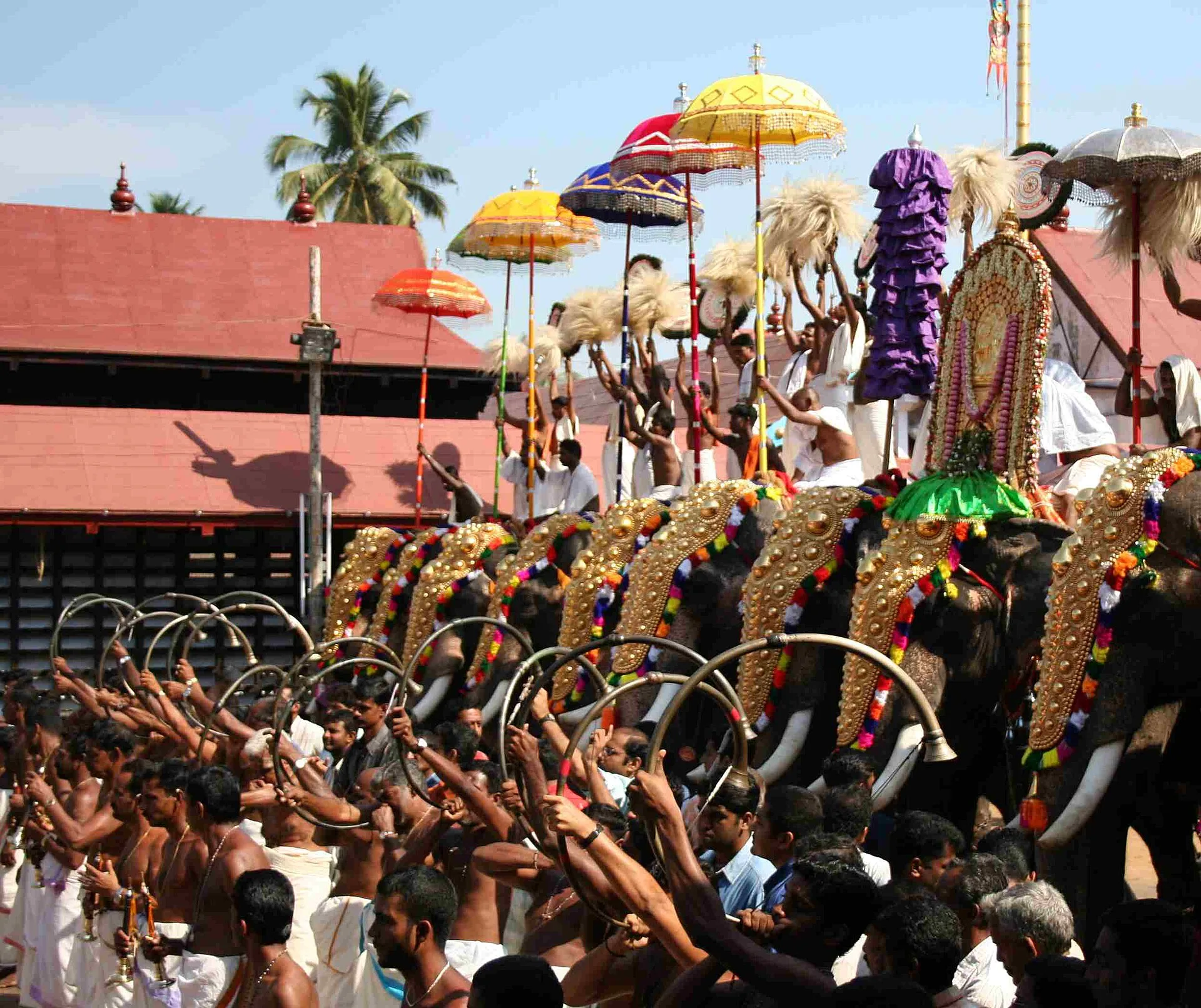
Image credit: Rajesh Kakkanatt, CC BY-SA 3.0, via Wikimedia Commons (https://commons.wikimedia.org/wiki/File:Thrippunithura-Elephants-Panchavadyam-1_crop.jpg).
You might also like
Madhava of Sangamagrama and the Kerala School: The Infinite Series for Pi, Sine and Arctangent, Worked Out Step by Step

AI and the Sanskrit Revival in 2026: Language Models, Manuscript OCR, Translation Tools and What AI Still Gets Wrong

Can a Robot Perform Puja? Robot Aarti, AI in Rituals and What Hindu Tradition Says