
Vedic Mathematics: Myth vs Fact. Bharati Krishna Tirtha's 16 Sutras, Where They Come From, and What Still Works
The 16 sutras of 'Vedic Mathematics' are fun, fast and genuinely useful for some mental arithmetic. But are they from the Vedas? The book's own editor said they are not found in known Vedic texts. Here is the history of Bharati Krishna Tirtha's 1965 book, three worked tricks, the scholarly verdict and the authentic Indian mathematics worth celebrating instead.
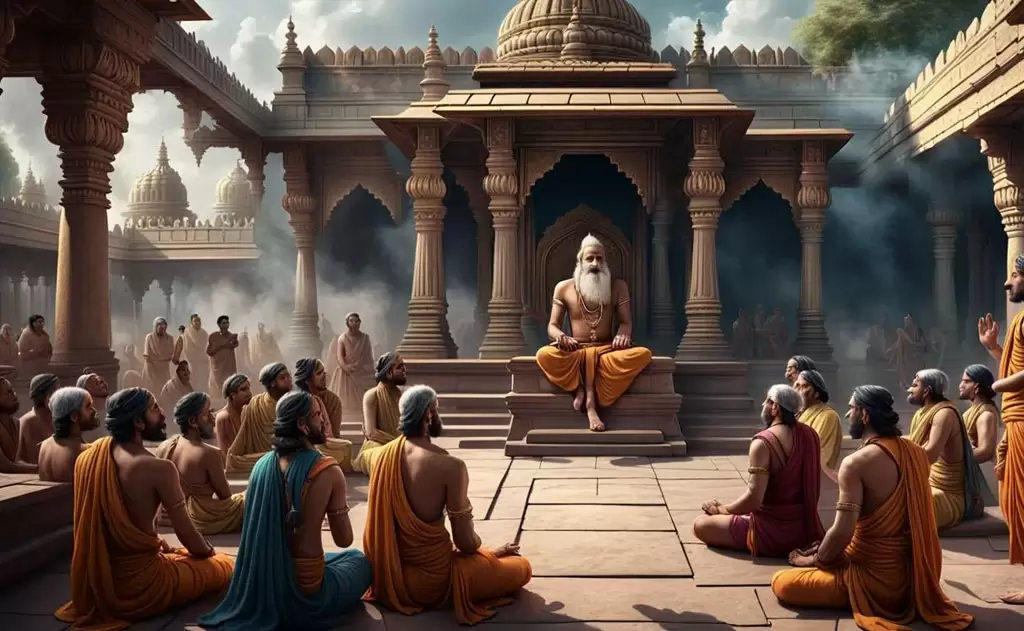
The 16 sutras of 'Vedic Mathematics' are fun, fast and genuinely useful for some mental arithmetic. But are they from the Vedas?
Quick answer: "Vedic Mathematics" is a 1965 book by Bharati Krishna Tirtha, Shankaracharya of Govardhan Math, Puri, built on 16 short Sanskrit sutras and 13 sub-sutras. Tirtha said they came from an appendix of the Atharvaveda, but no one has found them in any Vedic text, and the book's own editor accepted that they are not in the known texts. Historians of mathematics agree the sutras are not Vedic. Myth: ancient Vedic methods that cover all of mathematics. Fact: a 20th-century collection of clever mental-arithmetic shortcuts, some genuinely fast for special cases. Enjoy the tricks, and celebrate India's real mathematical heritage separately.
A surprising true fact to start
The most important evidence against the "Vedic" label is printed inside the book itself. V. S. Agrawala, its general editor, wrote in his foreword that the style of the sutras points "to their discovery by Shri Swamiji himself". Avinash Sathaye of the University of Kentucky notes that Agrawala concedes the claimed appendix "should simply be regarded as a new one attributed to Swamiji himself" (Source: Avinash Sathaye, University of Kentucky).
The book and its author
Bharati Krishna Tirtha was Shankaracharya of Govardhan Math, Puri, from 1925 until he died in 1960. Vedic Mathematics was published in 1965 by Motilal Banarsidass, five years after his death, edited by V. S. Agrawala. Tirtha had promoted the methods for decades through lectures and blackboard demonstrations (Source: S. G. Dani, 'Myths and Reality: On "Vedic Mathematics"', reprinted in arXiv:math/0611347).
Respect for Tirtha as a spiritual teacher and enthusiasm for his methods can sit alongside an honest look at where the sutras came from. That is the spirit of this guide.
The 16 sutras: short phrases, many uses
Dani describes the sutras as phrases of about two to four words, 16 of them plus 13 sub-sutras. Three well-known ones:
| Sutra (romanised) | Usual translation | Typical use in the book |
|---|---|---|
| Ekādhikena Pūrveṇa | By one more than the previous one | Squaring numbers ending in 5; decimal expansions of fractions like 1/19 |
| Nikhilaṃ Navataścaramaṃ Daśataḥ | All from 9 and the last from 10 | Multiplying numbers close to a power of 10 |
| Ūrdhva-Tiryagbhyām | Vertically and crosswise | General multiplication |
One feature puzzled reviewers: Tirtha applied a single sutra to several unrelated procedures. Ekadhikena Purvena is used both for the decimal expansion of 1/19 and for squaring numbers ending in 5 (Source: S. G. Dani).
Worked examples: the tricks that genuinely help
1. Squaring a number ending in 5 (Ekadhikena Purvena)
- Take 35. The digit before the 5 is 3.
- 'One more than the previous one': 3 + 1 = 4. Multiply: 3 x 4 = 12.
- Write 25 after it: 1225. Check: 35 x 35 = 1225.
- Try 85: 8 x 9 = 72, then 25, so 7225.
2. Multiplying numbers near 100 (Nikhilam)
- Take 97 x 96. Their shortfalls from 100 are 3 and 4.
- Cross-subtract: 97 - 4 = 93 (or 96 - 3 = 93). This is the left part.
- Multiply the shortfalls: 3 x 4 = 12. This is the right part (two digits).
- Answer: 9312. Check: 97 x 96 = 9312.
3. Vertically and crosswise (Urdhva-Tiryagbhyam)
- Take 23 x 41.
- Vertically on the left: 2 x 4 = 8.
- Crosswise: (2 x 1) + (3 x 4) = 2 + 12 = 14.
- Vertically on the right: 3 x 1 = 3.
- Combine from the right, carrying: 3; then 14 gives 4 carry 1; then 8 + 1 = 9. Answer: 943.
These are real and satisfying. Dani calls the book "a compilation of tricks in elementary arithmetic and algebra"; some are "quite interesting" and faster than standard methods, but for general problems they take about the same effort. Notice that the first two tricks only work for special cases: numbers ending in 5, or numbers close to 100. Sathaye singles out the method for decimal expansions of fractions and the universal divisibility test as the mathematically interesting parts (Source: S. G. Dani).
The vertically-and-crosswise idea has also found a life in engineering: hardware "Vedic multipliers" are an active topic in VLSI and FPGA papers. A 2008 IEEE conference paper by Tiwari, Gankhuyag, Kim and Cho reported an FPGA multiplier and squarer faster than array and Booth multipliers. Dani argued the underlying principles were "by no means unfamiliar in professional circles", and Wikipedia notes that many proposed algorithms of this kind have higher time complexity than conventional methods (Source: IEEE Xplore, DOI 10.1109/SOCDC.2008.4815685).
Where did the sutras come from?
In his preface Tirtha wrote that the sutras were "contained in the Parishishta (the appendix portion) of the Atharva Veda". Dani notes that this passing reference is the only source ever given. K. S. Shukla recalled meeting Tirtha in Lucknow in 1950 with the standard Bolling and von Negelein edition of the Parishishtas; Tirtha told him the sutras "occurred in his own Parishishta and not any other" (Source: S. G. Dani).
Agrawala defended the label on ideal rather than textual grounds. He wrote that Tirtha approached the Vedas from "the ideal standpoint", what the Vedas as the traditional repository of all knowledge "should be", so the authorship of Vedic mathematics "need not be labouriously searched for in the texts as preserved from antiquity" (Source: Kandasamy and Smarandache, quoting Agrawala, arXiv:math/0611347).
Historians of mathematics including Dani, Shukla, Kim Plofker and Jan Hogendijk note that the Vedas contain none of the sutras or sub-sutras. Dani adds that the content has "practically nothing in common" with Vedic-period mathematics, which survives in texts such as the Shulvasutras (Source: Wikipedia, 'Vedic Mathematics').
Myth vs fact
| Myth | What the evidence says |
|---|---|
| The 16 sutras come from the Vedas. | Not found in any Vedic text or manuscript. The editor said they are not in known Parishishtas; Tirtha spoke of 'his own Parishishta'. Source: S. G. Dani |
| Vedic Mathematics covers all of mathematics, including calculus. | The 'successive differentiation' chapter treats only polynomials; overall the book covers middle- and high-school mathematics. Source: S. G. Dani |
| These are the methods ancient Indian mathematicians used. | Several techniques rely on decimal fractions, which appear nowhere in the Shulvasutras or in Aryabhata, Brahmagupta and Bhaskara and came into use in 16th-century Europe. Source: S. G. Dani |
| A year of Vedic Maths can replace 15-20 years of study. | Tirtha claimed 8 to 12 months would suffice; Dani calls this 'patently absurd'. Source: S. G. Dani and 2001 statement |
Vedic Maths in schools: the debate
- Early 1990s: Uttar Pradesh school textbooks presented the material as if it came from the Vedas (Source: S. G. Dani).
- 2001: more than 100 scientists and mathematicians, including Yash Pal, J. V. Narlikar, M. S. Raghunathan and S. G. Dani, signed 'Neither Vedic Nor Mathematics', opposing NCERT's plan and saying the subject's "value is at best recreational and its pedagogical use limited" (Source: arXiv:math/0611347, section 2.2).
- December 2021: Gujarat announced Vedic mathematics for classes 6 to 10 from 2022-23; educationists said it could only supplement modern maths (Source: Careers360).
- 2022: the Himachal Pradesh School Education Board announced it from Class VI; critics called it saffronisation (Source: NewsGram (IANS)).
- 2025: the government told the Rajya Sabha that seven universities, including Delhi University and BHU, had introduced Vedic Mathematics courses (Source: Careers360).
For parents abroad weighing a weekend Vedic Maths class: treat it as a fun mental-arithmetic supplement, not a substitute for the regular curriculum and not as Vedic scripture.
India's genuine mathematical heritage
The irony is that India has no need of a borrowed label. Real Vedic-era mathematics survives in the Shulvasutras, where the Baudhayana Shulvasutra states the theorem now called Pythagorean (Source: S. G. Dani). Pingala's study of metre, dated roughly between the 5th and 2nd century BCE, gave recursive methods for listing and numbering syllable patterns (Source: Jayant Shah). Around 1400, Madhava of Sangamagrama found infinite series equivalent to those for sine, cosine and arctangent and is credited with pi correct to 11 decimal places (Source: MacTutor, 'Madhava'). Read the full stories in our guides to Pingala's binary-like numbers and Madhava and the Kerala school.
Frequently asked questions
Is Vedic Maths really from the Vedas?
No text evidence supports that. The 16 sutras have not been found in any Vedic text, and no manuscript containing them has ever been identified. The book's own general editor, V. S. Agrawala, accepted that they do not appear in known Parishishtas, and historians including S. G. Dani, K. S. Shukla and Kim Plofker agree they are not in the Vedas.
Who wrote Vedic Mathematics?
Bharati Krishna Tirtha, Shankaracharya of Govardhan Math, Puri, from 1925 until his death in 1960. The book was published in 1965 by Motilal Banarsidass, edited by V. S. Agrawala, though Tirtha had demonstrated the methods in lectures for decades.
Are the Vedic Maths tricks useful?
Some are. S. G. Dani calls some of them 'quite interesting' and faster than standard methods for special cases, such as squaring numbers ending in 5. For general problems they take about the same effort as standard methods. They work best as a supplement for mental arithmetic, not a replacement for school mathematics.
Does Vedic Maths include calculus?
Not in any real sense. Tirtha claimed no part of mathematics was beyond the sutras, but Dani found the 'successive differentiation' chapter only treats differentiation of polynomials, which he calls elementary algebra 'devoid of the very soul of calculus'.
Is Vedic Maths taught in Indian schools and universities?
In places. Uttar Pradesh put it into textbooks in the early 1990s, Gujarat announced it for classes 6 to 10 from 2022-23, Himachal Pradesh announced it from Class VI in 2022, and in 2025 the government told the Rajya Sabha that seven universities had introduced courses.
What real ancient Indian mathematics can I teach my children?
Plenty: the Baudhayana Shulvasutra's statement of the 'Pythagorean' theorem, Pingala's enumeration of syllable patterns, the meru prastara (Pascal's triangle) in Halayudha's commentary, and Madhava of Sangamagrama's infinite series, including pi correct to 11 decimal places.
Related guides
- Pingala, binary-like numbers and the Meru Prastara
- Madhava and the Kerala school: infinite series and pi
- Panini's Ashtadhyayi and computer science
- The NASA-Sanskrit computer myth and Rick Briggs (1985)
- Sacred Hindu numbers: the story of 108
Editor's note (9 October 2026)
Facts and quotations on this page come from the sources linked in the text, chiefly S. G. Dani's 'Myths and Reality' (Frontline 1993, updated and reprinted in arXiv:math/0611347), Avinash Sathaye, Wikipedia's summary of the scholarly consensus and news reports on school curricula, checked on 9 October 2026. The worked examples are our own illustrations of the methods described in the book. We respect Bharati Krishna Tirtha as a spiritual teacher; this article assesses only the historical claim that the sutras are Vedic.
You might also like
Did NASA Say Sanskrit Is the Best Language for Computers? What Rick Briggs' 1985 Paper Actually Said
AI and the Sanskrit Revival in 2026: Language Models, Manuscript OCR, Translation Tools and What AI Still Gets Wrong
Panini and Computer Science: How the Ashtadhyayi Works Like a Formal Rule System, and the 'Panini-Backus Form' Story
