Lakshmi Puja Vidhi 2026 — Complete Step-by-Step Guide with Stories, Mantras & Muhurat
Perform Lakshmi Puja 2026 perfectly with HinduTone's complete guide.
Perform Lakshmi Puja 2026 perfectly with HinduTone's complete guide.
Perform Lakshmi Puja 2026 perfectly with HinduTone's complete guide. Discover the divine stories of Maa Lakshmi, 16-step Shodashopachar Vidhi, puja samagri list, Muhurat timings (5:54–7:50 PM, Nov 8), powerful mantras, Aarti, and city-wise tips. Invite the Goddess of Prosperity into your home this Diwali!
Introduction: When the Goddess Comes Looking for Your Lamp
Every year, on the darkest night of the autumn — the new moon of Kartik — something extraordinary happens. The universe holds its breath. The goddess Maa Lakshmi — she of the lotus eyes and golden grace, the Mother of all abundance — descends from her cosmic abode and walks among human homes.
She does not knock. She does not announce herself. She simply pauses at each doorstep and looks inside.
Is the home clean? Is it lit? Does the fragrance of incense rise from within? Is there the sound of mantras, the glow of ghee diyas, and the warmth of a devoted heart?
Wherever she finds these things — she enters. She stays. And she blesses.
This is the living truth behind Lakshmi Puja — the beating heart of Diwali, the most important ritual of the Hindu festival year. Not a superstition. Not merely a tradition. But a cosmic event repeated annually since the beginning of time: the moment when the Goddess of Wealth, Beauty, Grace, and Abundance comes looking for those who are ready to receive her.
Diwali 2026 Lakshmi Puja falls on Sunday, November 8, 2026.
At HinduTone, we have prepared for you the most complete, devotion-filled guide to Lakshmi Puja 2026 — the stories that make the worship alive, the 16-step Shodashopachar Vidhi, every mantra, every offering, every ritual detail — so that when the Goddess pauses at your door, she finds exactly what she is looking for.
Lakshmi Puja 2026 — Key Timings at a Glance
Note: All timings are based on New Delhi, India (IST). Timings vary by city. Always verify with your local Panchang or trusted astrologer for city-specific muhurat before November 8, 2026.
Why Is Vrishabha Lagna the Most Auspicious?
"Sthir means fixed — not moveable. If Lakshmi Puja is done during Sthir Lagna, Lakshmiji will stay in your home."
Vrishabha (Taurus) is a Sthira Rashi — a fixed, immovable sign ruled by Venus, the planet of beauty, abundance, and prosperity. When the ascendant falls in Vrishabha during Pradosh Kaal on Amavasya night, the cosmic conditions are at their peak for invoking and stabilizing the presence of Goddess Lakshmi. Wealth invoked in a moveable Lagna comes and goes; wealth invoked in a Sthira Lagna takes root and grows.
This is why pundits and sacred texts unanimously declare Vrishabha Lagna on Diwali night as the single most auspicious window for Lakshmi Puja in the entire year.
The Divine Stories of Goddess Lakshmi — Why We Worship Her
Story 1: Maa Lakshmi Born from the Cosmic Ocean (Samudra Manthan)
Before the world wore its present face, the universe had fallen into a great crisis. The gods (Devas) had been cursed by the sage Durvasa to lose all their power and wealth. Stripped of their divine energy, they could no longer maintain the cosmos. The demons (Asuras) seized the opportunity and overthrew the heavens.
Lord Vishnu, the preserver of the universe, counseled the Devas: "Churn the milk ocean — the Kshirasagara. From its depths will emerge the Amrita, the nectar of immortality, which will restore your power."
The gods and demons formed an uneasy truce. They used Mount Mandara as the churning rod and the divine serpent Vasuki as the rope. As they churned the ocean in opposite directions, fourteen divine gifts emerged — the Chaturdasha Ratnas, the fourteen jewels of creation.
Poison came first — the terrible Halahala, which threatened to destroy all three worlds. Lord Shiva swallowed it, his throat turning blue, earning him the name Nilakantha.
Then came the divine physician Dhanvantari with his pot of nectar. The divine elephant Airavata. The divine horse Ucchaishravas. The wish-fulfilling tree Kalpavriksha. The wish-granting cow Kamadhenu.
And then — in a moment that made all of creation go silent — the ocean parted and Goddess Lakshmi arose.
She stood on a blooming lotus, clothed in golden light, her complexion the golden-rose of the dawn sky, holding two lotus flowers in her four hands. Four divine elephants — one at each cardinal direction — poured the sacred waters of the universe over her in a continuous stream of divine coronation.
The gods sang. The sages composed hymns. The universe erupted in joy.
Lakshmi looked across the gathering — at the desperate gods, at the greedy demons, at all the powers of the cosmos assembled — and she made her choice with absolute grace. She walked to Lord Vishnu and placed the divine lotus garland around his neck, declaring him her eternal consort.
In that moment, the cosmic principle was established: Where Vishnu is — righteousness, dharma, the protection of life — there Lakshmi will always be. And wherever she is, all forms of abundance follow naturally.
This is why Lakshmi Puja is performed in conjunction with Vishnu's Diwali celebration of Rama's return — dharma and prosperity are eternally linked.
Story 2: Lakshmi and the Arrogance of Indra — The Departure and Return of Prosperity
Long ago, in the golden age when the gods were at the peak of their power, Lord Indra — king of the heavens — was riding his magnificent elephant Airavata through the celestial realms when he encountered the sage Durvasa.
Durvasa, known both for his fierce wisdom and his easily ignited temper, held out to Indra a divine garland of sacred flowers — a garland that the goddess Lakshmi herself had blessed and imbued with her divine energy.
Indra, swollen with pride and contempt, took the garland carelessly and placed it on Airavata's head. The elephant, irritated by the fragrance, threw it to the ground and trampled it.
Durvasa's eyes blazed with holy fury. He pronounced a curse:
"You have insulted Goddess Lakshmi herself. From this day, all the wealth, power, and prosperity that she has bestowed upon you — upon all the gods — shall depart the three worlds."
And so it was. Immediately, flowers began to wilt across the celestial gardens. Crops failed in the heavenly realms. The gods grew weak and pale. The sacred fire of dharma dimmed. The demons, sensing the retreat of divine energy, launched their attack.
Goddess Lakshmi, insulted and unworshipped, withdrew into the cosmic ocean — into the Kshirasagara, the milk of creation — waiting.
The gods' suffering led to the Samudra Manthan — the churning of the ocean — through which Lakshmi was propitiated again and returned, blessing all of creation with her grace once more.
The teaching of this story is eternal: Prosperity — like the divine Goddess herself — does not stay where arrogance lives. She is not compelled by status or power. She is drawn by devotion, humility, cleanliness, and pure intention. This is why Lakshmi Puja must be performed not just with the right rituals, but with the right heart.
Story 3: Maa Lakshmi and Vishnu's Vow — The Sacred Partnership
In the Vishnu Purana, there is a beautiful telling of why Goddess Lakshmi is inseparable from Lord Vishnu. When Vishnu descended to Earth as various avatars to protect dharma — as Matsya, Kurma, Varaha, Narasimha, Vamana, Parashurama, Rama, Krishna — Lakshmi always accompanied him, taking forms that matched his mission.
When he was Rama, she was Sita — kidnapped and recovered, the center of the greatest dharma-war in history. When he was Krishna, she was Rukmini — the devoted queen who wrote her own love letter to invite her lord. When he was Vamana, she appeared as Padma — lotus-born and serene.
Lord Vishnu once made Lakshmi this vow: "O Padme, O Kamale — wherever I am in the universe, in whatever form I take my birth, you will always be there. You are the nature to my spirit, the beauty to my truth, the grace to my power. Without you, the universe would be brilliant but cold — like a sun without warmth. With you, all existence becomes home."
This vow is renewed every Diwali night when Lakshmi Puja is performed — as the devotee lights the ghee lamp and places it before the goddess, they are participating in this ancient cosmic renewal of vow between sustenance and grace.
Story 4: The Merchant's Wife Who Called Lakshmi Back — The Vrat Katha
In the city of Saurashtra, there once lived a merchant who had fallen into great poverty. Despite his honest nature and endless hard work, nothing prospered. His wife, deeply devoted to Goddess Lakshmi, decided to perform the Lakshmi Vrat.
On the evening of Diwali, she cleaned her home until it shone like a mirror, drew rangoli at every threshold, lit lamps in every window, and performed Lakshmi Puja with total devotion — offering every flower, every sweet, every morsel of food she had in the house.
That night, she had a dream. Goddess Lakshmi appeared before her — radiant, golden, holding lotuses — and said:
"Your devotion has reached me. I have been watching your home for years, looking for the right moment to enter. But I could not enter until your heart was ready — ready not just to ask for wealth, but to create a home worthy of abundance. Tonight, you created that home. I will not leave."
The next morning, the merchant went to the market — and a stranger approached him with an unexpected business offer that changed their fortunes completely. Within a year, the family had prospered beyond anything they had imagined.
The Vrat Katha teaches that Lakshmi does not respond to desperation — she responds to devotion, preparation, and a worthy vessel.
Story 5: Why Lakshmi Has Four Arms — The Complete Symbol
Every image of Goddess Lakshmi carries within it a complete theology. Understanding her form is itself an act of worship:
Her Complexion — Golden: Like liquid sunlight, representing the divine glow of prosperity that radiates naturally from a righteous life.
Seated on the Lotus: The lotus grows in muddy water but rises unstained above it — just as prosperity, when righteous, rises above the mud of greed and corruption. The lotus is also Padma — one of Lakshmi's most beloved names.
Four Arms — Four Purposes of Human Life:
- Dharma (Right Living) — Upper right hand: blessing gesture (Abhaya Mudra), conferring fearlessness and protection.
- Artha (Prosperity) — Lower right hand: Varada Mudra (boon-giving), from which gold coins cascade downward — wealth flowing freely to the deserving.
- Kama (Fulfillment of Desire) — Upper left hand holds a lotus — beauty, grace, love, and all that makes life worth living.
- Moksha (Spiritual Liberation) — Lower left hand holds a second lotus — the reminder that true abundance includes spiritual wealth, not just material.
The Two Elephants (Gaja Lakshmi): When depicted with elephants flanking her, they pour sacred water — representing Ganga (purification) and Yamuna (devotion) — confirming her as the Empress of all realms.
Owl as Her Vahana (Vehicle): The owl (Uluka) represents the quality of seeing in darkness — wisdom that finds opportunity where others see only obstacles. It also symbolizes patience: the owl waits silently until the right moment. Lakshmi rides wisdom, not recklessness.
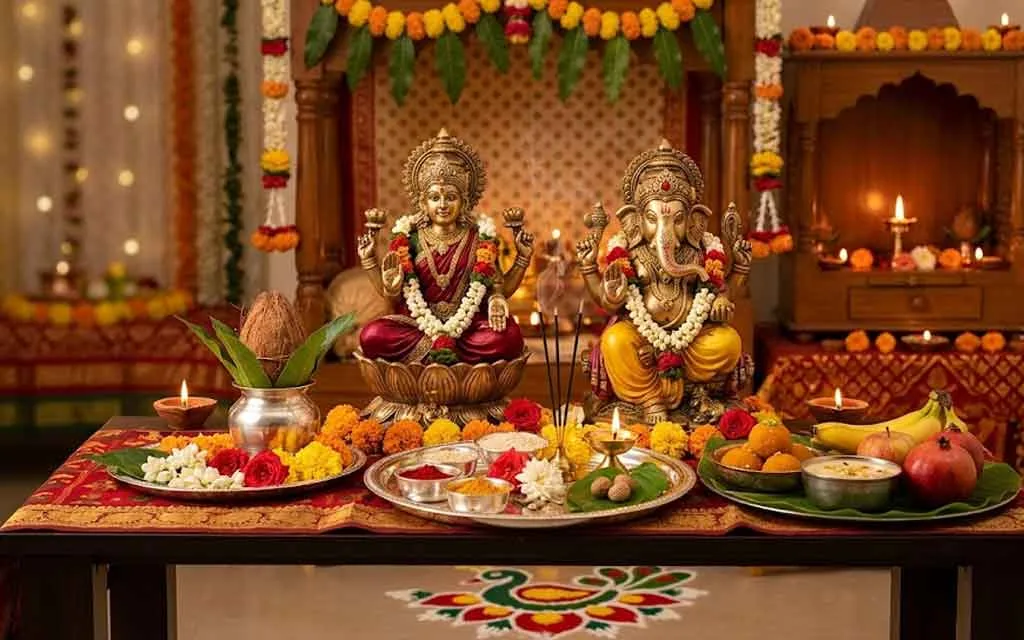
Lakshmi Puja Samagri — Complete Shopping List 2026
Gather all items before the puja day to avoid last-minute rush on November 8.
Sacred Platform & Setting
- Chowki (wooden platform/seat for the deity)
- Red cloth for Lakshmi's side of the platform
- White/yellow cloth for Navgraha side
- Gangajal (sacred Ganga water) — for purification
- Brass or copper Kalash (sacred pot)
- Mango leaves (5–7 leaves for Kalash)
- Coconut — to top the Kalash
Deity Items
- Lakshmi-Ganesha idol or framed image (silver, brass, or clay)
- New clothes/silk fabric for the idol (red for Lakshmi, yellow for Ganesha)
- Jewelry/ornaments for the deity (if available)
Puja Ingredients (Shodashopachar)
- Kumkum (red vermillion)
- Haldi (turmeric powder)
- Chandan (sandalwood paste or powder)
- Sindoor
- Kesar (saffron)
- Akshat (unbroken whole rice — NOT broken grains)
- Supari (betel nut)
- Betel leaves (Paan patta) — 5 or 11
- Elaichi (cardamom pods)
- Cloves (Laung)
- Camphor (Kapoor) — for aarti
- Dhoop / Agarbatti (incense sticks)
- Roli (red powder, different from kumkum)
- Abir / Gulal
Flowers & Garlands
- Marigold flowers (Genda) — Lakshmi's favorite
- Lotus flowers or lotus seeds (Makhana)
- Red/pink roses
- Jasmine (Mogra/Chameli)
- Flower garlands for the deity
- Tulsi leaves (Holy basil)
Lamps & Lighting
- Ghee diyas — minimum 13, ideally 21, 51, or 108
- Pure desi cow ghee for diyas
- Sesame oil diyas for outer areas
- Cotton wicks (Baati) — multi-wick for Aarti lamp
- Large brass Aarti lamp (5-wick)
- Matchbox
Naivedya (Food Offerings)
- Kheer (rice pudding with saffron)
- Halwa (wheat/suji)
- Puri or luchi
- Panchamrit ingredients: milk, curd, pure ghee, honey, sugar
- Misri (rock sugar crystals)
- 5 types of fruits (Pancha Phala): banana, coconut, apple, pomegranate, mango (or seasonal)
- Besan ke ladoo or barfi
- Lotus seeds (Makhana) — extremely dear to Maa Lakshmi
- Dry fruits — almonds, cashews, raisins
- Paan (betel leaf with supari)
Prosperity Items
- New coins (preferably silver, or gold — whatever is possible)
- New currency notes
- Gold or silver jewelry
- New account books for Chopda Puja (business community)
- Red cloth/envelope for storing money items
Miscellaneous
- Copper/silver Aarti thali (plate)
- Bell (Ghanta) — do NOT clap during aarti
- Shankha (conch shell)
- Panch Patra (small vessel with spoon) — for water offerings
- Aarti saucer with lit camphor
- Red thread (Mauli/Kalawa)
- Banana leaves (as natural plates for offering)
- New broom (Jhadu) — for Lakshmi's pathway
[image: 🕍] Preparation — Days Before Diwali (November 1–7, 2026)
The Sacred Preparation Period
Lakshmi Puja does not begin at 5:54 PM on November 8. It begins in the week before — in every act of cleaning, painting, decorating, and beautifying the home.
"Goddess Lakshmi enters clean homes — not just physically clean, but energetically clean."
7 Days Before (November 1):
- Begin deep cleaning — room by room. Clear clutter, discard what is broken or unused, organize storage.
- Remove all old, broken, or never-used items from the home.
5 Days Before (November 3):
- Painting or whitewashing of walls, if planned.
- Repair any broken doors, hinges, leaking taps — the home should be whole and sound.
3 Days Before (November 5):
- Decorate the home — flowers, marigold torans (door garlands), fairy lights.
- Purchase all puja samagri so nothing is forgotten.
- Purchase new clothes for the family — Lakshmi blesses those who honor themselves.
- Purchase new coins, account books (for businesses).
Day Before Diwali — November 7 (Choti Diwali):
- Draw or apply fresh rangoli at the entrance.
- Set up the puja altar (chowki, cloth, Kalash).
- Light first diyas in the evening to welcome the Goddess.
- Apply mehndi (women and girls).
Diwali Morning — November 8:
- Wake early. Bathe and wear clean clothes.
- Place fresh flowers on the puja altar.
- Keep all doors and windows clean and open during the puja hours — do NOT lock the front door during muhurat.
- Sprinkle Gangajal throughout the home.
- Begin fasting if observing the Lakshmi Vrat.
Lakshmi Puja Vidhi 2026 — The Complete 16-Step Shodashopachar
The word Shodashopachar means sixteen services — the sixteen forms of reverence offered to the deity, treating them as an honored royal guest whose every need is met with love and devotion. This is the most complete form of Lakshmi Puja, as described in the Vedic scriptures.
Begin puja at the start of the Lakshmi Puja Muhurat: 5:54 PM on November 8, 2026. Ideally within Vrishabha Lagna: 6:27 PM – 8:27 PM.
STEP 1 — DHYANA (Meditation & Visualization)
Setting the Sacred Intention
Before touching a single item, sit quietly before the puja altar. Close your eyes. Take three deep breaths. Visualize Goddess Lakshmi — golden-hued, seated on a lotus, elephants on either side, streams of gold flowing from her hands. See her descending, drawn by your devotion, entering your home through the front door, walking along the rangoli path, and settling on your puja altar.
This visualization is not imagination — it is invocation. The ancient texts say: "The deity manifests where the devotee's focused attention goes."
Recite the Dhyana Mantra:
"Om Hiranya Varnam Harinim Suvarnarajatasrajam| Chandraam Hiranmayim Lakshmin Jaatavedo Ma Aavaha| Taam Ma Aavaha Jatavedo Lakshmi-anapagaaminim| Yasyam Hiranyam Vindeyam Gaamas-ashvam Purushan-aham"
(O Agni, invoke for me that Goddess Lakshmi who is golden-hued, who is adorned with golden and silver garlands, luminous as the moon — the one who, once invoked, never departs.)
STEP 2 — AVAHANA (Invocation)
Calling the Goddess to Her Seat
Place flower petals in your joined palms, face the deity, and formally invite Goddess Lakshmi and Lord Ganesha to be present in the idols and in your home.
"Om Aim Hreem Kleem Maha Lakshmyai Namah — Aavahayami" (I invoke the Great Goddess Lakshmi)
"Om Gam Ganapataye Namah — Aavahayami" (I invoke Lord Ganesha)
After reciting, offer flower petals and unbroken rice grains at the base of the idol. This formally seats the divine presence in the image.
Remember: Ganesha is always installed on the LEFT of the altar, Lakshmi on the RIGHT (from the deity's perspective — meaning Ganesha is on your right when you face the altar).
STEP 3 — ASANA (Offering a Seat)
Welcoming the Honored Guest
Offer a sacred seat to the Goddess by placing fresh flowers or a piece of clean red cloth beneath the idol, symbolizing that she is received as royalty:
"Om Shreem Mahalakshmyai Namah — Asanam Samarpayami" (O Maha Lakshmi, I offer you this sacred seat)
STEP 4 — PADYA (Washing of the Feet)
The First Act of Service
Use the Panch Patra (small vessel) to pour a small amount of water — ideally mixed with Gangajal — near the base of the idol, symbolically washing the Goddess's divine feet:
"Om Shreem Mahalakshmyai Namah — Padyam Samarpayami" (I offer water to wash your divine feet)
Mantra for Padya:
"Gange Cha Yamune Chaiva Godavari Saraswati| Narmade Sindho Kaveri Jale Asmin Sannidhim Kuru" (O sacred rivers — Ganga, Yamuna, Godavari, Saraswati, Narmada, Sindhu, Kaveri — be present in this water)
STEP 5 — ARGHYA (Offering Water for Purification)
Honoring with Sacred Water
Offer water in cupped hands (or via Panch Patra) to the Goddess, symbolizing purification and respect. This is separate from foot-washing — Arghya is offered to the whole being of the Goddess:
"Om Shreem Mahalakshmyai Namah — Arghyam Samarpayami" (I offer this sacred water in your honor)
Add a pinch of sesame seeds, flower petals, and rice to the Arghya water for completeness.
STEP 6 — AACHAMAN (Sipping Water)
The Purifying Sip
Offer water for the deity to sip — symbolically representing complete hospitality:
"Om Shreem Mahalakshmyai Namah — Aachamaniyam Samarpayami"
Sprinkle a few drops of clean water near the idol with your ring finger.
STEP 7 — SNAN / ABHISHEK (Sacred Bath)
The Divine Bathing Ritual
This is one of the most powerful steps — the ritual bath of the deity with Panchamrit (five sacred substances):
Panchamrit Sequence:
- Milk (Dugdha): Pure cow's milk — for purity and maternal grace
- Curd (Dadhi): Homemade curd — for prosperity and abundance
- Pure Ghee (Ghrita): Desi cow ghee — for strength and divine energy
- Honey (Madhu): Natural honey — for sweetness and harmony
- Sugar (Mishri/Sharkara): Rock sugar — for liberation and joy
After Panchamrit, bathe with plain water, then with rose water, then with Gangajal.
As each substance is offered, recite:
"Om Shreem Mahalakshmyai Namah — Panchamrit Snanam Samarpayami"
After the bath, dry the idol gently with a clean, unused cloth, and dress her in new silk clothes.
STEP 8 — VASTRA (New Clothes)
Adorning the Goddess
Offer new clothes to the deity — symbolized by a piece of red silk or cotton fabric placed lovingly before or around the idol:
"Om Shreem Mahalakshmyai Namah — Vastram Samarpayami" (I offer you these garments, O Goddess)
Also offer a new sacred thread (Yagnopavita/Mauli) and the Uppavita (the sacred upper garment).
STEP 9 — ABHUSHAN / ALANKAR (Offering Ornaments)
The Royal Adornment
Place jewelry, flower garlands, and ornaments on the idol with love:
"Om Shreem Mahalakshmyai Namah — Abharanam Samarpayami"
Offer specifically:
- Kumkum (apply to the Goddess's forehead with the ring finger)
- Sindoor (apply to the center-parting of a married Lakshmi image)
- Chandan (sandalwood paste — on forehead and hands)
- Haldi (turmeric — for auspiciousness)
- Kajal (kohl — for divine beauty)
- Flower garland — especially lotus and marigold
STEP 10 — GANDHA (Sandalwood Paste & Fragrance)
The Divine Fragrance
Apply sandalwood paste (chandan) to the idol. Offer incense sticks (agarbatti) — light 5, 7, or 11 sticks. The fragrance rising to the heavens carries your prayer upward:
"Om Shreem Mahalakshmyai Namah — Gandham Samarpayami"
Recommended fragrances for Lakshmi:
- Sandalwood (Chandan) — her favorite
- Lotus (Kamal Sugandh) — her eternal seat
- Rose (Gulab) — beauty and grace
- Jasmine (Chameli) — purity and devotion
STEP 11 — PUSHPA (Flower Offering)
The Offering of Blooms
Flowers are among Lakshmi's most beloved offerings. Offer them petal by petal or as whole flowers, placing them at her feet and around her with devotion:
"Om Shreem Mahalakshmyai Namah — Pushpam Samarpayami"
Flowers that please Maa Lakshmi:
- Lotus (Kamal) — her seat; the most sacred offering
- Marigold (Genda) — abundance and auspiciousness
- Red rose — divine love and grace
- Mogra/Jasmine — purity
- Champa — celestial beauty
Flowers to AVOID: Do not offer Tulsi leaves directly to Lakshmi during Diwali puja (Tulsi is offered to Vishnu separately). Do not offer flowers that are wilted, already used, or that have fallen on the floor.
Also recite the 108 Names of Lakshmi (Ashtottara Shatanamavali) during the flower offering — one flower/petal for each name. This is the highest form of Pushpanjali.
STEP 12 — DHUPA (Incense)
The Smoke of Devotion
Light the dhoop (incense cone or resin incense) and wave it in slow clockwise circles before the Goddess three times:
"Om Shreem Mahalakshmyai Namah — Dhupam Aagrapayami" (I offer this fragrant incense to you, O Goddess)
The rising smoke carries the prayers of the devotee into the divine realm. "Dhupa mein devi ko pathrao" — in incense, the Goddess is summoned.
STEP 13 — DEEPA (The Sacred Lamp)
The Most Important Offering
This is the supreme moment of Diwali puja — the lighting of the ghee lamp before the Goddess.
Light your main ghee diya (ideally five-wicked or eleven-wicked for Lakshmi Puja) and wave it before the deity in slow clockwise circles — three or seven times:
"Om Shreem Mahalakshmyai Namah — Deepam Darshaymi"
The Deepa Mantra:
"Deepajyoti Param Brahma, Deepajyoti Janardhana| Deepo Me Hara Papani, Sandhyadeepa Namostute" (The flame is the Supreme Consciousness — it is Lord Vishnu Himself. May this flame destroy my sins. I bow to the evening lamp.)
Diya Placement Rules:
- Minimum 5 diyas in the puja room (representing Pancha Tattva)
- Light diyas in ALL rooms of the home — Lakshmi enters a fully lit home
- Place a diya at the main entrance — one on each side of the door
- Place a diya near the tulsi plant in the courtyard
- Light an Akhand Diya (continuous lamp) that burns through the night
- The facing of the main lamp: Lakshmi's lamp faces EAST (or North — never South)
STEP 14 — NAIVEDYA (Sacred Food Offering)
Feeding the Goddess
Place all prepared food offerings before the Goddess with love. Cover the puja room entrance symbolically with a thread or cloth barrier while offering Naivedya — this creates a sacred, private moment between devotee and deity.
Offer the following in order:
- Panchamrit (already offered in Snan — a fresh small offering here)
- Kheer (rice pudding with saffron and cardamom)
- Halwa
- Puri or Luchi
- Seasonal fruits — 5 varieties
- Besan ke ladoo or coconut barfi
- Lotus seeds (Makhana) — Lakshmi's favorite prasad
- Dry fruits — cashews, almonds, raisins
- Misri (rock sugar)
- Fresh water in a small vessel
Mantra for Naivedya:
"Om Shreem Mahalakshmyai Namah — Naivedyam Samarpayami"
Also offer Tamboolam (betel leaf with supari, cardamom, and cloves) after the food offering — this is the traditional after-meal offering in Hindu hospitality:
"Om Shreem Mahalakshmyai Namah — Tamboolam Samarpayami"
STEP 15 — PRADAKSHINA (Sacred Circumambulation)
Walking the Circle of Devotion
Rise from your seat and walk clockwise around the puja altar three, five, or seven times with folded hands, reciting:
"Yani Kani Cha Papani Janmantara Krutani Cha| Tani Tani Vinashyanti Pradakshinaa Pade Pade" (Whatever sins I have accumulated — in this life and in past lives — may they be destroyed with each step of this circumambulation)
If the altar is against a wall and cannot be circled, turn clockwise in place — the sacred intention is identical.
STEP 16 — AARTI (The Ceremony of Light)
The Grand Finale of Devotion
Aarti is the most beloved ritual in all of Hindu worship — the moment when the devotee, holding a flame, sings to the Goddess and the two merge in joy.
How to Perform Aarti:
- Light all wicks of the Aarti lamp with ghee.
- Hold the Aarti thali in both hands.
- Ring the bell with the left hand while moving the Aarti lamp in slow, large clockwise circles before the deity with the right hand.
- Move the lamp in five circles at the deity's feet, four circles at the navel, seven circles at the face, and one large circle over the whole form.
- Sing the Lakshmi Aarti with full voice and heart.
The Maha Lakshmi Aarti:
"Om Jai Lakshmi Mata, Maiya Jai Lakshmi Mata| Tumko Nis Din Sevat, Har Vishnu Vidhata|| Om Jai Lakshmi Mata...
Uma Rama Brahmani, Tum Hi Jagat Mata| Surya Chandrama Dhyavat, Narad Rishi Gaata|| Om Jai Lakshmi Mata...
Durga Roop Niranjani, Sukh Sampati Data| Jo Koi Tumko Dhyavat, Riddhi Siddhi Dhan Paata|| Om Jai Lakshmi Mata...
Tum Patal Nivasini, Tum Hi Shubhdata| Karma Prabhav Prakashini, Bhavanidhi Ki Data|| Om Jai Lakshmi Mata...
Jis Ghar Mein Tum Rahti, Sab Sadgun Aata| Sab Sambhav Ho Jaata, Man Nahin Ghabraata|| Om Jai Lakshmi Mata...
Tum Bin Yagya Na Hota, Vastra Na Koi Paata| Khaana Peena Ka Vaibhav, Sab Tumse Paata|| Om Jai Lakshmi Mata...
Shubh Gun Mandir Sundar, Kshirodadhi Data| Ratan Chaturdash Tum Bin, Koi Nahin Paata|| Om Jai Lakshmi Mata...
Mahalaxmiji Ki Aarti, Jo Koi Jan Gaata| Ur Aanand Samata, Paap Utar Jaata|| Om Jai Lakshmi Mata, Maiya Jai Lakshmi Mata"
After Aarti, offer the flame to all family members — each one receives the warmth of the Aarti lamp on their face and palms as the Goddess's blessing.
[image: 📿] Beyond the 16 Steps — Additional Sacred Rituals
Sri Sukta Recitation (Rigveda)
The Sri Sukta is the most ancient and most powerful Vedic hymn to Goddess Lakshmi — composed in the Rigveda, it is the oldest prayer to the Goddess of Prosperity in human history. Reciting it during Diwali puja is considered the highest form of Lakshmi worship.
Opening Verse:
"Hiranya Varnam Harinim Suvarnarajatasrajam| Chandraam Hiranmayim Lakshmin Jaatavedo Ma Aavaha"
(O Agni, invoke for me that Lakshmi who is golden-hued, dressed in garlands of gold and silver, radiant as the moon.)
The full Sri Sukta has 16 verses — one for each Upachar — and should be recited through the puja from beginning to end.
Lakshmi Chalisa Recitation
The Lakshmi Chalisa — 40 devotional verses to the Goddess — is recited after the main puja and before the distribution of prasad:
Opening Verse:
"Mata Lakshmi Karo Kalyan, Sukhon Ki Darein Jo Ho Dayaan| Dhan Daulat Aur Vaibhav Paun, Teri Kripa Se Sab Kuch Aaye Chahin"
Lakshmi Puja Mantras — Complete Collection
Beej (Seed) Mantra — Most Powerful:
"Om Shreem" (The single-syllable seed of Lakshmi. Chant 108 times for any single focused wish)
Maha Lakshmi Mantra:
"Om Shreem Hreem Shreem Kamale Kamalalaye Praseed Praseed| Om Shreem Hreem Shreem Mahalakshmyai Namah" (Chant 108 times during puja for wealth, prosperity, health, and divine grace)
Lakshmi Gayatri Mantra:
"Om Mahalakshmyai Cha Vidmahe, Vishnu Patnyai Cha Dhimahi| Tanno Lakshmi Prachodayat" (Chant for wisdom to use wealth rightly)
Kubera Mantra (for wealth accumulation):
"Om Yakshaya Kuberaya Vaishravanaya Dhanadhanyadhipataye| Dhanadhanyasamriddhim Me Dehi Dapaya Svaha"
Ashta Lakshmi Mantra (for all 8 forms):
"Om Ashta Lakshmyai Namah" (Offer one flower or lotus seed for each of the 8 forms)
Dhana Lakshmi Mantra (for material wealth):
"Om Hreem Shreem Kleem Maha Lakshmyai Namah"
Vidya Lakshmi Mantra (for knowledge wealth):
"Om Aim Saraswatyai Namah, Om Shreem Mahalakshmyai Namah" (Invoke both Saraswati and Lakshmi together for the highest form of prosperity)
Ganesh Puja within Lakshmi Puja
Lord Ganesha is ALWAYS worshipped before Goddess Lakshmi — without exception. He is the Prathamapujya — the First to Be Worshipped — and his grace is the gateway through which Lakshmi's blessings enter.
Ganesha Mantra:
"Om Gam Ganapataye Namah| Vakratunda Mahakaya Suryakoti Samaprabha| Nirvighnam Kuru Me Deva Sarva Karyeshu Sarvada"
Offer red flowers, durva grass, and modak (sweet dumpling) to Ganesha before beginning Lakshmi Puja.
Kuber Puja — Worship of the Divine Treasurer
Along with Lakshmi, Lord Kubera — the divine treasurer of the gods, keeper of all the world's wealth — is also worshipped on Diwali and Dhanteras. When Lakshmi and Kubera are propitiated together, wealth is both received AND preserved — one brings prosperity, the other ensures it stays.
Place Kubera's image or a representation (often a pot of gold coins) on the right of Lakshmi.
Kubera Yantra: Drawing or placing a Kubera Yantra on the puja altar on Diwali night is one of the most powerful wealth-attraction practices in Hindu tradition.
Chopda Puja — For Business Owners
For merchants, traders, entrepreneurs, and business families, Chopda Puja is performed alongside Lakshmi Puja on Diwali night.
Chopda Puja Vidhi:
- Place new account books on the altar beside the Lakshmi idol.
- Respectfully close the old account books.
- Inscribe the new account book's first page with:
- "Shubh Labh" (Auspicious Profit)
- "Jai Shri Lakshmi Narayan"
- The Swastika symbol in kumkum
- A red dot (tilak)
- The current date: November 8, 2026
- Perform puja over the new books — apply kumkum, offer flowers.
- The Goddess's presence in the first page of the accounts ensures her blessing through the entire year.
In Gujarat and Maharashtra, this is called Sharda Puja — the new business year formally begins on this night.
Ashta Lakshmi — The 8 Divine Forms Worshipped on Diwali
Begin Ashta Lakshmi puja by reciting: "Om Ashta Lakshmyai Namah" — then worship each form individually with a flower offering.
1. Adi Lakshmi (Primordial Lakshmi)
The most ancient, primal form — she who has always existed, before creation. She represents the eternal, inexhaustible source of all abundance. Mantra: "Om Adi Lakshmyai Namah"
2. Dhana Lakshmi (Wealth Lakshmi)
The bestower of material wealth — gold, silver, money, jewels, financial abundance. She holds a golden pot overflowing with coins in one hand, lotus in the other, and raises the Varada (boon-giving) mudra. Mantra: "Om Dhana Lakshmyai Namah"
3. Dhanya Lakshmi (Grain Lakshmi)
The provider of food, grain, and agricultural abundance. She ensures there is always enough to eat — nourishment for body, family, and community. Worshipping her protects against hunger and scarcity. Mantra: "Om Dhanya Lakshmyai Namah" Bhog: Offer grains — rice, wheat, barley — and rice-based sweets (kheer).
4. Gaja Lakshmi (Elephant Lakshmi)
The Goddess flanked by royal elephants. She represents power, royalty, authority, and the kind of abundance that comes with leadership and respect. She is especially worshipped for power, prestige, and the recovery of lost wealth. Mantra: "Om Gaja Lakshmyai Namah"
5. Santana Lakshmi (Children Lakshmi)
The bestower of offspring, lineage, and family continuity. She holds children in her arms and blesses couples with the gift of parenthood. Families pray to her for healthy children and for the continuation of the family lineage. Mantra: "Om Santana Lakshmyai Namah"
6. Veera Lakshmi (Courage Lakshmi)
The fierce, warrior aspect of Lakshmi — she who gives the courage, strength, and perseverance to face life's battles. She blesses those fighting chronic illness, financial hardship, legal battles, or any deep adversity. Mantra: "Om Veera Lakshmyai Namah"
7. Vidya Lakshmi (Knowledge Lakshmi)
The Goddess of learning, education, art, and all intellectual achievement. She bridges Lakshmi and Saraswati — the truth that true prosperity includes the wealth of wisdom. Students, scholars, artists, and teachers especially worship her. Mantra: "Om Vidya Lakshmyai Namah"
8. Vijaya Lakshmi (Victory Lakshmi)
The bestower of victory — in competition, in career, in relationships, in legal matters, in any endeavor requiring success. She carries a sword and rides into victory on the strength of righteous effort. Mantra: "Om Vijaya Lakshmyai Namah"
The 108 Names of Maa Lakshmi (Ashtottara Shatanamavali)
Chanting the 108 names of Maa Lakshmi during puja — with one flower or lotus seed offered per name — is the supreme form of Pushpanjali. Here are selected names with their meanings:
- Om Prakrityai Namah — She who is Nature itself
- Om Vikrityai Namah — She who manifests in all transformations
- Om Vidyayai Namah — She who is Knowledge
- Om Sarva Bhuta Hitapradayai Namah — She who gives welfare to all beings
- Om Shraddha Yai Namah — She who is Faith
- Om Vibhavaryai Namah — She who is Night (the eternal)
- Om Prabhayai Namah — She who is Radiance
- Om Chandrayai Namah — She who is the Moon
- Om Lakshmyai Namah — She who is the Auspicious One
- Om Sthiraya Namah — She who is the Stable, the Fixed
- Om Virochanayai Namah — She who illuminates
- Om Padmayai Namah — She who is the Lotus
- Om Padmapriyayai Namah — She who loves the lotus
- Om Padmahastayai Namah — She who holds lotuses in her hands
- Om Padmakshai Namah — She whose eyes are like lotuses
- Om Padmasundaryai Namah — She whose beauty is like the lotus
- Om Padmodabhavayai Namah — She who was born from the lotus
- Om Padmamukhyai Namah — She whose face is like a lotus
- Om Padmanabhpriyayai Namah — She who is dear to the lotus-naveled Vishnu
- Om Ramaayai Namah — She who gives delight to all (The full Ashtottara continues for 108 names — available in the HinduTone Aarti & Mantra collection)
Post-Puja Rituals — After the Aarti
Distribution of Prasad
After Aarti, distribute the Naivedya as Prasad to all family members and guests. Prasad is not merely food — it is the Goddess's own energy, her grace made tangible. Receive it in both hands, with humility and gratitude.
Lighting the Diyas of the Home
After puja is complete, light diyas throughout the entire home — in every room, at every window, at the doorstep, in the courtyard, on the boundary wall. The more completely lit the home, the deeper the Goddess's presence.
Traditional diya sequence:
- 2 diyas flanking the main entrance
- 1 diya at each window
- 1 diya in each room
- 1 Akhand Diya (kept burning all night) in the puja room
- 1 diya at the tulsi plant
- 1 diya in the kitchen — the heart of nourishment
Rangoli Activation
After puja, step outside and freshly trace over the rangoli at the entrance. The act of reinforcing the design after puja is said to "seal" the Goddess's path into the home.
Donation (Daan) — Most Important Post-Puja Action
The scriptures declare: "Lakshmi pauses at the door of the one who gives."
On Diwali night, after puja, make a sincere donation:
- Feed the hungry — send food to neighbors or community
- Donate to a cow shelter (Goshala)
- Give clothing or sweets to domestic workers, security guards, and others who serve your home
- Light a lamp at a public space — a temple, a crossroads, a park
- Leave a small offering of sweets or prasad outside the home
Giving on Diwali night activates the full cycle of Lakshmi's blessing. Receiving without giving creates stagnation; the energy must flow.
What NOT to Do on Diwali — Puja Dos and Don'ts
Do NOT:
- Lock the front door during puja muhurat — Lakshmi cannot enter a locked home
- Clap during Lakshmi Aarti — always use a bell (Ghanta)
- Keep the home dark or dirty during muhurat
- Use glass or iron idols — use clay, silver, brass, or gold
- Place Lakshmi's idol facing South — South is Yama's direction
- Consume non-vegetarian food or alcohol on Diwali
- Argue, speak harshly, or harbor negative emotions during puja
- Use a broken or old lamp for the Aarti
- Offer wilted or used flowers
- Begin puja without first worshipping Lord Ganesha
- Discard old coins on Diwali — this removes existing wealth
Always DO:
- Bathe and wear fresh, new clothes before puja
- Open all doors and windows during muhurat
- Light a diya in every room
- Keep coins, gold, and silver near the idol during puja to energize them
- Observe the vrat (fast) until after puja for maximum spiritual benefit
- Maintain silence and focus during the main 16 steps of puja
- Make a sincere donation after puja
- Place new account books on the altar (for business families)
- Keep the Akhand Diya burning through the night
Lakshmi Puja Vrat (Fasting Rules)
Many devotees observe a full-day fast on Diwali (Lakshmi Puja day) — breaking it only after performing the evening puja and receiving prasad.
Permitted During Lakshmi Vrat:
- All fresh fruits
- Milk, curd, butter, paneer, ghee
- Sabudana (tapioca) — khichdi, kheer, vada
- Kuttu atta (buckwheat flour) — poori, paratha, halwa
- Singhara atta (water chestnut flour) — poori, barfi
- Makhana (fox nuts) — kheer, curry
- Sweet potato (Shakarkandi)
- Rock salt (Sendha namak) — NOT regular salt
- Dry fruits — almonds, cashews, walnuts, raisins
Not Permitted:
- Regular wheat, rice, or dal
- Regular table salt (iodized)
- Onion, garlic, non-vegetarian food
- Alcohol in any form
Breaking the fast: After completing Lakshmi Puja and receiving prasad, eat a full sattvic meal with family. The first bite of the meal is the Goddess's blessing made nourishment.
Lakshmi Puja by Region — How India Worships Her on Diwali
North India (Delhi, UP, Rajasthan, Haryana)
The grandest, most elaborate Lakshmi Puja celebrations. Diyas in every home, massive community pujas, traditional Lakshmi-Ganesha idols of clay, fireworks from sundown to midnight, Kheer and Halwa as main prasad, and the beautiful tradition of leaving diyas burning through the entire night.
West Bengal & Eastern India — Kali Puja Night
In Bengal, Odisha, and Assam, the same Amavasya night is the night of Kali Puja — the fierce Goddess Kali is worshipped alongside Lakshmi, representing the truth that prosperity requires both grace AND the destruction of what blocks it.
Gujarat — Chopda Puja & Gujarati New Year
For Gujarat's business communities, Diwali night's Chopda Puja is the year's most important business ritual. New account books are opened with the Goddess's blessing, and the Gujarati New Year (Bestu Varas) begins at sunrise the next day.
Maharashtra — Lakshmi Puja + Padwa
Maharashtra celebrates Diwali with great devotion, with Lakshmi Puja on Amavasya followed by Padwa on Pratipada — a day husbands gift their wives and celebrate marital love.
South India — Naraka Chaturdashi as Main Day
Tamil, Telugu, Kannada, and Malayalam traditions celebrate the main Diwali puja one day earlier — on Naraka Chaturdashi (Choti Diwali) — with the pre-dawn Abhyanga Snan as the central ritual. However, Lakshmi Puja is also performed on Amavasya night.
Punjab — Bandi Chhor Divas
Sikh families celebrate this night as Bandi Chhor Divas, lighting lamps at Gurudwaras to honor Guru Hargobind Sahib Ji's release from imprisonment — and Lakshmi Puja is observed in many Hindu-Punjabi homes simultaneously.
[image: 🔑] Lakshmi Puja 2026 — Complete FAQ
Q: What is the best time for Lakshmi Puja in 2026? A: The most auspicious Lakshmi Puja muhurat is 5:54 PM to 7:50 PM (New Delhi IST) on November 8, 2026. Within this, the Vrishabha Lagna window — 6:27 PM to 8:27 PM — is the most powerful, as it ensures wealth "stays" in the home.
Q: Which direction should the Lakshmi idol face? A: The idol should face East or North. Never South (direction of Yama). You should sit facing East or North while performing puja.
Q: Can Lakshmi Puja be done after 8 PM? A: Yes — puja can continue past 8 PM if it is started within the muhurat window. It should ideally conclude before midnight. Starting after midnight is not recommended for householders.
Q: What is the Sthir Lagna and why does it matter? A: Sthir (Fixed) Lagna means a fixed zodiac sign is rising on the horizon. Vrishabha (Taurus) is a fixed sign. Doing Lakshmi Puja in Sthira Lagna ensures that the prosperity invoked becomes stable and permanent — it does not fluctuate or flow away.
Q: How many diyas should be lit? A: Odd numbers are preferred — 5, 11, 13, 21, 51, or 108. At minimum, 5 diyas representing the Pancha Tattva (five elements). The more the better — there is no upper limit.
Q: Can unmarried women/girls perform Lakshmi Puja? A: Absolutely. Lakshmi blesses all devotees regardless of marital status. For unmarried daughters, Lakshmi Puja on Diwali is considered equally or more important — it invites all forms of prosperity and a blessed future.
Q: Should old Lakshmi Puja coins be kept or discarded? A: Old coins should be kept — they carry accumulated Lakshmi energy. Discarding them removes existing wealth. The new coins energized on Diwali 2026 can be placed with the old ones to multiply the blessing.
Q: What to do with the Diwali Lakshmi idol after the festival? A: Clay idols are immersed (Visarjan) respectfully in clean flowing water. Metal idols (brass, silver, gold) are cleaned carefully, wrapped in red cloth, and stored for the following year in the puja room or safe.
Q: Can the puja be performed without a pandit? A: Yes — Lakshmi Puja can be performed by any family member with a pure heart and sincere intention. The 16-step guide above is sufficient for a complete home puja. A pandit adds the benefit of Vedic Sanskrit chanting if desired.
Q: Why is Ganesha worshipped with Lakshmi? A: Wealth without wisdom leads to ruin. Ganesha represents Buddhi (intelligence), Riddhi (material prosperity), and Siddhi (spiritual accomplishment). He ensures that the wealth Lakshmi brings is managed with wisdom and used for righteous purposes.
The Inner Lakshmi Puja — A Devotional Reflection
In the deepest spiritual tradition of Sanatana Dharma, every outer ritual is a mirror of an inner reality. The Lakshmi Puja you perform with diyas and flowers and mantras on the night of November 8, 2026 — it has an inner equivalent that is even more powerful.
The cleaning of the home — is the cleaning of the mind, removing the clutter of old grudges, stale fears, and outgrown beliefs.
The lighting of the lamp — is the igniting of Viveka (discernment) and Jnana (wisdom) in the heart — the only light that truly never goes out.
The rangoli at the threshold — is the adorning of your character with beauty, so that the Goddess recognizes you as one who makes the world more beautiful by being in it.
The 16 Upachars — are the 16 qualities of a devoted heart: patience, surrender, generosity, cleanliness, focus, love, humility, service, faith, attention, joy, gratitude, honesty, discipline, continuity, and completion.
The Naivedya — is the offering of the fruits of your work back to the source that made it possible. Every meal becomes a ritual when you recognize that what you have, you were given.
When outer and inner Lakshmi Puja are aligned — when the home is clean AND the heart is clear, when the lamp is lit AND the ego is dimmed, when the Goddess is invoked AND you are ready to receive her — that is when Diwali becomes truly divine.
Goddess Lakshmi does not come to those who desperately need wealth. She comes to those who have prepared themselves to be worthy vessels of it.
This Diwali 2026 — be that vessel.
Om Shreem Mahalakshmyai Namah. Jai Mata Lakshmi.
Related Articles on HinduTone
- Diwali 2026 — Complete 5-Day Festival Guide (Dhanteras to Bhai Dooj)
- Lakshmi Chalisa — Full Text with Meaning in Hindi & English
- Sri Sukta (Rigveda) — Complete Text with Word-by-Word Meaning
- Maha Lakshmi Aarti Lyrics — Hindi, English & Transliteration
- Navratri & Dussehra 2026 — 9 Days of Devi Worship Complete Guide
- 108 Names of Goddess Lakshmi — Ashtottara Shatanamavali
- Dhanteras 2026 — Gold Buying Muhurat, Story & Puja Vidhi
- Chopda Puja 2026 — Complete Business Puja Guide for Diwali
- Kubera Mantra for Wealth — The Most Powerful Treasure Invocation
- Diwali Rangoli Designs 2026 — Lakshmi Footprints, Lotus & Swastika Patterns
- Govardhan Puja 2026 — Story, Annakut & Chappan Bhog Guide
- Bhai Dooj 2026 — Tilak Ceremony, Story & Muhurat
- Goddess Lakshmi in Different Indian Traditions — North, South, East & West
Published by HinduTone — www.hindutone.com "Bringing the Wisdom of Sanatan Dharma to Every Heart"
Tags: lakshmi puja vidhi 2026, lakshmi puja muhurat 2026, diwali 2026 puja time, shodashopachar lakshmi puja, maha lakshmi mantra, lakshmi aarti, goddess lakshmi story, sri sukta, samudra manthan lakshmi, ashta lakshmi puja, lakshmi puja samagri list, diwali puja vidhi, chopda puja 2026, ganesha lakshmi puja, vrishabha lagna diwali, pradosh kaal diwali, lakshmi puja steps at home, diwali 2026, deepavali 2026, lakshmi vrat, diwali fasting rules, rangoli for lakshmi, lakshmi 108 names, kubera puja, dhana lakshmi, lakshmi puja dos and donts, how to do lakshmi puja, hindutone diwali guide
Frequently Asked Questions
What is the Lakshmi Puja Vidhi?
Perform Lakshmi Puja 2026 perfectly with HinduTone's complete guide. Discover the divine stories of Maa Lakshmi, 16-step Shodashopachar Vidhi, puja samagri list, Muhurat timings (5:54–7:50 PM, Nov 8), powerful mantras, Aarti, and city-wise tips.
How many times should the Lakshmi Puja Vidhi be chanted?
It is traditionally chanted 108 times using a rudraksha or tulsi mala. Even 11 or 21 sincere repetitions daily are considered beneficial — steady, focused practice matters more than the count.
What is the best time to chant the Lakshmi Puja Vidhi?
Dawn (Brahma Muhurta) after a bath is considered ideal, though it may be chanted any time with a calm, focused mind. Many devotees keep a fixed daily time to build consistency.
Who can chant the Lakshmi Puja Vidhi?
Anyone may chant it with faith and a pure mind, regardless of age, gender or background. Beginners benefit from first hearing the correct pronunciation and understanding its meaning.
What are the benefits of chanting the Lakshmi Puja Vidhi?
Devotees chant it to invoke Goddess Lakshmi's grace — for inner peace, protection, focus and spiritual progress.
You might also like
Powerful Mantras for Students & Parents Before Joining School
Powerful Hindu Mantras for Purushottam Maas 2026: Vishnu Bhakti, Chanting Guide & Global Devotion
Hare Krishna Maha Mantra: Meaning & Benefits