Ananth
Ananth (अनन्थ) is a Sanskrit-origin Hindu boy-name meaning “Eternal; Vishnu”. Find pronunciation, origin, deity association, popularity and similar Hindu baby names.
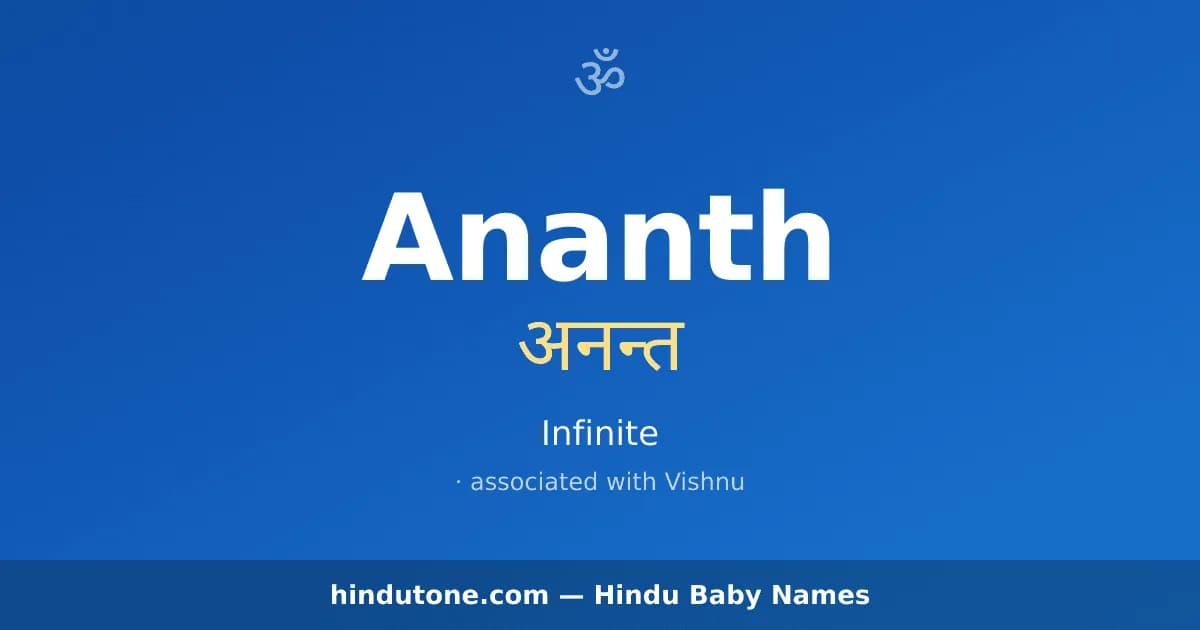
Ananth (अनन्थ) is a Sanskrit-origin Hindu boy-name meaning “Eternal; Vishnu”. Find pronunciation, origin, deity association, popularity and similar Hindu baby names.
Ananth (अनन्थ) is a Sanskrit-origin Hindu boy-name meaning “Eternal; Vishnu”. Ananth is associated with Lord Vishnu, deepening its devotional significance. This guide covers Ananth’s meaning, origin, pronunciation, deity association, popularity and similar names.
What does Ananth mean?
Ananth means Eternal; Vishnu in Sanskrit. The name carries a serene devotional resonance — every Hindu name encodes a virtue, a deity or a cosmic principle. Ananth is associated with Lord Vishnu, deepening its devotional significance.
Origin and Sanskrit script
Ananth is written अनन्थ in Devanagari. The Sanskrit mātṛkā (mother-syllables) preserve the sacred sound — important during the Namakarana Samskara.
Ananth and its deity association
Ananth is associated with Lord Vishnu. Deity-linked names are lifelong sankalpa — a soft remembrance of the divine each time the child is called.
Pronunciation of Ananth
Ananth is pronounced as it is spelled in standard Hindi/Sanskrit and travels well across school registers, government forms and social settings in the USA, UK, Canada and Australia.
Why parents choose Ananth
Ananth carries the timeless feel of classical Sanskrit and has been used in Hindu families for generations. It is a steadily popular Hindu boy-name with rising recognition in modern Indian and NRI families.
Quick facts about the name Ananth
- Gender: Hindu boy-name
- Sanskrit: अनन्थ
- Meaning: Eternal; Vishnu
- Associated deity: Lord Vishnu
- Origin: Sanskrit
- Popularity: 75/100 in 2026
Ananth in the broader Hindu devotional tradition
Ananth belongs to the Vaishnava current — the tradition of the Vishnu Sahasranama, the Bhagavata, and the great acharyas Ramanuja, Madhva and Vallabha. The name carries the dasya-bhava (servant-mood) of bhakti, and is often recited in pradosha-time chanting and in Bhagavata-saptaha discourses. The Sanskrit अनन्त preserves the original phonetic resonance.
In the diaspora, Ananth resonates with Hindu families who maintain ties to Tirupati, Srirangam, Guruvayur and Pandharpur. The name is easy on English speakers and natural in Indic scripts — making it a steady choice for parents in the USA, UK, Canada and Australia who want a classical Vaishnava name.
Frequently Asked Questions about Ananth
Quick answers to the most common questions Hindu families ask about the name Ananth.
What does the name Ananth mean?
Ananth means Infinite in Sanskrit. The name is written अनन्त in Devanagari and is rooted in the classical Sanskrit tradition where every Hindu name encodes a virtue, a deity, or a cosmic principle.
Is Ananth a Hindu boy or girl name?
Ananth is a Hindu boy-name, commonly chosen by Hindu and Indian families in India and the global diaspora — including in the USA, UK, Canada and Australia.
Which deity is associated with Ananth?
Ananth is associated with Lord Vishnu. Choosing a deity-linked name is regarded as a lifelong sankalpa (intention) — every time the child's name is called, it becomes a soft remembrance of the divine.
Is Ananth popular in 2026?
Ananth is a well-loved Hindu boy-name in 2026, especially among diaspora Hindu families who want a Sanskrit-rooted name that travels well internationally.
How do you pronounce Ananth in English?
Ananth is pronounced as it is spelled in standard Hindi/Sanskrit — even-syllabled and naturally rhythmic. It is easy for English speakers and travels well across school registers, government forms and social settings for Hindu families in the diaspora.
Related Hindu boy names starting with A
Aarav · Aaryan · Arjun · Aryan · Aaditya · Akshay
More Hindu boy names associated with Lord Vishnu
Aarav · Akshay · Vishnu · Ajay · Anant · Avinash
Browse the full A–Z directory of Hindu boy names on Hindutone, or jump to the A boy-names listing.
Ananth — Name Facts
- Meaning
- Eternal; Vishnu
- Gender
- Hindu boy name
- Nakshatra
- Krittika
- Rashi
- Mesha (Aries)
- Numerology
- 3
Frequently asked questions
What does the name Ananth mean?
Ananth is a Sanskrit-origin Hindu boy name meaning “Eternal; Vishnu”.
Is Ananth a boy or girl name?
Ananth is traditionally a Hindu boy name.
Which nakshatra and rashi suit the name Ananth?
By the first-syllable rule of Vedic naming, Ananth aligns with the Krittika nakshatra, under the Mesha (Aries) rashi.
What is the numerology number of Ananth?
The Chaldean name number of Ananth is 3.
Explore more: Krittika nakshatra names · Mesha rashi names · Hindu boy names with A · All Hindu names A–Z
Deepen the naming journey
Choosing a name is one step. Continue with:
- Find your child’s nakshatra from today’s panchangam — verify the Krittika assignment against your birth chart.
- Hindu gods & goddesses — the pantheon behind Hindu names — Vishnu, Shiva, Devi, and the deities most Hindu names honour.
- Slokas & mantras for the family altar — chant ashtottaras and daily prayers as your child grows.
- The Namakaranam ceremony — 11th-day naming ritual — samskara vidhi, prasadam, and family customs.
- Auspicious Hindu festivals & naming muhurats — best tithis in 2026 for a namakarana ceremony.
- Temple for the first darshan — take the newborn to the family deity temple within 40 days.
- Hinduism guide for young parents — samskaras, dharma, and raising children in the tradition.