Mannat
Mannat (मन्नत) is a Sanskrit-origin Hindu boy-name meaning “Vow, prayer fulfilled”. Find pronunciation, origin, deity association, popularity and similar Hindu baby names.
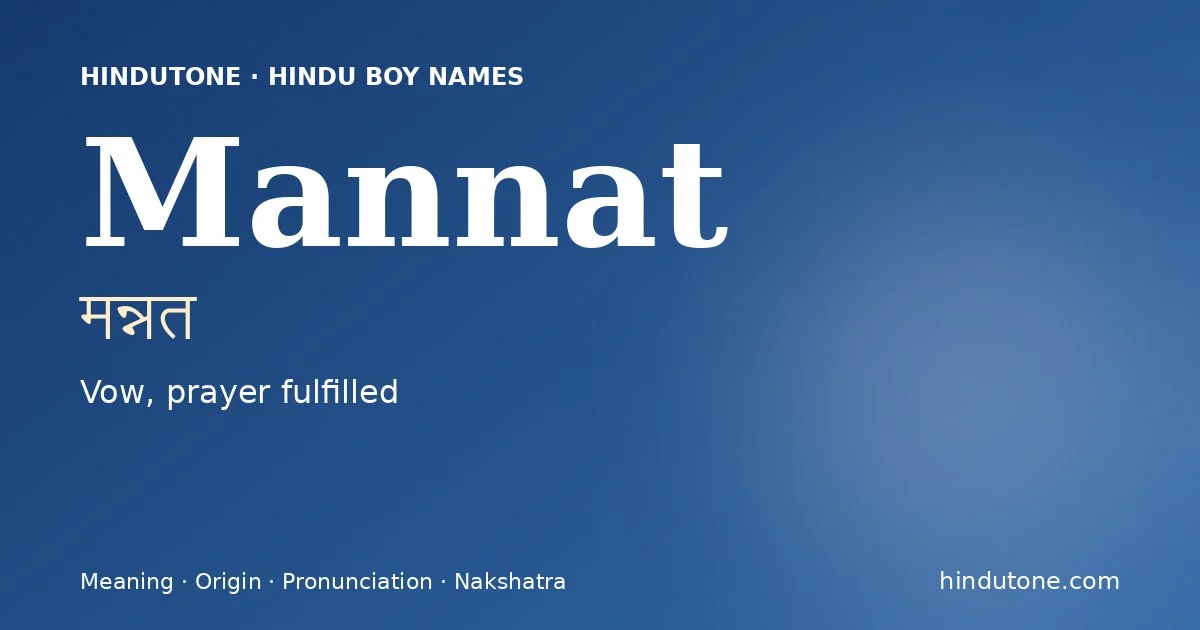
Mannat (मन्नत) is a Sanskrit-origin Hindu boy-name meaning “Vow, prayer fulfilled”. Find pronunciation, origin, deity association, popularity and similar Hindu baby names.
Mannat (मन्नत) is a Sanskrit-origin Hindu boy-name meaning “Vow, prayer fulfilled”. This guide covers Mannat’s meaning, origin, pronunciation, deity association, popularity and similar names.
What does Mannat mean?
Mannat means Vow, prayer fulfilled in Sanskrit. The name carries a serene devotional resonance — every Hindu name encodes a virtue, a deity or a cosmic principle.
Origin and Sanskrit script
Mannat is written मन्नत in Devanagari. The Sanskrit mātṛkā (mother-syllables) preserve the sacred sound — important during the Namakarana Samskara.
Pronunciation of Mannat
Mannat is pronounced as it is spelled in standard Hindi/Sanskrit and travels well across school registers, government forms and social settings in the USA, UK, Canada and Australia.
Why parents choose Mannat
Mannat carries the timeless feel of classical Sanskrit and has been used in Hindu families for generations. It is a steadily popular Hindu boy-name with rising recognition in modern Indian and NRI families.
Quick facts about the name Mannat
- Gender: Hindu boy-name
- Sanskrit: मन्नत
- Meaning: Vow, prayer fulfilled
- Origin: Sanskrit
- Popularity: 70/100 in 2026
Quick Facts
Attribute: Details
Gender: Boy (occasionally unisex)
Origin: Sanskrit / Urdu-influenced
Meaning: Vow, prayer fulfilled, wish
Pronunciation: MUN-nat (IPA: /mʌn.nət/)
Syllables: 2
Lucky Number: 6
Rashi: Simha (Leo)
Nakshatra: Magha
Sanskrit Etymology & Devanagari
The name Mannat (मन्नत) sits at an interesting linguistic crossroads. While it is written in Devanagari and used widely in Hindu families, its etymology draws from both Sanskrit and Perso-Arabic roots. The word mannat in Urdu and Hindi means "vow" or "wish made to God," commonly associated with a promise or prayer offered at a shrine or temple. In Sanskrit contexts, the name is often linked to manas (मनस्, "mind" or "heart") and nata (नत, "bowed" or "devoted"), together suggesting "one whose mind is devoted" or "one who has made a sacred vow."
In IAST transliteration, the name is rendered as Mannat. The Devanagari spelling मन्नत reflects a geminated न (n), emphasizing the solemnity of the vow. Culturally, the concept of mannat is deeply embedded in Indian devotional practice—parents visit temples, tie sacred threads, or offer prayers with a mannat for the health, prosperity, or safe birth of a child. Naming a child Mannat is thus a thanksgiving gesture, acknowledging that the child himself is the fulfillment of a divine promise.
The name carries connotations of faith, devotion, gratitude, and the sacred bond between the devotee and the divine. It is commonly believed that children named Mannat grow up with a strong sense of purpose and spiritual awareness, embodying the answered prayer their parents once made.
Mythological & Historical Figures
There are no direct mythological or Puranic figures named Mannat in the classical Hindu epics such as the Mahabharata, Ramayana, or major Puranas. However, the concept of vows and sacred promises is central to Hindu scripture. In the Ramayana, Lord Rama honors his father Dasharatha's vow (vachan) by accepting exile. In the Mahabharata, Bhishma's vow of celibacy (Bhishma Pratigya) is one of the most famous vows in Hindu tradition. The Puranas are replete with stories of sages, kings, and devotees who undertook vows (vrata) to please deities and secure boons.
While the name Mannat itself may not appear in ancient texts, its spiritual essence—devotion, promise, and divine fulfillment—resonates deeply with the bhakti (devotional) tradition that runs through Hindu philosophy. Modern usage of the name reflects this timeless reverence for sacred commitments.
Regional Popularity in India
Mannat enjoys moderate to strong popularity across North India, particularly in Hindi-speaking states such as Uttar Pradesh, Delhi, Haryana, Rajasthan, and Madhya Pradesh. It is also well-received in Punjab, where the tradition of making vows at Gurudwaras and temples is common, and the name's devotional undertone appeals to both Hindu and Sikh families.
In Maharashtra and Gujarat, Mannat is used occasionally, though less frequently than in the North. In South India—Tamil Nadu, Karnataka, Andhra Pradesh, and Kerala—the name is less common, as regional naming conventions tend to favor Dravidian or Sanskrit names with different phonetic structures. However, urban, cosmopolitan families in cities like Bangalore, Hyderabad, and Chennai have begun adopting Mannat, especially among parents seeking modern, meaningful, and easy-to-pronounce names.
Among the Indian diaspora in the USA, UK, Canada, and Australia, Mannat is gaining traction as a short, distinctive, and culturally resonant name that works well in multicultural environments.
Numerology & Astrology
According to Vedic numerology, the name Mannat is commonly associated with the lucky number 6. Individuals with this number are often believed to be nurturing, responsible, harmonious, and family-oriented. They are seen as natural caregivers who value balance, beauty, and service to others.
Astrologically, Mannat is linked to the Simha (Leo) rashi and the Magha nakshatra. Magha, ruled by Ketu, is associated with ancestral pride, leadership, respect for tradition, and a regal bearing. Children born under Magha are often thought to possess dignity, courage, and a strong sense of duty. The Leo influence adds warmth, generosity, and a natural charisma, making Mannat a name that suggests both strength and devotion.
Personality Traits
Parents and astrologers commonly associate the name Mannat with the following personality traits:
Devotional and Spiritual: A deep connection to faith, prayer, and inner reflection.
Grateful and Humble: An awareness of blessings and a tendency to express thankfulness.
Purposeful and Determined: A strong sense of mission or calling, often fulfilling promises or goals.
Compassionate and Caring: Empathy toward others, especially family and community.
Loyal and Trustworthy: Keeps commitments and values integrity in relationships.
Charismatic and Warm: A natural ability to inspire and connect with people.
Variants & Similar Names
Spelling Variants: Manat, Manatt, Mannath
Similar Hindu Boy Names: Manan, Manav, Manish, Manvik, Manas, Manyu, Manik, Manit, Manthan, Madhav, Moksh, Maitreya
FAQ
How do you pronounce Mannat correctly?
Mannat is pronounced MUN-nat, with the stress on the first syllable. The double "n" is slightly emphasized, giving the name a firm, grounded sound. It is phonetically simple and easily recognized in both Indian and Western contexts.
Is Mannat appropriate for modern or diaspora families?
Yes, Mannat is highly suitable for modern Indian families and the diaspora. It is short, meaningful, easy to spell, and carries a universal spiritual resonance. The name works well in multicultural settings—schools, workplaces, and social circles—in the USA, UK, Canada, and Australia, while retaining its deep cultural and devotional roots.
Is Mannat religiously appropriate for Hindu families?
Absolutely. While the word mannat has Urdu influences and is used across religious communities in India, it is fully appropriate for Hindu families. The concept of vows, prayers, and divine fulfillment is central to Hindu worship and tradition. Many Hindu parents choose Mannat as a name of gratitude, honoring the answered prayers that brought their child into the world.
Frequently Asked Questions
What does the name Mannat mean?
Mannat ( मन्नत ) is a Sanskrit-origin Hindu boy-name meaning “Vow, prayer fulfilled” . This guide covers Mannat’s meaning, origin, pronunciation, deity association, popularity and similar names.
Is Mannat a good Hindu baby name?
Yes — it is a traditional Hindu name with an auspicious meaning, suitable for a baby and rooted in Sanatana Dharma values.
What is the origin of the name Mannat?
It has Sanskrit/Hindu origins; its roots, deity association and significance are detailed above.
Are there variations or similar names to Mannat?
Related and similarly-themed Hindu names, along with their meanings, are listed in the guide above to help you choose.
Mannat — Name Facts
- Meaning
- Vow, prayer fulfilled
- Gender
- Hindu boy name
- Nakshatra
- Magha
- Rashi
- Simha (Leo)
- Numerology
- 2
Frequently asked questions
What does the name Mannat mean?
Mannat is a Sanskrit-origin Hindu boy name meaning “Vow, prayer fulfilled”.
Is Mannat a boy or girl name?
Mannat is traditionally a Hindu boy name.
Which nakshatra and rashi suit the name Mannat?
By the first-syllable rule of Vedic naming, Mannat aligns with the Magha nakshatra, under the Simha (Leo) rashi.
What is the numerology number of Mannat?
The Chaldean name number of Mannat is 2.
Explore more: Magha nakshatra names · Simha rashi names · Hindu boy names with M · All Hindu names A–Z