From Gurukul to ISRO: Govind Krishnan M’s Inspiring Journey from Vedic Education to Space Scientist
In a remarkable blend of tradition and modernity, Govind Krishnan M, a young talent from Kannur, Kerala, has shattered stereotypes by transitioning from a…
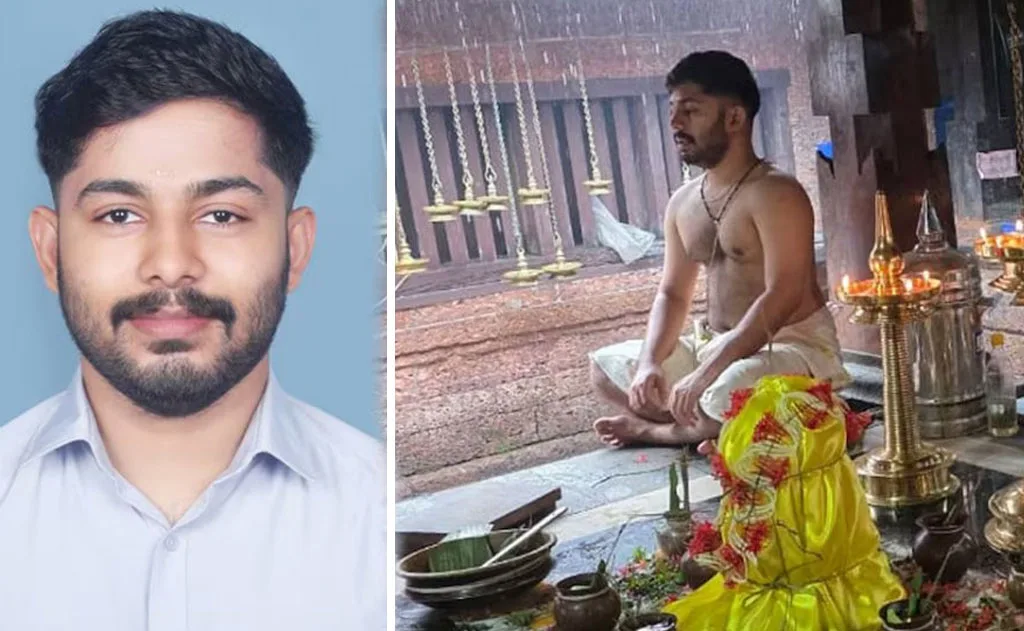
In a remarkable blend of tradition and modernity, Govind Krishnan M, a young talent from Kannur, Kerala, has shattered stereotypes by transitioning from a…
In a remarkable blend of tradition and modernity, Govind Krishnan M, a young talent from Kannur, Kerala, has shattered stereotypes by transitioning from a Gurukul’s Vedic education to becoming a scientist at ISRO’s Vikram Sarabhai Space Centre (VSSC).
His journey—marked by clearing the prestigious JEE Advanced and securing admission to the Indian Institute of Space Science and Technology (IIST)—proves how spirituality and science can harmoniously coexist.
“I am deeply aware of the common misconception that Vedic education limits career opportunities. People often think spirituality and science don’t mix. But I’ve proven they can. It’s all about balance and discipline.”
This inspiring account explores Govind’s unique path, his achievements, and the powerful message he sends to the world.
A Unique Beginning: Vedic Education at Bhramaswam Madham
Govind’s story began unconventionally. After completing Class 4 at Kendriya Vidyalaya, Payyannur, he made a bold decision in 2011 to join Bhramaswam Madham, a traditional Vedic school in Thrissur, Kerala.
For four years, he immersed himself in Yajurveda studies through oral learning under a guru’s guidance.
Days started at 5 a.m. with Vedic chants, spiritual routines, and strict discipline—while formal schooling was minimal.
Unlike batchmates pursuing priesthood, Govind envisioned a different path, balancing Vedic rituals (like Ganapathihomam, Thevaram) with his passion for science.
Cracking JEE & Joining IIST: A Leap Toward Space Science
Govind’s dual dedication bore fruit when he:
- Cleared JEE Advanced
- Joined IIST, Thiruvananthapuram (BTech in Electronics and Communication Engineering - Avionics)
At IIST, he:
- Excelled academically
- Maintained daily spiritual practices (1 hour of Vedic discipline)
- Graduated with distinction
Govind calls his spiritual routine his “mental gym” — strengthening clarity, concentration, and memory alongside rigorous engineering studies.
Joining ISRO’s VSSC: A Dream Realized
Now, Govind is set to join Vikram Sarabhai Space Centre (VSSC) at Thumba, Thiruvananthapuram.
VSSC leads ISRO’s launch vehicle technology, supporting missions like Chandrayaan and Aditya-L1.
His selection, through ISRO’s rigorous recruitment process, showcases his talent and dedication.
Debunking Myths: Vedic Education and Modern Careers
Govind’s story challenges misconceptions that Vedic education limits careers to priesthood or traditional roles.
“People think spirituality and science don’t mix. I’ve proven they can. It’s all about balance and discipline.”
His success offers hope and direction for students wishing to honor cultural roots while pursuing modern ambitions.
The Role of Family & Discipline
Govind credits his father, Hareesh Kumar (a former Indian Navy officer), for supporting his unique path.
After upanayanam (sacred thread ceremony) in Class 4, his family encouraged Vedic learning and academic excellence.
His Gurukul discipline enhanced memory and focus—crucial for JEE and IIST success.
Why Govind’s Journey Matters
Govind’s story is a cultural milestone.
- Proves Vedic wisdom can complement modern science
- Bridges ancient traditions with cutting-edge innovation
- Aligns with ISRO Chairman S. Somanath’s views on Vedic science
His path inspires students passionate about space, science, and spirituality.
Conclusion: A Beacon of Inspiration
Govind Krishnan M’s journey from a Gurukul in Thrissur to ISRO’s VSSC is a tale of balance, discipline, and determination.
By blending Vedic education with modern science, he shows that one can achieve great heights without abandoning their roots.
For more such inspiring stories, visit Hindutone.com — your source for India’s cultural and scientific achievements.
What did four years of Yajurveda training actually teach Govind — and how did it shape a future engineer?
The Yajurveda, one of the four principal Vedas, is specifically associated with ritual action, precise pronunciation, and structured sequence — qualities that map with surprising directness onto the demands of engineering and systems thinking. Govind's training at Bhramaswam Madham in Thrissur followed the traditional shiksha (phonetics) and krama-patha (step-by-step recitation) methods, where even a fractional mispronunciation must be corrected and repeated until exact. This cultivates a standard of precision rare in conventional schooling.
Vedic oral transmission relies on techniques such as pada-patha (word-by-word recitation), krama-patha (paired-word recitation), and ghana-patha (complex interlocked patterns), each designed to embed text so thoroughly in memory that no written crutch is ever needed. Neuroscientific interest in these methods has grown because sustained phonetic memorisation appears to enlarge areas of the brain associated with working memory and attention — precisely the faculties that Govind describes as his 'mental gym.' For an avionics engineer who must hold complex circuit logic in mind simultaneously, this is no trivial advantage.
Daily practice of rituals such as Ganapathi Homam also trained Govind in the careful management of sequential processes under time pressure — a sensibility directly transferable to mission-critical aerospace workflows at VSSC, where procedural discipline is not optional but life-determining.
Bhramaswam Madham, Thrissur: the institution behind Govind's Vedic foundation
Bhramaswam Madham is one of Kerala's historically significant Vedic institutions, rooted in the Nambudiri Brahmin scholarly tradition that has preserved unbroken lines of Vedic recitation across centuries in the region. Kerala's Vedic gurukuls are notable for maintaining the full ashtadhyayi curriculum alongside ritual training, producing graduates who are considered custodians of an oral heritage that UNESCO has recognised as Intangible Cultural Heritage of Humanity in the form of the Vedic chanting tradition.
Unlike many modern institutions that offer diluted hybrid programmes, Bhramaswam Madham maintains the residential gurukul format: students live with or near the acharya, observe brahmacharya discipline, and follow a timetable anchored in pre-dawn sandhyavandanam and evening rituals. This total immersion — the same model described in texts like Manusmriti and the Taittiriya Upanishad's famous Shikshavalli — is precisely what distinguishes a genuine gurukul from a supplementary Veda class.
Govind's four years there, beginning at roughly age ten, placed him in a lineage of students who were never expected to pursue STEM careers. His choice to carry that foundation into JEE preparation rather than priesthood does not represent a rejection of the madham's values — it represents a living demonstration that the cognitive and moral architecture the madham builds is robust enough to support any vocation.
How does the ancient concept of Brahmacharya align with the discipline required to crack JEE Advanced?
Brahmacharya, often narrowly translated as celibacy, carries a fuller meaning in the Vedic tradition: it is the stage of life (ashrama) dedicated entirely to learning, marked by sensory restraint, respect for the guru, and conservation of vital energy (ojas) toward intellectual cultivation. The Taittiriya Upanishad's convocation address — 'Satyam vada, Dharmam chara' (Speak truth, walk the path of righteousness) — was delivered specifically to brahmacharins completing their gurukul tenure, signalling that this stage is foundational to everything that follows.
JEE Advanced is widely regarded as one of the most cognitively demanding entrance examinations in the world, requiring not just content mastery but the ability to reason under sustained pressure and manage time with surgical precision. Govind's gurukul years had already trained him in exactly this mode: rising before sunrise, performing recitations that demanded total concentration with zero tolerance for error, and maintaining that standard daily for four years. When he returned to formal schooling and later to JEE coaching, he brought a mental endurance that most of his peers were still trying to build.
This alignment is not accidental. Ancient Indian educational philosophy, as articulated in texts like the Mundaka Upanishad, holds that 'nayam atma balahinena labhyah' — truth (and by extension, deep knowledge) cannot be attained by the weak-willed. The rigour of brahmacharya was always designed to produce exactly the kind of disciplined, focused learner who thrives in high-stakes intellectual competition.
IIST Thiruvananthapuram and VSSC: where Govind's two worlds converged geographically and intellectually
The Indian Institute of Space Science and Technology (IIST), Thiruvananthapuram, is the world's first university fully dedicated to space science and technology, established in 2007 under the Department of Space, Government of India. Its BTech programme in Electronics and Communication Engineering with an Avionics specialisation is designed in close integration with ISRO's operational needs — graduates are expected to transition directly into ISRO centres, and many are bonded to the organisation through a service commitment.
Vikram Sarabhai Space Centre (VSSC), also located in Thiruvananthapuram, is ISRO's primary centre for launch vehicle development — it is the institution responsible for the design and development of rockets including the PSLV, GSLV, and the LVM3 that carried the Chandrayaan and Gaganyaan missions. For an avionics engineer, VSSC represents perhaps the most demanding and consequential workplace in Indian aerospace: onboard electronics must function without failure from liftoff through the vacuum of space.
That Govind's journey from a Thrissur gurukul to a Thiruvananthapuram space centre traversed only Kerala's geography while crossing centuries of epistemological distance makes his story especially resonant for a state that has simultaneously produced some of India's most rigorous Vedic scholars and some of its most accomplished scientists and engineers.
What message does Govind's path carry for families choosing between traditional and modern education?
The anxiety many families feel when considering Vedic or gurukul education for their children centres on a single fear: occupational foreclosure. The assumption is that time spent on Sanskrit recitation and ritual is time taken away from mathematics and competitive preparation. Govind's trajectory directly falsifies this assumption — not as an exception, but as a demonstration of what a strong foundational cognitive training, regardless of its content domain, can transfer across fields.
Educationally, his story points toward a model that several Indian thinkers — from Swami Vivekananda, who argued for 'man-making education,' to Sri Aurobindo, who envisioned a harmony between Vedic and modern learning — have theorised but few individuals have embodied so concretely. Govind did not have to choose between the Veda and the vector calculus; the discipline acquired through one fed directly into the mastery of the other.
For parents and students, the practical takeaway is not that everyone should attend a gurukul, but that depth of practice in any rigorous tradition — whether classical music, Sanskrit, or competitive sport — builds transferable mental capacities. What Govind calls his 'mental gym' is available to anyone willing to submit to genuine discipline. His daily one-hour Vedic practice at IIST, maintained through an engineering degree, signals that integration is not a one-time achievement but a continuing choice.
Frequently Asked Questions
Who is Govind Krishnan M?
He is a young talent from Kannur, Kerala, who moved from a Gurukul's Vedic education to becoming a scientist at ISRO's Vikram Sarabhai Space Centre (VSSC).
Where did Govind study Vedic education?
After Class 4 at Kendriya Vidyalaya, Payyannur, he joined Bhramaswam Madham, a traditional Vedic school in Thrissur, in 2011. He studied Yajurveda there for four years through oral learning.
How did Govind get from a Gurukul to IIST?
He cleared JEE Advanced and joined IIST, Thiruvananthapuram, for a BTech in Electronics and Communication Engineering (Avionics). He graduated with distinction.
Does Vedic education limit career options?
Govind says this is a common misconception and that spirituality and science can coexist with balance and discipline. His own career shows Vedic training can lead to modern scientific roles.
How did spiritual practice help Govind with engineering studies?
He calls his routine, including one hour of daily Vedic discipline at IIST, a 'mental gym' that strengthened clarity, concentration and memory.
What does VSSC do at ISRO?
Vikram Sarabhai Space Centre at Thumba, Thiruvananthapuram, leads ISRO's launch vehicle technology, supporting missions like Chandrayaan and Aditya-L1.
You might also like
Shani Deva Temples Worldwide & Must-Performed Rituals — Complete Devotee's Guide
ISKCON to Serve Pure Sattvik Mid-Day Meals to School Children in Bengal | Suvendu Adhikari Initiative
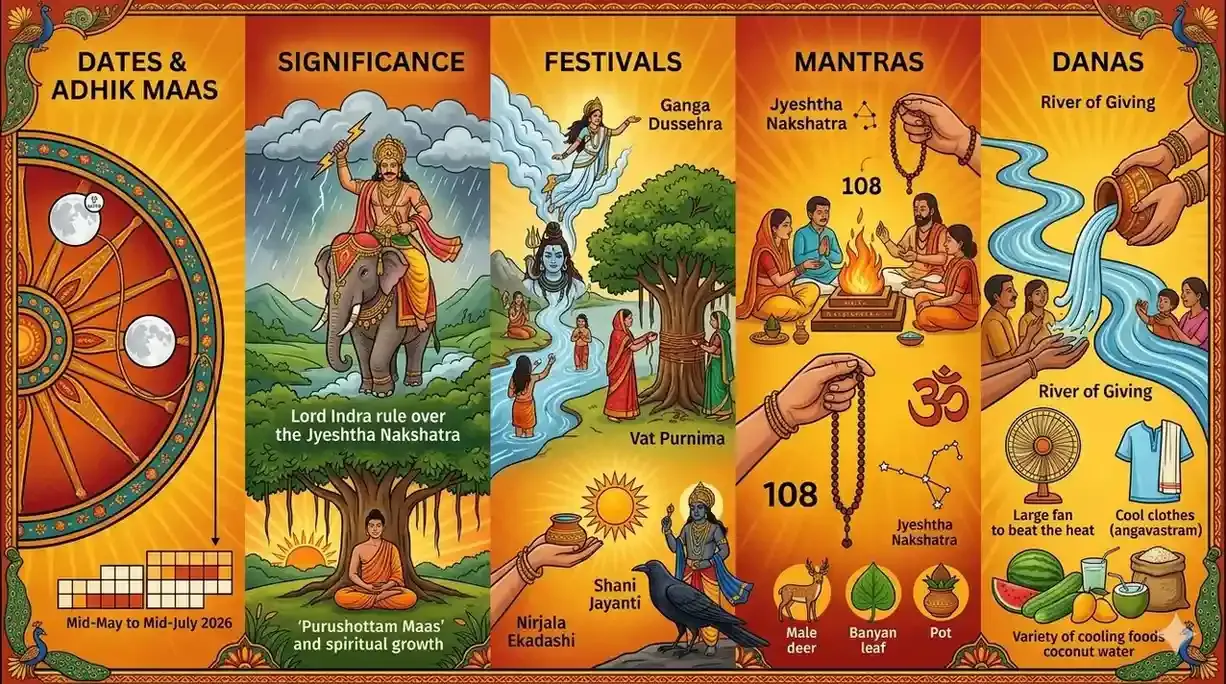
June 2026 Hindu Festival Calendar — Complete Dates, Vrat & Puja Guide for NRIs