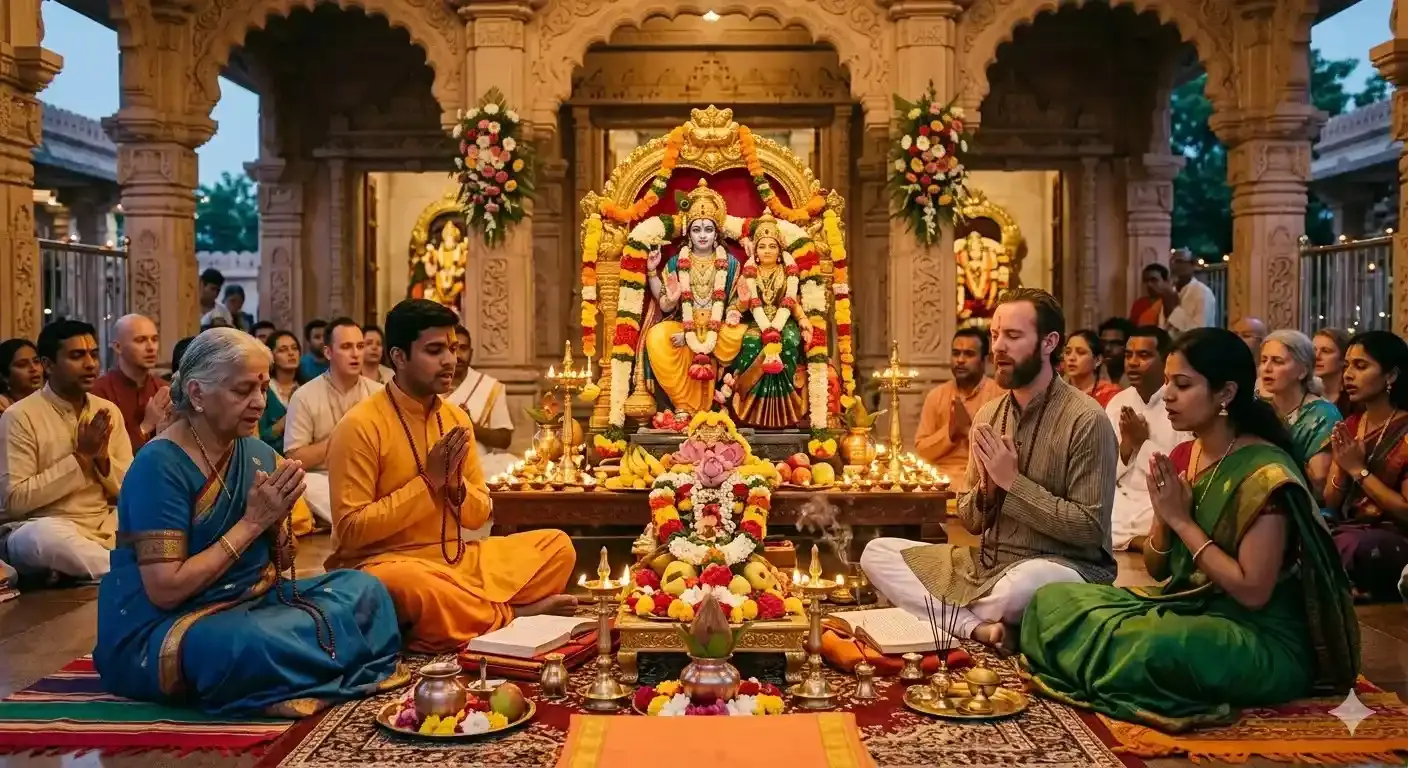
Gayatri Mantra: Complete Meaning, Power & How to Chant — The Supreme Vedic Prayer
[image: 🌅] The Gayatri Mantra — The Prayer That Has Been Chanted for 3,500 Years Every morning, as the first light of dawn breaks across the Indian…
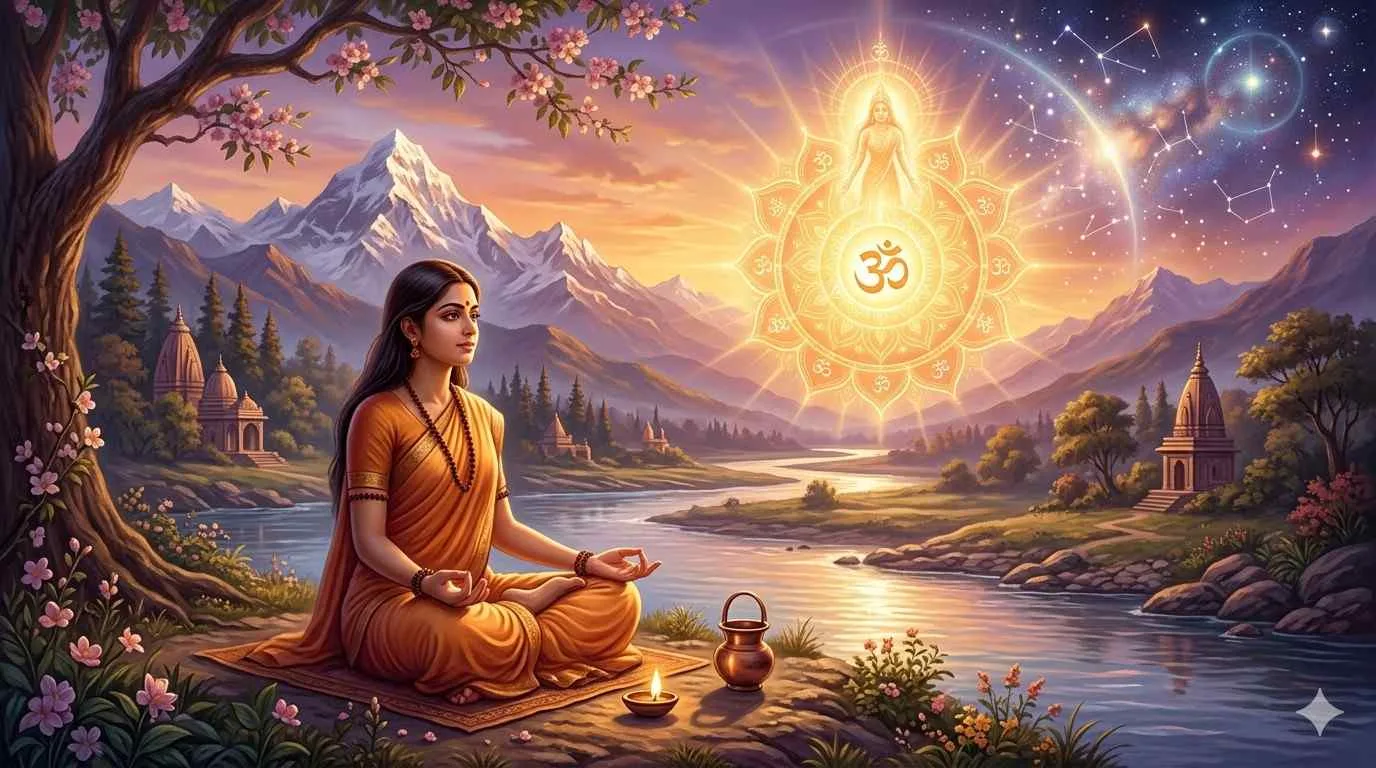
[image: 🌅] The Gayatri Mantra — The Prayer That Has Been Chanted for 3,500 Years Every morning, as the first light of dawn breaks across the Indian…
[image: 🌅] The Gayatri Mantra — The Prayer That Has Been Chanted for 3,500 Years
Every morning, as the first light of dawn breaks across the Indian subcontinent, hundreds of millions of voices rise with the sun — chanting the same 24 syllables that have been chanted at sunrise for at least 3,500 years. In Sanskrit. In perfect meter. With a devotion that defies easy explanation.
ॐ भूर्भुवः स्वः। तत्सवितुर्वरेण्यम्। भर्गो देवस्य धीमहि। धियो यो नः प्रचोदयात् ॥
This is the Gayatri Mantra — the most sacred, most universally revered, and most spiritually potent mantra in the entire treasury of Vedic civilization. It is found in the Rigveda (Mandala 3, Sukta 62, Mantra 10) — one of humanity's oldest surviving sacred texts — composed by the sage Vishwamitra as an offering to the divine light of cosmic consciousness.
It has been called:
- "The mother of all mantras" — the source from which all other Vedic mantras arise
- "The essence of the Vedas" — the four Vedas condensed into 24 syllables
- "The most important mantra in Hinduism" — by Adi Shankaracharya, Swami Vivekananda, Ramana Maharshi, and countless others
- "The supreme prayer of humanity" — by Mahatma Gandhi, who chanted it daily throughout his life
At HinduTone, we offer you the most complete, layered, and spiritually rich guide to the Gayatri Mantra — its exact text, its word-by-word meaning, its hidden symbolism, the extraordinary spiritual science encoded in its 24 syllables, the correct method of chanting, the best times and numbers, and the profound transformation it initiates in the consciousness of the sincere practitioner.
[image: 📜] The Complete Gayatri Mantra — Full Text
The Mantra in Sanskrit (Devanagari)
ॐ भूर्भुवः स्वः।
तत् सवितुर्वरेण्यम्।
भर्गो देवस्य धीमहि।
धियो यो नः प्रचोदयात् ॥
Transliteration (Roman Script)
Om Bhur Bhuvah Svah
Tat Savitur Varenyam
Bhargo Devasya Dhimahi
Dhiyo Yo Nah Prachodayat
Complete Translation (Word by Word)
The Complete Meaning — Full Translation
"We meditate upon the adorable, divine radiance of that supreme Sun (Savitri) who illumines all three worlds — the physical, the vital, and the mental. May that divine light illuminate and inspire our intellect toward the highest truth."
[image: 🌟] Understanding Every Layer — The Deep Structure of the Gayatri
The Gayatri Mantra is not a simple prayer. It is a precisely engineered instrument of consciousness — every syllable, every word, every structural element carrying multiple simultaneous layers of meaning. Understanding these layers transforms the chanting from a mechanical repetition into a living spiritual practice.
Layer 1: The Vyahritis — Three Sacred Seed Syllables
The three words that precede the main mantra — Bhur, Bhuvah, Svah — are called the Vyahritis (great utterances or manifestations). They represent:
The Three Worlds (Tri-Loka)
The Three States of Consciousness
The Three Bodies
The Three Times
When you chant "Bhur Bhuvah Svah" — you are invoking the entire universe simultaneously in its three dimensions of space, time, and consciousness. The Gayatri Mantra begins not with a small request but with a cosmic acknowledgment: the entire universe, in all its dimensions, is the context within which this prayer arises.
Layer 2: Savitri — The Sun Being Addressed
The Gayatri Mantra is addressed to Savitri — a specific aspect of the Sun God (Surya) that is particularly important to understand.
In the Vedic tradition, Surya has multiple names and aspects:
- Aditya — the son of Aditi (infinity)
- Surya — the luminous one
- Ravi — the one who dispels darkness
- Bhaskara — the one who makes things shine
- Savitri — the one who stimulates, animates, and impels
Savitri specifically refers to the Sun before it rises and after it sets — the invisible divine force of solar consciousness that exists even in darkness, that drives the sun's motion through the cosmos, that is the living intelligence behind the physical sun.
This is the crucial distinction: the Gayatri Mantra is not addressed to the physical disc of the sun that we see in the sky. It is addressed to Savitri — the divine consciousness that the physical sun represents and expresses.
Just as we distinguish between a lamp and the light of consciousness that reads by the lamp — the Gayatri distinguishes between the physical sun (a star, a ball of gas and nuclear fusion) and Savitri (the cosmic intelligence of which the physical sun is a manifestation).
This is why the Gayatri is meaningful and potent even at night, even when the physical sun is below the horizon — because Savitri, the divine consciousness, never sets.
Layer 3: Bhargo — The Purifying Radiance
The word Bhargo is one of the most profound and least understood words in the Gayatri Mantra. It is commonly translated simply as "radiance" or "light" — but its Sanskrit root carries much richer meaning.
Bharga comes from the root bhraj — meaning to shine, to flash, to blaze with light. But in the Vedic commentarial tradition, Bharga is understood as:
1. Tejas (Spiritual Radiance) The blazing inner light of pure consciousness — the self-luminous awareness that shines within the mind, revealing all thoughts and perceptions without itself being perceived by anything else.
2. Papanashaka (Destroyer of Sin) Bharga is specifically the quality of divine light that dissolves karma — that burns away the accumulated impressions (vasanas) of past actions, purifying the mind and freeing the soul from its bondage. Just as physical sunlight kills bacteria and purifies contaminated water — Bharga purifies the contaminated mind of its accumulated darkness.
3. Jnanashakti (Power of Knowledge) In the Upanishadic tradition, Bharga is identified with the power of Jnana (Self-Knowledge) — the knowledge that dissolves the fundamental ignorance (avidya) that binds the individual soul to the cycle of birth and death.
4. Prana (Life Force) In its most immediate manifestation, Bharga is the solar prana — the life-giving energy radiated by the sun that sustains all life on earth. This is why chanting the Gayatri at sunrise, facing the rising sun, is so potent — you are aligning yourself with the actual physical flow of solar prana at the moment of its maximum availability.
Layer 4: Dhimahi — We Meditate
Dhimahi is the first-person plural form of the verb root dhi — meaning to meditate, to contemplate, to hold in sustained awareness.
The choice of the plural form is extraordinarily significant. The Gayatri is not chanted as "I meditate" but as "We meditate" — making it inherently a collective prayer, not an individual petition.
When you chant the Gayatri, you are not praying alone. You are joining the unbroken stream of billions of voices across 3,500 years who have chanted these same syllables at dawn. You are part of a continuous current of human aspiration toward the light — a river of prayer that flows from the ancient rishis through every generation to the present moment.
Dhi is also the name for the faculty of higher intelligence — the discriminating wisdom (Prajna) that is distinct from ordinary intellectual cleverness. This is what makes the Gayatri a Dhimahi mantra — a meditation mantra for the activation and purification of the highest faculty of human consciousness.
Layer 5: Prachodayat — The Supreme Request
The mantra ends with a single petition: Prachodayat — "May it inspire/illuminate/impel."
Notice what is NOT being asked:
- Not for wealth or success
- Not for health or long life
- Not for children or relationships
- Not for power or fame
The Gayatri asks for only one thing: the illumination of the mind toward truth.
This makes it the most selfless, most spiritually elevated prayer possible. All other prayers ask for things that benefit the individual ego. The Gayatri asks for the purification of the very faculty — the intellect — that makes it possible to eventually realize the truth that transcends the individual ego altogether.
In asking for the illumination of the mind, the Gayatri asks for the one gift that makes all other gifts unnecessary — because the illuminated mind, recognizing its own nature as pure consciousness, is already whole and complete, already lacking nothing.
[image: 🔢] The Sacred Number 24 — Why Gayatri Has Exactly 24 Syllables
The Gayatri Mantra contains exactly 24 syllables — not 23, not 25. This is not accidental. The number 24 is one of the most sacred numbers in both Vedic cosmology and mathematical symbolism.
The 24 Syllables Listed
Why 24?
1. The 24 Hours of the Day The Gayatri encompasses the complete cycle of a day — as the Konark Sun Temple's 24 wheels also encode. Chanting the Gayatri is an act of consecrating all 24 hours of existence to the divine light.
2. The 24 Tattvas (Principles of Creation) Samkhya philosophy — one of the oldest philosophical schools of India — describes 24 fundamental principles (tattvas) that constitute the manifest universe, from Prakriti (primordial matter) to the five elements. The 24 syllables of the Gayatri correspond to these 24 principles — making the mantra a complete map of the entire created universe.
3. The 24 Vertebrae of the Human Spine The human spine has 24 movable vertebrae (7 cervical + 12 thoracic + 5 lumbar). In the yogic tradition, the spine is the axis of consciousness — the pathway of the Kundalini energy from the base to the crown. The 24 syllables of the Gayatri resonate with the 24 vertebral levels of this axis.
4. The 24 Avatars of Lord Vishnu The Bhagavata Purana lists 24 primary avatars of Lord Vishnu — divine descents into the world for the restoration of dharma. Each of the Gayatri's 24 syllables is associated with one of these avatars in the tradition of Vaishnava Gayatri interpretation.
5. The 24 Elders in the Book of Revelation (Cross-Cultural) The number 24 appears across multiple sacred traditions as a number of cosmic completeness — suggesting that this mathematical structure touches something fundamental in the organization of consciousness itself.
[image: 🎵] The Vedic Meter — Gayatri Chandas
The Gayatri Mantra is composed in the Gayatri Chandas (Gayatri meter) — a specific musical-mathematical structure that is itself considered sacred.
The Structure of Gayatri Meter
The Gayatri meter consists of:
- 3 lines (padas)
- 8 syllables per line
- Total: 24 syllables
The three padas are:
Pada 1: Tat — Sa — Vi — Tur — Va — Re — Ni — Yam (8 syllables)
Pada 2: Bhar — Go — De — Va — Sya — Dhi — Ma — Hi (8 syllables)
Pada 3: Dhi — Yo — Yo — Nah — Pra — Cho — Da — Yat (8 syllables)
This 3×8 structure is not arbitrary. In Vedic mathematics:
- 3 represents the Trimurti (Brahma-Vishnu-Shiva) — the three cosmic functions
- 8 represents the eight directions of space (Ashta Disha) — completeness in all spatial dimensions
- 3×8 = 24 represents the complete integration of the Trimurti across all directions of existence
How the Meter Creates Sound Healing
Modern research into cymatics (the science of sound-form relationships) and binaural acoustics suggests that the specific pattern of short and long syllables in the Gayatri meter creates standing waves of sound that have measurable effects on neural oscillation patterns in the brain — particularly in the alpha and theta wave ranges associated with meditative states.
Ancient Vedic scholars understood this intuitively — not through EEG machines but through direct experience and thousands of years of observation. The Gayatri meter was not chosen for poetic elegance alone but for its capacity to alter consciousness in a specific, beneficial direction.
[image: 📿] The Goddess Gayatri — The Divine Mother of the Mantra
The Gayatri Mantra is not merely a prayer — it is also the name and form of a goddess. Goddess Gayatri is one of the most revered forms of the Divine Mother in Hinduism — the presiding deity of the mantra that bears her name.
Who is Goddess Gayatri?
Goddess Gayatri is described in the texts as:
- The mother of the four Vedas — from whom all Vedic knowledge arises
- The consort of Lord Brahma — the creative power of the universe
- The embodiment of Savitri — the divine solar consciousness in feminine form
- Saraswati in her supreme form — the goddess of knowledge, wisdom, and speech
- The Adishakti — the primordial energy from which all forms of the Divine Mother arise
The Iconography of Goddess Gayatri
Goddess Gayatri is depicted with:
- Five faces (Pancha Mukha) — representing the five Pranas (life forces), the five elements, and the five great mantras (Pancha Brahma mantras)
- Ten arms — holding sacred objects including the lotus, conch, chakra, Vedas, and the gesture of blessing
- Seated on a lotus (Padmasana) — above a swan (Hamsa) — symbolizing the discrimination between the real and the unreal
- Radiant golden complexion — the color of the rising sun
- Wearing red and white garments — symbolizing auspiciousness and purity
The Three Forms of Gayatri — Morning, Noon, Evening
Like the three Surya idols at Konark, Goddess Gayatri manifests in three forms corresponding to the three times of day when the Gayatri is traditionally chanted:
This three-form understanding is why the Gayatri is chanted specifically at the three Sandhyas (twilight junctions) — dawn, noon, and dusk — when the transition between phases of the day opens a special channel to the divine.
[image: ⏰] When to Chant — The Three Sacred Times (Sandhya Vandanam)
The traditional practice of Sandhya Vandanam (twilight worship) prescribes the Gayatri Mantra to be chanted at three specific times each day. These are the Sandhya Kaalas — the sacred junction times when the boundary between the material and spiritual dimensions is at its thinnest.
The Three Sandhya Times
Why These Specific Times?
The three Sandhya times are not merely conventional — they correspond to genuine shifts in:
Solar radiation patterns: At the junctions of day and night, the angle of solar radiation changes dramatically, altering the quality of prana available in the atmosphere.
Atmospheric ionization: The earth's ionosphere — the layer of charged particles in the upper atmosphere — undergoes rapid changes at sunrise and sunset, creating measurable shifts in electromagnetic conditions.
Human physiology: The body's circadian rhythms, hormonal patterns, and neural oscillation cycles shift at these junction points — creating brief windows of natural receptivity.
Yogic tradition: The Sandhya times are when the Ida and Pingala nadis (the two main energy channels of the yogic body) are in their most balanced state, creating conditions for Sushumna activation — the opening of the central channel through which consciousness ascends.
This is why the Gayatri has always been chanted at these specific times — not because of arbitrary convention but because the universe itself creates a window of maximum spiritual receptivity at these junctions. The rishis observed this directly and encoded it in the practice.
[image: 🕉️] How to Chant the Gayatri Mantra — Complete Step-by-Step Guide
Preparation Before Chanting
Physical Preparation:
- Take a bath or at minimum wash your hands, feet, and face
- Wear clean, preferably white or light-colored clothing
- Sit on a woolen mat or grass mat (insulates from the earth's electromagnetic field during practice)
- Face east at sunrise, north at noon, west at sunset
Mental Preparation:
- Spend 2–3 minutes in silence before beginning, allowing the mind to settle
- Set a clear Sankalpa (intention): "I chant this Gayatri Mantra for the illumination of my intellect and the welfare of all beings"
- Begin with three deep Pranayama breaths — inhale filling the lungs completely, hold briefly, exhale slowly
The Achamana — Sipping Water Before Chanting
The traditional practice begins with Achamana — sipping water three times while chanting:
Om Achyutaya Namah (sip water)
Om Anantaya Namah (sip water)
Om Govindaya Namah (sip water)
This purifies the mouth and the prana sheath before chanting begins.
The Pranayama — Breathing Practice With the Mantra
Before the main chanting, the traditional practice includes Gayatri Pranayama — a breathing exercise that purifies the subtle body and prepares the mind for the mantra's vibration.
Method:
- Cover the right nostril with the right thumb — inhale slowly through the LEFT nostril, internally chanting the Gayatri once
- Close both nostrils — hold the breath, internally chanting the Gayatri three times
- Cover the left nostril — exhale slowly through the RIGHT nostril, internally chanting the Gayatri once
Repeat three times. This practice charges the entire system with Gayatri energy before audible chanting begins.
The Main Chanting — Japa Vidhi
Step 1: Begin with Om Chant Om three times, allowing the sound to resonate fully — feeling it vibrate in the chest, throat, and skull.
Step 2: Chant the Vyahritis
Om Bhur (pause)
Om Bhuvah (pause)
Om Svah (pause)
Om Bhur Bhuvah Svah (together)
Step 3: Chant the Full Gayatri Mantra
ॐ भूर्भुवः स्वः।
तत् सवितुर्वरेण्यम्।
भर्गो देवस्य धीमहि।
धियो यो नः प्रचोदयात् ॥
Pronunciation Guide:
Using a Mala (Rosary) for Counting
The traditional counting tool for Gayatri Japa is a Tulsi mala (holy basil rosary) of 108 beads.
How to use the mala:
- Hold the mala in the right hand, draped over the middle finger
- Use the thumb to turn each bead after completing one recitation
- Never cross the Sumeru bead (the large bead at the top) — when you reach it, reverse direction
- Keep the mala below the navel or in a mala bag to prevent it from touching the ground
Why 108? The number 108 is sacred in Hindu, Buddhist, and Jain traditions for multiple reasons:
- 1 represents the Divine unity; 0 represents the void/infinity; 8 represents infinity/eternity
- The distance between the earth and the sun is approximately 108 times the sun's diameter
- The distance between the earth and the moon is approximately 108 times the moon's diameter
- There are 108 Upanishads, 108 names of major deities, 108 sacred sites in the Vaishnavite tradition
- The body has 108 marma points (vital energy junctions) in Ayurveda
Recommended Numbers of Repetitions
Mudras During Gayatri Chanting
Certain hand gestures (mudras) enhance the resonance of the Gayatri during chanting:
Dhyana Mudra (Meditation gesture): Both hands resting in the lap, right hand over left, thumbs lightly touching — the standard meditation posture for sustained Japa practice.
Surya Mudra (Sun gesture): The ring finger bent to touch the base of the thumb, remaining fingers extended — activates solar energy in the body, appropriate for morning Gayatri practice.
Chin Mudra (Consciousness gesture): Thumb and index finger forming a circle, remaining fingers extended — the gesture of the teacher, appropriate for contemplative Gayatri practice.
The Samarpana — Offering the Merit at the End
Always conclude Gayatri Japa with this offering of the accumulated merit to all beings:
कायेन वाचा मनसेन्द्रियैर्वा
बुद्ध्यात्मना वानुसृतस्वभावात्।
करोमि यद्यत् सकलं परस्मै
नारायणायेति समर्पयामि ॥
Kayena Vacha Manasendriairva
Buddhyatmana Va Anusruta Svabhavat
Karomi Yad Yat Sakalam Parasmai
Narayanayeti Samarpayami
"Whatever I have done through body, speech, mind, senses, intellect, or my own natural being — I offer it all to the Supreme Narayana."
[image: 🧘] Visualization During Gayatri Chanting
The most advanced form of Gayatri practice combines chanting with dhyana (visualization). The traditional visualization is:
The Rising Sun: With eyes gently closed, visualize the golden disc of the rising sun on the eastern horizon — its light filling the entire sky with warm gold. See this light entering through the crown of your head, flowing down through the spine, filling every cell of the body with golden radiance.
The Goddess Gayatri: Visualize Goddess Gayatri seated within the sun disc — her five faces radiant, her ten arms holding sacred objects, her golden body glowing with the concentrated light of a thousand suns. See her presence as the source of all the light you are receiving.
The Inner Sun: As chanting deepens, shift the visualization inward — from the external sun to the inner sun of awareness at the center of your own chest (the Anahata chakra / heart center). This inner sun is your own consciousness — the same Savitri that the mantra addresses, present within you as the witness of all experience.
[image: 🔬] The Scientific Perspective — What Research Says About Gayatri
Modern science has begun investigating what traditional practitioners have known for millennia — that the Gayatri Mantra creates measurable, beneficial changes in the human body and brain.
Neurological Research
Studies conducted at various institutions including the All India Institute of Medical Sciences (AIIMS) and international acoustic research centers have found:
Brain Wave Patterns: Regular Gayatri chanting is associated with increased alpha wave activity (8–12 Hz range) — the brain state associated with calm alertness, creative thinking, and meditative awareness — and theta wave activity (4–8 Hz) associated with deep meditation and intuitive insight.
Bilateral Brain Activation: The specific phonemic pattern of the Gayatri's 24 syllables activates both hemispheres of the brain simultaneously in a synchronized pattern — creating what neuroscientists call neural coherence, associated with heightened intelligence, emotional stability, and spiritual experiences.
Stress Hormone Reduction: Regular chanting practice is associated with reduced cortisol levels (the stress hormone) and increased DHEA levels — suggesting that the practice engages the parasympathetic nervous system and promotes the physiological state of calm, restful alertness.
Acoustic Research
Resonance in Sacred Spaces: The frequency spectrum of the Gayatri Mantra — when chanted correctly with proper pronunciation — creates standing wave patterns in enclosed spaces that have been measured to resonate with the Schumann Resonance (7.83 Hz) — the fundamental electromagnetic frequency of the earth-ionosphere cavity, sometimes called "the heartbeat of the earth."
Cymatics: When the Gayatri is chanted over water and the water's surface is photographed using cymatics techniques (making sound waves visible through the patterns they create in liquids), the patterns observed correspond to geometric forms found across sacred architecture — including patterns similar to the Sri Yantra and the lotus flower.
Ayurvedic Perspective
Pranashakti Enhancement: Chanting the Gayatri — particularly at sunrise — is understood in Ayurveda to significantly enhance Pranashakti (life force) by aligning the practitioner's prana with the solar prana that is most abundant and accessible at the moment of sunrise.
Tridosha Balancing: The specific sound frequencies of the Gayatri are said to balance all three doshas (Vata, Pitta, and Kapha) simultaneously — explaining why Ayurvedic texts recommend Gayatri chanting as a form of Svaraushadi (sound medicine) for a wide range of physical and mental health conditions.
[image: ✨] The Extraordinary Benefits of Gayatri Japa
Spiritual Benefits
Mental and Psychological Benefits
Physical Benefits
Worldly Benefits (Described in Tradition)
- Protection from negative energies and harmful influences
- Improvement in academic and professional performance
- Harmonious relationships and family welfare
- Financial stability and prosperity
- Protection during travel
- Success in righteous endeavors
[image: 👶] Who Can Chant the Gayatri Mantra?
The Traditional Position
Traditionally, the Gayatri Mantra was initiated through the Upanayana ceremony (sacred thread ceremony) and was taught only to males of the three upper varnas (Brahmin, Kshatriya, Vaishya). This restriction was based on the concern that improper pronunciation or context could make the mantra ineffective — and reflected the social structure of ancient India.
The Modern Understanding
Swami Vivekananda, Mahatma Gandhi, Ramana Maharshi, Pandurang Shastri Athavale (founder of the Swadhyaya movement), Swami Sivananda, and most contemporary spiritual masters have explicitly declared that:
"The Gayatri Mantra belongs to all of humanity. The divine light of Savitri shines equally on all beings regardless of gender, caste, creed, or nationality. Any sincere seeker who approaches the Gayatri with reverence and proper understanding is entitled to its grace."
Women and the Gayatri: Many great women saints — including Anandamayi Ma, Mirabai, and many others — were devoted Gayatri practitioners. The mantra is addressed to Savitri — the divine feminine solar principle — and it would be cosmically inconsistent for the feminine form of the divine to be inaccessible to women.
Non-Hindus and the Gayatri: The Gayatri addresses universal solar consciousness — not a deity of any particular religion. It is a prayer to the light of awareness itself. Sincere seekers of all traditions who approach it with reverence have reported profound experiences.
Children: Children can begin chanting the Gayatri from approximately age 5 — initially as a simple morning prayer, developing into more formal practice as they grow. Teaching children the Gayatri is considered one of the greatest gifts a parent can give.
[image: 🌸] Special Gayatri Practices for Different Purposes
Gayatri for Students — Enhancing Learning
For students preparing for examinations or seeking to enhance their learning capacity:
- Chant 108 times every morning before study
- Specifically visualize the golden light of the Gayatri filling the brain with clarity
- Chant slowly and deliberately, giving each syllable its full value
- This practice specifically activates the Saraswati (knowledge) aspect of Goddess Gayatri
Gayatri for Healing
For those seeking physical healing or supporting recovery from illness:
- Chant 1,008 times over 11 consecutive days (a traditional healing Anushthana)
- Face the rising sun while chanting
- Drink a glass of water that has been held in the sunlight during chanting
- This practice invokes the Savitri (solar healing) aspect of the Goddess
Gayatri for Protection
For those seeking protection from negative energies or harmful circumstances:
- Chant 108 times before sleep — visualizing a golden shield of light forming around yourself and your home
- This practice invokes Bhargo — the purifying radiance that dissolves all negative influences
Gayatri for Grief and Healing of the Heart
For those experiencing grief, loss, or emotional pain:
- Chant slowly and softly, at sunset, 21 times
- Allow the mantra to become a gentle current carrying the grief, not fighting it
- The evening Saraswati form of the Goddess is particularly compassionate toward those in sorrow
[image: 📿] The Gayatri Mantra and the Great Saints
Mahatma Gandhi
Mahatma Gandhi chanted the Gayatri Mantra every day of his adult life — describing it as the greatest gift he had received from his mother, who taught it to him as a child. He said:
"The Gayatri Mantra is the most meaningful mantra I know. It protects the one who chants it."
Swami Vivekananda
Swami Vivekananda called the Gayatri "the holiest verse of the Vedas" and explicitly taught it to people of all castes and backgrounds — a revolutionary act in 19th-century India. He said:
"The Gayatri is the essence of all mantras. As rivers merge in the ocean, all mantras merge in the Gayatri."
Ramana Maharshi
The great sage of Arunachala, Ramana Maharshi, when asked about the Gayatri's meaning, pointed beyond the words to the Self:
"The Gayatri is the best mantra because it asks for the illumination of the Buddhi (intellect). When the Buddhi is purified, it recognizes its own source — the Self — and that recognition is liberation."
Sri Aurobindo
The philosopher-sage Sri Aurobindo translated and meditated upon the Gayatri extensively, calling it "the mantra of the divine light — the conscious force that creates, sustains, and transforms." He saw in the word Savitri not just the Sun but the entire creative force of the Supermind — the divine consciousness descending into matter.
Pandurang Shastri Athavale (Dada)
The founder of the Swadhyaya movement, Dada Athavale, made the Gayatri the central practice of his movement — teaching it to millions of ordinary people across Maharashtra and Gujarat as the practice of "offering oneself to the divine light."
[image: 🌍] The Gayatri Across Traditions — A Universal Prayer
The Gayatri's address to the divine light of consciousness — without specifying any particular form, name, or theology — has made it resonant across multiple traditions:
Gayatri and Buddhism
The concept of Prajna (wisdom/light) in Buddhism parallels the Gayatri's request for illumination of the Buddhi. The Gayatri's three planes (Bhur-Bhuvah-Svah) correspond to Buddhist teachings on the three realms of existence. Many Buddhist practitioners in India use the Gayatri as a morning contemplative practice.
Gayatri and Jainism
The Jain Navkar Mantra — the supreme prayer of Jainism — shares structural similarities with the Gayatri in its universal scope. Both pray not to a personal deity but to the quality of enlightened consciousness itself.
Gayatri and the Sikh Tradition
The Mul Mantar — the foundational prayer of Sikhism from the Guru Granth Sahib — addresses the same eternal truth that the Gayatri points toward: the infinite, formless, self-luminous divine consciousness that transcends all description.
The Gayatri and Modern Humanity
In an age when the world is fragmented by religious, national, and ideological divisions — when the question "What can unite humanity?" feels increasingly urgent — the Gayatri offers a quiet answer:
This prayer for the illumination of the human mind — offered in the same words at the same sunrise, by people of every caste, creed, and background — is perhaps the oldest, most continuous act of human solidarity in existence.
Every person who chants the Gayatri joins a river of prayer that flows from the dawn of human civilization to this present moment — carrying the same aspiration, the same light, the same hope:
May our minds be illuminated. May our actions serve the truth. May the divine light that created us guide us back home.
[image: 🌅] The Gayatri at Dawn — The Most Sacred Practice
Of all the times to chant the Gayatri, the practice at Brahma Muhurta — the hour before sunrise — is considered the most powerful and transformative.
The Brahma Muhurta (literally "the time of Brahma" — the Creator) begins approximately 1 hour 36 minutes before sunrise and ends 48 minutes before sunrise. This is the time when:
- The atmosphere is at its most charged with prana from the approaching sun
- The Ida and Pingala nadis are perfectly balanced — creating ideal conditions for spiritual practice
- The mind, refreshed from sleep, is at its most receptive
- The veil between the material and spiritual dimensions is thinnest
- The sattva guna (quality of clarity and purity) dominates the atmosphere before the activity and passion of the day begin
The Brahma Muhurta Practice:
- Wake at least 90 minutes before sunrise
- Bathe and come to your practice space
- Sit facing east, in a comfortable meditative posture
- Begin with pranayama
- Chant Gayatri 108 times — slowly, with full awareness of each syllable
- Sit in silence for 10–20 minutes after chanting — this silent period after chanting is when the deepest transformation occurs
- Open your eyes as the first light of the sun appears on the horizon
Practitioners who have maintained this practice for years consistently describe it as the single most transformative spiritual practice in their life — regardless of what other practices they may also follow.
[image: 🙏] Closing — The Light That Is Already Here
After everything — all the layers of meaning, the science, the history, the practice instructions, the stories of saints — the Gayatri eventually brings every sincere practitioner to the same silent threshold.
It is the threshold where the prayer ceases to be something you are doing and becomes something you are being.
Where the 24 syllables have been repeated enough times that they no longer feel like words but like the natural rhythm of your own breathing, your own heartbeat, your own awareness.
Where Savitri — the divine solar consciousness addressed in the mantra — is recognized not as something external and distant, reachable only through prayer, but as the very light by which you are reading these words, by which you are aware of your own existence, by which the universe is conscious of itself through you.
This is the fulfillment of the Gayatri's petition.
"May that divine light illuminate our intellect" — not the small intellect that solves problems and accumulates information, but the supreme intelligence of the soul that recognizes its own divine nature.
When that recognition dawns — as simply and as naturally as the sun rising over the horizon — the mantra has done its work.
You are Savitri. You are the light. You always were.
The Gayatri was only ever reminding you.
ॐ भूर्भुवः स्वः।
तत् सवितुर्वरेण्यम्।
भर्गो देवस्य धीमहि।
धियो यो नः प्रचोदयात् ॥
Om Tat Sat | Jai Mata Gayatri | Om Suryaya Namah
[image: 📖] Frequently Asked Questions
Q1. Can women chant the Gayatri Mantra?
A: Yes — unambiguously and completely. While ancient texts restricted Gayatri initiation through the Upanayana ceremony to males of certain varnas, modern spiritual masters including Swami Vivekananda, Ramana Maharshi, Swami Sivananda, and virtually all contemporary teachers have explicitly confirmed that the Gayatri Mantra is for all sincere seekers regardless of gender, caste, or background. The mantra is addressed to Savitri — the divine feminine solar principle — and is naturally appropriate for women.
Q2. How many times should I chant the Gayatri Mantra daily?
A: The minimum recommended number is 3 times (once at each Sandhya). For a meaningful Japa practice, 108 times per session is standard. For intensive practice, 324 (three malas) per day produces deep transformation. Complete consistency over time matters far more than occasional large numbers — 108 repetitions every morning for a year is more transformative than 10,000 repetitions on a single day.
Q3. Can I chant the Gayatri Mantra at night?
A: The primary prescription is for the three Sandhya times — sunrise, noon, and sunset. Chanting at night is not prohibited, but the optimal prana conditions are not present after dark. If night is the only time available, chanting is still beneficial — the sincerity of the practitioner is always more important than the perfect external conditions.
Q4. Is there a specific age to begin chanting the Gayatri Mantra?
A: Traditionally, Gayatri initiation occurred through the Upanayana ceremony between ages 7–12. In modern practice, children can begin a simple, devotional Gayatri practice from age 5. Young children should approach it as a beautiful morning prayer rather than a formal Japa practice. As they grow older and develop concentration, the practice can deepen naturally.
Q5. What is the difference between the Gayatri Mantra and the Surya Namaskara mantras?
A: The Gayatri Mantra is a meditation prayer addressed to Savitri — the divine solar consciousness — in its aspect as the illuminator of the mind. The Surya Namaskara mantras (12 names of Surya) are salutations to the Sun God in his 12 aspects corresponding to the zodiacal year. They are complementary practices — the Surya Namaskara honors the physical solar cycle while the Gayatri addresses the inner solar consciousness. Many practitioners combine both: Surya Namaskara (the physical practice) followed by Gayatri Japa (the meditative practice) at sunrise.
Q6. Does the Gayatri Mantra need to be formally initiated by a guru?
A: Traditional practice recommends formal initiation (Diksha) from a qualified teacher — because the guru's transmission adds the living current of a continuous lineage to the mantra's inherent power. However, the Gayatri Mantra is available in all Vedic texts and can be begun as a sincere personal practice by anyone with reverence and proper understanding. If a qualified teacher is available, initiation is recommended. If not — begin with sincerity, learn proper pronunciation, and the Goddess herself becomes your teacher.
Q7. What should I do if I make pronunciation mistakes while chanting?
A: Don't be anxious about it. Perfect pronunciation is the goal to work toward — not the prerequisite for beginning. The intention and sincerity of the heart carry the greatest weight. Study the correct pronunciation using audio recordings from authentic sources, practice slowly, and the pronunciation will improve naturally over time. The ancient texts say: "Even a mantra chanted imperfectly, with sincere devotion, reaches the divine."
© 2026 HinduTone.com | All Rights Reserved
www.hindutone.com — Your Trusted Guide to Hindu Spirituality, Mantras, and Sacred Traditions
Related Posts You May Like:
- Konark Sun Temple: Spiritual Significance & Hidden Symbolism
- Surya Jayanti 2026: The Festival of the Sun God — Significance, Rituals & Mantras
- Pournami Vrat Katha: The Sacred Story of Full Moon Fasting
- Chitra Pournami 2026: Significance, Rituals & Mantras
- Maha Mrityunjaya Mantra: Complete Meaning, Power & How to Chant
- Om Namah Shivaya: The Five-Syllable Mantra That Contains the Universe
- Aditya Hridayam: The Heart of the Sun — Complete Text, Meaning & Benefits
You might also like
Gayatri Mantra: Meaning, Benefits & Chanting Guide
Gayatri Mantra — Complete Meaning, 24-Syllable Vedic Breakdown, Sandhya Vandanam & 30-Day NRI Practice Guide for 2026
Mahamrityunjaya Mantra: Meaning & Healing Power