Aditya Hridayam: The Heart of the Sun — Complete Text, Meaning & Benefits
[image: ☀️] Aditya Hridayam — The Prayer That Turned the Tide of the Greatest War There are prayers born in temples — composed in the calm of sacred groves,…

[image: ☀️] Aditya Hridayam — The Prayer That Turned the Tide of the Greatest War There are prayers born in temples — composed in the calm of sacred groves,…
[image: ☀️] Aditya Hridayam — The Prayer That Turned the Tide of the Greatest War
There are prayers born in temples — composed in the calm of sacred groves, offered in the stillness of early morning, shaped by the leisure of devotion.
And then there are prayers born on battlefields — forged in the furnace of exhaustion and despair, offered in the dust and smoke of war, given when the one praying has nothing left and everything to lose.
The Aditya Hridayam is such a prayer.
It was not composed in a peaceful ashram. It was not offered at a quiet altar. It was given on the battlefield of Lanka — at the most desperate moment of the most epic war in human history — to a warrior who had fought for months across an ocean, who stood before the greatest demon-king the world had ever seen, and who, for the first time, felt his strength failing.
That warrior was Lord Rama.
The sage who appeared to him in that moment — like a shaft of sunlight breaking through storm clouds — was Agastya Muni, one of the seven immortal Saptarishis.
And the teaching Agastya gave Rama — the 31 verses of the Aditya Hridayam — is one of the most extraordinary spiritual documents in all of Sanskrit literature. It is simultaneously a complete theology of the Sun God, a practical mantra for invincibility, a philosophical treatise on cosmic consciousness, and a living transmission of the ancient solar science that had sustained Rama's entire lineage — the Suryavansha (Solar Dynasty) — from the very beginning of time.
At HinduTone, we offer you the most complete guide to the Aditya Hridayam — the original battlefield story, the complete Sanskrit text with transliteration, the verse-by-verse meaning in English, the extraordinary spiritual significance of each section, the complete chanting guide, and the transformative benefits that thousands of years of devoted practice have established in this most powerful of all Surya stotras.
[image: 📅] Aditya Hridayam — Sacred Facts at a Glance
[image: 📖] The Battlefield Story — How Aditya Hridayam Was Born
The War at Lanka — The Context
To truly understand the Aditya Hridayam, we must understand the moment in which it was born — because the prayer carries the full weight and urgency of that extraordinary moment in every syllable.
The Ramayana war had been raging on the shores and plains of Lanka for months. Lord Rama — the seventh avatar of Vishnu, prince of Ayodhya, son of the Solar Dynasty — had crossed an ocean with an army of Vanaras (forest warriors), breached the demon-king Ravana's invincible fortress, and fought through wave after wave of Ravana's greatest generals.
Indrajit — Ravana's son, the one who had defeated even Indra — had been slain by Lakshmana. Kumbhakarna — the colossus who shook the earth with his footsteps — had been slain by Rama himself. Every champion of Lanka had fallen.
Now, at last, the two principals stood opposite each other on the battlefield: Sri Rama and Ravana.
This was not merely a military confrontation. It was a cosmic moment — the meeting of dharma and adharma, of light and darkness, of the divine and the demonic, on the open field of history.
The Crisis — Rama's Exhaustion
The battle between Rama and Ravana had been fierce beyond description. Rama's arrows struck true — but Ravana would not fall. His ten heads, severed by Rama's celestial weapons, grew back immediately. His chariots, destroyed, were replaced instantly. His armor, shattered, reformed around him.
The demon-king seemed invincible.
And Rama — for the first time in the entire war — stood still in the middle of the battlefield, looking at Ravana with something that the Valmiki Ramayana describes in four devastating Sanskrit words:
"Chintaya samavisto — ravim cha samudaikshata"
"Seized by deep thought — he gazed upon the sun."
This single image — the divine warrior, standing still in the chaos of battle, gazing at the sun — is one of the most profound moments in all of Sanskrit literature. It captures something deeply human: the moment when every strategy has been tried, every weapon deployed, every resource exhausted, and the warrior stands not knowing what to do next.
Rama was exhausted. Not merely physically — but in a way that the Ramayana's tradition of commentary has always recognized as something deeper: he was experiencing what the Bhagavad Gita would later call Vishada — the spiritual crisis that precedes the deepest transformation.
He was standing at the edge of his known capacity — looking at the sun, as if seeking from the source of all light the illumination he needed to complete his dharma.
The Appearance of Agastya — Grace Arriving at the Right Moment
At this exact moment — when Rama stood gazing at the sun in exhausted contemplation — the ancient sage Agastya Muni descended from the sky and alighted beside him on the battlefield.
Agastya is no ordinary sage in the Vedic tradition. He is one of the seven immortal Saptarishis — the seven cosmic sages who were created by Lord Brahma at the dawn of creation to serve as the custodians of Vedic knowledge across all cycles of time. He is the sage who drank the entire ocean in one sip to expose the demons hiding in it. He is the sage who crossed the Vindhya mountains when they threatened to grow so high they would block the sun. He is the sage who civilized the entire South of India, bringing the Vedic knowledge from the north to every corner of the subcontinent.
This is the sage who appeared to Rama at his darkest moment.
And before Agastya speaks a single word of the teaching, Valmiki describes his arrival with extraordinary precision:
"The glorious great Agastya — who had come with the gods to witness the great war — approached Rama who was battle-weary and standing absorbed in thought, and spoke these words..."
Notice: Agastya had been watching the entire war from among the divine witnesses in the sky. He knew exactly what was happening. He came precisely when Rama needed him — not a moment before, not a moment after.
This is the nature of the true Guru: present always, appearing when the student is finally ready to receive.
Agastya's Opening Words — The Framing of the Teaching
Before giving Rama the hymn, Agastya speaks words that frame everything that follows:
"Rama Rama mahabaho shrunu guhyam sanatana"
"O Rama, O Rama of mighty arms — listen to this eternal secret"
Two things in this framing are extraordinary:
First — Agastya addresses Rama as "mahabaho" (mighty-armed) in the very moment when Rama's mighty arms have been unable to defeat the enemy before him. It is a reminder: Rama's strength is real and divine — but it needs to be connected to its source.
Second — Agastya calls the teaching "guhyam sanatana" — "the eternal secret." Not a new technique, not a special weapon, not a clever strategy. An eternal secret — something that has always been true, that Rama has always known at some level, but that needs to be explicitly remembered and activated in this moment.
[image: 🕉️] The Complete Aditya Hridayam — All 31 Verses
Invocation Verses (1–2) — The Setting
Verse 1:
ततो युद्धपरिश्रान्तं समरे चिन्तया स्थितम्।
रावणं चाग्रतो दृष्ट्वा युद्धाय समुपस्थितम् ॥१॥
Tato yuddha-parishrantam samare chintaya sthitam
Ravanam chagrato drishtva yuddhaya samupasthitam
Meaning: Then, seeing Rama standing exhausted and absorbed in deep thought on the battlefield, with Ravana standing before him ready to fight —
Verse 2:
दैवतैश्च समागम्य द्रष्टुमभ्यागतो रणम्।
उपागम्याब्रवीद्रामम् अगस्त्यो भगवानृषिः ॥२॥
Daivataischa samagamya drashtum abhyagato ranam
Upagamyabravid Ramam Agastyo Bhagavan Rishih
Meaning: — the divine sage Bhagavan Agastya, who had come with the gods to witness the war, approached Rama and spoke these words:
The Teaching Begins (Verses 3–5) — The Eternal Secret
Verse 3:
राम राम महाबाहो श्रृणु गुह्यं सनातनम्।
येन सर्वानरीन् वत्स समरे विजयिष्यसि ॥३॥
Rama Rama maha-baho shrinu guhyam sanatanam
Yena sarvan arim vatsa samare vijayishyasi
Meaning: O Rama, O Rama of mighty arms — listen, dear child, to this eternal secret by which you shall conquer all your enemies in battle.
Verse 4:
आदित्यहृदयं पुण्यं सर्वशत्रुविनाशनम्।
जयावहं जपेन्नित्यम् अक्षय्यं परमं शिवम् ॥४॥
Aditya-hridayam punyam sarva-shatru-vinashanam
Jayavaham japen nityam akshayam paramam shivam
Meaning: This holy Aditya Hridayam — destroyer of all enemies, bringer of victory, supremely auspicious, inexhaustible in merit — should be chanted daily.
Verse 5:
सर्वमङ्गलमाङ्गल्यं सर्वपापप्रणाशनम्।
चिन्ताशोकप्रशमनम् आयुर्वर्धनमुत्तमम् ॥५॥
Sarva-mangala-mangalyam sarva-papa-pranashanam
Chinta-shoka-prashamanam ayur-vardhanam uttamam
Meaning: It is the most auspicious of all auspicious things, destroyer of all sins, dispeller of anxiety and grief, and the supreme enhancer of the length of life.
The Glorification of Surya (Verses 6–13) — The Many Names and Forms
Verse 6:
रश्मिमन्तं समुद्यन्तं देवासुरनमस्कृतम्।
पूजयस्व विवस्वन्तं भास्करं भुवनेश्वरम् ॥६॥
Rashmi-mantam samudyantam deva-asura-namaskritam
Pujayasva Vivasvantam Bhaskaram Bhuvaneshwaram
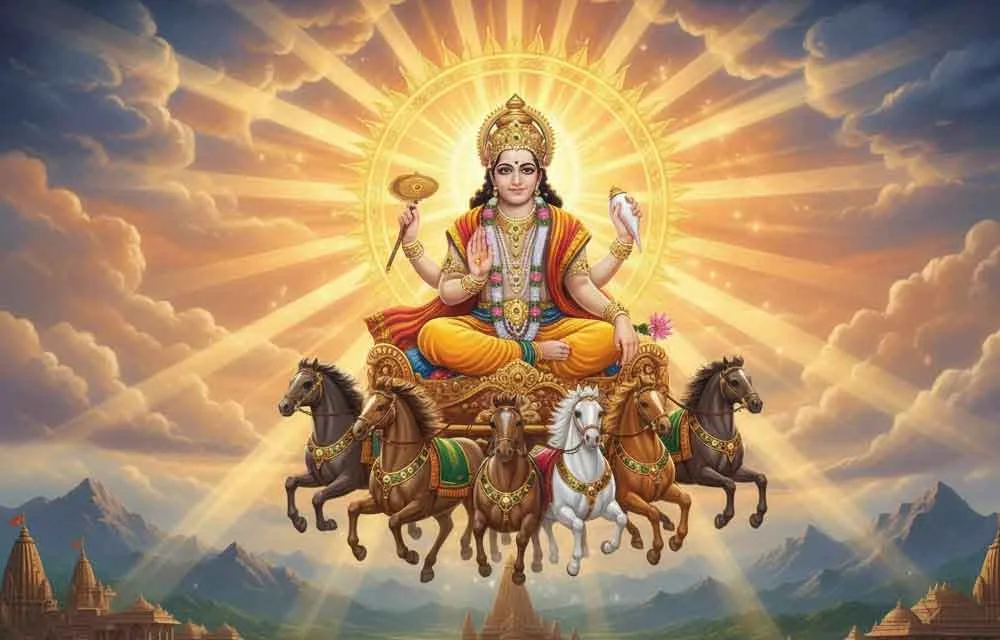
Meaning: Worship that rising Sun — the one possessed of rays (Rashmimat), bowed to by both gods and demons, Vivasvat the shining one, Bhaskara the maker of light, the Lord of all worlds.
Verse 7:
सर्वदेवात्मको ह्येष तेजस्वी रश्मिभावनः।
एष देवासुरगणान् लोकान् पाति गभस्तिभिः ॥७॥
Sarva-devatmako hyesha tejasvi rashmi-bhavanah
Esha deva-asura-ganan lokan pati gabhastibhih
Meaning: He is the soul of all gods — radiant, nourishing all with his rays. He protects both the divine and demonic hosts, and all the worlds, with his beams of light.
Verse 8:
एष ब्रह्मा च विष्णुश्च शिवः स्कन्दः प्रजापतिः।
महेन्द्रो धनदः कालो यमः सोमो ह्यपां पतिः ॥८॥
Esha Brahma cha Vishnushcha Shivah Skandah Prajapatih
Mahendro Dhanadah Kalo Yamah Somo hyapam patih
Meaning: He is Brahma (the Creator), Vishnu (the Sustainer), Shiva (the Transformer), Skanda (the war god), Prajapati (lord of all beings), Mahendra (Indra, king of gods), Dhanada (Kubera, lord of wealth), Kala (Time), Yama (lord of death), Soma (the Moon), and the lord of waters.
Verse 9:
पितरो वसवः साध्या ह्यश्विनौ मरुतो मनुः।
वायुर्वह्निः प्रजाप्राण ऋतुकर्ता प्रभाकरः ॥९॥
Pitaro Vasavah Sadhya hyashvinau Maruto Manuh
Vayur Vahnih Prajaprana Ritukarta Prabhakara
Meaning: He is the Pitrus (ancestors), the Vasus, the Sadhyas, the two Ashvins, the Maruts, Manu (the progenitor of humanity), Vayu (Wind), Agni (Fire), the life-breath of all beings, the creator of the seasons, and Prabhakara (the illuminator).
Verse 10:
आदित्यः सविता सूर्यः खगः पूषा गभस्तिमान्।
सुवर्णसदृशो भानुः हिरण्यरेता दिवाकरः ॥१०॥
Adityah Savita Suryah Khagah Pusha Gabhastiman
Suvarna-sadrisho Bhanuh Hiranya-reta Divakarah
Meaning: He is Aditya (son of Aditi), Savita (the stimulator), Surya (the luminous), Khaga (the sky-traveler), Pusha (the nourisher), Gabhastiman (possessor of rays), golden-complexioned Bhanu (the brilliant), Hiranya-reta (golden-seeded), and Divakara (maker of the day).
Verse 11:
हरिदश्वः सहस्रार्चिः सप्तसप्तिर्मरीचिमान्।
तिमिरोन्मथनः शम्भुस्त्वष्टा मार्तण्ड अंशुमान् ॥११॥
Haridashvah Sahasrarchi Sapta-saptir Marichiman
Timironmathanah Shambhus Tvashta Martanda Ansuman
Meaning: He is Haridashva (whose horses are golden-green), Sahasrarchi (thousand-rayed), Sapta-sapti (drawn by seven horses), Marichiman (radiant), the destroyer of darkness (Timironmathana), Shambhu, Tvashta, Martanda (the blazing egg), and Ansuman (possessor of rays).
Verse 12:
हिरण्यगर्भः शिशिरस्तपनो भास्करो रविः।
अग्निगर्भोऽदितेः पुत्रः शङ्खः शिशिरनाशनः ॥१२॥
Hiranyagarbhah Shishiras Tapano Bhaskaro Ravih
Agni-garbho Aditeh Putrah Shankhah Shishira-nashanah
Meaning: He is Hiranyagarbha (the golden womb), Shishira (the cool one), Tapana (the scorching one), Bhaskara (the light-maker), Ravi (the radiant), the one who carries fire within (Agni-garbha), son of Aditi, Shankha (conch-like brilliance), and destroyer of winter cold.
Verse 13:
व्योमनाथस्तमोभेदी ऋग्यजुःसामपारगः।
घनवृष्टिरपां मित्रो विन्ध्यवीथीप्लवङ्गमः ॥१३॥
Vyoma-nathas Tamo-bhedi Rig-Yajuh-Sama-paragah
Ghana-vrushhtir Apam Mitro Vindhya-vithi-Plavangamah
Meaning: He is the lord of the sky (Vyoma-natha), piercer of darkness, master of the three Vedas (Rig, Yajur, and Sama), the rain-bringer, friend of water, and the one who courses through the path of the Vindhyas.
The Cosmic Powers of Surya (Verses 14–20) — The Universal Sustainer
Verse 14:
आतपी मण्डली मृत्युः पिङ्गलः सर्वतापनः।
कविर्विश्वो महातेजाः रक्तः सर्वभवोद्भवः ॥१४॥
Atapi Mandali Mrityuh Pingalah Sarva-tapanah
Kavir Vishvo Maha-tejah Raktah Sarva-bhav-odbhavah
Meaning: He is the heat-giver, the disc (Mandali), Death (Mrityu), the tawny one (Pingala), the scorcher of all, the poet-seer (Kavi), all-pervading (Vishva), of great splendor, reddish, and the origin of all existence.
Verse 15:
नक्षत्रग्रहताराणामधिपो विश्वभावनः।
तेजसामपि तेजस्वी द्वादशात्मन् नमोऽस्तु ते ॥१५॥
Nakshatra-graha-taranam adhipo Vishva-bhavanah
Tejasam api tejasvi Dvadashatman namo astu te
Meaning: Lord of all stars, planets, and constellations, sustainer of the universe, the most radiant among all radiant things — O twelve-formed one (Dvadashatma), I bow to you.
Verse 16:
नमः पूर्वाय गिरये पश्चिमायाद्रये नमः।
ज्योतिर्गणानां पतये दिनाधिपतये नमः ॥१६॥
Namah purvaya giraye pashchimaya adriye namah
Jyotirgananam pataye Dinadhipataye namah
Meaning: Salutations to the eastern mountain (where you rise), salutations to the western mountain (where you set). Salutations to the lord of all luminaries, lord of the day.
Verse 17:
जयाय जयभद्राय हर्यश्वाय नमो नमः।
नमो नमः सहस्रांशो आदित्याय नमो नमः ॥१७॥
Jayaya Jaya-bhadraya Haryashvaya namo namah
Namo namah Sahasramsho Adityaya namo namah
Meaning: Salutations again and again to Jaya (the victorious), Jaya-bhadra (the auspiciously victorious), Haryashva (whose horses are golden), the thousand-rayed Sahasramshu, and Aditya. Salutations, again and again.
Verse 18:
नम उग्राय वीराय सारङ्गाय नमो नमः।
नमः पद्मप्रबोधाय मार्ताण्डाय नमो नमः ॥१८॥
Nama ugraya viraya sarangaya namo namah
Namah padma-prabodhhaya Martandaya namo namah
Meaning: Salutations to the fierce one (Ugra), the heroic one (Vira), the spotted/multicolored one (Saranga). Salutations to the awakener of lotuses, and Martanda (the blazing solar egg). Salutations again and again.
Verse 19:
ब्रह्मेशानाच्युतेशाय सूर्यायादित्यवर्चसे।
भास्वते सर्वभक्षाय रौद्राय वपुषे नमः ॥१९॥
Brahme-shanachyuteshaya Suryaya Aditya-varchase
Bhasvate Sarva-bhakshaya Raudraya vapushe namah
Meaning: Salutations to the lord of Brahma, Shiva, and Achyuta (Vishnu), to Surya of brilliant solar splendor, the effulgent, the all-consumer, and to his fierce (Raudra) form.
Verse 20:
तमोघ्नाय हिमघ्नाय शत्रुघ्नायामितात्मने।
कृतघ्नघ्नाय देवाय ज्योतिषां पतये नमः ॥२०॥
Tamo-ghnaya Hima-ghnaya Shatru-ghnayamita-atmane
Kritahgna-ghnaya Devaya Jyotisham Pataye namah
Meaning: Salutations to the destroyer of darkness, destroyer of cold, destroyer of enemies, the infinite-souled one, the destroyer of the ungrateful, to the shining Deva, and to the lord of all luminaries.
The Complete Theology (Verses 21–23) — Surya as the Supreme Reality
Verse 21:
तप्तचामीकराभाय हरये विश्वकर्मणे।
नमस्तमोऽभिनिघ्नाय रुचये लोकसाक्षिणे ॥२१॥
Tapta-chamikara-bhaya Haraye Vishva-karmane
Namas tamo-abhi-nighnaya ruchaye Loka-sakshhine
Meaning: Salutations to the one who shines like molten gold, to Hari (Vishnu), to the divine architect of the universe (Vishvakarma), to the destroyer of darkness, the brilliantly shining one, and the witness of all worlds.
Verse 22:
नाशयत्येष वै भूतं तदेव सृजति प्रभुः।
पायत्येष तपत्येष वर्षत्येष गभस्तिभिः ॥२२॥
Nashayatyesha vai bhutam tadeva srijati Prabhuh
Payatyesha tapatyesha varshhatyesha gabhastibhih
Meaning: He destroys all existence — and then recreates it. He is the Lord. He nourishes, he scorches, and he causes rain through his rays.
Verse 23:
एष सुप्तेषु जागर्ति भूतेषु परिनिष्ठितः।
एष एवाग्निहोत्रं च फलं चैवाग्निहोत्रिणाम् ॥२३॥
Esha supteshu jagarti bhuteshu pari-nishthitah
Esha evagni-hotram cha phalam chaiva-agni-hotrinam
Meaning: He is awake when all beings sleep — fully present within all existence. He alone is the sacred fire ritual (Agnihotra) and the fruit of the fire ritual's performers.
Verse 24:
वेदाश्च क्रतवश्चैव क्रतूनां फलमेव च।
यानि कृत्यानि लोकेषु सर्व एष रविः प्रभुः ॥२४॥
Vedascha kratavashchaiva kratunam phalam eva cha
Yani krityani lokeshu sarva esha Ravih Prabhuh
Meaning: He is the Vedas, he is the sacrificial rites, he is the fruit of those rites. Whatever actions occur in all the worlds — all of these is the radiant Sun, the Lord.
The Direct Instruction to Rama (Verses 25–27)
Verse 25:
एनमापत्सु कृच्छ्रेषु कान्तारेषु भयेषु च।
कीर्तयन् पुरुषः कश्चिन् नावसीदति राघव ॥२५॥
Enam apatsu kricchhreshu kantareshu bhayeshu cha
Kirtayan purushah kashchin navasidati Raghava
Meaning: O Rama of the Raghu lineage — whoever glorifies this Sun in times of danger, in times of difficulty, in desolate places, and in fear — such a person never perishes.
Verse 26:
पूजयस्वैनमेकाग्रो देवदेवं जगत्पतिम्।
एतत् त्रिगुणितं जप्त्वा युद्धेषु विजयिष्यसि ॥२६॥
Pujayasv-ainam ekagro Deva-devam Jagat-patim
Etat tri-gunitam japtva yudddheshu vijayishyasi
Meaning: Worship this Lord of lords, the master of the universe, with single-pointed focus. Having chanted this three times, you shall be victorious in battle.
Verse 27:
अस्मिन्क्षणे महाबाहो रावणं त्वं वधिष्यसि।
एवमुक्त्वा ततोऽगस्त्यो जगाम च यथागतम् ॥२७॥
Asmin kshane maha-baho Ravanam tvam vadhishyasi
Evam uktva tato Agastyo jagama cha yathaghatam
Meaning: "At this very moment, O mighty-armed one, you shall slay Ravana." Having spoken thus, Agastya departed as he had come.
Rama's Response (Verses 28–29) — The Transformation
Verse 28:
एतच्छ्रुत्वा महातेजाः नष्टशोको ऽभवत्तदा।
धारयामास सुप्रीतो राघवः प्रयतात्मवान् ॥२८॥
Etach-chrutva maha-tejah nashta-shoko abhavat tada
Dharayamasa suprito Raghavah prayata-atma-van
Meaning: Having heard this, the great and radiant Rama was freed instantly from his grief. With a joyful, composed mind, he held the teaching within himself.
Verse 29:
आदित्यं प्रेक्ष्य जप्त्वा तु परं हर्षमवाप्तवान्।
त्रिराचम्य शुचिर्भूत्वा धनुरादाय वीर्यवान् ॥२९॥
Adityam prekshya japtva tu param harsham avaptavan
Trira-chamya shuchirbhutva dhanur-adaya viryavan
Meaning: Gazing upon the Sun and chanting (the hymn), he was filled with supreme joy. Having sipped water three times (Achamana), now purified, the heroic Rama took up his bow.
The Victory (Verses 30–31) — The Fulfillment
Verse 30:
रावणं प्रेक्ष्य हृष्टात्मा युद्धाय समुपागमत्।
सर्वयत्नेन महता वधे तस्य धृतोऽभवत् ॥३०॥
Ravanam prekshya hrishthatma yuddhaya samupagamat
Sarva-yatnena mahata vadhe tasya dhrito abhavat
Meaning: With a joyful heart, he advanced toward Ravana for battle — resolving with all his great effort and determination to slay him.
Verse 31:
अथ रविरवदन् निरीक्ष्य रामं
मुदितमनाः परमं प्रहृष्यमाणः।
निशिचरपतिसंक्षयं विदित्वा
सुरगणमध्यगतो वचस्त्वरेति ॥३१॥
Atha Ravir-avadan nirIkshya Ramam
Muditamanah paramam prahrishyamanah
Nishichara-pati-samkshayam viditva
Sura-gana-madhya-gato vachas-tvarete
Meaning: Then the Sun God himself, standing in the midst of the assembly of gods, looked at Rama with supreme delight and joy. Knowing that the destruction of the lord of the demons was imminent, he called out with urgency: "Make haste!"
[image: 🌞] The 108 Names of Surya in Aditya Hridayam
The verses 6–20 of the Aditya Hridayam constitute one of the most complete catalogues of the names and forms of Lord Surya in all of Sanskrit literature. Each name is a complete teaching — a specific attribute, power, or cosmic function of the solar deity.
Here is the complete list of all the names of Surya mentioned across these verses:
[image: 🔮] The Hidden Theology — Why Surya Contains All the Gods
The extraordinary Verse 8 of the Aditya Hridayam makes a claim that has fascinated philosophers for centuries:
"He is Brahma, Vishnu, Shiva, Skanda, Prajapati, Indra, Kubera, Kala, Yama, Soma, and the lord of waters."
How can Surya be all the gods simultaneously? Is this theological confusion — or is it the most sophisticated theological statement in all of Hindu philosophy?
The Vedic Answer — Surya as Paramatman
The answer lies in one of the deepest teachings of the Rigveda — the oldest layer of Vedic thought:
"Ekam sat vipra bahudha vadanti"
"Truth is One — the wise call it by many names."
The Vedic seers understood that the one divine reality — the single consciousness that underlies and pervades all existence — expresses itself through multiple functions, each of which the human mind perceives as a separate deity.
When that one consciousness creates — it is experienced as Brahma.
When it sustains — as Vishnu.
When it transforms — as Shiva.
When it governs time — as Kala.
When it measures the harvest of karma — as Yama.
When it nourishes through moonlight — as Soma.
Surya — the Sun — is the most direct, most immediate, most viscerally experienced manifestation of this one divine reality available to ordinary human perception. Every morning, you can see Surya with your own eyes, feel his warmth on your own skin, trace his movement through the sky from dawn to dusk.
He is visible Brahman — the Absolute made tangible.
And because the one Brahman expresses through all the other gods, Surya — as the visible form of Brahman — contains them all within himself. When Surya creates (in the spring, through warmth that awakens dormant seeds) — that is Brahma's function operating through him. When Surya sustains (in summer, through consistent warmth that maintains all life) — that is Vishnu's function. When Surya transforms (in autumn and winter, through the withdrawal of warmth that compels death and rest) — that is Shiva's function.
Verse 22 makes this explicit in the most direct language:
"He destroys all existence — and then recreates it. He is the Lord. He nourishes, he scorches, and he causes rain through his rays."
Creation, sustenance, destruction — all three cosmic functions — performed by Surya alone, through his seasonal cycle.
Surya as the Twelve Adityas
The identification of Surya as "Dvadasha-atma" (the twelve-formed one) in Verse 15 refers to the twelve Adityas — the twelve monthly forms of the Sun God, each governing one month of the year:
The twelve Adityas are not separate suns — they are twelve aspects of the one Sun, each expressing the solar consciousness in the specific quality needed for that month of the year.
[image: 🌅] The Three-Times Instruction — Chant Three Times
Verse 26 gives a specific, unusual instruction:
"Having chanted this three times — you shall be victorious in battle."
Why specifically three times?
The Three Times Correspond to the Three Sandhyas
First chanting — offered to Brahma/Gayatri — the morning form of Surya, the creative power that manifests in the dawn of all endeavors
Second chanting — offered to Vishnu/Savitri — the noon form, the sustaining power that maintains the momentum of action through its middle phase
Third chanting — offered to Shiva/Saraswati — the evening form, the transforming power that brings all endeavors to their completion
By chanting three times, the devotee aligns with all three phases of the divine cosmic cycle — ensuring that the endeavor undertaken receives divine support not just at its beginning but through its entire arc from initiation to completion.
The Three Times and the Triple Purification
In the Sanskrit tradition, repetition in threes is the sacred number of completeness — three purifies at the level of:
- Body (Sthula)
- Mind (Sukshma)
- Spirit (Karana)
Three repetitions of the Aditya Hridayam purifies all three levels of the human being — making the devotee a completely aligned instrument through which the divine will can operate without obstruction.
[image: 🙏] How to Chant the Aditya Hridayam — Complete Guide
The Ideal Setting
- Outdoors at sunrise, facing east — so that the rising sun is directly in your field of vision
- Alternatively, at an east-facing window or altar with a Surya image
- Sit on a woolen or grass mat (never on bare earth during chanting)
- Wear clean, preferably white or saffron clothing
Preparation Ritual
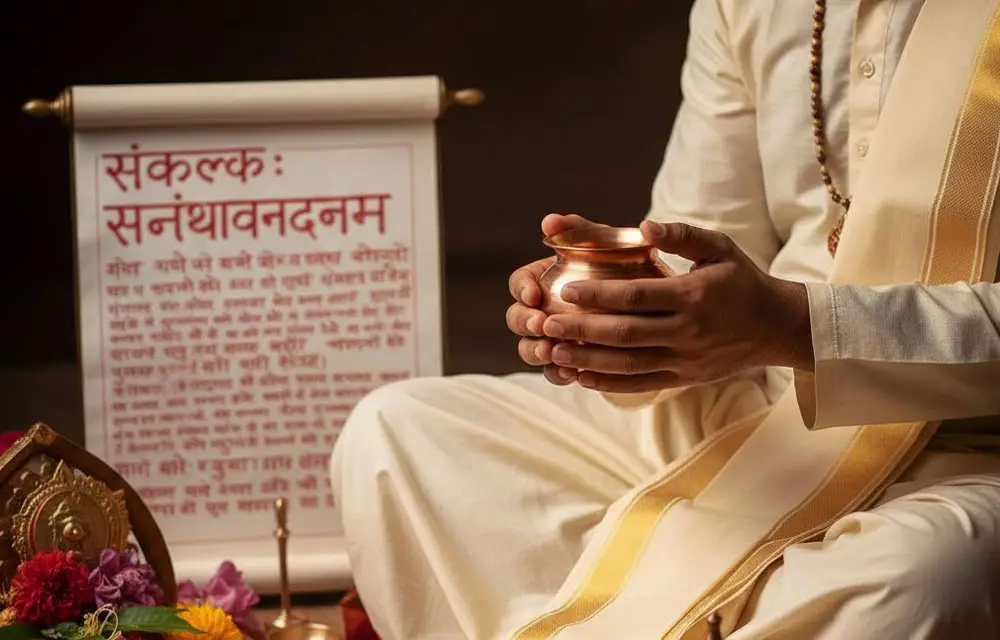
1. Sankalpa (Intention-Setting) Hold a copper vessel of water in both hands and state:
"I chant the Aditya Hridayam for and for the welfare of all beings."
2. Achamana (Purification Sipping) Sip water three times while chanting:
Om Achyutaya Namah | Om Anantaya Namah | Om Govindaya Namah
3. Pranayama (Breath Preparation) Take three deep, slow breaths — completely filling and emptying the lungs. With each inhalation, visualize the golden light of the sun entering the body. With each exhalation, release all tension and darkness.
4. Surya Dhyana (Sun Visualization) Close the eyes for one minute. Visualize the brilliantly rising sun on the eastern horizon. See its golden light filling all of space. Then see that same golden light at the center of your own chest — a miniature sun shining within you, the same Surya present within as without.
The Chanting Process
Option 1: Pure Recitation Chant all 31 verses aloud — slowly, clearly, with correct pronunciation — at a pace that allows each syllable to resonate fully. One complete recitation takes approximately 15–20 minutes.
Option 2: With Understanding After learning the meaning of each verse, chant while simultaneously holding the meaning in awareness — so that the mind participates fully in the prayer, not just the voice.
Option 3: With Counting Use a rudraksha mala or copper coin mala (not crystal — copper is associated with Surya) to count three complete recitations of the text (as instructed in Verse 26).
Pronunciation Guide for Key Verses
After Chanting — The Silent Absorption
The most important — and most neglected — part of the Aditya Hridayam practice is the silence after chanting.
After completing the three recitations, sit in complete silence for at least 10 minutes. Do not check your phone. Do not move immediately into activity. Simply sit — with the eyes gently closed, awareness resting at the heart center or at the space between the eyebrows — and allow the vibration of the 31 verses to settle into the deeper layers of consciousness.
This silent period is when the actual transformation occurs. The chanting creates the wave. The silence allows the wave to fully wash through and purify the system. Moving immediately into activity after chanting is like turning off the washing machine mid-cycle — the cleaning remains incomplete.
[image: ✨] The Extraordinary Benefits of Aditya Hridayam
Immediate Benefits (Described in the Text Itself — Verses 4–5)
Spiritual Benefits
Dissolution of Grief and Despondency: Verse 28 records the immediate effect on Rama: "Nashta-shoko abhavat tada" — his grief was instantly dissolved. The Aditya Hridayam is specifically described as the antidote to Vishada (spiritual depression) — the same state that required the Bhagavad Gita's teaching for Arjuna. For those experiencing grief, despair, or loss of purpose, regular chanting of the Aditya Hridayam is the traditional Vedic prescription.
Invincibility in the Face of Challenges: The context of the Aditya Hridayam is the facing of an "invincible" enemy. In spiritual terms, our "Ravanas" are the inner enemies — ego, fear, addiction, chronic self-doubt, overwhelming circumstances. The hymn gives the same invincibility to the sincere practitioner as it gave to Rama — not by removing the challenge, but by connecting the devotee to the divine solar source that is greater than any challenge.
Purification of the Three Bodies: Regular chanting purifies the gross body, the subtle body, and the causal body (the body of accumulated impressions from past lives) — creating the conditions for spiritual clarity and eventual liberation.
Ancestral Blessing: Surya governs the ancestors (Pitru) in the Vedic tradition — as explicitly stated in Verse 9. Regular Aditya Hridayam practice is considered beneficial for those with Pitru Dosha (ancestral debt) — harmonizing the ancestral dimension of one's karma.
Physical Benefits
Immunity and Vitality: The solar energy invoked through the Aditya Hridayam — particularly when chanted at sunrise — is believed in the Vedic tradition to significantly strengthen the immune system and overall vitality. The practice of chanting facing the early morning sun while absorbing its prana is one of the oldest prescriptions for health in Ayurveda.
Eye Health: Traditional Vedic practice specifically associates Surya worship with eye health — the eyes are the physical organs governed by Surya in the system of correspondences. The practice of Trataka (sun gazing at sunrise and sunset) combined with Aditya Hridayam chanting is a traditional practice for maintaining and improving eyesight.
Recovery from Illness: The Aditya Hridayam has been used in the Vedic tradition as a healing practice — following the model of Samba's recovery from leprosy through Sun worship. Its efficacy as a support for healing from serious illness is described in traditional medical texts.
Protection and Victory
Protection from Enemies: Verse 25 is explicit: "Whoever glorifies this Sun in times of danger, in desolate places, and in fear — such a person never perishes." The Aditya Hridayam is traditionally used as a protective kavacham (armor) — chanted before journeys, before difficult confrontations, before examinations, and before any endeavor where victory is sought.
Success in Competition: Students, athletes, professionals, and all those engaged in competitive endeavors use the Aditya Hridayam for the same reason Rama used it — to access the invincible solar energy that makes victory possible.
Legal and Financial Victory: The hymn is specifically associated with victory over adversarial situations — legal disputes, financial challenges, and competitive environments.
[image: 🌟] Aditya Hridayam and the Suryavansha — Lord Rama's Solar Heritage
One of the most profound dimensions of the Aditya Hridayam story is the significance of the teaching being given to Rama specifically — as the supreme representative of the Suryavansha (Solar Dynasty).
The Solar Dynasty — Rama's Lineage
The Suryavansha traces its origin directly to Lord Surya himself. The lineage runs:
Surya → Vaivasvata Manu → Ikshvaku → → Raghu → Aja → Dasharatha → Rama
Every king of this dynasty was a Surya-upasaka (devotee of the Sun) by hereditary tradition. The Solar Dynasty's code of conduct — its dharma — was the dharma of the sun itself: illuminating all equally, sustaining all life, moving without deviation from its ordained path, never failing to rise.
When Agastya teaches Rama the Aditya Hridayam on the battlefield, he is not introducing Rama to an unfamiliar deity. He is reminding Rama of his own lineage's foundational teaching — the solar knowledge that had sustained the Suryavansha for countless generations.
The exhaustion Rama feels in that moment is the exhaustion of a man who has, in the intensity of battle, temporarily lost contact with his own deepest identity — the solar consciousness that is his birthright.
Agastya's teaching is essentially this:
"Rama — you are the Solar Dynasty's supreme king. You are Suryavansha incarnate. The Sun's invincible nature is not outside you — it is your own heritage, your own deepest nature. Remember who you are. Reconnect with your source. And then — nothing can stand before you."
This is the eternal relevance of the Aditya Hridayam for every human being: we too have forgotten our own solar nature — the self-luminous awareness that is our deepest identity. The hymn is the reminder. Ravana is the forgetting. And the victory that follows chanting — in Rama's case and in ours — is the restoration of our remembrance.
[image: 📿] When to Chant Aditya Hridayam — Specific Occasions
Daily Practice
The most powerful daily practice is chanting the Aditya Hridayam once (or three times) every morning at sunrise, facing east, after bathing. This is the equivalent of Rama's practice after receiving the teaching — and it creates the same daily reconnection with the solar source that sustained him throughout the rest of his life.
On Specific Days
The Ratha Saptami Special Practice
Ratha Saptami — the seventh day of the bright fortnight of Magha (January-February) — is the most sacred day of the year for Surya worship. On this day, Surya's chariot is said to turn northward (Uttarayan) in its full power. The traditional practice on Ratha Saptami is:
- Pre-dawn bath with seven Arka (Calotropis) leaves placed on the head and shoulders
- Sunrise facing the sun
- Chanting the Aditya Hridayam seven times
- Surya Namaskar (twelve cycles)
- Offering arghya (water) to the sun
- Distributing sesame sweets and jaggery
This single annual observance, done with sincerity, is said to confer the merit of a lifetime of daily Surya worship.
[image: 🧘] The Aditya Hridayam as a Complete Yoga Practice
The Aditya Hridayam is not merely a prayer to be recited — it is a complete yoga sadhana when practiced in its full traditional form:
When these eight elements are practiced together in the morning, the Aditya Hridayam becomes an Ashtanga (eight-limbed) Solar Yoga — engaging every dimension of the human being in the act of solar worship.
[image: 🌍] The Universal Relevance of Aditya Hridayam
The story of Rama and the teaching of Agastya encodes a truth that transcends its historical and mythological context — a truth that is as relevant to the modern human being as it was to the warrior-king on the battlefield of Lanka.
We all have our Ravanas. They are not ten-headed demon kings — but they are formidable:
The Ravana of self-doubt that grows back every time we cut it down.
The Ravana of addiction that seems invincible despite our best efforts.
The Ravana of grief that we cannot overcome through force of will alone.
The Ravana of injustice — in our lives, our communities, our world — that seems to resist every remedy.
The Ravana of fear that paralyzes the creative and righteous action we know we must take.
And we all have our moments of standing still on the battlefield — exhausted, strategy-depleted, gazing at the sun in the desperate, wordless prayer that there must be something more.
At those moments, the Aditya Hridayam is Agastya's voice in our ear — quiet, certain, unfrightened by the magnitude of what we face:
"Shrinu guhyam sanatana — Listen to this eternal secret."
The secret is this: You are the Solar Dynasty. You are made of the same consciousness as the Sun — the same invincible, self-renewing, endlessly radiant solar awareness that rises every morning without exception, that cannot be permanently darkened, that is the witness of all experience and the source of all light.
Connect with that. Remember that. Let that fill you until there is no room for despair.
And then — as Rama took up his bow — act. Fully, completely, without reservation.
Ravana falls. He always does. The Sun always rises. It always will.
ॐ आदित्याय नमः ॥
ॐ भास्कराय नमः ॥
ॐ सूर्याय नमः ॥
Jai Surya Deva | Jai Shri Rama | Om Adityaya Namah
[image: 📖] Frequently Asked Questions
Q1. What is the Aditya Hridayam and where does it come from?
A: The Aditya Hridayam is a 31-verse hymn to the Sun God (Surya/Aditya) found in the Valmiki Ramayana, specifically in the Yuddha Kanda (the Book of War), chapters 107–108. It was taught by the sage Agastya Muni to Lord Rama on the battlefield of Lanka at the most desperate moment of the war against Ravana — when Rama was exhausted and unable to defeat his enemy. After chanting it three times, Rama gained the divine energy to slay Ravana.
Q2. How many times should I chant the Aditya Hridayam?
A: Verse 26 of the hymn itself instructs: chant it three times for victory. In daily practice, chanting it once at sunrise is the standard recommendation. For specific intentions — health, protection, victory in challenges — chanting three times (as Rama did) is ideal. On Ratha Saptami and other solar festivals, seven recitations are traditional.
Q3. What is the best time to chant the Aditya Hridayam?
A: Sunrise — specifically the Brahma Muhurta (90 minutes before sunrise) to shortly after sunrise — while facing east toward the rising sun. Sunday morning is the most potent weekly time, as Sunday is Surya's own day. The hymn can be chanted at any time of day, but the morning connection to the actual rising sun amplifies its spiritual power significantly.
Q4. Can women chant the Aditya Hridayam?
A: Absolutely yes. The Aditya Hridayam contains no gender restrictions within its text. It is a universal hymn to the Sun God — the divine light that shines without distinction on all beings. Women who chant it regularly report the same benefits as men. There are no restrictions on women chanting this powerful Surya stotra.
Q5. What is the difference between Aditya Hridayam and the Gayatri Mantra?
A: The Gayatri Mantra (24 syllables) is the concentrated essence of Vedic philosophy addressed to Savitri — the divine solar consciousness as the illuminator of the intellect. It is a meditation mantra designed for deep, sustained contemplative practice. The Aditya Hridayam (31 verses) is an elaborate glorification and theology of the Sun God — encompassing all his names, forms, and cosmic functions — designed for devotional recitation and the invocation of divine protection and victory. They are complementary: the Gayatri is the seed, the Aditya Hridayam is the full tree.
Q6. Can I chant the Aditya Hridayam without knowing Sanskrit?
A: Yes. Many people chant the Aditya Hridayam using transliterated Roman text or phonetic guides. While correct Sanskrit pronunciation amplifies the mantra's resonance, the sincere intention and devotion of the practitioner is the primary factor in the practice's effectiveness. Begin with the transliterated version, learn the meaning of each verse, and work toward correct pronunciation gradually. The Sage Agastya's gift was not reserved for Sanskrit scholars — it was given to a warrior in the heat of battle, to be used immediately.
Q7. Is the Aditya Hridayam the same as the Surya Ashtakam?
A: No — these are different texts. The Surya Ashtakam is a shorter, eight-verse hymn to Surya found in various Purana texts. The Aditya Hridayam is the 31-verse hymn from the Valmiki Ramayana, which is considered far more comprehensive, more ancient, and more spiritually potent. Both are valuable forms of Surya worship, but the Aditya Hridayam — by virtue of its extraordinary context (taught on the battlefield of Lanka) and its comprehensive theology — holds a uniquely exalted place in the tradition.
© 2026 HinduTone.com | All Rights Reserved
www.hindutone.com — Your Trusted Guide to Hindu Spirituality, Mantras, and Sacred Traditions
Related Posts You May Like:
- Gayatri Mantra: Complete Meaning, Power & How to Chant
- Konark Sun Temple: Spiritual Significance & Hidden Symbolism
- Valmiki Ramayana: The Complete Story of Lord Rama — Chapter by Chapter
- Lord Rama: The Ideal Man, King & Avatar — Complete Spiritual Biography
- Surya Jayanti 2026: The Festival of the Sun God — Significance, Rituals & Mantras
- Ratha Saptami 2026: Complete Guide to the Sun Chariot Festival
- Maha Mrityunjaya Mantra: Complete Meaning, Power & How to Chant