Sabarimala Ayyappa: Divine Mysteries & Soul-Stirring Miracles of the Forest Lord
The 41-day Mandala vratham, the 18 sacred steps, "Swamiye Saranam Ayyappa" — discover the mystery of Lord Ayyappa, born of Shiva and Mohini, the forest deity who unifies all castes and faiths in his Kerala shrine. Origin, rituals, Makarajyothi, and the discipline that purifies millions.

The 41-day Mandala vratham, the 18 sacred steps, "Swamiye Saranam Ayyappa" — discover the mystery of Lord Ayyappa, born of Shiva and Mohini, the forest deity who unifies all castes and faiths in his Kerala shrine. Origin, rituals, Makarajyothi, and the discipline that purifies millions.
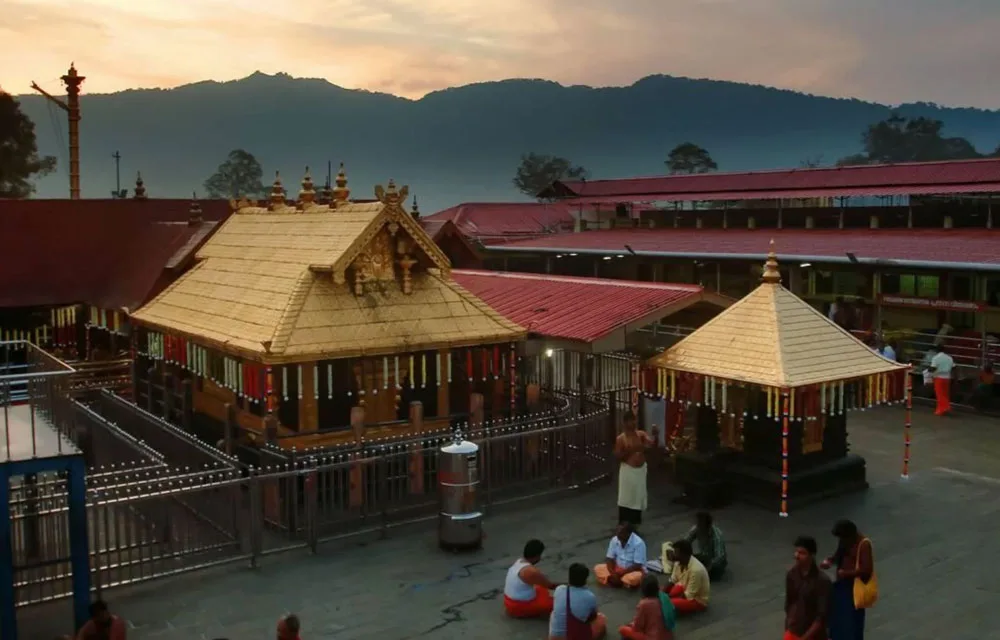
Deep in the forests of the Western Ghats, eighteen hundred feet above sea level, surrounded by the dense Periyar Tiger Reserve, lies a temple unlike any other. Sabarimala — the Hill of Sabari — is the abode of Lord Ayyappa, son of Shiva and Mohini, born to vanquish a single demoness, and now drawing fifty million pilgrims a year. There are no caste lines here, no religious lines, no gendered grandeur. The forest itself is the temple; the discipline is the deity.
This HinduTone guide explores the unique cosmic origin of Ayyappa, the forty-one day Mandala vratham that strips the pilgrim of everything, the eighteen sacred steps that cannot be climbed without it, the Makarajyothi mystery, and the radical equality that has made Sabarimala a quiet revolution at the heart of Hindu pilgrimage.
The Cosmic Story: How a Forest God Was Born to End a Boon
The demoness Mahishi, sister of Mahishasura, performed a tapasya so intense that Brahma was forced to grant her boon: she could be killed only by a child born to Shiva and Vishnu. The condition was meant to make her immortal — two male gods cannot produce a child. Mahishi grew fearless, conquered the heavens, and tormented the world.
To resolve the impasse, Lord Vishnu assumed Mohini — his enchantress form — and from his union with Shiva, a child was born on the banks of the Pampa river. The infant was found by King Rajashekhara of Pandalam, a Pandya descendant, who had been childless. He raised the boy as his own and named him Manikandan, "the one with the bell around his neck." The child grew with extraordinary martial and spiritual gifts, and at the appointed time set out into the forest to confront and slay Mahishi. Her killing released the soul of a heavenly damsel imprisoned in the demoness's form — a final liberation, not a destruction.
Mission complete, Manikandan revealed his divine nature to King Rajashekhara, refused the throne, and asked instead for a temple to be built where his arrow would land. The arrow flew through the air and settled on the hill of Sabari — the very spot where Lord Rama's elder devotee Sabari had attained moksha in the Treta yuga. There, Manikandan installed himself as Dharmasastha-Ayyappa, the forest Lord. The temple was built; the discipline was prescribed; the path was open to all who could walk it.
The Forty-One Day Mandala Vratham: The Most Demanding Discipline in Hinduism
Unlike any other major temple, Sabarimala does not invite the pilgrim casually. Before approaching the eighteen steps, the devotee must complete forty-one days of mandala vratham — a regimen so total that it strips away the ordinary self.
- Black or saffron robes are worn for the full forty-one days. No other clothing. No comb, no shave, no cosmetics, no shoes.
- A tulasi mala is worn from day one — placed in front of the family deity. It does not come off until the pilgrim returns from Sabarimala.
- Strict celibacy. The pilgrim sleeps on the floor; physical comforts of every kind are renounced.
- Pure vegetarian diet — no onions, no garlic, no caffeine. Two simple meals a day, often cooked by the pilgrim himself.
- Daily bath at dawn, daily worship, daily reading of the Bhagavata or Ayyappa stotras.
- Speech is restrained. Anger, gossip, and casual conversation are renounced. The pilgrim addresses every other person, even strangers, as "Swami" — "Lord."
Forty-one days. By the end of it, the pilgrim is unrecognisable. He has lived for over a month as a renunciate. The man who walks into the forest is not the man who entered the vratham.
The Eighteen Sacred Steps: A Cosmic Ascent
At the foot of the sanctum, between the pilgrim and Lord Ayyappa, rise eighteen golden steps — Pathinettam Padi. They cannot be climbed by anyone who has not completed the vratham and is not carrying the irumudi (the sacred bundle of offerings). Each step represents one of the eighteen layers the seeker must pass through to reach the divine.
- Steps 1–5: the five panchabhutas — earth, water, fire, air, akasha — the elements of the body, surrendered.
- Steps 6–13: the eight passions — kama, krodha, lobha, moha, mada, matsarya, dambha, asuya — the inner demons, set aside.
- Steps 14–16: the three gunas — sattva, rajas, tamas — even virtue itself, surrendered.
- Steps 17–18: vidya and avidya — knowledge and ignorance — both transcended at the door of the sanctum.
At the top, the small golden idol of Ayyappa sits in the yogic posture, knee bent, hand in chinmudra. There is no jewellery, no extravagance. Just the Lord of the forest, eyes half-closed, waiting.
Soul-Stirring Miracles: Makarajyothi and the Forest Light
The Makarajyothi: On Makara Sankranti night (January 14), a divine light is said to appear on the hill of Ponnambalamedu opposite the sanctum. Pilgrims who have walked for days simply to witness it report a profound shudder of presence the moment it appears. The temple authorities and the Kerala government have debated its source for decades — but the experience of millions of pilgrims is not what science measures. The light comes; the discipline pays.
The Animal Truce: For centuries, pilgrims have walked the forest paths to Sabarimala through dense tiger and elephant country. Encounters with wild animals are recorded by the thousands — yet attacks on pilgrims wearing the tulasi mala are vanishingly rare. The forest itself, the chronicles say, recognises Ayyappa's devotees.
Disciplined Healing: Devotees describe physical and spiritual transformations that begin during the vratham, not at the darshan. Addictions broken in forty-one days. Marriages saved by the silence. Diseases that resolved when the pilgrim took up the mala. The Lord, the saying goes, begins working the moment you decide to come to him.
Equality Across Caste and Religion: One of the most striking features of Sabarimala is the participation of non-Hindus. Muslim pilgrims have walked to Ayyappa for centuries; the shrine at Erumeli, the starting point of the traditional path, includes a Muslim saint's tomb (Vavar Swami) who in legend was Ayyappa's closest friend. Pilgrims still worship at both shrines before continuing to Sabarimala. This is religion under the banner of friendship.
The Path of Devotion: Walking to the Forest Lord
The traditional pilgrimage begins at Erumeli, where pilgrims perform the Petta Thullal — a ritual dance through the streets, painted in colour, signifying the dropping of every social identity. From there, the route winds 65 km through the forest, crossing the Pamba river (where the infant Manikandan was found), then climbing the steep slope to the sanctum. Modern pilgrims often start from Pamba itself, but the spiritual practice remains the same.
Guidance for the pilgrim:
- Take the vratham seriously. Half a discipline yields no transformation.
- Carry an irumudi (the two-pocket bundle): one for the offerings to the Lord (ghee, coconut, flowers), one for personal needs. It is held on the head from Pamba to the sanctum.
- Walk the last stretch barefoot. The forest path is the prayer.
- Greet every fellow pilgrim as "Swamiye Saranam Ayyappa." It is the only mantra needed.
- Bathe at the Pampa before the climb. The river is the cosmic mother who once received the infant Manikandan.
- Do not break the discipline before darshan. The vratham extends until the final return home.
Why Sabarimala is a Mirror of the Inner Path
Sabarimala does not promise quick blessings. It demands forty-one days of austerity for a few minutes of darshan. It is, in a sense, the most honest temple in India: it tells the pilgrim plainly that the divine is not earned through donations or status, but through the willingness to give up the self. The eighteen steps make the metaphor literal — every passion, every illusion, every claim of knowledge must be set down at the threshold.
Lord Ayyappa is the Lord of the forest because the forest is what the inner journey looks like: dark, unmapped, full of unseen creatures, and at the end, an unexpected stillness. The pilgrim who completes the journey returns transformed not by what he received at the top, but by what he let go of on the way up.
Swamiye Saranam Ayyappa.
Frequently asked questions
How long is the Mandala vratham before visiting Sabarimala?
The Mandala vratham lasts forty-one days. Pilgrims must complete it before climbing the eighteen sacred steps.
What are the rules of the 41-day vratham?
Devotees wear black or saffron robes and a tulasi mala, practise strict celibacy, sleep on the floor, and eat a pure vegetarian diet with two simple meals a day. They also bathe at dawn, worship daily and address everyone as "Swami".
What is the irumudi and who carries it?
The irumudi is a two-pocket sacred bundle: one pocket holds offerings such as ghee, coconut and flowers, the other personal needs. Pilgrims carry it on the head to the sanctum, and it is required to climb the eighteen steps.
When is the Makarajyothi seen at Sabarimala?
The Makarajyothi is said to appear on Makara Sankranti night, January 14, on the hill of Ponnambalamedu opposite the sanctum.
Where does the traditional Sabarimala pilgrimage begin?
It begins at Erumeli, where pilgrims perform the Petta Thullal ritual dance. The route then winds 65 km through the forest and across the Pamba river, though many modern pilgrims start from Pamba itself.
How was Lord Ayyappa born, as commonly told?
As commonly told, Vishnu took the form of Mohini and a child was born to Shiva and Mohini on the banks of the Pampa river, to defeat the demoness Mahishi. King Rajashekhara of Pandalam found and raised him as Manikandan.
You might also like

Mahakaleshwar: Divine Mysteries & Soul-Stirring Miracles of the Lord of Time at Ujjain

Guruvayur: Divine Mysteries & Soul-Stirring Miracles of the Dwarka of the South

Amarnath: Divine Mysteries & Soul-Stirring Miracles of the Ice Linga Cave in Kashmir