

Traditional Diwali Bath (Abhyanga Snan) for Lakshmi Puja
On Diwali day, taking a ritualistic bath before sunrise is considered auspicious.
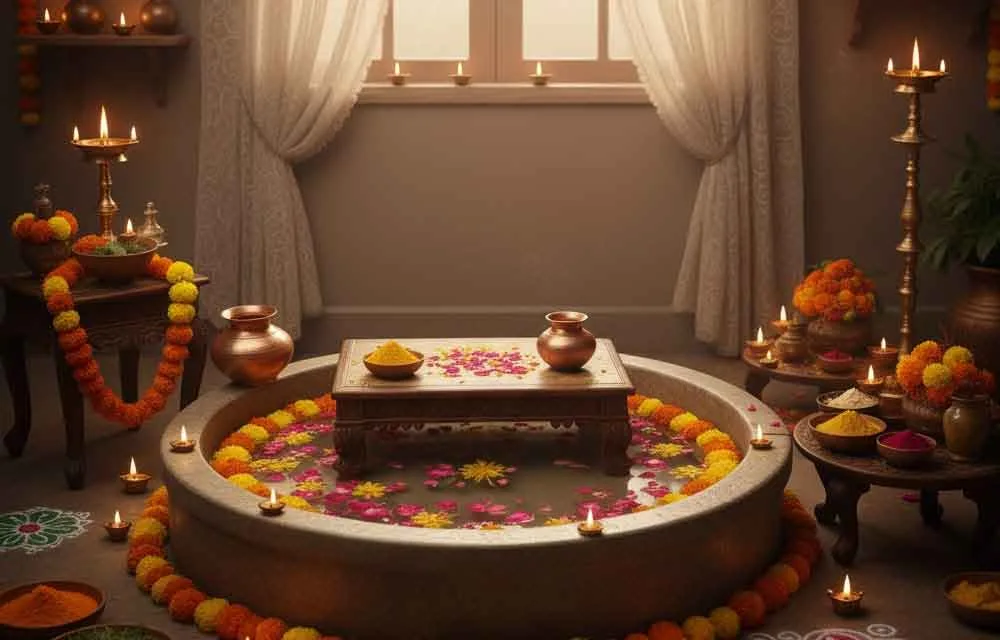
On Diwali day, taking a ritualistic bath before sunrise is considered auspicious.
On Diwali day, taking a ritualistic bath before sunrise is considered auspicious. Here's the traditional method:
Best Time
- Brahma Muhurta (approximately 4:30-5:30 AM) or before sunrise
- Some also bathe during Amavasya tithi (new moon period)
Traditional Method
1. Prepare the Bath Water:
- Add a few drops of til oil (sesame oil) to your bath water
- You can also add a pinch of turmeric and gangajal (holy water) if available
- Some add ubtan (gram flour paste) for cleansing
2. Oil Massage (Abhyanga):
- Before bathing, apply til oil all over your body
- Massage gently for 5-10 minutes
- This is believed to remove negativity and bring prosperity
3. The Bath:
- Bathe with the prepared water
- While bathing, you can chant mantras like:
- "Om Lakshmi Vigan Shri Kamala Dharigan Swaha"
- Or simply pray to Goddess Lakshmi with devotion
4. Wear Clean Clothes:
- After bathing, wear fresh, preferably new clothes
- Traditional colors include red, yellow, or orange
Significance
This ritual bath is believed to purify the body and mind, making you ready to welcome Goddess Lakshmi into your home during the evening puja.
Note: The most important aspect is the devotion and cleanliness, not just the ritual itself.
Why Naraka Chaturdashi Is the True Origin of the Abhyanga Snan Tradition
The Abhyanga Snan on Diwali is most directly connected to Naraka Chaturdashi, the day before Amavasya, when Lord Krishna — according to the Bhagavata Purana (Skandha 10) — slew the demon Narakasura at dawn and returned home covered in the demon's blood. Satyabhama, his consort who had fought alongside him, massaged scented oils onto Krishna's body and bathed him before sunrise, transforming a moment of battle-weariness into a celebration of liberation. This mythological episode is the precise scriptural root of the pre-dawn oil bath.
Across Maharashtra, Goa, and Karnataka, Naraka Chaturdashi morning is observed with particular rigour: family members apply tilted (sesame) oil mixed with a paste of apta leaves or sunthi (dry ginger) before the eldest woman of the household lights the first lamp. The cry 'Narak Chaturdashila Udho!' — a symbolic waking-up from the darkness of ignorance — accompanies the ritual in many Konkani and Marathi households, directly echoing the Puranic narrative of light triumphing over demonic rule.
What the Dharmashastra Texts Say About Til Oil and Turmeric in the Snan
The Dharmasindhu, an 18th-century digest of Hindu ritual law composed by Kashinath Upadhyaya, and the earlier Nirnayasindhu specifically prescribe tila taila (sesame oil) for the Diwali Abhyanga because sesame is considered a plant of Yama — the deity who governs death and transition — and applying it on this liminal dark-moon day is said to appease him, granting the bather protection from untimely death (akala mrityu nivarana). The Vishnu Purana similarly identifies sesame as born from the sweat of Vishnu, lending it a purifying, Sattvik quality.
Haridra (turmeric) carries the Vedic designation pavitra, meaning ritually pure, and is invoked in the Atharva Veda (Kanda 1, Sukta 22) as a substance that wards off malevolent forces. In the context of the Diwali snan, turmeric paste — often combined with besan (gram flour) to form the traditional ubtan — serves a dual function: it is simultaneously a cosmetic preparation that brightens the skin and a ritual purifier that readies the body to serve as a worthy vessel for receiving the goddess. Gangajal, where available, adds a further tier of sanctity because the Ganga is described in the Skanda Purana as sarvapapa pranaashini, the destroyer of all sin.
How Brahma Muhurta Connects to Lakshmi's Own Daily Awakening
The Brahma Muhurta — roughly the 48-minute window ending 96 minutes before sunrise — is described in the Ashtanga Hridayam of Vagbhata as the period when sattva guna predominates in the atmosphere, making the mind uniquely receptive to both spiritual practice and bodily purification. This is not merely an Ayurvedic observation; the Vishnu Sahasranama Bhashya of Adi Shankaracharya identifies this sandhya as the time when Goddess Lakshmi herself performs pradakshina of Vishnu before the world stirs.
Bathing during Brahma Muhurta on Diwali therefore carries a theological logic: the devotee rises at the same hour as the goddess, bathes in her honour, and is considered, in a symbolic sense, to be synchronising their own spiritual wakefulness with hers. Temples dedicated to Mahalakshmi — such as the Shri Mahalakshmi Mandir in Kolhapur (Maharashtra) and the Padmavathi Ammavari Temple in Tiruchanur, Andhra Pradesh — perform a special Abhisheka for the deity precisely at this hour on Diwali, mirroring the domestic Abhyanga Snan that devotees perform at home.
Regional Variations: How the Snan Differs Across India
In Tamil Nadu, the equivalent observance is called Karthigai Deepam snan and is more closely associated with the month of Karthigai, yet on Diwali (locally called Deepavali) the pre-dawn oil bath — called 'Ganga Snanam' in colloquial Tamil — is upheld as a near-universal custom. The belief is that on this specific day, all sacred rivers — the Ganga, Yamuna, Godavari, Saraswati, Narmada, Sindhu, and Kaveri — enter the bathwater wherever one bathes, a concept called Sapta Nadi Sannidhi, granting the merit of bathing at all seven sacred rivers simultaneously.
In Bengal and Odisha, the Diwali bath is preceded by the worship of Kali rather than Lakshmi, and the ritual oil used is often mustard oil rather than sesame, reflecting local agricultural and ritual traditions. In Gujarat and Rajasthan, where Diwali also marks the start of the new Vikram Samvat year, the bath is followed immediately by new account-books (chopda puja) being brought out and blessed — making the snan the physical and spiritual gateway to an entirely new annual cycle of commerce and householder life.
The Ayurvedic Dimension: Why an Oil Massage Before Dawn Is Considered Healing
The Charaka Samhita (Sutrasthana, Chapter 5) recommends daily Abhyanga — full-body oil massage — as a practice that imparts dridhatva (firmness), smoothness of skin, and resistance to fatigue. On the specific day of Diwali, which falls in the Hemanta ritu (early winter season) of the traditional Indian six-season calendar, the body's vata dosha is naturally elevated, making it prone to dryness, anxiety, and joint stiffness. The application of warm sesame oil — described as ushna (heating) and vata-shamaka (vata-pacifying) — is therefore both a ritual act and a seasonally appropriate therapeutic measure.
Ideally, the oil should be slightly warmed and applied from the scalp downward, following the direction of hair growth, which classical Ayurvedic texts call anuloma (with the grain). The soles of the feet receive particular attention because they contain marma points — vital energy junctions identified in the Sushruta Samhita — that correspond to the eyes and the digestive system. A full massage before the cold pre-dawn bath ensures that the pores open gradually rather than abruptly, aligning the physical preparation of the body with the ritual preparation of the heart for Lakshmi Puja in the evening.
Mantras and Sankalpa: Giving the Bath Its Spiritual Intention
Before pouring the first water, traditional practice calls for a sankalpa — a formal statement of intention — in which the bather declares the tithi (Amavasya), the year in the Vikram or Shaka Samvat calendar, their gotra (lineage), and the purpose of the act: typically 'sarva papa kshaya artham, Lakshmi prasada siddhyartham' (for the dissolution of all past wrongdoing and the attainment of Lakshmi's grace). This transforms the bath from a hygienic act into a conscious sacrament.
The Shri Sukta, a hymn from the Rigvedic Khila (appendix) tradition consisting of sixteen verses addressed directly to Goddess Lakshmi, is considered particularly appropriate to recite during the Abhyanga Snan. Verses such as 'Aashva puurvaam ratha madhyaam, hastinaada prabodhineem' invoke the goddess as one who arrives heralded by horses, chariots, and the call of elephants — imagery that describes Lakshmi entering a prosperous household, which is precisely the atmosphere the Diwali bath and puja together seek to create.
Frequently Asked Questions
When is Traditional Diwali Bath (Abhyanga Snan) for Lakshmi?
Traditional Diwali Bath (Abhyanga Snan) for Lakshmi is observed on its traditional tithi in the Hindu lunar calendar; refer to the year's panchang for the exact date in your region.
What is the significance of Traditional Diwali Bath (Abhyanga Snan) for Lakshmi?
On Diwali day, taking a ritualistic bath before sunrise is considered auspicious. Here's the traditional method: Best Time Brahma Muhurta (approximately 4:30-5:30 AM) or before sunrise Some also bathe during Amavasya tithi (new moon period) Traditional Method 1.
How is Traditional Diwali Bath (Abhyanga Snan) for Lakshmi celebrated?
Devotees observe it with puja, fasting or special offerings, visiting temples, chanting mantras, and gathering with family. Customs vary by region and tradition.
What should devotees do on Traditional Diwali Bath (Abhyanga Snan) for Lakshmi?
Worship Goddess Lakshmi, perform the day's puja and offerings, observe the fast where prescribed, and chant the associated mantras with devotion.
You might also like

Jyeshtha Masam 2026: Dates, Significance, Festivals, Mantras, and Danas – Complete Guide

Gita Jayanti 2026 Prasad Recipes — Tulsi-Honoring Sweets, Krishna's Favourites & December 10 Bhog Plate
Sri Suktam: Complete Guide to the 15-Verse Vedic Hymn to Goddess Lakshmi