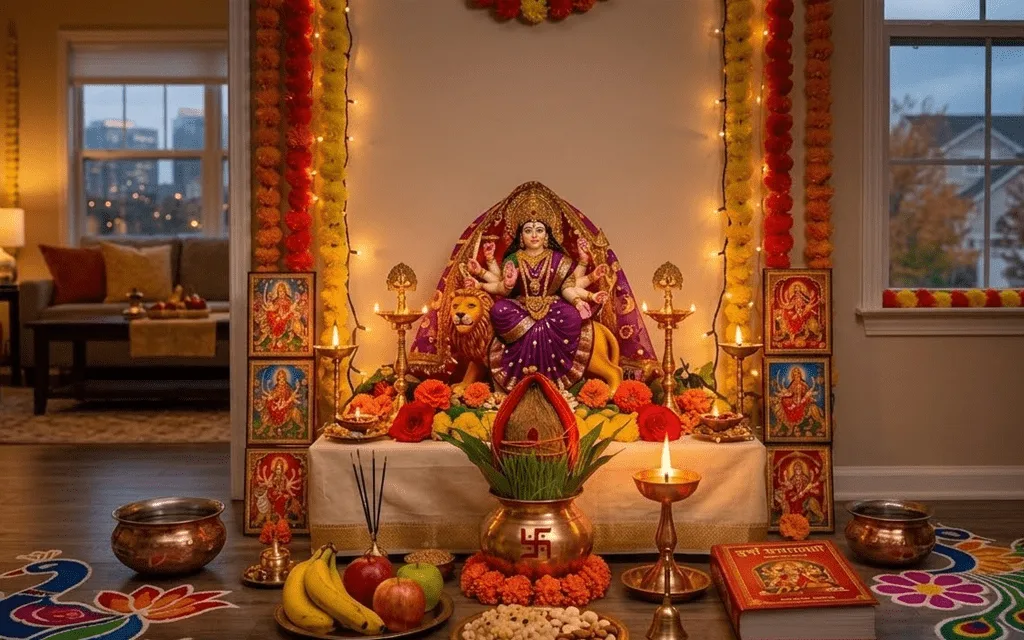
Dussehra 2026 for Women: Shakti Puja, Prayers and New Beginnings on Vijayadashami (Tuesday 20 October)
Vijayadashami falls on Tuesday 20 October 2026. This gentle guide for women and families covers the Shakti meaning of the day, Aparajita and Shami puja, the apta and Jammi leaf exchange, Sindoor Khela in Bengal, a women-led home puja, starting new work, what to wear, reflection prompts and canonical Vijayadashami mantras.
Vijayadashami falls on Tuesday 20 October 2026. This gentle guide for women and families covers the Shakti meaning of the day, Aparajita and Shami puja, the apta and Jammi leaf exchange, Sindoor Khela in Bengal, a women-led home puja, starting new work, what to wear, reflection prompts and canonical Vijayadashami mantras.
Quick answer: Dussehra 2026 for women begins with the date: Vijayadashami is Tuesday 20 October 2026 in India, per Drik Panchang. It celebrates the victory of Shakti and of dharma: Maa Durga's victory over Mahishasura and Lord Rama's victory over Ravana, as commonly told. Women and families mark it with Aparajita and Shami puja, the exchange of leaves, Sindoor Khela in Bengal, prayer and auspicious new beginnings. Every custom here is optional.
This guide is written for daughters, mothers, sisters, grandmothers, students and working women who want to understand the day and keep it in their own way, whether in India or abroad. It separates fact, tradition, regional custom and devotional belief so you can choose what speaks to you.
Dussehra 2026 date and key days for women and families
Short answer: Dussehra falls on Tuesday 20 October 2026 in India, the day after Navratri ends. Durga Ashtami, Maha Navami and South Indian Ayudha Puja are all on Monday 19 October. In Kolkata, Bijoya Dashami and Sindoor Khela are on Wednesday 21 October. Muhurat times vary by city, so check your local panchang.
| Day | Date (2026) | What it is |
|---|---|---|
| Navratri | Sunday 11 to Monday 19 October | Nine nights of Devi worship (India, Drik) |
| Durga Ashtami and Maha Navami | Monday 19 October | Both on the same day in India; Kanya Pujan is commonly done |
| Ayudha Puja (South India) | Monday 19 October | Worship of tools, books and instruments |
| Dussehra / Vijayadashami | Tuesday 20 October | Aparajita and Shami puja, Ravan Dahan, new beginnings |
| Bijoya Dashami, Kolkata | Wednesday 21 October | Durga visarjan and Sindoor Khela (Drik, Kolkata) |
Abroad: Drik Panchang lists Durga Ashtami on 18 October and Maha Navami on 19 October in the USA, Canada and the UK, with Dussehra on 20 October. Never use India's muhurat times abroad; look up your own city. For the full picture, see the Dussehra / Vijayadashami 2026 guide.
What Dussehra means: Shakti and the victory of good
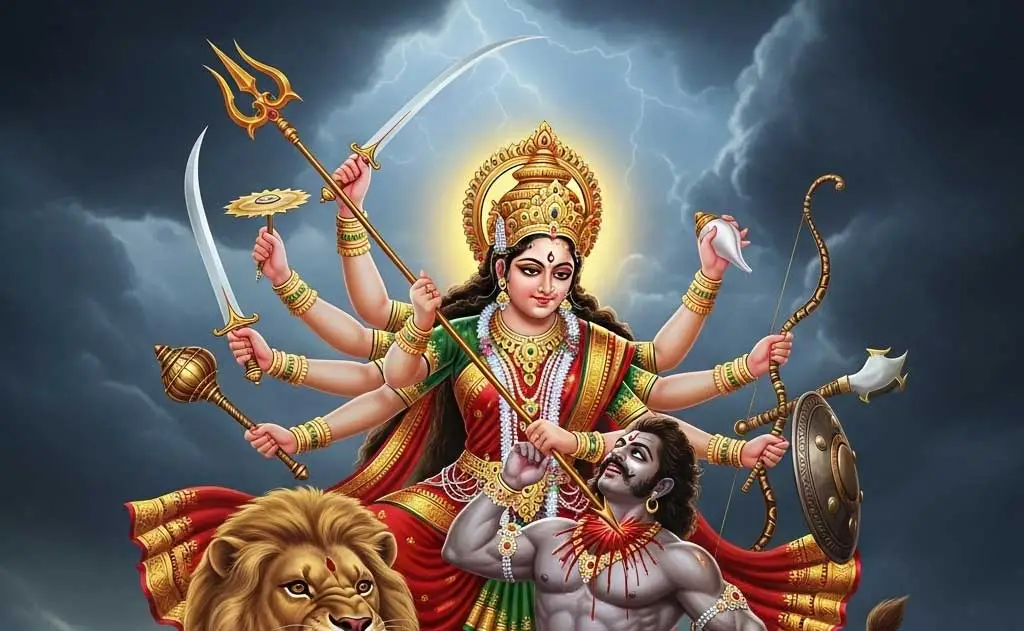
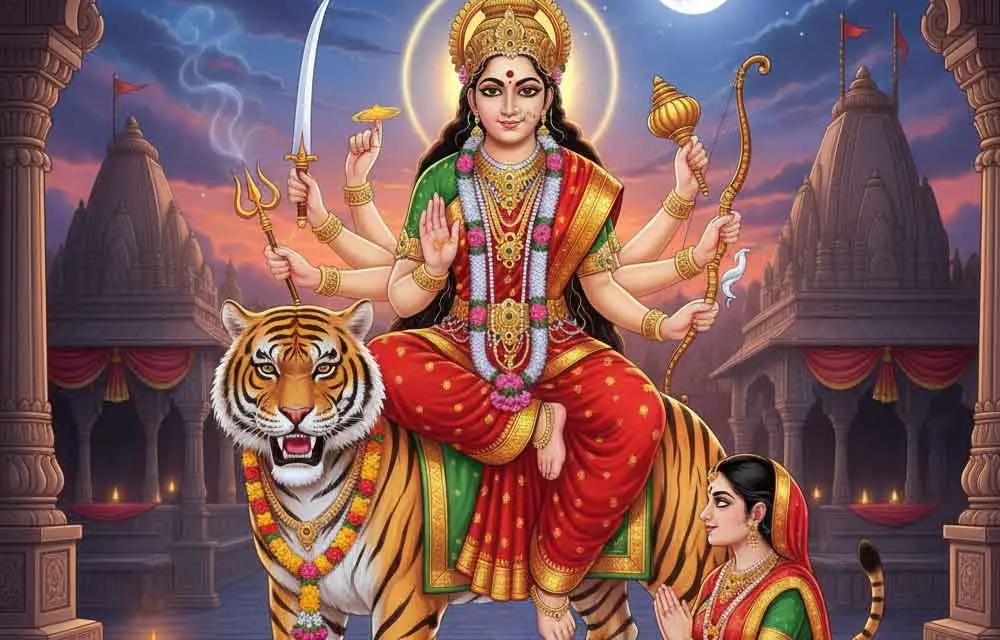
Short answer: Vijayadashami means "the tenth day of victory". As commonly told, Maa Durga defeated the buffalo demon Mahishasura after nine nights of battle, and Lord Rama defeated Ravana. For many women the day is a celebration of Shakti, the divine power of the Mother, expressed as courage, discipline, compassion and clarity.
The Devi story, as commonly told: when Mahishasura could not be defeated by the gods, their combined radiance took form as the Goddess Durga. She fought him for nine days and nights and triumphed on the tenth. This is why Navratri leads into Vijayadashami, and why many devotees see the nine nights as an inner journey that ends in victory over fear and ego.
The Ramayana story, as commonly told: Lord Rama worshipped the Goddess before his final battle and defeated Ravana, rescuing Sita. In North India this is remembered through Ramlila and Ravan Dahan.
A devotional reading: Shakti is not only the power of the Goddess in the stories; devotees believe the same Mother abides in every being. The verse "Ya Devi sarvabhuteshu shakti-rupena samsthita" says exactly this. It is a reminder of dignity and strength that belongs to every person, woman or man, equally.
Aparajita puja and the Shami and apta leaf exchange
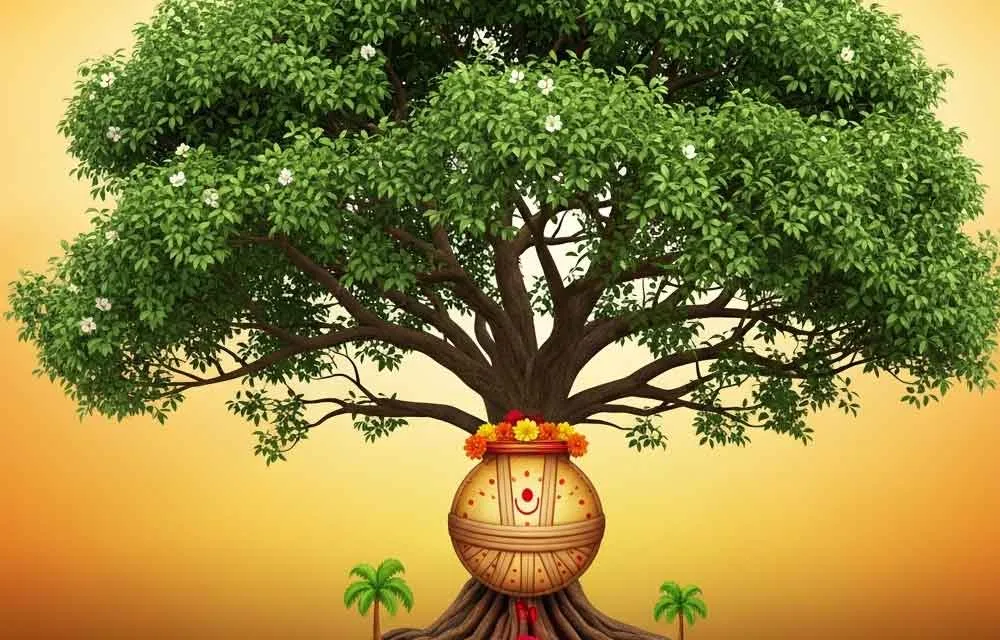
Short answer: Aparajita, "the unconquered", is the Goddess worshipped on Vijayadashami, usually in the afternoon. Families then worship the Shami tree and, in many regions, exchange leaves with elders as a blessing: Jammi (Shami) leaves in Telangana and Andhra Pradesh, and apta leaves, called "gold", in Maharashtra. Anyone in the family can lead it.
- Tradition: Aparajita puja and Shami puja are widely described in household practice for Vijayadashami. Many homes draw a simple eight-petalled design or place a picture of the Goddess, offer kumkum, flowers and a lamp, and chant her name.
- Regional custom: in Telangana and Andhra Pradesh, families visit a Shami (Jammi) tree and share the leaves with elders, touching their feet for blessings. In Maharashtra, apta leaves are exchanged as "sona" (gold) and the day is linked with Seemollanghan, crossing the boundary to begin new journeys.
- Family perspective: in many homes it is the mother or grandmother who keeps these customs alive and teaches the children the words. Daughters, sons and guests can all take part; there is no rule that a particular person must do it.
For a step-by-step vidhi with all the texts, see Vijayadashami 2026 mantras, Aparajita and Shami puja vidhi.
Sindoor Khela: the Bengali farewell to Maa Durga
Short answer: Sindoor Khela is a Bengali tradition on Bijoya Dashami, which Drik Panchang lists for Wednesday 21 October 2026 in Kolkata. Traditionally, married women offer sindoor and sweets to Maa Durga before her immersion, then smear sindoor on one another. It is a joyful, emotional farewell to the Goddess before she returns to Kailash.
In Bengali belief, Maa Durga visits her parental home with her children for the days of the puja, and Bijoya Dashami is the day she leaves. Women bid her farewell with "Debi baran": offering sindoor, sweets and betel leaf, and touching her face with love. The sindoor play that follows is a celebration of companionship among women. Customs about who takes part vary by family and community pandal, so follow the practice where you celebrate. After the immersion, families greet each other with "Shubho Bijoya" and share sweets.
For the full Kolkata calendar, from Mahalaya on 10 October to Bijoya Dashami, see Durga Puja 2026 dates in Kolkata.
A women-led family puja for Vijayadashami
Short answer: A simple home puja takes about thirty minutes. Clean the puja corner, light a lamp, offer kumkum, flowers and sweets to Maa Durga and to Aparajita, chant her naam mantra, worship a Shami plant or leaves if available, recite a Rama mantra together, and close with aarti. Any family member may lead it.
- Prepare: bathe, wear clean clothes, and place a picture of Maa Durga, a lamp, flowers, kumkum, haldi, akshata and a sweet on a clean cloth.
- Remember the nine days: if you kept a kalash or sowed barley sprouts, thank the Goddess and gently close the Navratri worship, as your family does.
- Aparajita: offer kumkum and a flower, and chant "Om Aparajitayai Namah" 11, 21 or 108 times.
- Shami: if you have a Shami plant or leaves, offer water and kumkum and recite the Shami shloka three times.
- Tools and books: many families place books, instruments, laptops or work tools before the Goddess, continuing the spirit of Ayudha Puja.
- Together: sing "Shri Ram Jaya Ram Jaya Jaya Ram" with the children, then perform the aarti and share prasad.
- Blessings: children and younger members seek blessings from elders; elders bless them in return.
Keep lamps on a metal plate, away from curtains, and never leave a flame unattended. A short puja done with care is as complete as a long one.
Canonical Vijayadashami mantras with meaning
These texts are given exactly as traditionally recited. Sincerity matters more than perfect pronunciation.
Aparajita naam mantra
ॐ अपराजितायै नमः॥
Om Aparajitayai Namah
Meaning: "Om, salutations to Aparajita, the unconquered Goddess."
How to chant: 11, 21 or 108 times on a mala after lighting the lamp.
Ya Devi Sarvabhuteshu Shakti-rupena
या देवी सर्वभूतेषु शक्तिरूपेण संस्थिता। नमस्तस्यै नमस्तस्यै नमस्तस्यै नमो नमः॥
Ya Devi sarvabhuteshu shakti-rupena samsthita, namastasyai namastasyai namastasyai namo namah.
Meaning: "To the Goddess who abides in all beings in the form of power: salutations to her, salutations to her, salutations to her, again and again." It comes from the Aparajita Stuti of the Devi Mahatmya.
How to chant: three or eleven times, offering a flower each time if you like.
Shami shloka
शमी शमयते पापं शमी शत्रुविनाशिनी। अर्जुनस्य धनुर्धारी रामस्य प्रियदर्शिनी॥
Shami shamayate papam shami shatru-vinashini, arjunasya dhanurdhari ramasya priyadarshini.
Meaning: "The Shami quiets wrongdoing; the Shami destroys enemies. She held Arjuna's bow, and she was dear to Rama's sight."
How to chant: three times while offering water and kumkum to the Shami, then walk around it.
Rama mantra
रामाय रामभद्राय रामचन्द्राय वेधसे। रघुनाथाय नाथाय सीतायाः पतये नमः॥
Ramaya ramabhadraya ramachandraya vedhase, raghunathaya nathaya sitayah pataye namah.
Meaning: "Salutations to Rama, to Ramabhadra, to Ramachandra, to the wise one, to the Lord of the Raghus, to the Protector, to the husband of Sita."
How to chant: 11 times, or sing "Shri Ram Jaya Ram Jaya Jaya Ram" (श्री राम जय राम जय जय राम॥) together as a family.
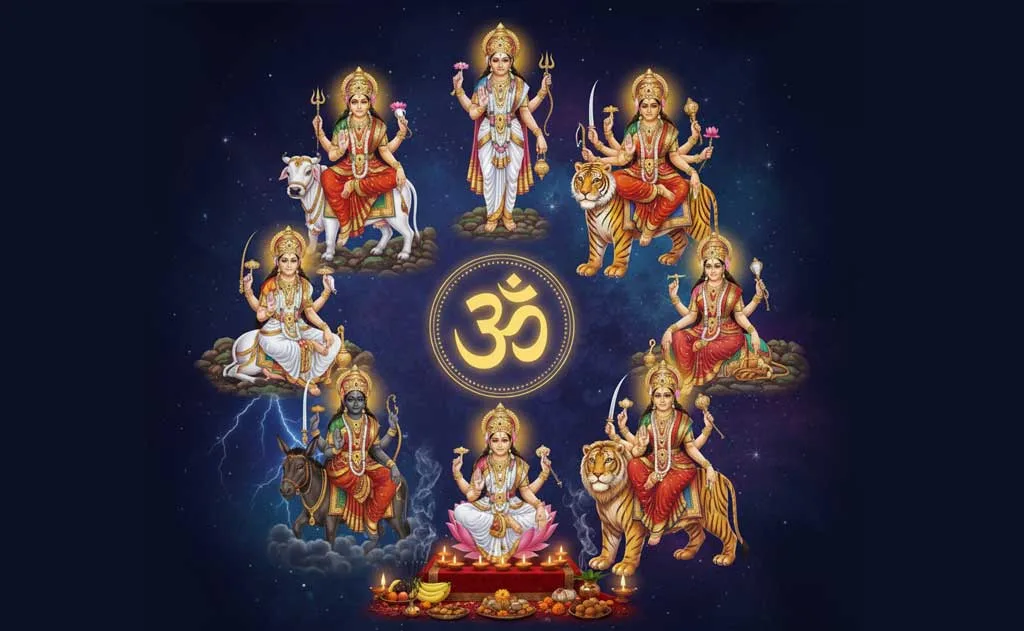
For the mantras of all nine Navadurga forms, start with Navratri 2026 Day 1: Maa Shailaputri mantra and puja vidhi.
New beginnings: work, learning and ventures on Vijayadashami
Short answer: In many Hindu families Vijayadashami is traditionally considered auspicious for starting something new: a course of study, music or dance lessons, a job, a business or a creative project. Women professionals and entrepreneurs often begin with a short prayer. This is a devotional belief, not a guarantee; effort and sound planning still matter.
- Place a notebook, laptop, instrument or a written plan before the Goddess and ask for clarity and steadiness of mind.
- Write down one intention for the coming year and one small first step you will take this week.
- In Kerala and parts of South India, Vidyarambham initiates young children into letters on this day; our Saraswati Puja and Vidyarambham guide is listed under Related guides below.
- If you want a specific time for a launch or signing, check your local panchang or ask your family priest; muhurat times differ by city.
What to wear on Dussehra 2026
There is no prescribed dress for Vijayadashami. Many women choose a festive silk or cotton saree, a lehenga or a kurta set; red, gold, yellow and white are popular, and in Bengal the red-bordered white saree is closely linked with Bijoya Dashami. The nine-day Navratri colours are a popular tradition, not scripturally mandated, and lists for days 8 and 9 vary. See Navratri 2026 colours for all 9 days if you followed them through the week. Wear what is comfortable, especially if you will stand at a pandal or Ravan Dahan for long.
Fasting and health
Some families end their Navratri fast on Navami or Dashami; others do not fast at all. Practices vary by family, region and health, and fasting is never mandatory. If you are pregnant, diabetic, elderly, on medication or unwell, or if children are involved, follow medical advice and choose prayer and simple offerings instead.
Reflection prompts for Vijayadashami
Take ten quiet minutes after the puja, alone or with your daughters, sisters or friends, and reflect on these:
- What inner "Ravana" or "Mahishasura", such as anger, fear, envy or self-doubt, would I like to leave behind this year?
- Where did I show courage in the past year, even quietly?
- Which woman in my family or community taught me strength, and how can I thank her?
- What new beginning am I ready for, and what is the smallest first step?
- How can I offer compassion to someone who is struggling this festive season?
Frequently asked questions
When is Dussehra 2026?
Dussehra (Vijayadashami) is on Tuesday 20 October 2026 in India, per Drik Panchang, and it is also on the Government of India holiday calendar. Drik also lists 20 October for the USA, Canada and the UK. In Kolkata, Bijoya Dashami and Sindoor Khela fall on Wednesday 21 October.
Do women have to do any special ritual on Dussehra?
No. Nothing on Vijayadashami is compulsory for women. Many women lead or join the family puja, the Aparajita and Shami worship or Sindoor Khela because they love these customs, but devotion is personal. A lamp lit with a sincere prayer is complete worship.
Which mantra can women chant on Vijayadashami?
Anyone may chant the Aparajita naam mantra, "Om Aparajitayai Namah", and the stuti "Ya Devi sarvabhuteshu shakti-rupena samsthita". Many families also recite the Shami shloka at the Shami tree and "Shri Ram Jaya Ram Jaya Jaya Ram" as a family kirtan.
What is Sindoor Khela and when is it in 2026?
Sindoor Khela is a Bengali custom on Bijoya Dashami. Traditionally, married women offer sindoor and sweets to Maa Durga before her immersion and then apply sindoor to one another as a farewell to the Goddess. Drik Panchang lists it for Wednesday 21 October 2026 in Kolkata.
Is Vijayadashami a good day to start a new job or business?
In many Hindu families Vijayadashami is traditionally considered an auspicious day to begin learning, new work or a venture. It is a devotional belief, not a promise of results. Success still depends on effort, planning and good advice. Check your local panchang for timings.
Can I celebrate Dussehra if I am fasting, pregnant or unwell?
Yes. Fasting is never mandatory and practices vary by family and region. If you are pregnant, diabetic, elderly, on medication or unwell, follow your doctor's advice and choose prayer, a lamp and a simple offering instead of a fast. The Goddess is honoured by devotion, not hardship.
Editor's note
Editor's note (6 October 2026): This page has been restored at its original address. India dates are from Drik Panchang; Dussehra on Tuesday 20 October is also on the Government of India holiday calendar, and Kolkata dates follow Drik's Durga Puja calendar. Abroad, Drik lists Durga Ashtami on 18 October and Maha Navami on 19 October in the USA, Canada and the UK. The mantras are canonical texts as commonly recited; meanings are plain-English renderings. Legends are given as commonly told, and customs vary by family and region. We do not list muhurat times here; please check your local panchang.
Related guides
You might also like
Vijayadashami 2026 Mantras and Puja Vidhi: Aparajita Puja, Shami Puja, Rama Mantras and Vijay Muhurat (Tuesday 20 October)
Navratri 2026 for Women: Devi Worship, Daily Rituals, Colours, Fasting and Mantras (11–19 October)
Navratri 2026 Day 3: Maa Chandraghanta Mantra, Colour, Bhog and Puja Vidhi (Tuesday 13 October)